

- AI product descriptions solve a real problem: writing unique, quality copy for hundreds or thousands of products is time-consuming, and most sellers either skip it (using manufacturer copy that creates duplicate content) or write thin descriptions that don't convert. AI can generate a full catalog of descriptions in a fraction of the time, but only if you use it correctly.
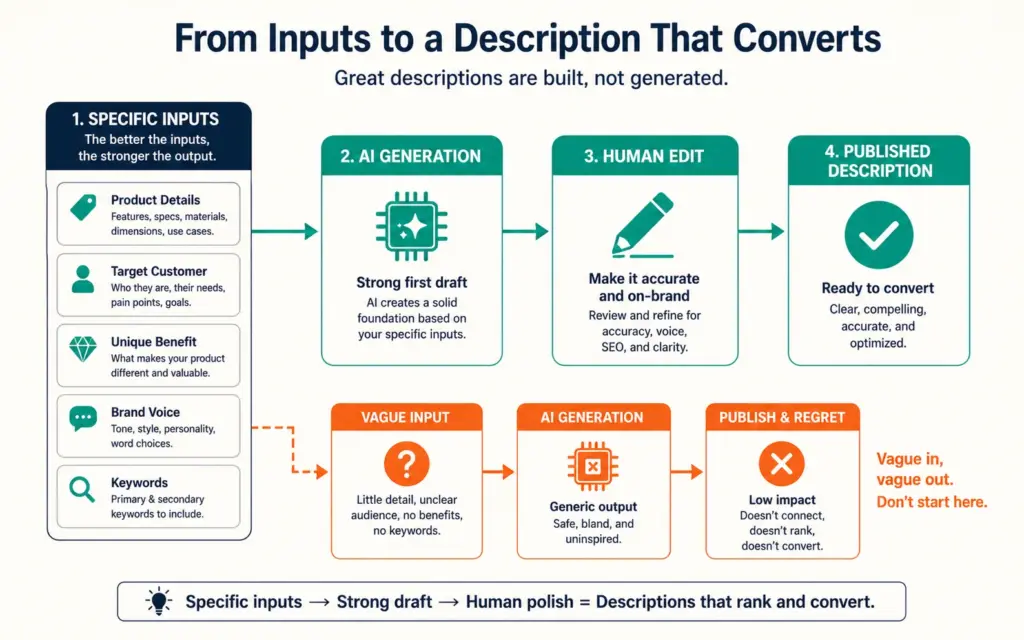
- The biggest risk is generic, templated output. AI trained on the whole internet defaults to bland, interchangeable copy ("premium quality," "perfect for any occasion") that reads as AI-generated and doesn't differentiate your product. The fix is specific inputs: feed the AI real product details, target customer, unique benefits, and brand voice, then edit the output.
- AI-generated descriptions used verbatim across a catalog can create the same duplicate-content and thin-content problems as manufacturer copy if every description follows an identical template. Vary structure, inject specific product details, and edit for brand voice so each reads as genuinely written, not machine-stamped.
- The winning workflow is AI-assisted, not AI-only: use AI to generate a strong first draft from detailed inputs, then edit for accuracy, brand voice, specific selling points, and SEO. This combines AI's speed with the specificity and voice that make descriptions convert. Pure copy-paste from AI is the fast route to a catalog of forgettable, generic pages.
AI product descriptions use generative AI tools to write the copy that describes and sells your products. For a store with hundreds or thousands of SKUs, writing unique, quality descriptions by hand is a massive time investment, which is why so many sellers either paste in manufacturer copy (creating duplicate content that hurts SEO) or write thin, hurried descriptions that don’t convert. AI offers a way to generate a full catalog of descriptions quickly, but the speed comes with a trap: used carelessly, AI produces generic, templated copy that’s just as ineffective as the shortcuts it replaced.
The difference between AI descriptions that convert and rank versus AI descriptions that read as forgettable filler comes down to how you use the tool. Feed AI vague inputs and accept its first output, and you get bland, interchangeable copy. Feed it specific product details and brand voice, then edit the result, and you get descriptions that genuinely sell. This guide covers the tools, the prompt strategy, and the editing workflow that make AI product descriptions actually work. The product descriptions guide covers the copywriting principles; this focuses on doing it with AI at scale.
Why AI Product Descriptions Are Worth Using
The core value is scale. A description that would take 15 to 20 minutes to write well by hand can be drafted by AI in seconds. Across a 500-product catalog, that’s the difference between weeks of writing and an afternoon of generating and editing. For stores that have been running on manufacturer copy or empty description fields, AI makes it feasible to give every product unique, optimized copy for the first time. According to Shopify’s guidance on AI product descriptions, the tools work best as a starting point that you refine, not a replacement for knowing your product and customer.
The SEO benefit is significant. As covered in the product page SEO guide, Google demotes thin pages that restate product feeds and penalizes duplicate content shared across retailers. Unique descriptions on every product page are a ranking requirement, and AI makes producing them at scale practical. The AI tools for ecommerce landscape includes description generators as one of the highest-ROI applications because the time savings are immediate and the SEO payoff is direct.
AI Product Description Tools Worth Considering
| Tool | Best For | Note |
|---|---|---|
| ChatGPT / Claude | Flexible, high-quality drafts | Best output with detailed prompts |
| Jasper | Marketing-focused copy at scale | Templates for ecommerce |
| Copy.ai | Bulk generation | Ecommerce description workflows |
| Shopify Magic | Native Shopify integration | Built into product editor |
| Describely | Bulk ecommerce descriptions | Catalog-scale generation |
General-purpose models (ChatGPT, Claude) produce the highest-quality output when given detailed prompts and are flexible enough for any product type. Dedicated tools (Jasper, Copy.ai, Describely) offer ecommerce-specific templates and bulk workflows that speed up catalog-scale generation. Shopify Magic is convenient for its native integration but tends toward more generic output. The ecommerce tools and tech stack should match the tool to your catalog size: general models for smaller catalogs where quality matters most, bulk tools for large catalogs where volume is the constraint.
The Prompt Strategy That Avoids Generic Output
The single biggest mistake is a vague prompt. “Write a product description for a water bottle” produces generic copy because you gave the AI nothing specific to work with. It defaults to bland filler: “premium quality,” “perfect for any occasion,” “must-have item.” This is the copy that reads as obviously AI-generated and does nothing to differentiate your product.
The fix is specific inputs. Feed the AI:
- Real product details: exact specifications, materials, dimensions, features. Not “durable” but “double-wall vacuum-insulated stainless steel, keeps drinks cold 24 hours.”
- Target customer: who buys this and why. “For commuters and gym-goers who want a bottle that fits a car cup holder.”
- Unique benefits: what makes this product different from competitors. The specific problem it solves.
- Brand voice: playful, premium, technical, warm. Give examples of your existing copy so the AI matches your tone.
- Keywords: the primary and secondary terms the description should include for SEO.
A prompt loaded with these specifics produces dramatically better output than a vague request. The quality of AI copy is directly proportional to the quality of your inputs. According to Semrush’s analysis of AI copywriting, specificity in the prompt is the single biggest factor separating usable AI output from generic filler that requires a complete rewrite. The domain and branding work you’ve done defining your brand voice becomes the input that makes AI descriptions sound like your brand rather than like generic AI.
Avoiding the Duplicate and Templated Content Trap
AI-generated descriptions used verbatim across a catalog can recreate the exact problems they were meant to solve. If every description follows an identical AI template (same structure, same phrasing patterns, same transitions), search engines may treat them as thin, templated content, and shoppers notice the repetitive feel.
Three practices prevent this: vary the structure across products (don’t let every description open the same way), inject specific product details unique to each item (the specifics are what make each description distinct), and edit the output rather than pasting it verbatim. The goal is descriptions that read as genuinely and individually written, which is exactly what both search engines and shoppers reward. The ecommerce technical SEO principle that unique, valuable content ranks applies fully: AI is a drafting tool, not a duplicate-content generator, when used with per-product specifics.
The AI-Assisted Editing Workflow
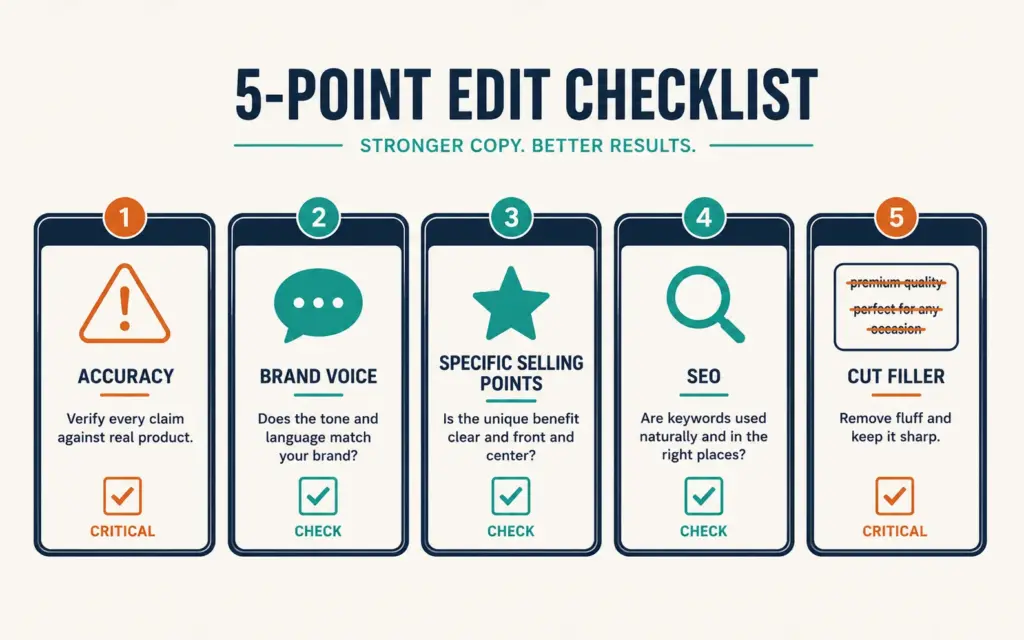
The winning approach is AI-assisted, not AI-only. Use AI to generate a strong first draft, then edit it. The editing pass covers:
- Accuracy: AI can invent features or specifications. Verify every factual claim against the actual product. This is non-negotiable, since a description promising a feature the product lacks creates returns and complaints.
- Brand voice: Adjust phrasing to match your brand’s personality. AI gets you 80% there; the edit adds the distinctive voice.
- Specific selling points: Ensure the unique benefit that differentiates this product is front and center, not buried in generic praise.
- SEO: Confirm the primary keyword appears naturally, add secondary keywords, and check the description supports the structured data on the page.
- Cut the filler: Delete the generic AI phrases (“premium quality,” “perfect for any occasion”) that add nothing. Replace with specifics.
This workflow combines AI’s speed with human specificity and voice. A description that took 15 minutes to write from scratch now takes 3 to 5 minutes to generate and edit, while reading as genuinely written. Across a catalog, that’s transformative time savings without the generic-output penalty. The conversion rate optimization impact is real: specific, benefit-focused descriptions convert better than generic ones, so the editing pass directly affects sales. Track description performance in your ecommerce KPIs by monitoring product page conversion rates before and after upgrading your descriptions.
Scaling AI Descriptions Across a Large Catalog
For large catalogs, build a repeatable system: create a master prompt template with placeholders for your product-specific inputs, generate descriptions in batches by product category (so similar products get consistent treatment), and run a standardized editing pass on each. Bulk tools like Describely or Copy.ai streamline the generation step, but the editing pass remains essential for quality.
Prioritize your highest-traffic and highest-revenue products for the most careful treatment. A bestseller deserves a hand-polished, AI-assisted description. A long-tail product with occasional sales can get a lighter-touch AI draft. Allocate your editing time where it drives the most revenue. A practical ratio: spend the majority of your editing effort on the top 20% of products that generate most of your sales, and accept lighter-touch AI drafts on the long tail where the traffic and revenue don’t justify heavy hand-editing. The standard operating procedures for your description workflow let you delegate the generation-and-edit process to a team member or VA once you’ve documented the prompt template and editing checklist, freeing you to focus on strategy while maintaining description quality at scale.
Frequently Asked Questions
Not if used correctly. AI descriptions that are unique, specific, and edited for quality rank well and satisfy Google’s requirement for original content. The SEO problem arises when AI output is generic, templated, and pasted verbatim across a catalog, which can create thin or duplicate content. The fix is feeding AI specific product details, varying structure across products, and editing the output. Used this way, AI descriptions are actually better for SEO than the manufacturer copy or empty fields they replace.
For highest quality, general-purpose models (ChatGPT, Claude) produce the best output when given detailed prompts and work for any product type. For ecommerce-specific templates and bulk generation, Jasper, Copy.ai, and Describely offer catalog-scale workflows. Shopify Magic is convenient for its native integration but tends toward generic output. Match the tool to your catalog: general models for smaller catalogs where quality matters most, bulk tools for large catalogs where volume is the primary constraint.
Feed the AI specific inputs: exact product details and specifications (not “durable” but the actual material and performance), your target customer and why they buy, the unique benefit that differentiates the product, your brand voice with examples, and target keywords. Then edit the output to cut generic filler phrases (“premium quality,” “perfect for any occasion”) and replace them with specifics. The quality of AI copy is directly proportional to the specificity of your inputs and the care of your editing.
Always. The winning workflow is AI-assisted, not AI-only. Use AI for a strong first draft, then edit for accuracy (AI can invent features, so verify every claim against the actual product), brand voice, specific selling points, SEO, and filler removal. Editing takes a 15-minute writing task down to 3 to 5 minutes of generate-and-edit while producing copy that reads as genuinely written. Pasting AI output verbatim produces generic, templated descriptions that hurt both conversion and SEO.
Yes. AI can invent features, specifications, or benefits the product doesn’t actually have. This is why verifying accuracy is the most important part of the editing pass. A description promising a feature the product lacks creates returns, complaints, and negative reviews. Always check every factual claim (materials, dimensions, features, performance) against the real product before publishing. Never trust AI output as factually accurate without verification, especially for specifications and capabilities.
Build a repeatable system: create a master prompt template with placeholders for product-specific inputs, generate descriptions in batches by product category, and run a standardized editing pass on each. Bulk tools (Describely, Copy.ai) streamline generation. Prioritize your highest-traffic and highest-revenue products for the most careful treatment, giving long-tail products a lighter touch. Document the prompt template and editing checklist as an SOP so you can delegate the process while maintaining quality.
Related Reads
- Product Descriptions
- Product Page SEO
- AI Tools for Ecommerce
- Domain and Branding
- Conversion Rate Optimization
- Standard Operating Procedures
Enjoying this? Get more like it every week.
One email per week with ecommerce strategies, tool picks, and seller insights. No spam.