
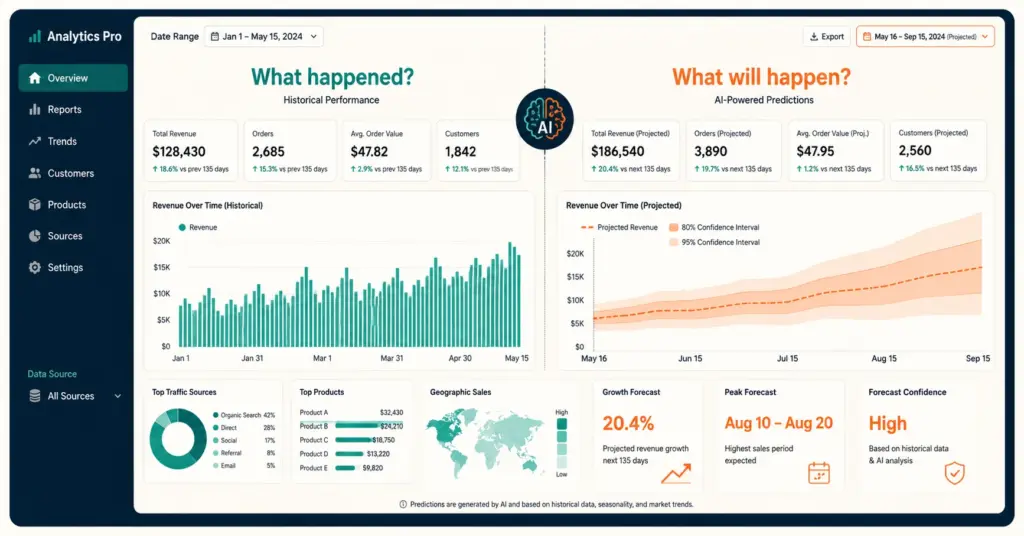
- Predictive analytics uses your store's historical data (orders, customer behavior, traffic patterns, seasonal trends) to forecast what will happen next. Not what might happen in theory. What the data says will likely happen based on patterns it has already observed. The shift from "what happened last month?" (descriptive analytics) to "what will happen next month?" (predictive analytics) is the difference between reacting and preparing.
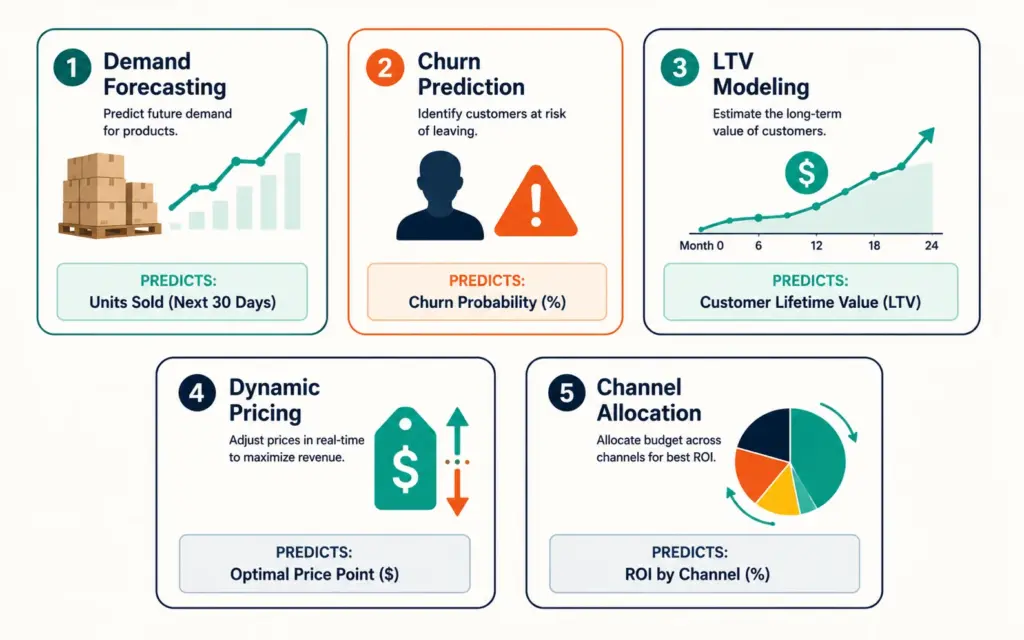
- Five high-value predictive use cases for ecommerce: demand forecasting (how many units to order), churn prediction (which customers are about to stop buying), customer lifetime value modeling (how much each customer will spend over their lifetime), dynamic pricing optimization (when to raise or lower prices), and marketing spend allocation (which channels will produce the best returns next quarter).
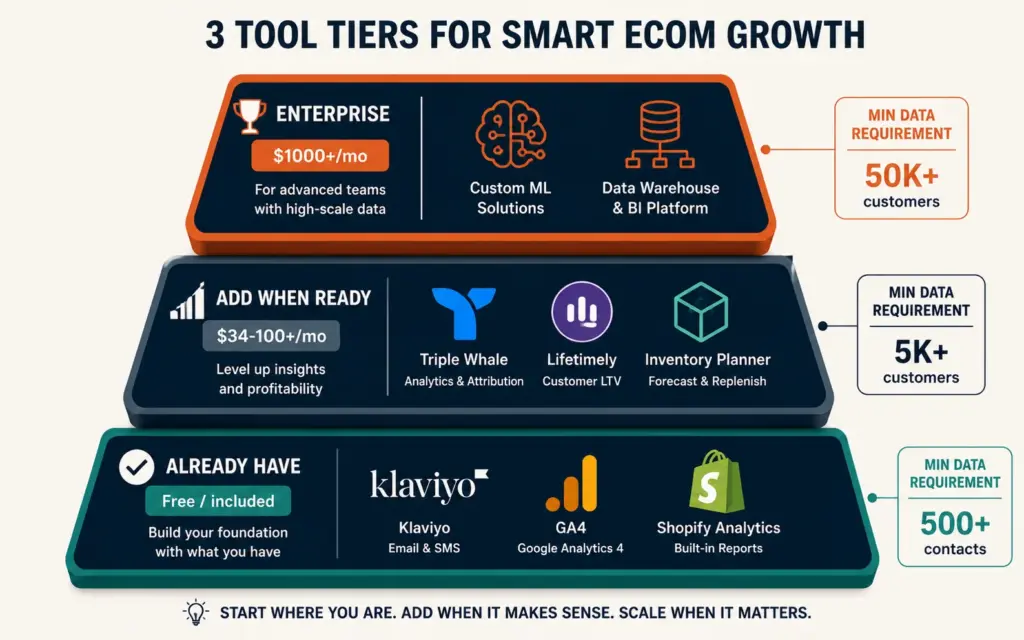
- You don't need a data science team to start. Klaviyo predicts churn risk and next-order timing natively. Shopify's built-in analytics surface customer segments and product trends. Google Analytics 4 includes predictive audiences (likely purchasers, likely churners). Most ecommerce stores already have predictive tools installed. They just aren't using the predictive features.
- Predictive analytics requires 6 to 12 months of clean data minimum. Stores with fewer than 1,000 orders don't have enough data for predictions to outperform educated guesses. Data quality matters more than data quantity. Clean, consistent data from 5,000 customers beats messy data from 50,000.
Predictive analytics in ecommerce turns the data your store already collects into forecasts that inform decisions before those decisions become urgent. Instead of discovering you’re out of stock after the last unit sells, a demand model tells you 3 weeks in advance. Instead of realizing your best customer segment stopped buying after they’re already gone, a churn model flags the risk while there’s still time to re-engage them. The data is already there. Predictive analytics is the layer that reads it forward instead of backward.
The shift happening in 2026 is significant. According to LatentView’s retail analytics research, ecommerce has started moving from traditional predictive analytics to what they call “Agentic Commerce,” where AI doesn’t just forecast outcomes but autonomously acts on them: rebalancing inventory, adjusting pricing, and rerouting logistics in real time. Most ecommerce stores aren’t there yet. But the foundation starts with getting the basic predictive use cases working first.
Five Predictive Use Cases That Drive Ecommerce Revenue
Demand Forecasting: Know How Many Units You Need Before You Run Out
Demand forecasting predicts future sales volume per product based on historical sales patterns, seasonal trends, and marketing activity. It answers the most expensive question in product-based ecommerce: “How much should I order and when should I order it?”
A store selling 10 units/day in September doesn’t necessarily sell 10 units/day in November. Seasonal multipliers, promotional calendar effects, and marketing spend changes all modify demand. Predictive models capture these patterns from 12+ months of data and project them forward. The demand forecasting guide covers the specific formulas and tools. Predictive analytics is the underlying discipline that makes those formulas work.
Churn Prediction: Identify At-Risk Customers Before They Leave
Churn prediction models analyze purchase frequency, recency, and engagement patterns to flag customers who are likely to stop buying. A customer who purchased every 30 days for 6 months and suddenly hasn’t purchased in 60 days is at high churn risk. The prediction enables proactive outreach (a win-back email, a special offer, a personal check-in) while the customer is still recoverable.
Klaviyo includes churn risk scoring natively. It flags customers as “at risk” or “needs attention” based on their predicted behavior relative to their historical pattern. The email marketing strategy should include automated win-back flows triggered by churn risk scores, not by arbitrary timeframes. Sending a win-back email at 90 days to every customer misses the customer who typically buys every 14 days and is already gone by day 45.
Customer Lifetime Value Modeling: Predict Total Revenue Per Customer
LTV prediction estimates how much revenue each customer will generate over their entire relationship with your brand. This prediction informs how much you can spend to acquire each customer. If predicted LTV is $200, spending $40 on acquisition (20% of LTV) is sustainable. If predicted LTV is $50, that same $40 CAC is unprofitable.
Klaviyo and Triple Whale both offer predictive LTV models that update as customer behavior data accumulates. The lifetime value calculation guide covers the specific formulas. Predictive models go further by estimating LTV at the moment of first purchase, before the customer has demonstrated their actual future behavior, based on patterns from similar customers.
Dynamic Pricing Signals: Know When to Adjust Prices Based on Demand
Predictive pricing models monitor competitor pricing, demand trends, inventory levels, and seasonal patterns to recommend price adjustments. A product with rising demand and declining inventory should be priced higher. A product with flat demand and excess inventory should be discounted. The dynamic pricing strategy covers implementation approaches. Predictive analytics provides the demand signals that trigger those adjustments.
Marketing Spend Allocation: Predict Which Channels Will Perform Best
Historical channel performance data combined with seasonal patterns predicts which marketing channels will produce the best returns in any given period. If Meta ads historically underperform in January (post-holiday fatigue) but Google Shopping performs well (New Year’s resolution buying), the predictive model recommends shifting Q1 budget from Meta to Google. The attribution modeling data feeds these predictions by showing which channels actually drive incremental revenue versus capturing existing demand.
Tools That Bring Predictive Analytics to Mid-Market Ecommerce
The tools most ecommerce stores already pay for include predictive features they’re not using.
Klaviyo’s Built-In Predictive Analytics Are Already in Your Stack
If you use Klaviyo, you already have: predicted next order date (when each customer is likely to buy again), predicted LTV (estimated total revenue per customer), predicted gender (based on purchase and engagement patterns), and churn risk scoring. These predictions power automated flows that trigger at the right moment for each individual customer. A replenishment reminder sent on the predicted reorder date converts dramatically better than one sent on a generic 30-day schedule. The segmentation approach should incorporate Klaviyo’s predictive segments alongside behavioral segments.
Google Analytics 4 Predictive Audiences You’re Probably Ignoring
GA4 includes predictive audiences: “Likely 7-day purchasers” (users predicted to purchase within 7 days) and “Likely 7-day churning users” (users predicted to not visit within 7 days). Export these audiences to Google Ads for targeting. Bid higher on likely purchasers. Suppress likely churners from prospecting campaigns. The tracking setup for GA4 needs proper ecommerce event configuration for predictive audiences to populate.
Shopify’s Native Analytics Surface Predictive Patterns Without Extra Tools
Shopify Analytics includes customer cohort reports, product performance trends, and sales forecasting. The “Returning customer rate” and “Customer cohort analysis” reports reveal retention patterns that predict future revenue. Shopify’s “Expected revenue from returning customers” metric is a basic predictive output built into the admin dashboard. The cohort analysis methodology turns these Shopify reports into actionable retention predictions.
Dedicated Predictive Platforms for Stores Ready to Go Deeper
Triple Whale ($100+/month) consolidates ad, Shopify, and attribution data with predictive LTV modeling. Lifetimely ($34/month) focuses specifically on customer lifetime value predictions and cohort analytics. Inventory Planner ($99+/month) applies predictive demand models to automate purchase order recommendations. According to AI Superior’s predictive analytics guide, most ecommerce businesses with at least 6 to 12 months of operational history have sufficient data for initial predictions, and data quality matters more than sheer volume. The ecommerce tools and tech stack should evaluate predictive capabilities within tools you already own before adding new platforms.
When Predictive Analytics Works and When It Doesn’t
Minimum Data Requirements for Meaningful Predictions
Demand forecasting needs 6 to 12 months of sales data per product. Churn prediction needs purchase history from 1,000+ customers with multiple orders. LTV prediction needs 12+ months of customer lifecycle data. Stores with fewer than 1,000 orders total don’t have enough data for predictions to outperform educated guesses. Build the data foundation first. Predict later.
Data Quality Beats Data Quantity Every Time
A prediction model trained on clean, consistent data from 5,000 customers produces more accurate forecasts than one trained on messy, inconsistent data from 50,000 customers. “Clean” means: consistent event tracking (no gaps where the Pixel was broken for 2 weeks), accurate product categorization, and reliable attribution data. If your GA4 setup has been broken or misconfigured for 3 of the past 12 months, your predictive data has a 25% hole in it. Fix tracking first. The ecommerce KPIs framework should include data quality checks as a monthly operational task.
Predictions Are Probabilities Not Certainties
A churn prediction model saying a customer has 80% churn risk doesn’t mean they’re gone. It means 80 out of 100 customers with similar patterns stopped buying. The other 20 didn’t. Act on predictions directionally (send the win-back email, adjust the inventory order) but don’t treat them as certainties. The value is in being mostly right across thousands of decisions, not in being perfectly right on any single one.
Getting Started Without a Data Science Team
- Audit what you already have. Check Klaviyo for predicted LTV and churn scores. Check GA4 for predictive audiences. Check Shopify for cohort reports. You likely have predictive outputs you’ve never looked at.
- Pick one use case. Start with demand forecasting (most immediate revenue impact) or churn prediction (easiest to act on through email automation). Don’t try to predict everything at once.
- Build one automated action. Connect the prediction to an automation: churn risk score triggers a win-back flow, or demand forecast triggers a reorder alert. A prediction without an action is a number on a dashboard nobody checks.
- Measure prediction accuracy after 90 days. Compare predicted outcomes against actual outcomes. The demand forecasting accuracy metrics (MAPE, stockout rate) apply to all predictive models. If predictions are consistently 30%+ wrong, the input data needs cleaning before the model needs tuning.
Frequently Asked Questions
Predictive analytics uses statistical models and machine learning on your historical data (orders, customer behavior, traffic, seasonal trends) to forecast future outcomes: how many units you’ll sell, which customers will churn, what each customer’s lifetime value will be, and which marketing channels will perform best. It turns backward-looking reports into forward-looking predictions that inform proactive decisions rather than reactive responses.
Minimum 6 to 12 months of clean operational data and 1,000+ orders for basic predictions. Simple models (demand forecasting, trend analysis) work with less data. Sophisticated models (churn prediction, LTV modeling) need 12+ months of customer lifecycle data to identify meaningful patterns. Data quality matters more than quantity. Clean, consistent tracking from 5,000 customers beats messy data from 50,000.
Start with what you already have: Klaviyo (predicted LTV, churn scores, predicted next order date), GA4 (predictive audiences for likely purchasers and churners), and Shopify Analytics (cohort reports, customer trends). Add dedicated tools when these outgrow your needs: Triple Whale ($100+/month for unified predictive dashboard), Lifetimely ($34/month for LTV modeling), or Inventory Planner ($99+/month for demand prediction). Most stores don’t need additional tools until they have 10,000+ customers.
Yes, if they have 6+ months of data and use the predictive features built into tools they already pay for. Klaviyo’s predictive scores work for stores with 500+ contacts. GA4’s predictive audiences activate with standard ecommerce tracking. Shopify’s cohort reports work from day one. You don’t need enterprise software or a data science team. You need to turn on features that are already there and connect predictions to automated actions (emails, reorder alerts, audience targeting).
Descriptive analytics tells you what happened: “Revenue was $50,000 last month.” Predictive analytics tells you what will happen: “Revenue will likely be $58,000 next month based on seasonal trends and current trajectory.” Prescriptive analytics (the next level) tells you what to do about it: “Increase inventory of Product A by 30% and shift $2,000 of Meta budget to Google Shopping.” Most ecommerce stores are stuck at descriptive. Moving to predictive is the highest-use analytics upgrade available.
Demand forecasting models typically achieve 75 to 85% accuracy (MAPE under 25%) with 12 months of clean data. Churn prediction models correctly identify 70 to 80% of at-risk customers. LTV predictions are accurate within 20 to 30% for individual customers but highly accurate at the cohort level. Accuracy improves with more data and regular model retraining. No prediction is certain. The value is being directionally right across thousands of decisions, not perfectly right on any single one.
Related Reads
- Cohort Analysis
- Lifetime Value Calculation
- Demand Forecasting
- AI Personalization
- Segmentation
- Tracking Setup
Enjoying this? Get more like it every week.
One email per week with ecommerce strategies, tool picks, and seller insights. No spam.