
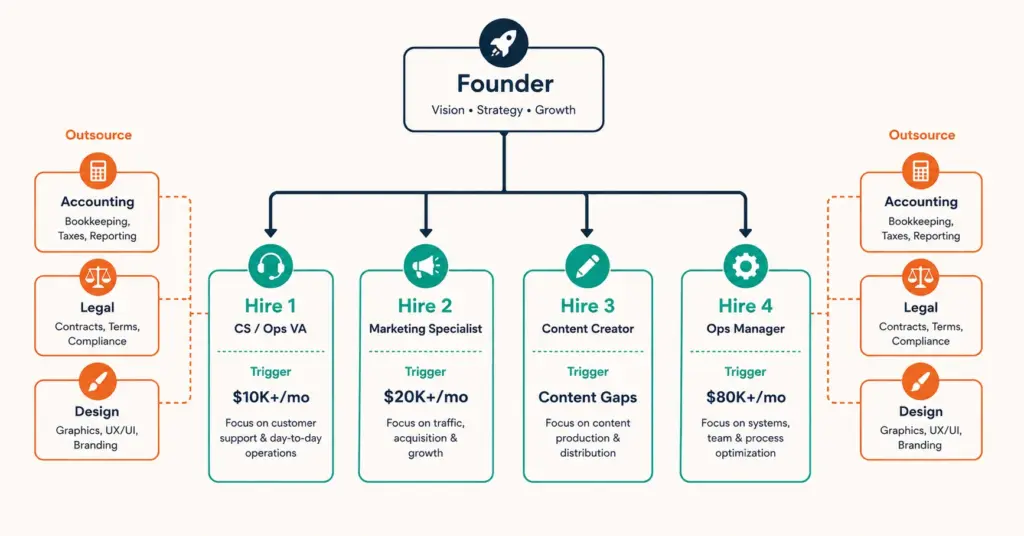
- Most ecommerce founders hire too late (burning out doing everything) or too early (paying salaries before revenue supports them). The trigger for your first hire isn't a revenue milestone. It's when a specific task consumes so much of your time that higher-value work isn't getting done, and the task is repeatable enough for someone else to own.
- The typical hiring order for ecommerce: (1) customer service/operations VA, (2) marketing specialist (email or paid ads, whichever channel drives more revenue), (3) content creator (product photos, social media), (4) operations manager (inventory, shipping, vendor relations). Most stores reach full-time hire #4 around $1M to $2M annual revenue.
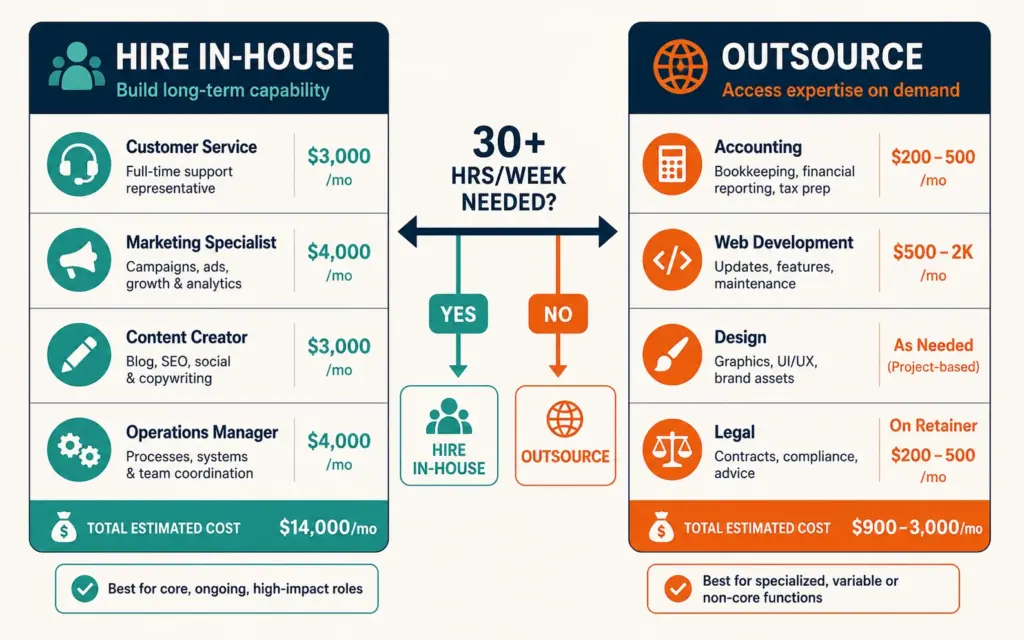
- Outsource before you hire for: accounting (bookkeeper or fractional CFO), graphic design (freelancer or agency), web development (contractor or agency), and legal (attorney on retainer). These functions don't require full-time staff until you're well past $3M annual revenue. Hiring full-time for them earlier wastes payroll on underutilized positions.
- The most expensive hiring mistake is the "do everything" role. "We need someone who handles social media, customer service, inventory, email marketing, and website updates" produces a mediocre generalist who does nothing well. Define roles narrowly enough that one person can actually master them.
Hiring ecommerce team members is the decision that transforms a one-person operation into a real business that can grow beyond what one person can handle. Every founder hits the ceiling eventually. You’re fulfilling orders, answering customer emails, creating ads, updating product pages, managing inventory, and trying to think strategically about growth, all at the same time. Something always gets dropped. Usually it’s the strategic work, which means you’re running hard but not actually moving the business forward.
The question isn’t whether to hire. It’s who to hire first, when, and what to keep doing yourself. According to Shopify’s team-building guide, the most common mistake is hiring a generalist who “does a little of everything” instead of a specialist who owns one function completely. A generalist distributes your overwhelm across two people instead of eliminating it. A specialist takes an entire function off your plate so you never think about it again.
When to Make Your First Hire
The trigger isn’t a revenue number. It’s a time audit. Track how you spend your work hours for one week. Write down every task and how long it takes. Then sort those tasks into two buckets:
Repeatable tasks with clear processes: fulfilling orders, responding to customer emails, uploading products, scheduling social posts, processing returns, updating inventory counts. These are hire-ready. Someone else can learn them from an SOP.
Judgment tasks that require your expertise: product selection, pricing decisions, brand strategy, vendor negotiations, financial planning, hiring decisions. These stay with you until the business can afford experienced managers.
Your first hire should take over the repeatable tasks that consume the most hours. For most ecommerce founders, that’s customer service and order operations. The standard operating procedures you’ve written for these tasks become the training manual for your first hire. If you haven’t written SOPs, do that before hiring. Handing someone a function with no documented process guarantees confusion and rework.
The Hiring Order That Works
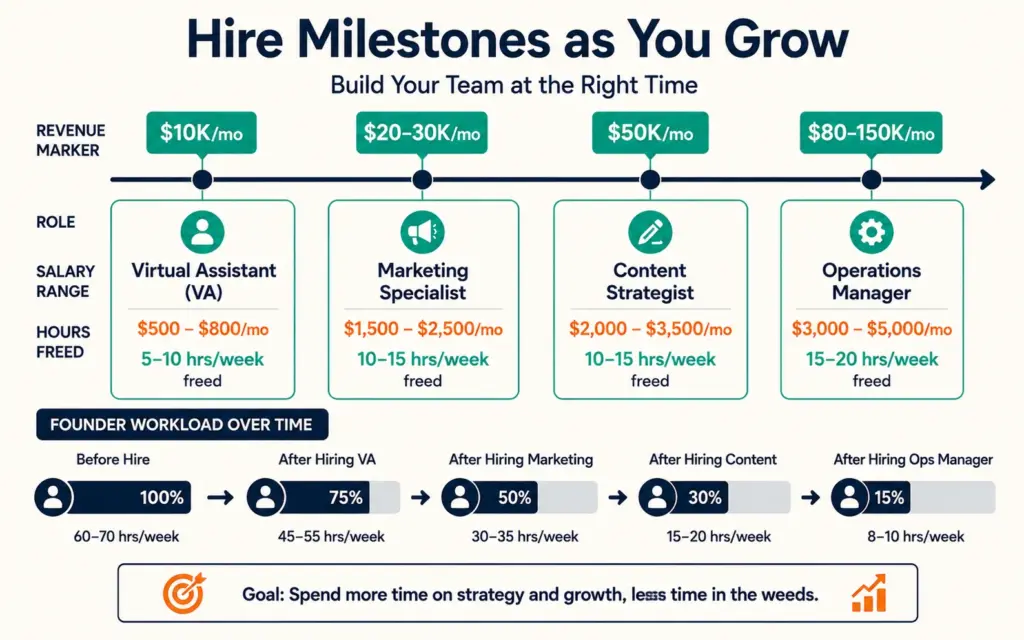
Hire 1: Customer service and operations VA ($15 to $25/hour or $800 to $2,000/month for overseas VA)
This person handles: responding to customer inquiries, processing orders and returns, managing shipping and tracking updates, basic inventory monitoring, and routine admin tasks. The role frees 15 to 25 hours per week of founder time immediately.
Start with a part-time virtual assistant before committing to a full-time employee. Test the working relationship, refine the SOPs, and confirm the workload justifies the cost. Platforms like Belay, Time Etc, or direct hiring through Upwork provide VAs at $15 to $25/hour domestically or $5 to $12/hour for overseas VAs (Philippines, Latin America). The outsourcing guide covers when to use a VA versus a contractor versus a full-time hire for each function.
Make this hire when: you’re spending 2+ hours daily on customer messages and order management AND revenue consistently exceeds $10,000/month. Below that, the payroll cost may not justify the time saved.
Hire 2: Marketing specialist ($50,000 to $80,000/year or $3,000 to $5,000/month contractor)
This person owns your primary revenue-driving marketing channel. If email generates 30% of revenue, hire an email marketing specialist. If Meta ads drive growth, hire a paid media buyer. Don’t hire a “marketing person” who does email AND ads AND social AND SEO. Hire for the channel that matters most and outsource or defer the rest.
The specialist should be able to operate the channel independently: write campaigns, set up automation, manage budgets, analyze performance, and optimize without daily direction from you. The email marketing strategy or Facebook ads for ecommerce guides define what competency looks like for each channel.
Make this hire when: you’re spending $5,000+/month on marketing and don’t have time to optimize it yourself, OR when a channel is producing returns but you can’t scale it because you’re managing 5 other things.
Hire 3: Content creator ($40,000 to $60,000/year or $2,000 to $4,000/month contractor)
Product photography, social media content, short-form video for TikTok and Instagram Reels, and basic graphic design. This role produces the visual assets that feed your marketing channels. Without dedicated content creation, your social accounts go quiet for weeks and product pages use the same 3 photos from launch day.
A content creator who can shoot product photos AND create social content AND edit short-form video is worth more than three freelancers handling those tasks separately. The product photography standards and UGC strategy define the quality bar this hire needs to meet.
Make this hire when: content gaps are measurably costing you (social engagement is declining, product pages have fewer images than competitors, you’re spending $1,000+/month on freelance content creation).
Hire 4: Operations manager ($55,000 to $85,000/year)
Inventory management, supplier relationships, shipping optimization, returns processing, and warehouse operations coordination. This person owns the supply chain from purchase order to customer delivery. They make the customer service VA’s job easier because operations run smoothly, and they free the founder from day-to-day logistics decisions.
Make this hire when: order volume exceeds 50 to 100 orders/day AND operational complexity (multiple suppliers, multi-channel fulfillment, international shipping) exceeds what a VA can manage with SOPs alone. Most stores reach this point around $1M to $2M annual revenue. The team structure scaling guide maps the full organizational evolution from solo founder through department-level management.
What to Outsource Instead of Hiring
Accounting and bookkeeping. A bookkeeper ($200 to $500/month) handles monthly reconciliation, expense tracking, and tax preparation. A fractional CFO ($1,000 to $3,000/month for 5 to 10 hours) handles financial planning, cash flow forecasting, and strategic financial decisions. Neither role requires a full-time hire until revenue exceeds $5M+. The cash flow management systems can be maintained by a part-time bookkeeper with minimal oversight.
Web development. A Shopify expert on retainer ($500 to $2,000/month for 5 to 10 hours) handles theme customization, app conflicts, site speed optimization, and new feature implementation. Full-time developers are expensive ($80,000 to $120,000/year) and underutilized at most ecommerce stores unless you’re building custom features monthly.
Graphic design. Canva handles 80% of design needs. A freelance designer ($25 to $75/hour as needed) handles the rest: branded templates, email headers, ad creative variations. Full-time design hires make sense above $3M revenue when brand consistency across dozens of touchpoints requires dedicated attention.
Legal. An ecommerce attorney on retainer ($200 to $500/month) reviews contracts, handles trademark issues, and advises on compliance. You don’t need in-house counsel until you have 50+ employees and complex legal exposure.
Writing Job Descriptions That Attract the Right People
The #1 reason ecommerce hires fail: vague job descriptions that attract vague candidates.
Bad: “We’re looking for a marketing rockstar who can manage all aspects of our digital marketing, including email, social media, paid ads, SEO, content, influencer partnerships, and anything else that comes up. Must be a self-starter.”
Good: “Email Marketing Specialist. You’ll own our Klaviyo-powered email program (welcome series, abandoned cart, campaigns, segmentation) with the goal of growing email revenue from 20% to 35% of total revenue within 12 months. You need 2+ years of ecommerce email experience, Klaviyo proficiency, and a portfolio showing campaign results.”
The good version defines the tool, the goal, the metric, and the experience level. It attracts someone who does exactly that job. The bad version attracts everyone and no one. The financial planning and scaling model should include projected salary costs for each hire timed to the revenue milestones that justify them.
Common Hiring Mistakes
Hiring before you have SOPs. If you can’t describe the role’s daily tasks in a written document, you’re not ready to hire for it. The new hire will flounder, you’ll spend as much time managing them as you saved by hiring them, and both of you will be frustrated. Write the SOP first. Test it yourself for a week. Then hand it to someone.
Hiring for comfort instead of capability. “They’re nice and they seem like they’d fit in” is not a hiring criteria when you have 3 employees. Hire for demonstrated skill in the specific function you need. A pleasant person who can’t run Klaviyo won’t grow your email revenue.
Not defining success metrics for the first 90 days. “Do a good job” isn’t measurable. “Reduce average customer response time from 8 hours to 2 hours” is. “Grow email revenue from $8,000/month to $12,000/month” is. Define 2 to 3 specific outcomes for the first 90 days so both you and the hire know whether it’s working. According to Shopify’s team data, clear 90-day milestones reduce early turnover by giving new hires a tangible target to work toward.
Hiring full-time when part-time covers the need. A role that requires 15 hours/week doesn’t justify a 40-hour salary. Start part-time or contract. Increase hours as the workload grows. Converting a successful part-time contractor to full-time is far lower risk than hiring full-time from the start and discovering 3 months later that you don’t have enough work to fill their week.
Frequently Asked Questions
A customer service and operations virtual assistant. This role takes the highest-volume repeatable tasks off your plate: answering customer messages, processing orders and returns, updating shipping status, and basic inventory monitoring. Start part-time ($15 to $25/hour domestic, $5 to $12/hour overseas). This frees 15 to 25 hours per week for the strategic work that only you can do.
First VA: $10,000+/month consistent revenue. First specialist (marketing or content): $20,000 to $30,000+/month. Operations manager: $80,000 to $150,000+/month ($1M to $2M annual). These aren’t hard rules. The trigger is when a specific function consumes enough founder time that higher-value work isn’t getting done, and revenue consistently supports the payroll cost without straining cash flow.
Start with contractors for every role. Convert to full-time when the workload justifies 30+ hours/week consistently AND the person has proven their capability over 3 to 6 months. Contractors are lower risk: no benefits, no payroll tax, easy to end the relationship if it’s not working. Full-time employees are higher commitment but earn loyalty, consistency, and deeper institutional knowledge over time.
Approximate annual costs: VA ($10,000 to $30,000), email marketing specialist ($50,000 to $80,000), content creator ($40,000 to $60,000), operations manager ($55,000 to $85,000). Total for a 4-person core team: $155,000 to $255,000/year. Most stores build this team over 12 to 24 months, not all at once. Start with the VA, add roles as revenue milestones justify each one. Contractors reduce costs 20 to 30% versus full-time equivalents.
Brand strategy, product selection, pricing decisions, vendor relationship management (at least initially), and financial oversight. These tasks require founder-level context and judgment that can’t be captured in an SOP. They’re also the tasks that determine the business’s direction. Everything else (operations execution, marketing execution, content creation, admin, accounting) can be delegated to hired team members or outsourced partners.
Three essentials: documented SOPs for every repeatable task (so expectations are clear), a project management tool (Asana, Trello, or Notion) for task assignment and progress tracking, and a weekly 30-minute check-in with each team member to review metrics and address blockers. Don’t micromanage daily tasks. Set clear outcomes (“reduce response time to under 2 hours” or “publish 5 social posts per week”) and review results weekly, not hourly.
Related Reads
- Team Structure Scaling
- Outsourcing Guide
- Standard Operating Procedures
- Financial Planning and Scaling
- Cash Flow Management
- Email Marketing Strategy
Enjoying this? Get more like it every week.
One email per week with ecommerce strategies, tool picks, and seller insights. No spam.