
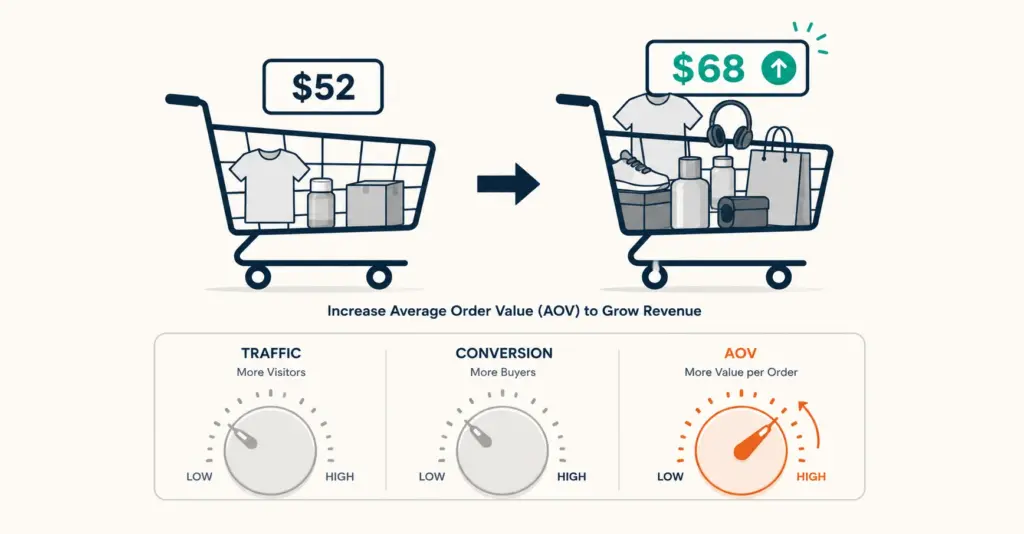
- Ecommerce revenue has three levers: traffic, conversion rate, and average order value. AOV is the cheapest to move because it works on customers who are already buying. No ad spend. No conversion optimization. Just getting the person who was going to spend $50 to spend $65 instead.
- The global ecommerce AOV sits near $185. But averages mislead. Beauty and personal care averages $67. Luxury averages $328. Desktop AOV ($192) outperforms mobile ($133) because desktop shoppers browse more products and encounter more cross-sell opportunities. Your benchmark is your category on your primary device, not the global number.
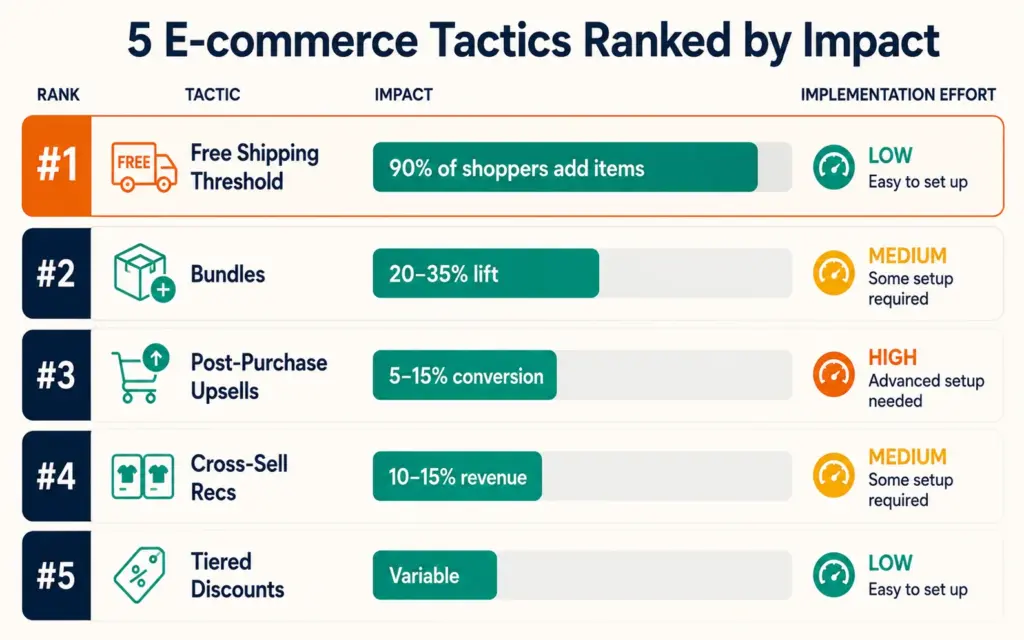
- The three highest-impact AOV tactics: free shipping thresholds (90% of US shoppers add items to qualify), product bundles (20 to 35% AOV lift), and post-purchase upsells on the thank-you page (the customer already committed, adding one more item has near-zero friction). Start with these three before testing anything else.
- AOV optimization has a ceiling. Pushing AOV too high increases cart abandonment and return rates. If your AOV jumps 40% but returns increase 15%, net revenue may not improve. Track margin-adjusted AOV, not just raw AOV, and watch return rates alongside any AOV initiative. The most sustainable AOV gains come from making it genuinely easier for customers to buy complementary products, not from tricks that inflate the number without delivering customer value.
AOV optimization is the practice of increasing the average dollar amount each customer spends per order. It’s the revenue lever most ecommerce stores underwork because it’s less visible than traffic growth or conversion rate. But it’s often the most profitable one to pull. Increasing AOV from $52 to $68 on a store processing 500 orders/month adds $8,000/month in revenue with zero additional traffic or ad spend. That $8,000 drops almost entirely to the bottom line because the customer was already buying.
According to Popupsmart’s AOV analysis, the global ecommerce AOV is approximately $185, with product recommendations driving 10 to 30% of total revenue for stores that use them effectively. But global averages are misleading. Your benchmark depends on your category, your price range, and the device your customers use. Desktop shoppers spend an average of $192 per order. Mobile shoppers spend $133. That 44% gap isn’t a fun statistic. It’s a signal that your mobile CRO strategy and mobile cross-sell experience directly impact AOV.
The 10 AOV Tactics Ranked by Impact
1. Free shipping threshold (highest impact, lowest effort)
Set your free shipping threshold 20 to 30% above your current AOV. If your AOV is $50, set free shipping at $65. 90% of US shoppers say they add items to qualify for free shipping. That behavior is so predictable it’s basically a pricing mechanism. Display the threshold prominently: a progress bar in the cart showing “You’re $12 away from free shipping!” converts the threshold from a policy into a nudge.
The shipping cost calculator tells you whether absorbing shipping at your threshold leaves enough margin. If shipping cost is $8 and the incremental items the customer adds carry 50% margin, you need $16 in added cart value to break even on the free shipping. At a $65 threshold with $50 AOV, the $15 add-on easily covers it.
2. Product bundles (20 to 35% AOV lift)
Bundle complementary products at a 10 to 15% discount versus buying separately. “Starter Kit: Cleanser + Toner + Moisturizer” at $42 instead of $48 bought individually. The customer perceives a deal. You sell 3 products instead of 1. AOV triples on that transaction even with the discount.
Bundles work best when the products are genuinely complementary (not just random items grouped together) and when the savings are visible. Show the individual prices crossed out next to the bundle price. The bundling strategies guide covers 6 bundle types and when each one fits.
3. Post-purchase upsells (near-zero friction)
After checkout, on the thank-you page, offer a one-click add-on: “Add [complementary product] for $12? Ships with your order.” The customer’s credit card is already charged. Shipping address is entered. Adding one more item requires a single tap. Conversion rates on post-purchase upsells run 5 to 15% because the buying friction is essentially zero.
ReConvert and AfterSell are the standard Shopify apps for this. The best Shopify apps guide covers when to install each one based on your store’s stage.
4. Cross-sell recommendations on product pages
“Frequently bought together” and “Customers also bought” widgets on product pages expose the shopper to complementary items at the moment of highest purchase intent. A customer looking at a tent sees sleeping bags and camping lanterns. A customer looking at a phone case sees screen protectors and charging cables.
Product page recommendations drive 10 to 15% of revenue for stores with them enabled. The AI personalization engine powers these recommendations, surfacing the most relevant cross-sells based on aggregate purchase patterns and individual browsing behavior.
5. Tiered discounts (“Spend more, save more”)
Spend $50, get 5% off. Spend $100, get 10% off. Spend $150, get 15% off. Tiered discounts give the customer a reason to add items to reach the next threshold. They’re particularly effective for consumables and repeat-purchase products where the customer will use the additional quantity anyway.
The risk: if your tiers are too generous, the discount eats the AOV gain. Set tiers so the marginal discount is less than the contribution margin on the incremental spend. A 10% discount tier at $100 spend costs you $10 in margin. The $50 incremental spend (from $50 AOV to $100) at 50% margin produces $25 gross profit minus $10 discount = $15 net gain. That math works. A 20% discount at the same threshold costs $20 and nets only $5. Model each tier before activating. The ecommerce pricing strategy should model tier economics before activating them.
6. BNPL (Buy Now Pay Later)
Installment payments reframe a $200 purchase as “4 payments of $50.” This psychological repricing lifts AOV 20 to 40% on orders above $75 because the per-payment amount feels manageable. The customer spends more because the number they focus on is smaller. The payment methods guide covers BNPL provider options and the merchant cost calculation.
7. Minimum order quantities for discounts
“Buy 2, get 10% off” or “Buy 3, get 1 free.” Simple, clear, and effective for products that come in multiples: socks, candles, skincare, supplements. The customer was going to buy 1. The discount on 2 or 3 makes them buy more at a slightly lower margin per unit but much higher total revenue.
8. Gift wrapping and premium packaging
Offer gift wrapping for $3 to $5 at checkout. The cost to you is under $1 (tissue paper, ribbon, a card). It adds $3 to $5 of pure-profit AOV. Gift wrapping also signals that your store offers gift-worthy presentation, which attracts gift buyers who tend to have higher AOV than self-purchasers.
9. Product customization upsells
Engraving, monogramming, custom colors, or personalized packaging at an additional fee. A $25 mug becomes a $35 personalized mug. The marginal cost of engraving or printing is $2 to $5, so the $10 upcharge is nearly pure margin. Customization also reduces return rates because personalized products are rarely returned. Personalization works across price ranges too. A $15 notebook becomes $22 with a name embossed on the cover. A $200 leather bag becomes $240 with initials. The psychology is the same: the customer pays a premium for something unique to them, and the premium is almost entirely margin for you.
10. Cart page add-ons (low-price impulse items)
The checkout page is the last chance to lift AOV before the transaction closes. Display $5 to $15 accessories on the cart page: batteries, gift cards, sample sizes, stickers, care kits. These low-priced items don’t require decision-making. They’re impulse additions that feel trivial relative to the main purchase. “Add a $5 sample kit?” next to the checkout button catches 8 to 12% of shoppers and adds pure incremental revenue.
Measuring AOV the Right Way
Segment AOV by channel. Your blended AOV might be $65, but email-driven orders average $80 while social media orders average $45. Optimizing for the blended number hides the opportunity: push email harder (higher AOV) and improve social media cross-selling (lower AOV). The segmentation approach should include AOV segmentation by acquisition channel.
Track margin-adjusted AOV. A 20% AOV increase accompanied by 15% deeper discounts doesn’t improve profitability. Track gross profit per order alongside AOV. The ecommerce profit margins framework should evaluate whether AOV initiatives increase total profit, not just total revenue.
Watch return rates. Customers who spend more per order sometimes return more items. Monitor return rate and return value alongside AOV changes. A 30% AOV increase that produces a 20% return rate increase may net out to a much smaller real gain. According to Saras Analytics’ AOV research, over-incentivizing AOV through aggressive discounting can backfire when tracked against margin impact.
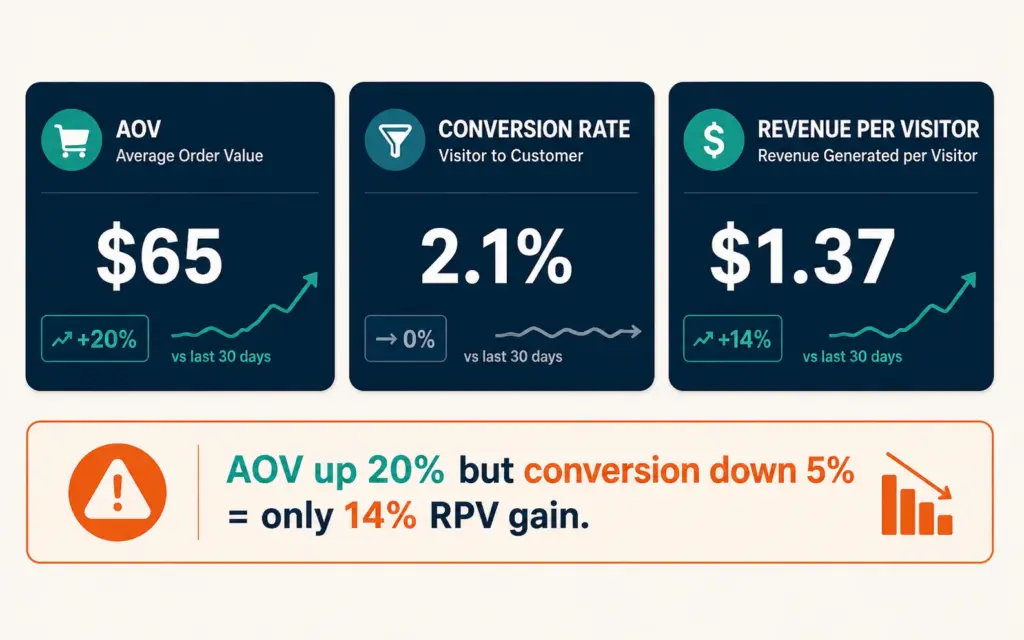
The ecommerce KPIs dashboard should display AOV alongside conversion rate and revenue per visitor. Optimizing one at the expense of the other is common: a free shipping threshold that lifts AOV but reduces conversion rate (because marginal shoppers leave when they can’t reach the threshold) may produce net-zero impact.
Frequently Asked Questions
It depends entirely on your category. Global ecommerce AOV is approximately $185, but benchmarks vary dramatically: Beauty $67, Apparel $120, Electronics $200, Luxury $328. Desktop AOV averages $192 versus mobile at $133. Compare your AOV against your specific category and primary device, not the global average. A “good” AOV is one that’s increasing quarter over quarter while maintaining or improving contribution margin per order.
Set a free shipping threshold 20 to 30% above your current AOV. This takes 5 minutes to configure, costs nothing, and 90% of shoppers actively add items to qualify. Display a progress bar in the cart showing how close they are. This single tactic lifts AOV 10 to 20% for most stores within the first week. No new tools, no design changes, no ads required.
Yes. Bundles lift AOV 20 to 35% when the products are genuinely complementary and the savings are visible. The key: bundle products that solve related problems (cleanser + toner + moisturizer, not cleanser + candle + notebook). Show the individual prices crossed out next to the bundle price so the savings are immediately obvious. Test 2 to 3 bundle combinations and keep the ones that sell.
Yes, if done poorly. A free shipping threshold set too high discourages marginal shoppers who leave instead of adding items. Aggressive upsell popups during checkout create friction that causes abandonment. The solution: test each AOV tactic in isolation and monitor conversion rate alongside AOV. If conversion drops more than AOV increases, the tactic is net-negative. The goal is higher revenue per visitor, which is AOV times conversion rate.
Revenue per visitor (RPV) = AOV x Conversion Rate. It’s the metric that balances AOV and conversion against each other. A store with $100 AOV and 1% conversion has $1.00 RPV. A store with $60 AOV and 2.5% conversion has $1.50 RPV. The second store generates more revenue per visitor despite lower AOV. Optimize for RPV, not AOV in isolation, to avoid lifting order value at the expense of conversion. Track RPV weekly alongside AOV and conversion rate to catch negative interactions between tactics early. A free shipping threshold that lifts AOV 15% but drops conversion 10% produces only a 3.5% net RPV gain, not the 15% revenue increase AOV alone would suggest.
Sparingly and structurally. Tiered discounts (spend $100, save 10%) and bundle discounts (save 15% on the set) work because they increase total spending while giving the customer a reason. Blanket discounts (10% off everything) lower AOV because customers buy the same amount at a lower price. Use discounts as AOV levers, not as conversion levers. The discount strategy guide covers when discounts help and when they erode margins without lifting volume.
Related Reads
- Upsell and Cross-Sell
- Bundling Strategies
- Payment Methods
- Ecommerce Profit Margins
- Ecommerce KPIs
- Discount Strategy
Enjoying this? Get more like it every week.
One email per week with ecommerce strategies, tool picks, and seller insights. No spam.