
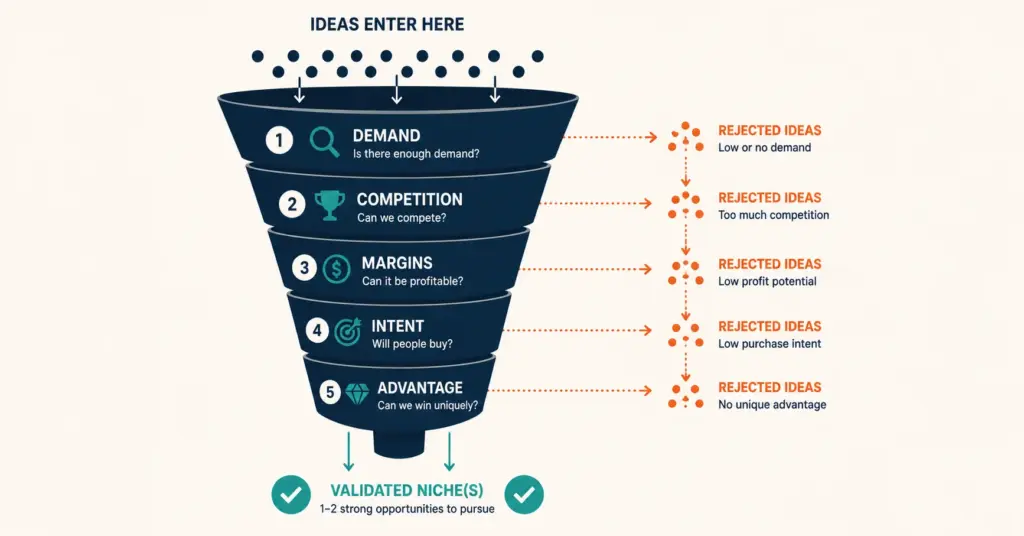
- Niche validation is the process of confirming that a product category has sufficient demand, manageable competition, and viable profit margins before investing in inventory, store setup, or marketing. Validation takes 2 to 4 weeks and $50 to $500. Skipping it risks $5,000 to $25,000 on a niche that fails for reasons discoverable in advance.
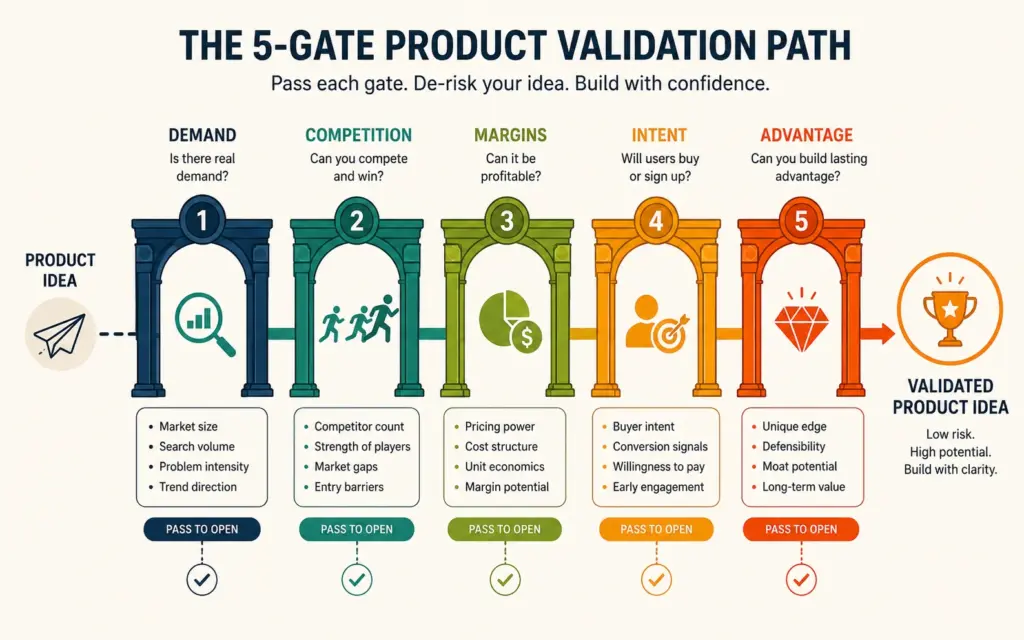
- The 5-step validation process: confirm search demand exists (Google Trends, keyword volume), analyze competitive density (how many established sellers, how strong), verify margin viability (can you price profitably after all costs), test purchase intent (landing page or marketplace listing), and assess your sustainable advantage (why customers would choose you long-term).
- A niche passes validation when it meets all 5 criteria: 1,000+ monthly searches for the primary keyword, fewer than 3 dominant competitors with 1,000+ reviews, 40%+ achievable gross margin after all costs, measurable purchase intent from real test traffic, and a defensible angle (brand story, product improvement, underserved segment).
- The most validated-seeming niches are often the worst choices because high demand with low barriers attracts maximum competition. A niche with moderate demand and meaningful barriers (specialized knowledge, regulatory requirements, community trust) often produces better outcomes than a crowded mass-market category.
Niche validation separates ecommerce ideas that feel promising from ideas that actually make money. Every founder believes their product concept will sell. Validation replaces belief with evidence by testing demand, competition, and margins before committing the capital that turns an idea into a business. The cost of validation ($50 to $500 and 2 to 4 weeks of research) is trivial compared to the $5,000 to $25,000 lost on inventory, store setup, and marketing for a niche that fails because the demand wasn’t real, the competition was too strong, or the margins couldn’t sustain customer acquisition costs. According to CB Insights’ post-mortem analysis, 35% of failed startups cite “no market need” as the primary cause of failure, a problem that structured validation catches before the investment.
Validation isn’t about proving an idea will work. It’s about finding the specific evidence that would disprove it before you’re financially committed. If the evidence doesn’t disprove it, proceed. If it does, pivot to a different niche without losing real money. The best selling products research methodology identifies niche candidates; this guide determines which candidates deserve your capital.
Step 1: Confirm Search Demand Exists
If people aren’t actively searching for products in your niche, organic discovery won’t work and paid advertising will be expensive because you’re creating demand rather than capturing existing demand.
Demand signals to check
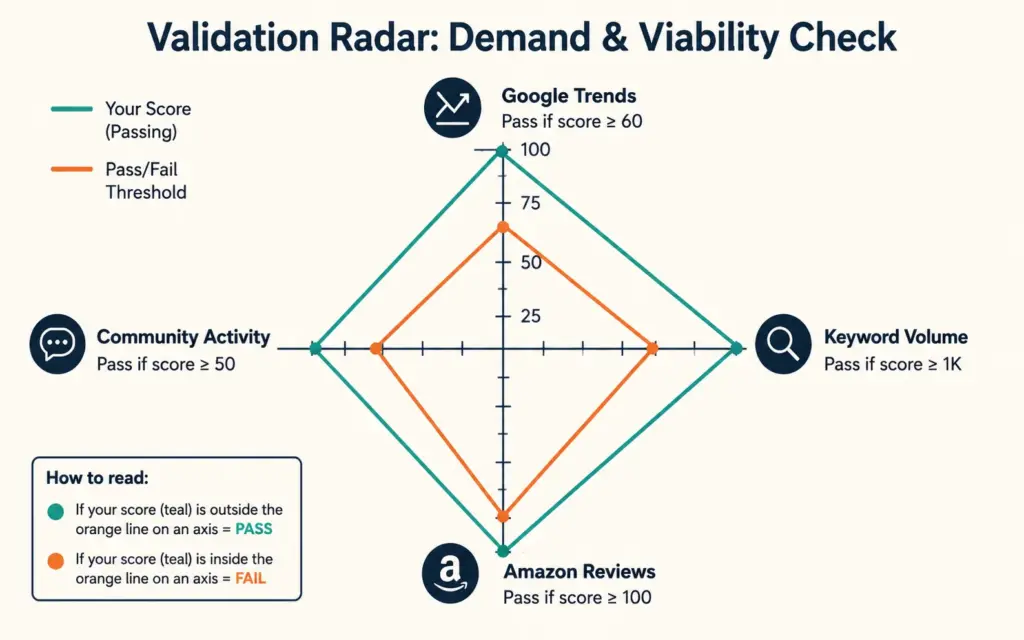
Google Trends: Search the niche keyword. Look for stable or growing interest over 24 months. Declining trends signal a shrinking market. Seasonal spikes are fine (holiday products, summer items) as long as there’s a baseline between peaks. A niche with zero Google Trends interest outside of one viral moment is a trend, not a market.
Keyword search volume: Use Ahrefs, SEMrush, or free tools like Ubersuggest. The primary niche keyword should have 1,000+ monthly searches. Related long-tail keywords (“best [niche product] for [use case]”) should collectively add 5,000+ monthly searches. Volume under 500/month for the primary keyword signals a niche too small to support a standalone business.
Amazon search volume: Search your niche on Amazon. Are there products with 500+ reviews? Products with thousands of reviews confirm heavy ongoing demand. Zero relevant results or products with under 50 reviews suggest the demand might not justify a dedicated store. Amazon search autocomplete suggestions also reveal what buyers actually type when shopping your category.
Community activity: Are there active subreddits, Facebook groups, or forums dedicated to this niche? Active communities (1,000+ members with daily posts) confirm passionate interest. Dead communities (last post 6 months ago) suggest the enthusiasm has moved elsewhere.
Step 2: Analyze Competitive Density
High demand with low competition is the ideal niche. High demand with saturated competition is a trap. Understanding who you’d compete against and how entrenched they are determines whether there’s realistic space for a new entrant.
Competition assessment framework
Google page 1 analysis: Search your primary niche keyword. If page 1 is dominated by established brands (Nike, Amazon, major retailers) with domain authorities above 60, organic ranking will take 12 to 18+ months and significant link building investment. If page 1 includes smaller niche sites, blogs, or newer brands, the ranking opportunity is realistic within 6 to 12 months.
Amazon competitive analysis: For the top 10 results on your primary Amazon keyword, check: average review count (above 1,000 reviews = entrenched competitors), average rating (above 4.5 = high customer satisfaction, hard to differentiate on quality), number of sellers on page 1 with under 100 reviews (these are your actual competition peer group). If fewer than 3 sellers have 1,000+ reviews and several have under 100, there’s room for a well-executed new entrant.
DTC brand landscape: Search “[niche] brand” or “[niche] online store.” Count how many dedicated DTC brands exist with professional stores, active social media, and visible ad campaigns. More than 10 to 15 well-funded DTC competitors in a niche makes differentiation and customer acquisition expensive. Fewer than 5 suggests the niche is either underserved (opportunity) or unprofitable (which is why nobody’s there). The business model comparison should match the competitive landscape: wholesale reselling works when established brands dominate, while private label works when the category lacks a clear market leader.
Step 3: Verify Margin Viability
A niche with strong demand and manageable competition still fails if the economics don’t work. Margin verification confirms that you can price products high enough to cover all costs AND fund customer acquisition.
The margin viability calculation
- Target selling price: Based on competitor pricing analysis from Step 2. What do similar products sell for? Your price needs to be within 20% of this range (above or below) to avoid pricing yourself out of the market or signaling low quality.
- Product cost: Manufacturing or wholesale cost per unit. For private label, request quotes from 3 to 5 suppliers. For wholesale, check distributor pricing. For dropshipping, verify supplier pricing on AliExpress, Alibaba, or domestic distributors.
- Shipping cost: Weight-based shipping estimate for domestic delivery. Use USPS/UPS rate calculators with your product’s weight and dimensions.
- Platform fees: Shopify/WooCommerce processing (2.9% + $0.30), marketplace fees (Amazon 15% referral + FBA, Etsy 6.5% + processing), and any app subscription costs allocated per unit.
- Target CAC: What you’ll spend on marketing to acquire each customer. For new DTC brands, assume $20 to $50 CAC until you have actual campaign data.
Viable if: Selling price – (product cost + shipping + platform fees + target CAC) = positive contribution margin of at least 15 to 20% of selling price. Below 15%, there’s no room for operating costs, returns, or unexpected expenses. The margin calculator runs these numbers instantly. For Amazon-specific fee modeling, the Amazon FBA calculator accounts for referral fees, fulfillment fees, and storage costs that significantly impact per-unit economics.
Step 4: Test Purchase Intent
Demand signals (search volume, community interest) indicate curiosity. Purchase intent testing confirms people will actually pay money. Two testing methods:
Method A: Landing page test ($50 to $200)
- Create a simple landing page showing your product concept with a “Buy Now” or “Join Waitlist” button
- Run $50 to $100 in Meta or Google ads targeting your niche keywords for 7 to 14 days
- Track click-through rate (ad to landing page) and conversion action rate (clicks on Buy/Waitlist button)
- If 2%+ of landing page visitors click the purchase button, demand is validated. If under 1%, the product concept or positioning needs rework. The pre-launch marketing approach can double as a validation test by measuring how quickly subscribers accumulate.
Method B: Marketplace listing test ($100 to $500)
- List 1 to 3 products on Etsy, Amazon, or eBay using dropshipping or small-batch inventory (10 to 50 units)
- Optimize listings with the Amazon listing optimization best practices to ensure the test reflects listing quality, not just product demand
- Run for 30 days. If you sell 10+ units at your target price point without paid promotion, organic demand exists. If sales come only from heavy ad spend, validate that the unit economics work at that CPA
- Use sales data from this test as the demand baseline for demand forecasting when you scale
Step 5: Assess Your Sustainable Advantage
A niche that passes Steps 1 through 4 confirms market viability. Step 5 confirms whether YOU specifically can win in this niche long-term. Viable markets attract competitors. Your advantage determines whether new entrants take your customers or you take theirs.
Advantage types for ecommerce
- Product improvement: You’ve identified a specific flaw in existing products that you can fix. Every competitor’s 3-star reviews that mention the same problem are your product development brief.
- Audience access: You already have a following, email list, or community in this niche. Starting with 5,000 relevant followers versus zero is a meaningful advantage for the first 6 to 12 months.
- Domain expertise: You understand the niche’s needs from personal experience as a customer, professional, or enthusiast. This knowledge shapes better products, more authentic marketing, and more relevant content than a generalist competitor can produce.
- Brand story: A compelling founder story that resonates with the target customer. “I’m a veterinarian who couldn’t find quality [pet product], so I designed one” is more defensible than “I found a trending product on TikTok.”
- Cost or supply advantage: You have access to better suppliers, manufacturing capabilities, or fulfillment infrastructure than competitors. Rare for new entrants but powerful when it exists. The Alibaba sourcing guide can create cost advantages over time through volume negotiations and exclusivity agreements.
If you can’t articulate a specific advantage beyond “I’ll market it better,” the niche will be difficult to defend as competitors enter with the same products and similar marketing. According to Inc.’s niche business analysis, ecommerce brands that target narrow niches with clear positioning grow 2 to 3x faster than brands competing broadly because focused positioning converts at higher rates and attracts more loyal repeat customers.
Red Flags That Kill Niches
Declining Google Trends with no seasonal explanation. A niche trending downward for 24 months is losing consumer interest. Even perfect execution can’t overcome a shrinking market.
All top competitors are venture-funded DTC brands. Competing against brands with $10M+ in funding on customer acquisition means your $3,000/month ad budget is invisible. Look for niches where the incumbents are small, bootstrapped, or marketplace-only sellers.
Average product price under $15. Below $15, profit margins can’t absorb customer acquisition costs at any reasonable CAC. After COGS ($4 to $6), shipping ($3 to $5), fees ($1 to $2), and CAC ($10 to $20), there’s nothing left. Viable ecommerce niches typically have average order values above $30. The ecommerce pricing strategy floor analysis should confirm that the target price supports a minimum 40% gross margin.
The niche requires regulatory compliance you can’t afford. FDA registration for supplements, CPSC testing for children’s products, or DOT certification for automotive parts add $5,000 to $50,000+ in compliance costs that make small-scale entry impossible. Verify regulatory requirements before committing.
High return rate categories without margin to absorb them. Fashion (25 to 40% return rate), furniture (10 to 20%), and electronics (8 to 15%) have structurally high returns. The ecommerce profit margins structure must accommodate the return rate as a standard cost, not treat it as an exception.
Frequently Asked Questions
Niche validation confirms that a product category has sufficient demand, manageable competition, and viable profit margins before investing real capital. The process takes 2 to 4 weeks and costs $50 to $500 in testing. Five steps: confirm search demand, analyze competitive density, verify margin viability, test purchase intent with a landing page or marketplace listing, and assess your sustainable advantage in the niche.
The primary niche keyword should have 1,000+ monthly searches. Related long-tail keywords should collectively add 5,000+ monthly searches. Volume under 500/month for the primary keyword signals a niche too small for a standalone business. Also check Amazon search volume: products with 500+ reviews in the category confirm ongoing purchase demand, which search volume alone doesn’t guarantee.
Two methods: (1) Landing page test: create a product concept page with a Buy/Waitlist button, run $50 to $100 in Meta or Google ads for 7 to 14 days, and measure button click rate (2%+ validates demand). (2) Marketplace listing test: list 1 to 3 products on Etsy, Amazon, or eBay with small inventory or dropshipping, run for 30 days, and measure organic sales velocity (10+ units at target price validates demand).
Five criteria: 1,000+ monthly searches for the primary keyword, fewer than 3 dominant competitors with 1,000+ reviews, 40%+ achievable gross margin after all costs, measurable purchase intent from real test traffic, and a defensible advantage (product improvement, audience access, domain expertise, or brand story). The best niches combine moderate demand with meaningful entry barriers rather than maximum demand with no barriers.
2 to 4 weeks total. Week 1: demand and competition research (Steps 1 and 2). Week 2: margin calculation and supplier pricing research (Step 3). Weeks 2 to 4: purchase intent testing with landing page or marketplace listing (Step 4). Step 5 (advantage assessment) happens in parallel. The total investment is $50 to $500 in ad testing and supplier samples, which is trivial compared to the $5,000 to $25,000 at risk from launching an unvalidated niche.
Amazon marketplace testing is faster and cheaper for validation because Amazon provides built-in traffic. Listing 1 to 3 products on Amazon tests demand without building a website or running ads. Your own store (landing page test) is better for validating brand positioning and willingness to pay outside of Amazon’s competitive price environment. Ideally, test both: Amazon validates category demand, your landing page validates your specific brand and pricing.
Related Reads
- Best Selling Products Research
- Business Model Comparison
- Ecommerce Pricing Strategy
- Ecommerce Startup Costs
- Pre-Launch Marketing
- Ecommerce Profit Margins
Enjoying this? Get more like it every week.
One email per week with ecommerce strategies, tool picks, and seller insights. No spam.