
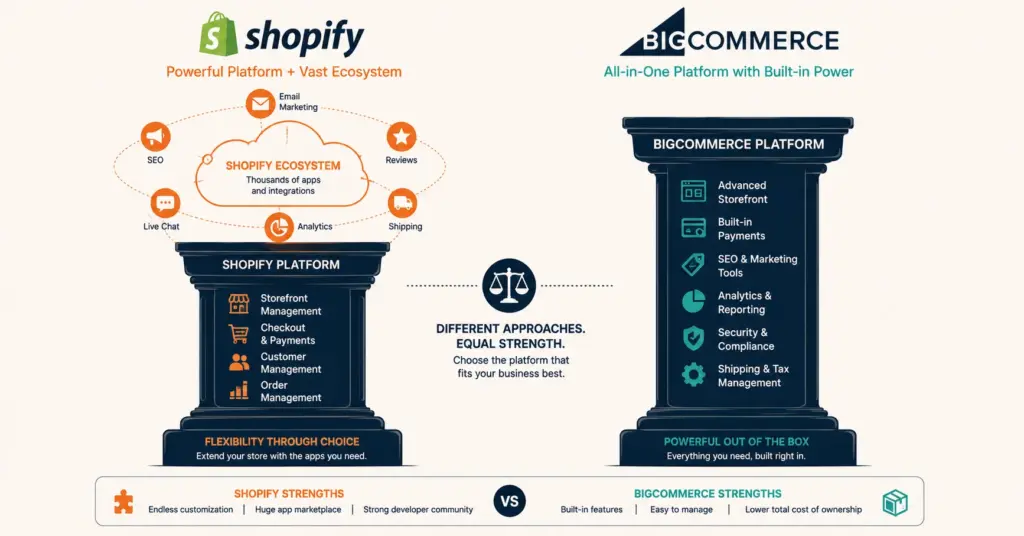
- Shopify wins on ecosystem: the largest app marketplace (8,000+ apps), the most third-party integrations, the fastest setup for beginners, and the strongest brand recognition among ecommerce platforms. BigCommerce wins on built-in features: native multi-channel selling, no transaction fees on external payment gateways, and more advanced product catalog capabilities without requiring paid apps.
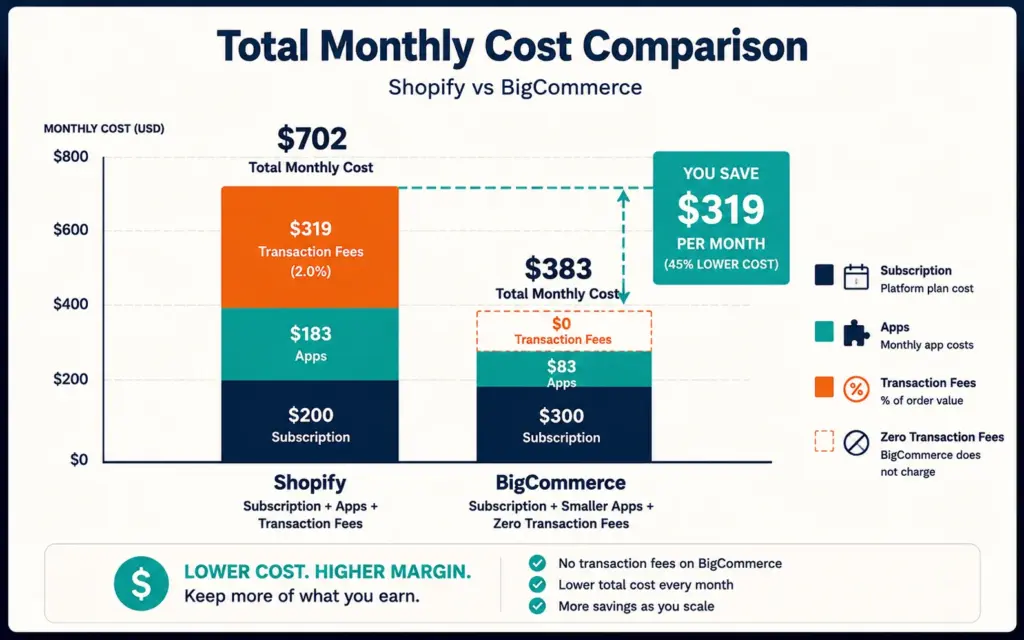
- The transaction fee difference is meaningful. Shopify charges 0.5 to 2% per transaction unless you use Shopify Payments. BigCommerce charges zero transaction fees regardless of which payment processor you use. For stores processing $50,000+/month through a non-Shopify-Payments gateway, this saves $250 to $1,000/month on BigCommerce.
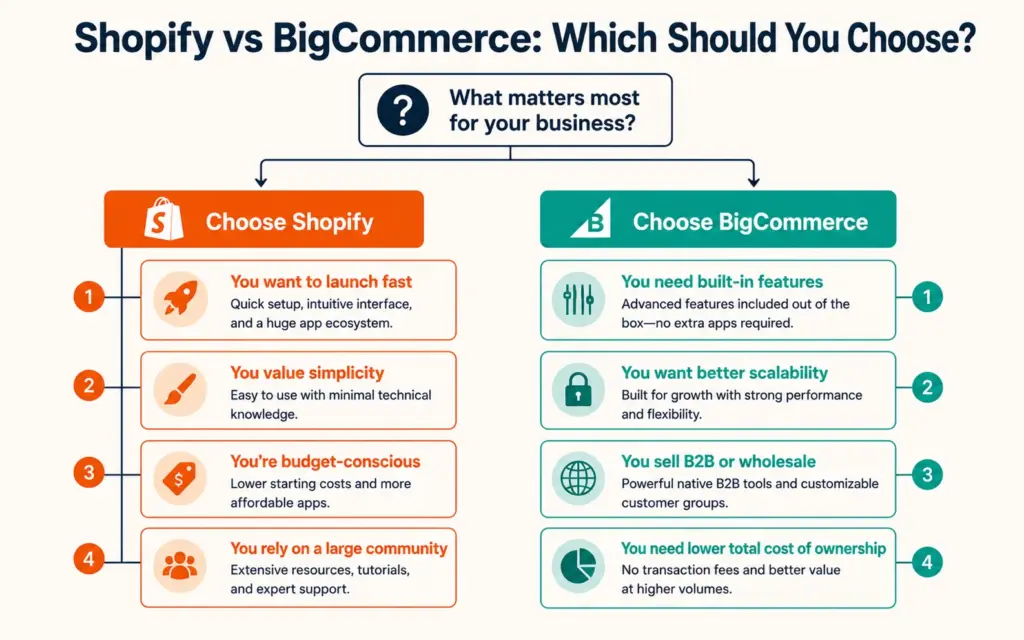
- Shopify is the better choice for: first-time sellers, stores that want the fastest setup, businesses already using or willing to use Shopify Payments, and brands that need extensive third-party app integrations. BigCommerce is the better choice for: B2B/wholesale sellers, stores with complex product catalogs (100+ variants per product), businesses using external payment gateways, and brands that want more built-in features without app dependency.
- Both platforms handle $10M+ annual revenue without breaking. The "which platform scales better" debate is a distraction; both scale. The real decision criteria are transaction fees, app dependency, B2B capabilities, and your team's technical comfort level.
The BigCommerce vs Shopify decision shapes your store’s fee structure, feature access, and operational flexibility for years. Both platforms power successful ecommerce businesses from startup through $10M+ annual revenue. The difference isn’t capability (both can do almost everything the other can) but how they deliver it: Shopify through a lean core plus extensive paid app ecosystem, BigCommerce through a feature-rich core with fewer but less necessary third-party dependencies. According to BigCommerce’s platform analysis, the average Shopify store spends $120 to $300/month on third-party apps for features that BigCommerce includes natively, a cost gap that compounds over the lifetime of the business.
This comparison focuses on the dimensions that affect profitability and growth rather than listing every feature side by side. If you’ve already narrowed your choices to these two platforms (and eliminated WooCommerce, which the Shopify vs WooCommerce comparison covers), the decision comes down to five factors: transaction fees, built-in vs app-dependent features, B2B capabilities, product catalog complexity, and ecosystem strength.
Pricing and Fee Structure
Monthly platform costs
| Plan Level | Shopify | BigCommerce |
|---|---|---|
| Starter / Standard | $39/month | $39/month |
| Mid-tier | $105/month (Shopify plan) | $105/month (Plus plan) |
| Advanced | $399/month | $399/month (Pro plan) |
| Enterprise | $2,300+/month (Shopify Plus) | Custom pricing (Enterprise) |
Monthly platform pricing is nearly identical. The cost difference lives in transaction fees and app spend, not base subscription.
The transaction fee gap
Shopify charges a transaction fee (0.5% to 2% depending on plan) on every sale processed through an external payment gateway (PayPal, Stripe, Authorize.net). This fee disappears only when using Shopify Payments. BigCommerce charges zero transaction fees regardless of which payment processor you use.
Impact calculation: a store processing $100,000/month through PayPal on Shopify’s $105/month plan pays 1% transaction fee = $1,000/month to Shopify in addition to PayPal’s processing fees. The same store on BigCommerce pays $0 in platform transaction fees. Over 12 months: $12,000 saved on BigCommerce. If you use Shopify Payments, this gap disappears entirely, which is why Shopify aggressively promotes its own payment processor. For stores in countries where Shopify Payments isn’t available, BigCommerce eliminates a significant ongoing cost.
App cost comparison
Shopify’s lean core means many features require paid apps: advanced product filtering ($10 to $30/month), multi-currency pricing ($20 to $50/month), real-time shipping rates ($20 to $40/month on basic plans), and custom fields for products ($10 to $20/month). BigCommerce includes all of these natively. The typical Shopify store runs 6 to 12 paid apps at $120 to $300/month total. BigCommerce stores average 2 to 5 paid apps at $40 to $100/month. The ecommerce tools tech stack cost analysis should model total platform cost (subscription + apps + transaction fees), not just the subscription price.
Built-In Features vs App Ecosystem
Where BigCommerce leads (built-in)
- Multi-channel selling: Native integrations with Amazon, eBay, Facebook, Instagram, Pinterest, and Google without third-party apps. Shopify requires channel-specific apps for some marketplaces.
- B2B and wholesale: Built-in customer groups with custom pricing, price lists, and purchase order workflows. Shopify requires Shopify Plus ($2,300/month) or third-party B2B apps for equivalent functionality.
- Product catalog flexibility: Up to 600 variants per product (Shopify limits to 100 without apps). Custom fields, complex option sets, and configurable products work natively.
- Real-time shipping quotes: USPS, UPS, FedEx real-time rates included on all plans. Shopify includes this only on Advanced ($399/month) and Plus plans.
- Multi-currency: Built-in currency conversion and display. Shopify requires Shopify Payments for native multi-currency or third-party apps with other processors.
Where Shopify leads (ecosystem)
- App marketplace: 8,000+ apps covering every conceivable function. BigCommerce has approximately 1,000 apps. For niche requirements (specific loyalty programs, specialized subscription tools, unique shipping integrations), Shopify’s app marketplace is more likely to have a ready-made solution.
- Theme selection: 150+ themes (12 free) with consistent quality and mobile optimization. BigCommerce offers approximately 70 themes (5 free) with more variable quality.
- Shopify Payments: The integrated payment processor simplifies setup, provides competitive rates (2.4 to 2.9% + $0.30), and unlocks Shop Pay (1.7x higher checkout conversion), Shop Pay Installments (BNPL at 0% merchant fee), and eliminates transaction fees. No BigCommerce equivalent exists. The payment methods stack benefits from Shopify Payments’ integrated experience.
- POS integration: Shopify POS connects online and physical retail with native sync. Inventory, orders, and customer data sync across channels. BigCommerce POS options are less integrated, relying on third-party partnerships.
- Developer and partner ecosystem: More Shopify developers, agencies, and freelancers available for custom work. Easier to find specialized help. The talent pool for Shopify customization is 5 to 10x larger than BigCommerce.
Which Platform Fits Which Business?
Choose Shopify when
You’re launching your first store. Shopify’s setup is the fastest path from zero to selling. The admin interface is intuitive, documentation is extensive, and community support (forums, YouTube tutorials, courses) is unmatched. Most first-time sellers can have a functioning store within 48 hours on Shopify. The first store checklist maps to Shopify’s workflow natively.
You want Shopify Payments. If Shopify Payments is available in your country and you’re willing to use it as your primary processor, the transaction fee concern disappears and you gain Shop Pay’s conversion benefits. For US, Canada, UK, Australia, and most EU sellers, this is the strongest single argument for Shopify.
You need extensive app integrations. If your business requires specialized tools (specific loyalty platform, unique subscription model, advanced product customization, augmented reality try-on), Shopify’s 8,000+ app marketplace is more likely to have what you need.
You sell DTC only. Shopify’s DTC-first design means every feature is optimized for the direct-to-consumer purchase flow. If you’re not selling B2B, wholesale, or through complex multi-channel arrangements, Shopify’s focused approach serves you well.
Choose BigCommerce when
You sell B2B and DTC. BigCommerce’s native customer groups, custom pricing tiers, and purchase order workflows handle B2B requirements that cost $200 to $500/month in Shopify apps (or require Shopify Plus at $2,300/month). If wholesale represents 20%+ of revenue, BigCommerce’s B2B capabilities justify the platform choice alone.
You use an external payment gateway. If Shopify Payments isn’t available in your country, or you have negotiated processing rates through an existing provider that beat Shopify Payments’ standard rates, BigCommerce’s zero transaction fee policy saves $250 to $1,000+/month on mid-to-high volume stores.
You have a complex product catalog. Products with 100+ variants (size x color x material combinations), configurable options, or custom fields beyond standard title/description hit Shopify’s native limits quickly. BigCommerce handles 600 variants per product and complex option sets without apps. Stores selling customizable, made-to-order, or industrial products with extensive specifications favor BigCommerce’s catalog flexibility.
You want fewer app dependencies. If maintaining, updating, and paying for 8 to 12 third-party apps creates operational risk (app conflicts, update breakages, subscription creep), BigCommerce’s feature-rich core reduces that dependency. Fewer apps means fewer potential failure points and a simpler technology stack.
Migration Considerations
Already on one platform and considering the other? Platform migrations are disruptive regardless of direction. Product data, customer records, and order history migrate through tools like Cart2Cart or LitExtension ($50 to $500 depending on catalog size). But themes don’t transfer (you’ll need a new design), apps don’t transfer (you’ll need equivalent tools), and SEO URL structures change (requiring 301 redirects for every page to preserve search rankings).
Migrate only when the cumulative cost of staying (transaction fees, app spend, feature gaps) exceeds the one-time migration cost ($500 to $5,000 including design, data transfer, and SEO redirect setup) within 12 months. The ecommerce technical SEO implications of a migration require careful redirect planning to avoid losing organic rankings that took months to build. According to Shopify’s migration data, poorly planned platform migrations cause 10 to 30% temporary organic traffic loss that takes 3 to 6 months to recover.
Scalability Is Not the Differentiator
Both platforms handle $10M+ annual revenue without infrastructure problems. Shopify Plus and BigCommerce Enterprise both offer dedicated support, custom checkout, advanced API access, and multi-storefront capabilities. The “which scales better?” question is a distraction from the real decision criteria: fee structure, feature delivery model, B2B needs, and ecosystem strength. Pick the platform that fits your business today and know that both will support your growth tomorrow.
The scaling decisions that actually matter aren’t platform-related: they’re about financial planning for scaling, team structure scaling, and facebook ads for ecommerce. The platform is the foundation, not the growth strategy.
Frequently Asked Questions
Monthly subscription prices are identical ($39, $105, $399). BigCommerce is cheaper when you use an external payment gateway (zero transaction fees vs Shopify’s 0.5 to 2%) and when counting app costs (BigCommerce includes features like real-time shipping quotes, multi-currency, and B2B pricing natively that cost $120 to $300/month in Shopify apps). Shopify is cheaper when using Shopify Payments (zero transaction fees) and when your feature needs are simple enough to avoid many paid apps.
Shopify. The setup experience is faster, the admin interface is more intuitive, documentation and tutorials are more extensive, and community support (forums, YouTube, courses) is unmatched. Most first-time sellers can have a functioning Shopify store within 48 hours. BigCommerce has a steeper initial learning curve but offers more built-in features once you understand the interface. Start with Shopify if speed to launch matters most.
BigCommerce. Native customer groups with custom pricing, price lists, quote management, and purchase order workflows are built in at no extra cost. Shopify requires Shopify Plus ($2,300/month) for equivalent B2B functionality, or third-party apps costing $100 to $500/month on standard plans. If B2B or wholesale represents 20%+ of your revenue, BigCommerce’s built-in capabilities justify the platform choice.
Yes, using migration tools like Cart2Cart or LitExtension ($50 to $500). Product data, customers, and order history transfer. Themes, apps, and customizations don’t transfer and must be rebuilt. SEO requires 301 redirects for every page to preserve search rankings. Migrations cost $500 to $5,000 total including design, data, and SEO work. Only migrate when the annual cost difference exceeds the one-time migration cost; poorly planned migrations cause 10 to 30% temporary organic traffic loss.
Both handle core SEO adequately: custom title tags, meta descriptions, URL structures, sitemap generation, and canonical tags. Shopify’s URL structure includes forced prefixes (/products/, /collections/) that can’t be changed, which is a minor SEO limitation. BigCommerce allows fully custom URLs. In practice, the SEO difference between platforms is negligible compared to the impact of content quality, link building, and technical optimization. Neither platform limits your SEO ceiling.
Shopify by a wide margin: 8,000+ apps versus BigCommerce’s approximately 1,000. For standard needs (email marketing, reviews, loyalty, shipping), both platforms have strong options. For niche requirements (specialized subscription models, AR try-on, unique fulfillment integrations), Shopify’s marketplace is 8x more likely to have a ready-made solution. However, BigCommerce needs fewer apps because more features are built in, so the app count comparison is partially misleading.
Related Reads
- Shopify vs WooCommerce
- Ecommerce Tools and Tech Stack
- Best WooCommerce Plugins
- First Store Checklist
- Checkout Optimization
- Financial Planning and Scaling
Enjoying this? Get more like it every week.
One email per week with ecommerce strategies, tool picks, and seller insights. No spam.