
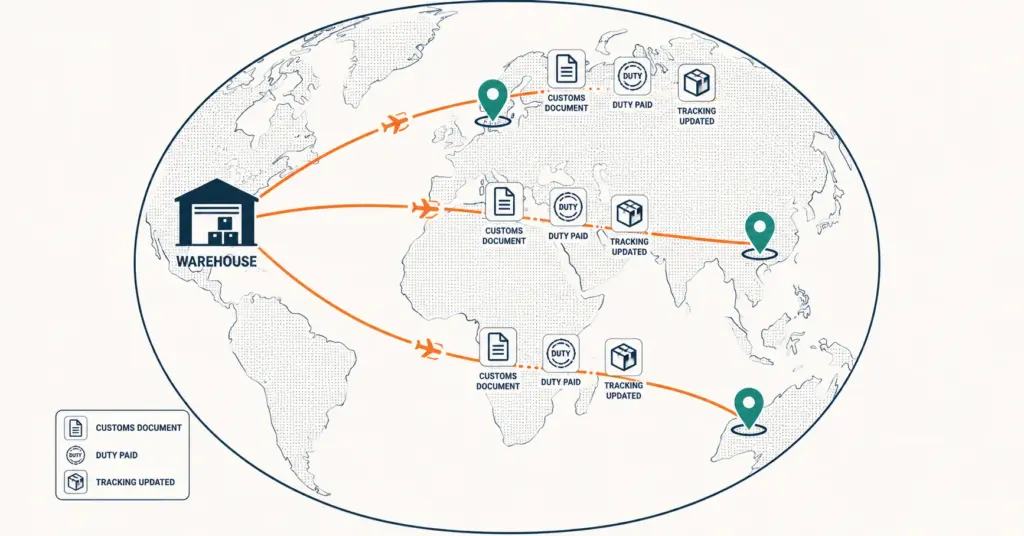
- International shipping opens your store to 95% of the world's consumers but introduces customs declarations, duties and taxes, longer transit times, higher return costs, and regulatory complexity. The revenue opportunity is real: cross-border ecommerce accounts for 22% of global online sales and is growing 2x faster than domestic ecommerce.
- Two fulfillment models for international orders: ship-from-home-country (simpler, higher per-order shipping cost, longer transit) or stock inventory in-market using international 3PLs (faster delivery, lower per-order cost, higher upfront investment).
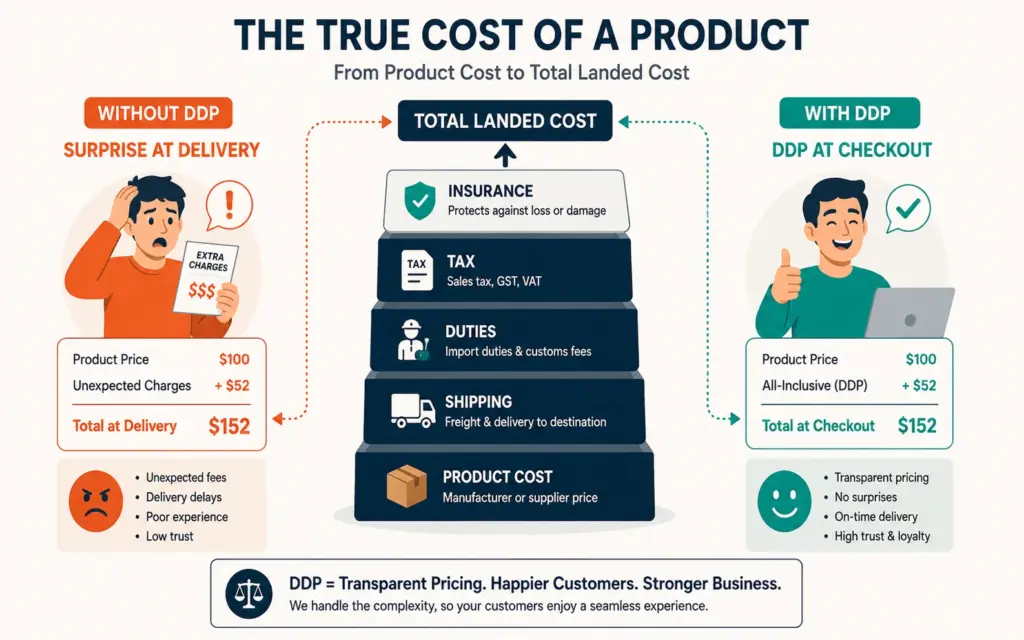
- Landed cost = product price + shipping + duties + taxes + insurance. Customers who encounter unexpected duties at delivery abandon 40 to 60% of those packages. Displaying landed cost at checkout or using DDP (Delivered Duty Paid) shipping eliminates this problem entirely.
- Start with 1 to 2 countries that share your language, have low duty thresholds, and show existing organic demand in your analytics. Canada, UK, and Australia are the most common first international markets for US-based stores.
International shipping is simultaneously the biggest untapped revenue opportunity and the most operationally complex expansion path for ecommerce stores. Selling domestically limits you to one country’s consumer base. Shipping internationally opens access to 95% of the world’s purchasing power. But that access comes with customs paperwork, import duties, VAT collection obligations, longer transit windows, and return logistics that cost 3 to 5x more than domestic returns. According to Statista’s cross-border ecommerce data, international online sales represent 22% of total global ecommerce revenue and are growing at twice the rate of domestic transactions, making the complexity worth solving for brands ready to scale beyond their home market.
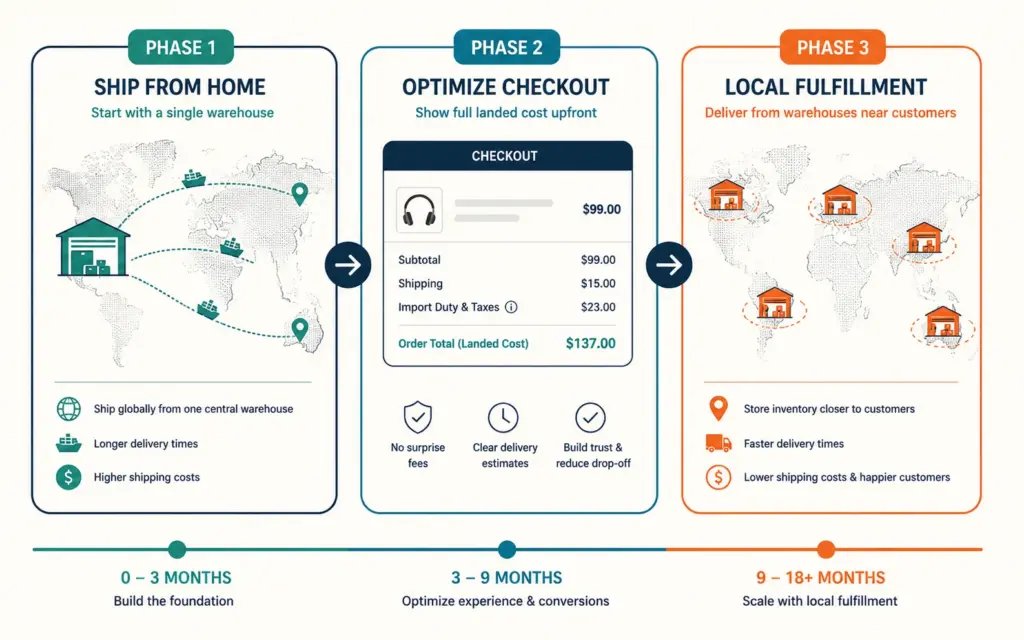
The stores that expand internationally without pain follow a phased approach: start with one or two low-friction countries, validate demand with ship-from-home fulfillment, then establish local inventory or 3PL partnerships once volume justifies it. Jumping into 20 countries simultaneously is how brands burn cash on shipping experiments that teach expensive lessons. The domestic shipping foundation should be solid before adding international complexity.
The Landed Cost Problem (and Why It Kills International Conversion)
Landed cost is the total price a customer pays for an international order: product price + shipping + import duties + local taxes (VAT/GST) + any insurance or handling fees. Most ecommerce stores show only product price and shipping at checkout, leaving duties and taxes as a surprise the customer discovers when the package arrives at customs.
That surprise is conversion poison. 40 to 60% of international customers refuse delivery when hit with unexpected duties, creating a returned package you’ve already paid to ship. The solution is DDP (Delivered Duty Paid) shipping, where you calculate and collect all duties and taxes at checkout so the customer sees the full landed cost before paying. No surprises at delivery.
Calculating duties
Import duties are percentage-based fees determined by the product’s HS (Harmonized System) code and the destination country’s tariff schedule. A cotton t-shirt might carry a 12% duty rate into the EU while a ceramic mug carries 6%. Tools like Zonos, Avalara, and Global-e automate HS code classification and duty calculation at checkout. Manual calculation works for 1 to 2 countries but becomes unsustainable beyond that. The margin calculator helps model whether your pricing absorbs duty costs or passes them to customers.
De minimis thresholds
Many countries waive duties on packages below a value threshold (de minimis). The US threshold is $800, Canada is CAD $20 (very low), the UK is GBP 135 (below which you must register for and charge UK VAT instead), and Australia is AUD $1,000. Knowing these thresholds determines whether your average order value triggers duty charges in each market, which directly impacts pricing strategy. Your pricing approach may need country-specific adjustments to stay competitive after landed costs are factored in.
Choosing Your First International Markets
Not all countries are equal for international expansion. The right first market shares your language, has manageable customs requirements, and already shows organic demand in your analytics.
The 5-factor market selection framework
- Existing demand signals: Check GA4 for international traffic. If 3%+ of sessions come from a specific country, customers there are already finding you. That’s validated demand worth serving.
- Language match: Selling in your native language eliminates translation costs and customer service complexity. For US stores: Canada, UK, Australia, New Zealand, Ireland.
- Duty and tax simplicity: Some countries have straightforward import processes (Canada, Australia). Others require local entity registration, VAT collection, and complex documentation (EU member states, Brazil). Start simple.
- Shipping cost and transit time: Proximity matters. US to Canada ships in 3 to 7 days at $10 to $20. US to Australia ships in 7 to 14 days at $25 to $50. US to Southeast Asia ships in 10 to 21 days at $30 to $60.
- Return logistics: International returns cost $15 to $40 per package. Countries with high return rate culture (Germany averages 30 to 50% return rates for fashion) require careful margin planning. The profit margins framework should account for country-specific return rates before committing to a market.
International Carrier Options Compared
International carriers fall into three tiers based on speed, cost, and tracking quality:
Express carriers (DHL Express, FedEx International, UPS Worldwide): 2 to 5 day delivery, $30 to $80+ per package, full tracking, customs brokerage included. Best for high-value products ($100+) where fast delivery justifies the shipping cost. DHL Express has the strongest international network outside North America.
Economy carriers (USPS Priority Mail International, Royal Mail, Canada Post): 6 to 14 day delivery, $15 to $40 per package, tracking varies by destination. Best for mid-price products ($30 to $100) where customers accept longer transit for lower shipping cost. USPS is often the cheapest option for packages under 4 lbs from the US.
Consolidators (Passport Shipping, Asendia, GlobalPost): 7 to 21 day delivery, $8 to $25 per package, limited tracking in some countries. Best for low-price, lightweight products where minimizing shipping cost is critical. Consolidators batch packages to reduce per-unit international postage. Rate-shop through your shipping tools (ShipStation, Pirate Ship) to compare all three tiers automatically.
Customs Documentation You Actually Need
Every international package requires a customs declaration. The essentials:
- Commercial invoice: Describes the contents, quantity, value, country of origin, and HS code. Most shipping platforms generate this automatically from order data.
- Customs declaration form (CN22 or CN23): Summary form attached to the outside of the package. CN22 for packages under $400 value, CN23 for packages above $400. Auto-generated by USPS and most label platforms.
- HS codes: The 6 to 10 digit classification code that determines duty rates. Incorrect HS codes cause customs delays and incorrect duty charges. Use your country’s tariff lookup tool (USITC HTS Search for US) or tools like Zonos for automated classification.
- Certificate of origin: Required for some product categories and some destination countries. Proves where the product was manufactured. Needed for goods qualifying for preferential trade agreement rates (USMCA for US-Canada-Mexico, for example).
Getting documentation wrong delays packages 1 to 3 weeks at customs, creating customer service tickets and eroding trust. The fulfillment workflow should include a customs documentation verification step for every international order.
The 3-Phase International Expansion Approach
Phase 1: Ship from home country (Month 1 to 6)
Keep all inventory domestic. Ship international orders directly from your existing warehouse or 3PL using economy carriers. This validates demand with zero infrastructure investment. Accept longer transit times (7 to 14 days) and higher per-order shipping costs. Monitor: order volume by country, return rates, customer feedback on shipping speed, and net margin after shipping and duties.
Phase 2: Optimize checkout and pricing (Month 3 to 9)
Once you have 50+ international orders per month to a single country, optimize: implement DDP checkout (collect duties and taxes upfront), create country-specific pricing that accounts for landed costs, translate key product pages if targeting non-English markets, and establish local payment methods (iDEAL for Netherlands, Klarna for Nordics). The checkout experience for international buyers needs different payment options and clear delivery timeline expectations.
Phase 3: Local fulfillment (Month 9+)
When a single country reaches 100+ orders/month consistently, evaluate stocking inventory locally. International 3PLs (ShipBob, Huboo in EU, ShipHero) hold your inventory in-country, enabling 2 to 5 day delivery at domestic shipping rates. The cost model shifts from high per-order shipping to warehousing fees plus local delivery costs, which is almost always cheaper above 100 monthly orders. The 3PL evaluation process applies identically to international providers.
VAT, GST, and Tax Collection Obligations
Many countries require foreign sellers to register for and collect local taxes above certain thresholds:
- UK: Register for UK VAT if selling goods valued under GBP 135 to UK consumers. You charge and remit 20% VAT at point of sale. Above GBP 135, the carrier collects VAT at import.
- EU: The Import One-Stop Shop (IOSS) simplifies VAT collection for goods under EUR 150. Register once, charge VAT at checkout per destination country rate (19 to 27% depending on country), remit monthly.
- Australia: Register for GST if annual sales to Australian consumers exceed AUD 75,000. Charge 10% GST at checkout.
- Canada: GST/HST registration required above CAD 30,000 in annual Canadian sales. Rates vary by province (5 to 15%).
Tax compliance tools (Avalara, TaxJar, Zonos) automate registration guidance, rate calculation, and filing. Non-compliance risks fines, package seizures, and marketplace account suspension. Your financial planning should budget $2,000 to $5,000 annually for international tax compliance across 2 to 3 countries. According to Avalara’s cross-border tax research, 67% of international ecommerce sellers underestimate their tax compliance obligations in at least one market.
Common International Shipping Mistakes
Surprising customers with duties at delivery. The single biggest reason international customers don’t reorder. Calculate and display landed cost at checkout or absorb duties into product pricing. Either approach eliminates the delivery surprise that destroys repeat purchase intent.
Offering free international shipping at domestic thresholds. A $50 free-shipping threshold that works domestically ($5 to $8 shipping cost absorbed) doesn’t work internationally ($25 to $50 shipping cost absorbed). Set international free-shipping thresholds 2 to 3x higher than domestic, or charge flat-rate international shipping. Margin analysis from your discount and offer strategy should model international shipping costs separately.
Shipping prohibited items without checking. Product categories that ship freely domestically may be restricted or prohibited internationally. Lithium batteries, cosmetics with certain ingredients, food products, and alcohol all face country-specific import restrictions. Check destination country regulations before shipping or risk package seizure and fines.
Using residential address formatting for international labels. International addresses follow different formatting conventions. Japanese addresses list prefecture before city. German addresses put the postal code before the city name. UK addresses include a postcode format unfamiliar to US-based systems. Address validation APIs (Google Address API, Loqate) format addresses correctly for each country, preventing failed deliveries. The SOP for international orders should include address formatting verification.
Not adjusting return policy for international orders. Accepting free returns internationally costs $15 to $40 per return. Most international sellers either charge a restocking fee, offer store credit instead of refunds for returns, or partner with local return hubs (Happy Returns, Narvar) that consolidate international returns into batch shipments. State the international return policy clearly on product pages and at checkout.
Frequently Asked Questions
Costs vary by carrier tier and destination. Express (DHL, FedEx): $30 to $80+ per package with 2 to 5 day delivery. Economy (USPS International, postal services): $15 to $40 with 6 to 14 day delivery. Consolidators (Passport, Asendia): $8 to $25 with 7 to 21 day delivery. For packages under 4 lbs, USPS Priority Mail International is often the cheapest option from the US. Rate-shopping tools like ShipStation compare all options automatically.
DDP (Delivered Duty Paid) means the seller calculates and collects all import duties and taxes at checkout, so the customer pays one total price with no surprise charges at delivery. DDP eliminates the 40 to 60% package refusal rate caused by unexpected duty charges. Tools like Zonos and Global-e automate DDP calculation. The alternative, DDU (Delivered Duty Unpaid), leaves the customer responsible for duties at delivery, which hurts international conversion and repeat purchase rates.
Start with countries that share your language, show existing organic traffic in analytics, and have manageable customs requirements. For US stores: Canada (proximity, USMCA trade agreement, English/French), UK (English, straightforward VAT rules), and Australia (English, high de minimis threshold of AUD $1,000). Validate demand by shipping from your home country before investing in local fulfillment infrastructure.
Depends on the destination and your sales volume. UK requires VAT registration for goods under GBP 135 sold to UK consumers. EU offers IOSS for simplified VAT on goods under EUR 150. Australia requires GST registration above AUD 75,000 annual sales. Canada requires GST/HST above CAD 30,000. Tax compliance tools (Avalara, TaxJar) automate rate calculation and filing. Budget $2,000 to $5,000 annually for international tax compliance across 2 to 3 countries.
An HS (Harmonized System) code is a 6 to 10 digit classification number that identifies your product’s category for customs purposes. The code determines the import duty rate applied to your package. A cotton t-shirt might carry a 12% duty while a ceramic mug carries 6%. Incorrect HS codes cause customs delays, wrong duty charges, and potential fines. Use your country’s tariff lookup tool or automated classification services like Zonos for accurate coding.
International returns cost $15 to $40 per package versus $5 to $10 domestically. Options: charge a flat restocking fee (common: $10 to $15), offer store credit instead of refunds for international returns, partner with local return consolidation services (Happy Returns, Narvar) that batch returns into single shipments, or establish a local returns address in high-volume markets. State international return policy clearly at checkout to set expectations before purchase.
Related Reads
- Shipping Strategies for Ecommerce
- Third-Party Logistics Guide
- Order Fulfillment Process
- Understanding Ecommerce Profit Margins
- Optimizing Your Checkout Flow
- Pricing Strategy Fundamentals
Enjoying this? Get more like it every week.
One email per week with ecommerce strategies, tool picks, and seller insights. No spam.