
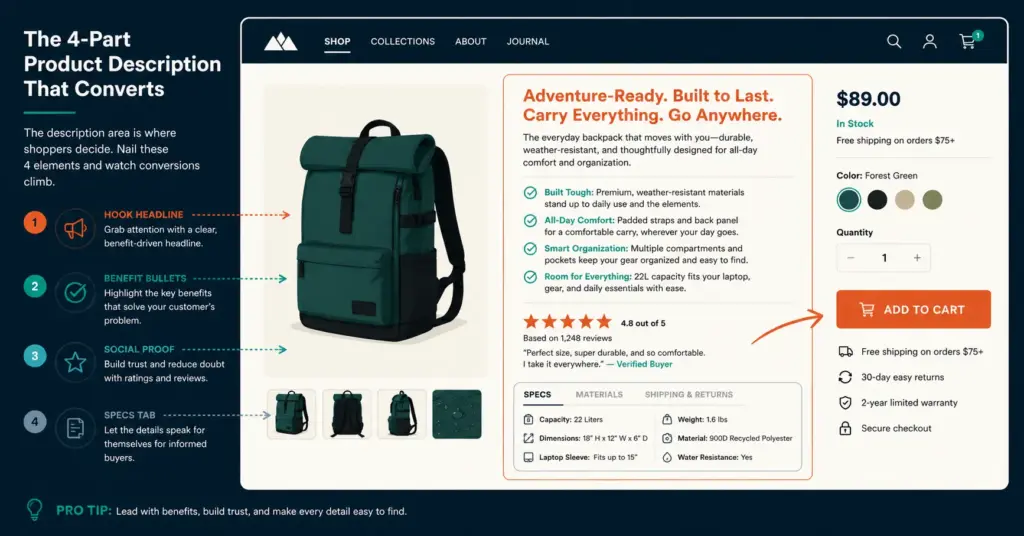
- Ecommerce product descriptions are the written content on product pages that explain what a product is, why someone should buy it, and how it compares to alternatives. Strong descriptions lift conversion 15 to 30% versus manufacturer copy or bare-minimum bullet points.
- The benefit-first formula: lead with what the product does for the buyer (benefit), then explain how (feature), then prove it (social proof or specification). "Cuts meal prep time in half (benefit) with 7 pre-set blade attachments (feature) rated 4.8 stars by 2,000+ home cooks (proof)."
- Product description length should match purchase complexity: 100 to 200 words for simple products under $30, 200 to 400 words for mid-range products ($30 to $150), and 400 to 800 words for high-consideration products above $150. Longer is not automatically better; relevant is better.
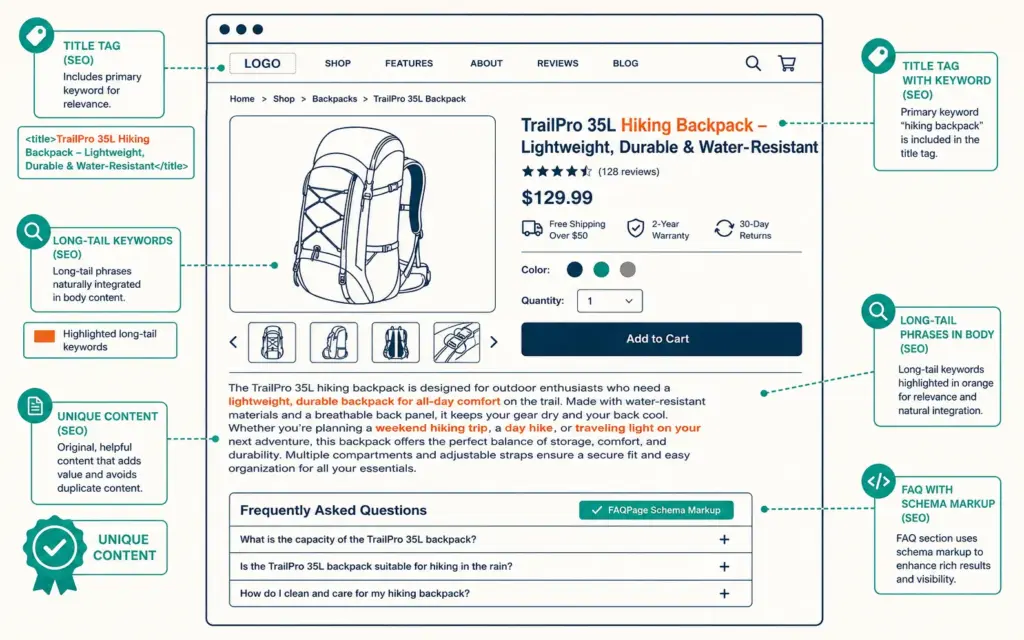
- SEO-optimized product descriptions rank for long-tail product queries that generic competitor pages miss. Including "best [product] for [use case]" variations, FAQ sections, and comparison context captures searches that product titles alone cannot.
Product descriptions are the written content on ecommerce product pages that explain what a product is, communicate why someone should buy it, and differentiate it from alternatives. Most online stores treat product descriptions as an afterthought: copy-pasted manufacturer text, a handful of bullet points, or nothing at all beyond the product title and price. According to Salsify’s consumer research, 87% of online shoppers rate product content as extremely important in their purchase decision, and pages with detailed descriptions convert 15 to 30% higher than those with minimal copy.
The gap between mediocre and effective product descriptions is one of the highest-ROI improvements an ecommerce store can make. Unlike redesigning a website or launching new ad campaigns, rewriting product descriptions requires no development work, no ad budget, and no new tools. A single afternoon of rewriting your top 20 products can lift revenue from those pages 15 to 30% within 30 days. For broader product page optimization, see our product page design guide.
This guide covers the benefit-first writing formula, the optimal description structure and length by product type, SEO optimization for product pages, and the mistakes that make product descriptions actively hurt conversion.
What Makes a Good Product Description?
A good product description answers four questions in order:
- What does this product do for me? (Benefit, not feature)
- How does it work? (Features that deliver the benefit)
- Why should I trust this claim? (Proof: reviews, specs, certifications)
- What do I need to know before buying? (Sizing, compatibility, care instructions)
The benefit-first formula
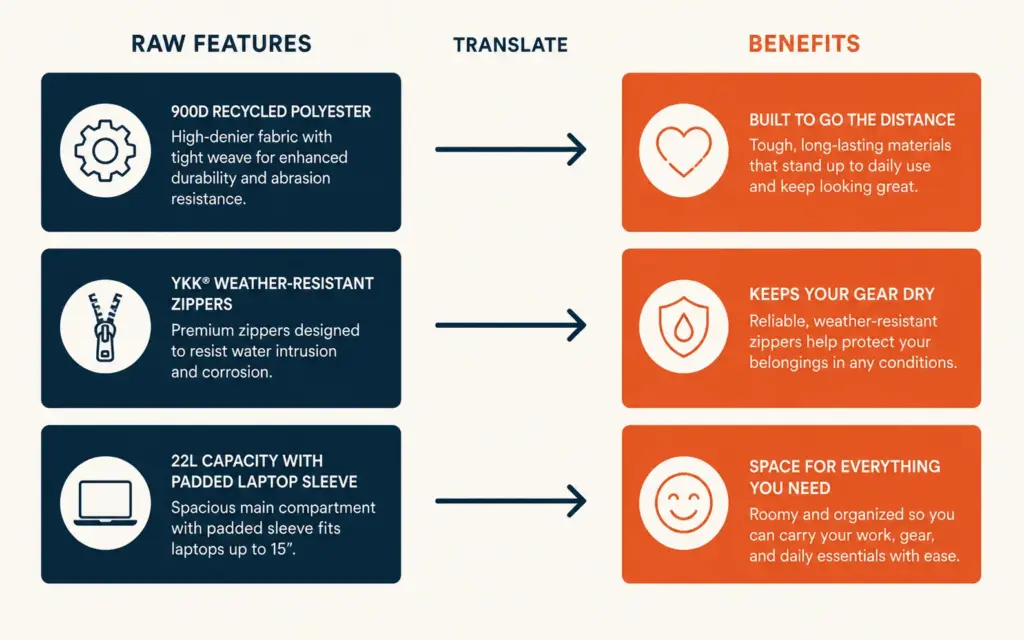
Features describe what a product is. Benefits describe what it does for the buyer. Buyers care about benefits; they use features to justify the purchase rationally.
| Feature | Benefit Translation |
|---|---|
| Stainless steel blade | Stays sharp for 3+ years without resharpening |
| 5,000 mAh battery | Lasts 2 full days on a single charge |
| Organic cotton, 300 thread count | Softer than hotel sheets without the synthetic feel |
| Adjustable lumbar support | Eliminates lower back pain during 8-hour work days |
| IP67 water resistance | Survives rain, spills, and accidental submersion |
Every feature in your description should have a corresponding benefit. If a feature doesn’t translate into a buyer benefit, remove it. Listing specifications without benefits reads like a datasheet, not a sales page.
Voice and tone
Write like a knowledgeable friend recommending something, not like a corporate brochure or a pushy salesperson. Address the reader directly (“you” language). Use short sentences. Avoid jargon unless your audience expects it (B2B, technical products). According to Nielsen Norman Group’s web reading research, online users read only 20 to 28% of text on a page, making concise, scannable product copy essential. Read the description aloud; if it sounds awkward spoken, it reads awkward too.
How Should I Structure a Product Description?
The 4-part structure
- Opening hook (1 to 2 sentences): The primary benefit in compelling language. This is the first thing the buyer reads after the title. Make it count. “Finally, a cutting board that doesn’t slide, warp, or absorb odors, even after 1,000 washes.”
- Benefit-feature pairs (3 to 5 bullet points or short paragraphs): Each major feature paired with its benefit. Use bullets for scanners (most ecommerce shoppers scan, they don’t read). Bold the benefit, follow with the feature explanation.
- Social proof integration (1 to 2 sentences): Embedded review quotes, “rated 4.8 by 2,000+ customers,” or relevant awards and certifications. Position proof near the buying decision point, not hidden at the bottom.
- Specifications and details (technical section): Dimensions, materials, weight, compatibility, care instructions. Use a collapsible section or tab to keep this available without cluttering the primary description. For checkout considerations, see our checkout optimization guide.
Length guidelines by product complexity
| Product Type | Price Range | Description Length | Focus |
|---|---|---|---|
| Simple/commodity | Under $30 | 100 to 200 words | Key differentiator + 3 bullet points |
| Mid-range | $30 to $150 | 200 to 400 words | Benefits, comparison context, use cases |
| High-consideration | $150+ | 400 to 800 words | Full story, detailed specs, FAQ, comparison |
| Technical/B2B | Any | 500 to 1,000 words | Specifications, integrations, documentation |
Match length to purchase consideration. A $12 kitchen sponge needs 2 sentences and 3 bullets. A $400 espresso machine needs 600 words covering features, comparison to alternatives, and detailed specifications. Over-writing simple products wastes the buyer’s time. Under-writing complex products leaves unanswered questions that prevent purchase.
How Do I Write Product Descriptions for SEO?
Product pages rank for long-tail queries that category and blog pages can’t capture. SEO-optimized product descriptions attract buyers who search for specific use cases, comparisons, and product details.
Keyword optimization for product pages
- Primary keyword in the title: “[Product Name] [Category]” (e.g., “Bamboo Cutting Board with Juice Groove”)
- Long-tail variations in the description: “best cutting board for raw meat,” “cutting board that doesn’t dull knives,” “large cutting board for meal prep.” These capture specific search queries that generic titles miss.
- Use-case phrases: “Perfect for [specific activity]” matches how buyers actually search. “Perfect for small kitchens,” “designed for daily runners,” “built for professional photographers.”
- Competitor comparison phrases: “Unlike [category norm], this [product] [differentiator].” This captures “[product] vs [competitor]” searches without naming specific brands.
Product page FAQ sections
Adding 3 to 5 FAQ items to product pages captures question-based searches (“Is [product] dishwasher safe?” “Does [product] fit [specific use case]?”) and earns FAQ schema rich results in Google. Use FAQPage structured data markup. Common product FAQ categories: sizing/compatibility, care/maintenance, warranty/returns, use cases, and comparison questions. For A/B testing description changes, see our A/B testing guide.
Unique descriptions vs manufacturer copy
Manufacturer-provided descriptions appear on every retailer’s site that sells the same product. Google’s duplicate content signals mean these pages rarely rank well. Original descriptions, even 150 words of unique content, outrank copy-pasted manufacturer text because they provide unique value. Rewrite every product description in your brand voice, even if the factual content is the same. For content strategy depth, see our content marketing guide.
How Do I Write Descriptions for Different Product Categories?
Fashion and apparel
Emphasize fit, feel, and versatility. Include “pairs well with” suggestions (cross-sell opportunity). Specify exact sizing in a table. Address common fit concerns (“runs true to size” or “size up for a relaxed fit”). Use sensory language for fabric and texture (“buttery soft,” “structured but breathable”). Lifestyle context (“from boardroom to weekend brunch”) helps buyers envision wearing the product.
Electronics and tech
Lead with what the device enables, not its specifications. “Record 4K video that looks professional” beats “4K 60fps CMOS sensor.” Follow with detailed specs in a separate table for comparison shoppers. Include compatibility information prominently (“Works with iPhone 14+ and Samsung Galaxy S22+”). Address common concerns: battery life in real-world usage (not lab conditions), warranty terms, and setup complexity.
Food and consumables
Flavor and ingredient quality lead. Origin stories work well for premium food products (“single-origin beans from Huila, Colombia”). Include nutritional information, allergen warnings, and serving suggestions. Subscription prompts (“never run out”) with frequency options. Review quotes about taste and quality provide powerful social proof for products buyers can’t sample before purchasing.
Home and furniture
Dimensions are critical because buyers need to know if the product fits their space. Include context dimensions (“fits comfortably in spaces 10×10 feet or larger”). Material and construction details signal durability. Assembly information (time estimate, tools needed, difficulty level) prevents post-purchase frustration. “Arrives fully assembled” is a major conversion driver in furniture.
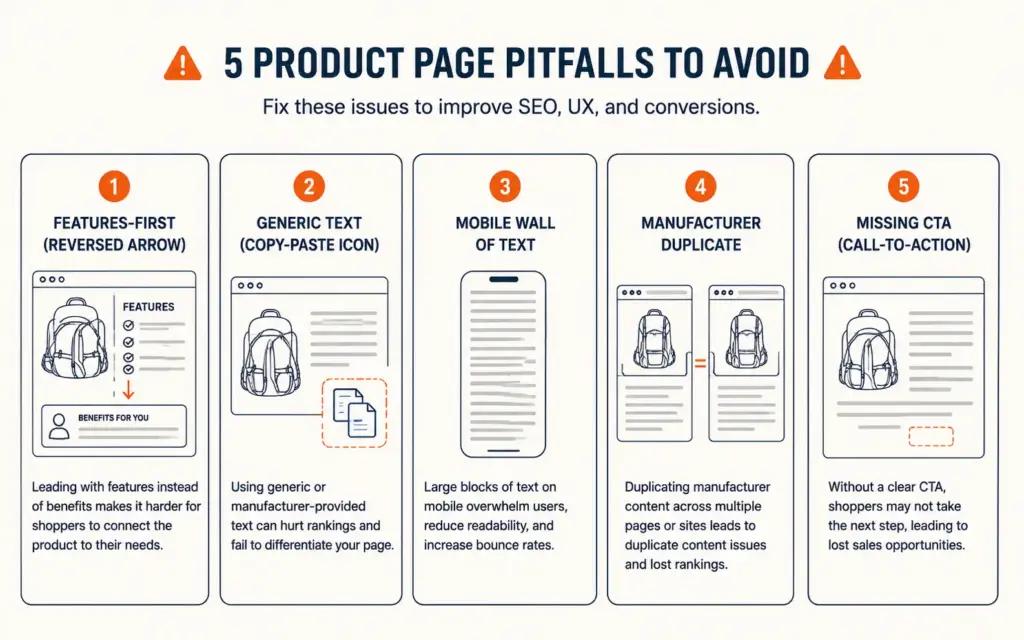
What Are the Most Common Product Description Mistakes?
Leading with features instead of benefits
“12V motor, 1,500 RPM, stainless steel housing” tells the buyer nothing about why they should care. Translate to: “Blends frozen fruit and ice into smooth consistency in under 30 seconds.” Features prove the benefit is real; they don’t replace the benefit as the primary message.
Writing generic descriptions that fit any product
“This high-quality product is perfect for anyone looking for the best solution.” This describes nothing. Every sentence should be specific to the product. If you can swap the description between two different products and it still makes sense, the description is too generic. For pricing strategy that supports description positioning, see our ecommerce pricing strategy guide.
Ignoring mobile readability
60 to 75% of product page views happen on mobile. Dense paragraphs that look fine on desktop become walls of text on phone screens. Use short paragraphs (2 to 3 sentences), bullet points for key features, and collapsible sections for specifications. Test every description on a phone before publishing.
Using manufacturer copy verbatim
Duplicate content across hundreds of retailer sites. Zero SEO value. No brand voice. Manufacturer descriptions are written for B2B buyers, not end consumers. Always rewrite in your own voice, emphasizing the benefits that matter to your specific audience. For broader product page strategy, see our product page design guide.
Forgetting the call to action
The description should build toward the purchase decision, not just describe the product. End with a clear next step: “Add to cart,” “Choose your size,” or “Start your subscription.” Reinforce the value proposition near the CTA: “Free shipping and 30-day returns on every order.” For discount and offer strategy, see our discount strategy guide.
Frequently Asked Questions
Length should match purchase complexity: 100 to 200 words for simple products under $30, 200 to 400 words for mid-range products ($30 to $150), and 400 to 800 words for high-consideration products above $150. The goal is answering all buyer questions without wasting their time. A $12 sponge needs 3 bullet points. A $400 espresso machine needs 600 words covering benefits, comparison, specifications, and FAQ.
The benefit-first formula: lead with what the product does for the buyer (benefit), then explain how (feature), then prove it (social proof or specification). Structure: opening hook (1 to 2 sentences with primary benefit), benefit-feature bullet pairs (3 to 5 points), social proof integration (review quote or rating), and specifications in a collapsible section. Every feature should have a corresponding benefit translation.
Include the primary keyword in the product title, use long-tail variations naturally in the description body (“best [product] for [use case]”), add use-case phrases that match real search queries, and include 3 to 5 FAQ items with FAQPage schema markup. Write unique descriptions for every product instead of using manufacturer copy. Unique content outranks duplicate manufacturer descriptions even when shorter.
Use both. Open with a 1 to 2 sentence paragraph that hooks the reader with the primary benefit. Follow with 3 to 5 bullet points for scannable feature-benefit pairs (most ecommerce shoppers scan, not read). Add a short paragraph for brand story or lifestyle context if relevant. Put specifications in a collapsible tab or section. This mixed format serves both scanners and detailed readers.
AI tools produce serviceable first drafts that need human editing for brand voice, accuracy, and differentiation. Use AI to generate initial descriptions, then edit for: factual accuracy (AI may invent specifications), brand voice consistency, unique selling points that differentiate from competitors, and removal of generic filler language. AI-generated descriptions without human editing read identically to every competitor using the same tool.
Review top-selling product descriptions quarterly for: accuracy (pricing, features, availability), freshness (update year references, seasonal context), SEO performance (check ranking positions, add new long-tail keywords), and conversion data (A/B test description changes on underperforming pages). Products ranking in positions 5 to 20 for target keywords often climb 3 to 5 positions with updated, expanded descriptions.
Related Reads
- Product Page Design Guide
- Checkout Optimization
- A/B Testing for Ecommerce
- Discount Strategy Guide
- Content Marketing Guide
- Ecommerce Technical SEO
Enjoying this? Get more like it every week.
One email per week with ecommerce strategies, tool picks, and seller insights. No spam.