

- Around 30% of customer service interactions were already handled by AI in 2025, projected to reach roughly 50% by 2027. For ecommerce, that automated volume is overwhelmingly the repetitive middle: "where is my order" (WISMO), returns, refunds, and order edits. This is exactly the work a capable AI agent can take off your team.
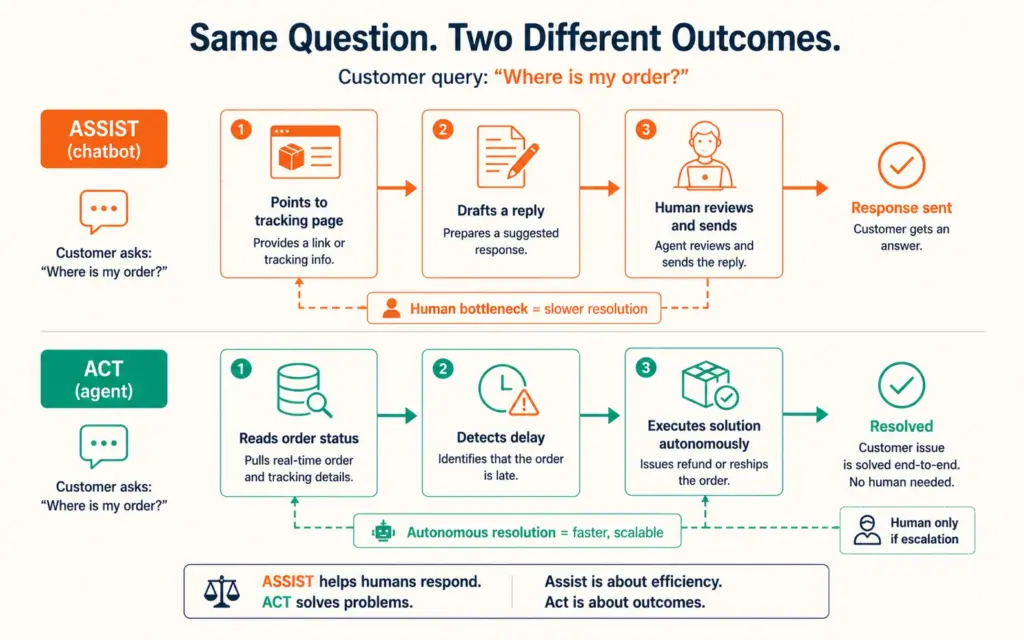
- The distinction that matters in 2026 is act vs assist. A chatbot answers "where is my order?" by pointing to a tracking page. An AI agent reads the order status and, if something's wrong, fixes it. Ask whether a tool completes the refund, edits the order, or processes the return inside your commerce stack, or whether it just drafts a reply for a human to send.
- The strain is real: one analysis of 16,140 ecommerce brands found average ticket resolution takes 18.6 hours with only 15% of interactions resolved through automation. Fast, accurate AI resolution of the repetitive middle turns support from a cost center into recovered capacity.
- Tool selection by store size: Tidio (Lyro AI) for small to mid-size stores wanting live chat plus AI in one tool, Gorgias for high-volume Shopify stores, Intercom (Fin) for SaaS and mid-market, and enterprise agents like Sierra or Agentforce for the highest volumes. Judge any tool on one number after 90 days: tickets resolved without a human.
AI customer service uses artificial intelligence to handle customer support conversations: answering questions, tracking orders, processing returns, and resolving issues across chat, email, and messaging channels. For ecommerce specifically, the value concentrates in the repetitive middle of your support volume: the same order-status, returns, refund, and sizing questions asked thousands of times. AI handles those at scale so your human team focuses on the complex, high-value, or emotionally sensitive cases that genuinely need a person.
The adoption curve is steep. According to Engaige’s AI customer service analysis citing Salesforce data, around 30% of customer service interactions were handled by AI in 2025, projected to reach roughly 50% by 2027. But the critical distinction in 2026 isn’t whether to use AI. It’s which kind: a tool that assists (drafts a reply for a human to send) versus a tool that acts (completes the refund or order change inside your store). That difference determines whether AI actually reduces your support load or just adds a drafting step. The AI tools for ecommerce overview covers the broader AI landscape; this guide focuses on support specifically.
Act vs Assist: The Distinction That Determines Real Value
This is the single most important concept in evaluating AI customer service tools. Gartner frames the destination as an “intelligent front door”: one entry point that understands intent, executes a transaction, and escalates when it should.
Assist (chatbot): A shopper asks “where is my order?” The bot points them to a tracking page or drafts a reply for a human agent to review and send. Helpful, but a human still does the work. The bot deflects the easy questions but doesn’t resolve them end to end.
Act (AI agent): The same shopper asks “where is my order?” The agent reads the actual order status from your commerce platform, sees the package is delayed, proactively offers a solution (reshipment, refund, or updated timeline), and executes it, all without a human touching the ticket. If it can’t resolve the issue, it escalates to a human with full context attached.
The filter for every tool you evaluate: does it complete the refund, edit the order, or process the return inside your commerce stack? Or does it only draft a reply for an agent to send? The tools winning the category in 2026 are agents, not chatbots. The ecommerce automation principle applies: automation that requires human follow-up on every task isn’t automation, it’s a queue.
The Support Strain AI Customer Service Solves
Ecommerce customer service is under measurable strain. An analysis of 16,140 ecommerce brands supporting more than 77 million shoppers found that average ticket resolution takes 18.6 hours, with only 15% of interactions resolved through automation. As order volumes grow and customer expectations for instant answers rise, that 18.6-hour gap becomes a competitive liability. Shoppers who wait 18 hours for an order-status answer that AI could resolve in 18 seconds don’t feel well served.
The repetitive middle that AI resolves well: WISMO (where is my order) queries, return initiations, refund requests, order edits (address changes, item swaps), shipping policy questions, sizing and fit questions, and product availability checks. These are high-volume, low-complexity, and rule-governed, exactly what AI agents handle reliably. According to Tidio’s customer service analysis, the tools winning the category resolve requests end to end and take action in the order system, handing off to a human only when they should. The standard operating procedures you’ve documented for these scenarios become the knowledge base that grounds your AI agent’s responses.
AI Customer Service Tools by Store Size and Need
| Tool | Best For | Strength |
|---|---|---|
| Tidio (Lyro AI) | Small to mid-size stores | Live chat + AI agent in one tool, fast setup |
| Gorgias | High-volume Shopify stores | Deep Shopify integration, order actions |
| Intercom (Fin) | SaaS and mid-market | Strong deflection, mature platform |
| Richpanel | Mid-size ecommerce | Ecommerce-specific workflows |
| Sierra / Agentforce | Enterprise volume | Highest resolution rates, custom agents |
For most small to mid-size stores, Tidio’s Lyro AI resolves common questions by pulling answers from your existing help content, combining live chat and AI in one tool without complex setup. High-volume Shopify stores tend toward Gorgias for its deep order-action integration. The ecommerce tools and tech stack should evaluate customer service AI alongside your helpdesk and CRM since integration depth determines resolution capability. The outsourcing guide covers when AI resolution reduces the need for human support hires versus when human agents remain necessary.
Four Criteria for Choosing an AI Customer Service Tool
- Commerce platform integration. The tool must connect deeply to your platform (Shopify, WooCommerce) to read orders, process refunds, and edit orders. Shallow integration means it can chat but can’t act. This is the difference between assist and act.
- Resolution depth (act vs answer). Can it complete transactions (refund, return, order edit) or only draft replies? Ask vendors for specifics on which actions the agent executes autonomously versus which require human approval.
- Pricing structure. Some price per resolution (outcome-based), some per seat, some per conversation. Outcome-based pricing aligns cost with value: you pay for tickets actually resolved. Model the cost at your ticket volume before committing.
- Time to value. How long from signup to resolving real tickets? Tools that ground in your existing help content and order data resolve tickets within days. Tools requiring extensive custom training take weeks. The ecommerce KPIs for support (resolution rate, resolution time, CSAT) should improve within the first month of a well-chosen tool.
Preventing AI Hallucinations and Maintaining Trust
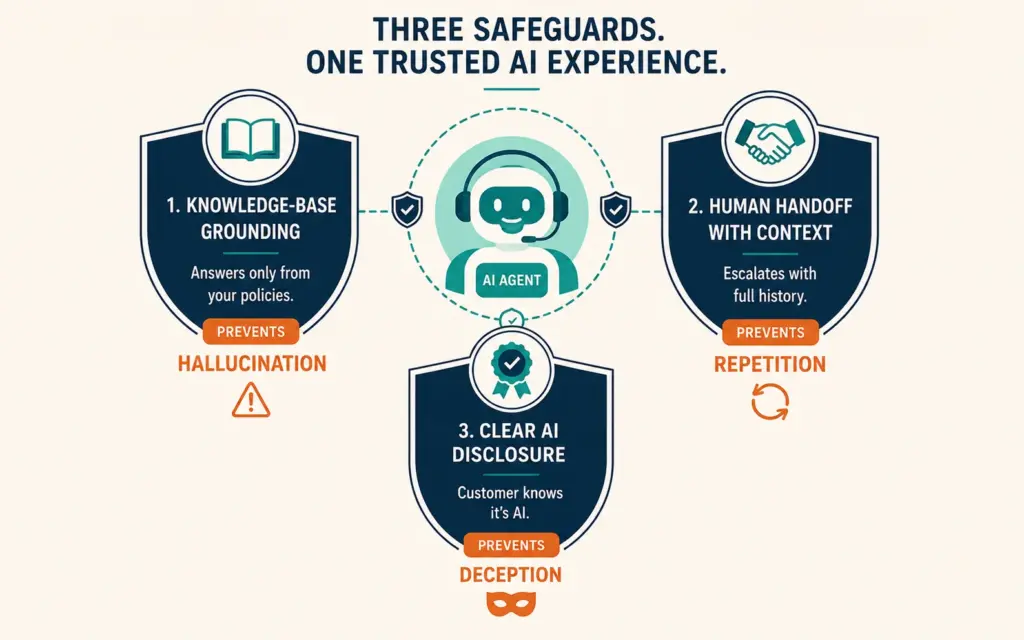
An AI agent that confidently gives wrong information (invents a return policy, promises a refund it can’t process, states incorrect shipping times) damages trust worse than no AI at all. Three safeguards:
Knowledge-base grounding. The agent should answer only from your actual policies, product data, and help content, not from general training. Grounding prevents the agent from inventing answers. When it doesn’t know, it should say so or escalate, not guess.
Human handoff with context. When the agent can’t resolve an issue, it must escalate to a human with the full conversation and relevant order data attached. A handoff that forces the customer to repeat everything erases the efficiency gain and frustrates them.
Clear AI disclosure. Customers should know they’re talking to an AI agent. Transparency builds trust; discovering they were deceived destroys it. The best implementations are upfront about the AI while making it capable enough that customers prefer it for speed. The ecommerce customer retention impact of support quality is direct: fast, accurate resolution builds loyalty, while frustrating AI interactions drive customers away.
Measuring AI Customer Service Success
Judge any AI customer service tool on one number after 90 days: how many tickets it resolved without a human. That resolution rate is what turns support from a cost center into recovered capacity. A tool resolving 40 to 60% of tickets autonomously frees your human team to handle the complex 40 to 60% that genuinely needs them.
Supporting metrics: resolution time (AI should resolve in seconds to minutes versus hours for human queues), CSAT on AI-handled tickets (should match or exceed human-handled tickets for routine issues), escalation rate (what percentage the AI correctly identifies as needing human help), and cost per resolution (should decline as AI handles more volume). The predictive analytics capabilities in modern support tools can also flag at-risk customers based on support sentiment, feeding your retention efforts. Track these in your ecommerce KPIs dashboard alongside sales metrics since support quality directly affects repeat purchase rates. Set a baseline before deploying AI (current resolution time, cost per ticket, CSAT) so you can measure the actual improvement rather than relying on the vendor’s marketing claims. Review the resolution rate monthly and expand the AI’s scope gradually: start it on the highest-volume, lowest-risk ticket types (order status), then extend to returns and refunds once it proves reliable on the simpler cases.
Frequently Asked Questions
A chatbot assists: it answers questions and drafts replies but a human completes the actual task. An AI agent acts: it reads order data, processes refunds, edits orders, and resolves issues end to end inside your commerce platform, escalating to a human only when needed. For “where is my order?”, a chatbot points to a tracking page; an agent reads the status and fixes the problem if there is one. In 2026, agents deliver dramatically more value because they resolve rather than just respond.
Around 30% of customer service interactions were handled by AI in 2025, projected to reach roughly 50% by 2027. For ecommerce, well-implemented AI agents resolve 40 to 60% of tickets autonomously, concentrated in the repetitive middle: order status, returns, refunds, order edits, shipping questions, and sizing. The complex, emotional, or unusual cases still need humans. AI handles the volume; humans handle the nuance.
For small to mid-size Shopify stores, Tidio with its Lyro AI agent combines live chat and AI resolution in one tool with fast setup. For high-volume Shopify stores, Gorgias offers deeper order-action integration. The right choice depends on your ticket volume and how much you need the AI to act (process refunds, edit orders) versus assist (answer questions). Evaluate on commerce platform integration depth, resolution capability, pricing structure, and time to value.
Not if implemented well. Fast, accurate AI resolution of routine issues (seconds instead of the 18.6-hour average) improves experience. Problems arise from poor implementation: hallucinated answers, no human handoff, or forcing customers to repeat information. Safeguard with knowledge-base grounding (AI answers only from your real policies), context-preserving human handoff, and clear AI disclosure. Done right, customers prefer AI for routine issues because it’s faster than waiting for a human.
The primary metric is resolution rate: how many tickets the AI resolves without a human after 90 days. A tool resolving 40 to 60% autonomously is delivering real value. Supporting metrics: resolution time (seconds/minutes vs hours), CSAT on AI-handled tickets (should match human-handled for routine issues), escalation accuracy (correctly identifying what needs a human), and cost per resolution. If resolution rate is low and escalations are high, the tool isn’t integrated deeply enough to act.
Three safeguards: knowledge-base grounding (the AI answers only from your actual policies, product data, and help content, not from general training), human handoff with full context when the AI is uncertain, and clear escalation rules so the AI knows when not to respond. An agent that says “let me connect you with a specialist” when unsure is better than one that confidently invents a return policy. Test the AI thoroughly on edge cases before deploying it to real customers.
Related Reads
- AI Tools for Ecommerce
- Ecommerce Automation
- Standard Operating Procedures
- Outsourcing Guide
- Ecommerce Customer Retention
- Predictive Analytics
Enjoying this? Get more like it every week.
One email per week with ecommerce strategies, tool picks, and seller insights. No spam.