
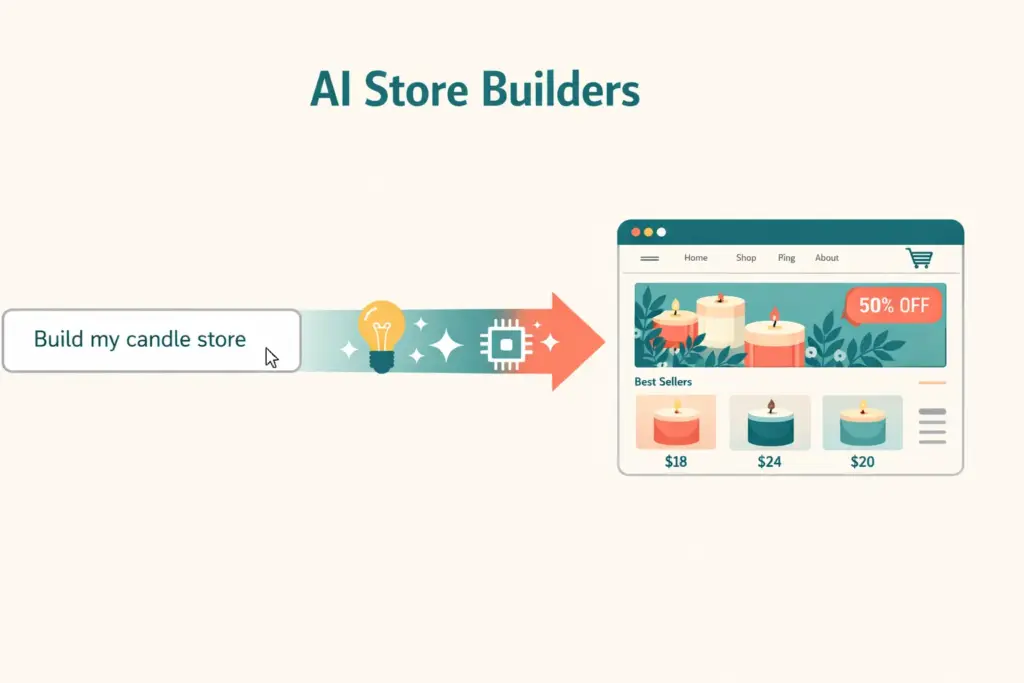
- AI store builders generate a functional online store, including design layout, product page structure, navigation, and basic copy, from a text description of your business in minutes rather than days. They dramatically reduce the time from "I want to sell online" to "I have a working store."
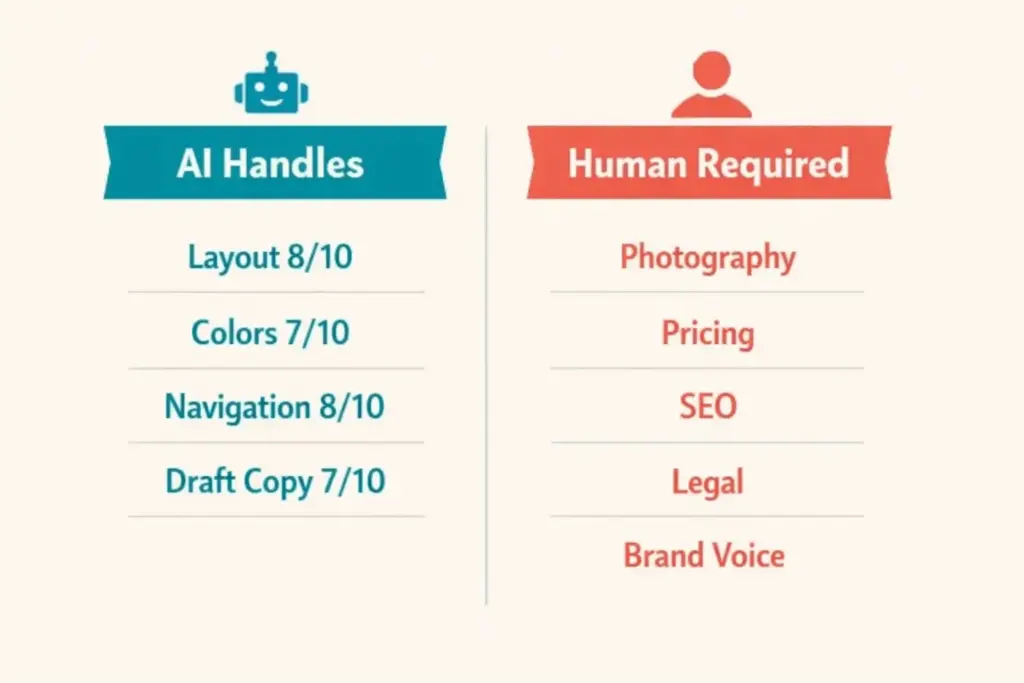
- What AI does well: theme selection and customization, page layout, navigation structure, basic product descriptions, color scheme and typography, and placeholder content. What AI still requires human work: product photography, brand voice refinement, pricing strategy, SEO optimization, and payment/shipping configuration.
- Best AI store builders: Shopify Magic (best overall for ecommerce, integrated into the strongest platform), Wix ADI (best for design quality), Hostinger AI Website Builder (best budget option), and 10Web (best for WordPress/WooCommerce users).
- AI builds a 70% store in 10 minutes. The remaining 30%, the parts that actually differentiate your brand and convert visitors, still requires human attention. Think of AI store builders as a fast foundation, not a finished product.
An ai store builder is a tool that uses artificial intelligence to generate an online store’s design, layout, product pages, navigation, and content based on a text description of your business, category, products, and preferences, producing a functional ecommerce website in minutes that would traditionally take days or weeks to build manually.
The promise is compelling: describe your business, let AI build the store, start selling. The reality is more nuanced. AI store builders have reached the point where they produce genuinely usable foundations, not just template demos. But “usable foundation” is not “finished store.” Understanding what AI handles well and what still needs your attention is the difference between launching quickly and launching with a store that actually converts.
This guide tests and compares six ai ecommerce store builder options, evaluates what they produce, and covers the human work that bridges the gap between AI-generated and revenue-generating. For the full platform comparison beyond AI features, our ecommerce platform guide covers all platforms.
6 AI Store Builders Compared
| Tool | Platform | Monthly Cost | What AI Generates | Best For |
|---|---|---|---|---|
| Shopify Magic | Shopify | $39/mo (Shopify plan) | Product descriptions, email copy, store name suggestions, image editing | Serious ecommerce sellers |
| Wix ADI | Wix | $17-32/mo | Complete site design, page layout, content, images | Design-first small stores |
| Hostinger AI | Hostinger | $3-7/mo | Full website from text prompt, pages, layout | Budget-conscious beginners |
| 10Web | WordPress | $10-60/mo | WordPress + WooCommerce site from prompt | WordPress/WooCommerce users |
| Durable | Standalone | $15-25/mo | Complete business site in 30 seconds | Service businesses adding products |
| Jimdo Dolphin | Jimdo | $0-15/mo | Site from questionnaire answers | Simple micro-stores |
Detailed Reviews
Shopify Magic: Best for Real Ecommerce
Shopify integrates AI throughout its platform rather than offering a single “build my store” button. Shopify Magic includes: AI-generated product descriptions (enter product specs, get selling copy), AI email subject lines and body copy, AI-suggested store names, and AI image editing (background removal, image enhancement).
What it does: Generates product descriptions from bullet points, writes email marketing copy, suggests SEO-friendly page titles, and edits product images. The AI works within Shopify’s admin as you build, assisting each step rather than generating the entire store at once.
What it doesn’t do: Shopify Magic doesn’t design your entire store from a text prompt. You still choose a theme, arrange sections, and configure settings. The AI assists with content generation within an existing structure rather than creating the structure itself.
Quality assessment: Product descriptions are 7-8/10 with editing. Email copy is 7/10. Image editing is 8/10. Shopify Magic’s strength is integration depth, not generation scope. The AI improves every task without pretending to replace the builder entirely.
Best for: Sellers building a real ecommerce business who want AI to speed up content creation within the strongest ecommerce platform. Not for people wanting a one-click store.
Wix ADI: Best for Design Quality
Wix’s Artificial Design Intelligence creates a complete website from answers to a questionnaire: business type, style preferences, features needed, and content. The result is a visually polished site with layout, images, and placeholder content ready for customization.
What it does: Generates a full multi-page website with appropriate sections (hero, features, products, about, contact), selects and places stock images, creates a color scheme and typography pairing, and structures navigation logically.
Quality assessment: Design quality is 8/10, the highest of any AI builder. The generated sites look professional and thoughtfully designed. Content quality is 6/10 (generic placeholder text that needs replacing). Ecommerce functionality is 6/10 (basic store setup, requires manual product configuration).
Best for: Small stores under 50 products where visual design matters more than ecommerce depth. Our Squarespace review covers an alternative for design-focused sellers who want more ecommerce features.
Hostinger AI Website Builder: Best Budget Option
Hostinger’s AI builder generates a complete website from a single text prompt describing your business. Type “I sell handmade candles with natural ingredients” and it produces a multi-page site with relevant sections, images, and copy.
Quality assessment: Design quality 7/10 (clean, modern, but less polished than Wix ADI). Content quality 6/10 (workable drafts). Ecommerce features 5/10 (basic store, limited compared to Shopify or WooCommerce). At $3-7/month, it’s the cheapest entry point.
Best for: Absolute beginners testing whether selling online is right for them before committing to a full platform. Good for validation, not for scaling.
10Web: Best for WordPress/WooCommerce
10Web generates a full WordPress website with WooCommerce integration from a text prompt. The result is an actual WordPress site with theme, pages, and plugin configuration, not a proprietary platform.
Quality assessment: Design 7/10, Content 6/10, Ecommerce 7/10 (full WooCommerce with all its capabilities). The main advantage: you get a WordPress/WooCommerce site, which means unlimited customization potential after the AI generates the foundation.
Best for: Users who want WooCommerce’s power and flexibility but don’t want to start from a blank WordPress installation. The AI handles the intimidating initial setup, and you customize from there.
What AI Builds Well vs What Needs Human Work
| Element | AI Quality | Human Work Needed |
|---|---|---|
| Page layout and structure | 8/10 | Minor arrangement tweaks |
| Color scheme and typography | 7/10 | Brand color adjustments |
| Navigation | 8/10 | Category naming and hierarchy |
| Product descriptions | 7/10 | Brand voice editing, accuracy check |
| Product photography | N/A | 100% human (AI generates placeholders) |
| Pricing strategy | N/A | 100% human |
| SEO optimization | 4/10 | Keyword research, meta tags, schema |
| Payment and shipping config | 3/10 | Manual setup required |
| Legal pages | 5/10 | Legal review essential |
| Brand storytelling | 4/10 | Complete rewrite for authenticity |
The pattern: AI excels at structural decisions (layout, navigation, design) and produces acceptable first drafts of content. It falls short on anything requiring business-specific knowledge (pricing, legal compliance, brand voice) or physical assets (photography). Plan for 2-4 hours of human refinement after AI generates the foundation.
Should You Use an AI Store Builder?
Use an AI builder when:
- You want a store live in days instead of weeks
- You’re testing a business idea and need minimum viable infrastructure fast
- Design isn’t your strength and you need a professional-looking starting point
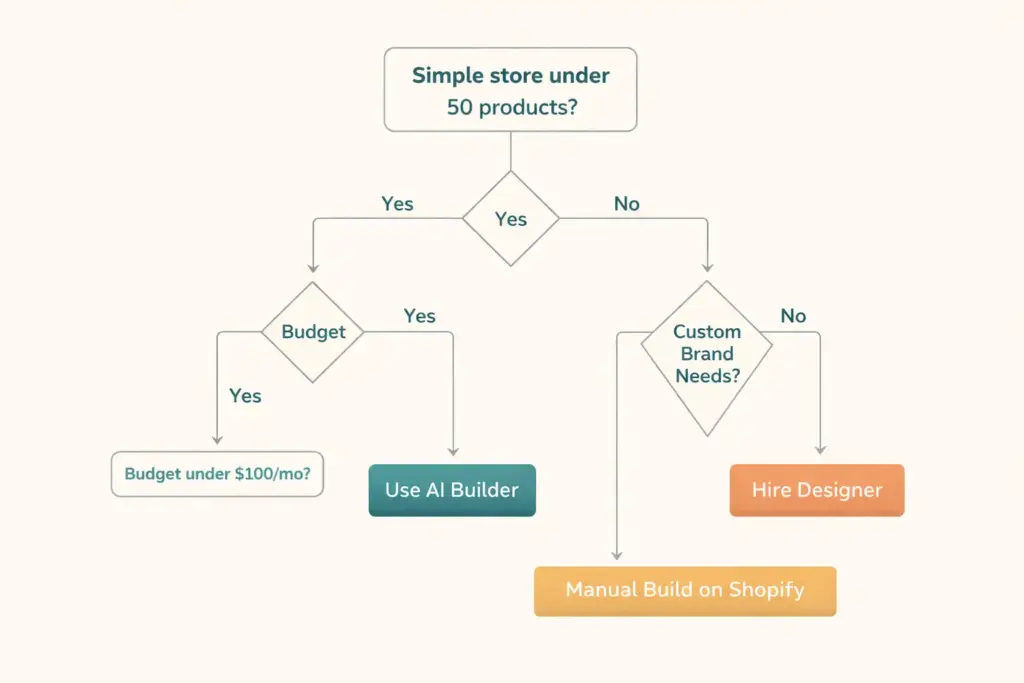
- You’re building a small store (under 50 products) and don’t need complex functionality
Skip the AI builder and build manually when:
- You have a strong brand identity that requires custom implementation
- You need complex store functionality (subscriptions, B2B pricing, multi-language)
- You’re building on WooCommerce and want full control from day one
- Your product category requires specialized page layouts (configurators, size finders)
The honest assessment: AI store builders save 60-70% of initial setup time for simple stores. For complex ecommerce operations, they save maybe 20-30% because the customization needed after AI generation takes nearly as long as building from scratch would. The value is inversely proportional to complexity.
For the post-AI-generation optimization, our web design guide covers making any store look professional, our technical SEO guide handles the SEO gaps AI builders leave, and our product page guide covers the conversion optimization that turns a basic store into a revenue-generating one. Budget considerations are covered in our startup costs guide.
Frequently Asked Questions
Shopify Magic is the best ai store builder for serious ecommerce because it integrates AI content generation into the strongest ecommerce platform. For design-first stores, Wix ADI produces the most visually polished results. For budget-conscious beginners, Hostinger AI ($3-7/mo) offers the cheapest functional starting point. For WordPress users, 10Web generates full WooCommerce sites from text prompts.
AI builds approximately 70% of a functional store: design, layout, navigation, and draft content. The remaining 30% requires human work: product photography, brand voice refinement, pricing strategy, payment/shipping configuration, SEO optimization, and legal page review. Think of AI as generating a strong foundation that still needs finishing work before it’s ready to sell effectively.
Hostinger AI starts at $3-7/month (cheapest). Wix ADI costs $17-32/month. Shopify with Magic costs $39/month (the AI features are included in standard Shopify plans). 10Web costs $10-60/month. Durable costs $15-25/month. The AI builder itself doesn’t add cost beyond the platform’s standard pricing. You’re paying for the platform with AI as an included feature.
Yes, after human refinement. The AI-generated foundation is functional and professional-looking. But selling effectively requires adding real product photography, editing AI-generated copy for brand voice and accuracy, configuring payments and shipping, optimizing for SEO, and testing the checkout flow. Plan for 2-4 hours of refinement after AI generation before your first sale.
Use an AI builder if you have a simple store (under 50 products), limited budget, and need to launch quickly. Hire a designer if you have a strong brand identity requiring custom implementation, complex functionality needs, or a budget of $2,000+ for professional design. A middle path: use AI to generate the foundation, then hire a designer for 2-3 hours of refinement at $50-100/hour.
Shopify Magic is built directly into Shopify and is the only AI tool that works natively within the Shopify admin. It generates product descriptions, email copy, and image edits. For a more complete AI store generation experience on Shopify, third-party tools like Shogun AI and PageFly AI create AI-generated landing pages and product page layouts within Shopify’s framework.
Related Reads
- Best Ecommerce Platform Comparison
- How to Sell on Shopify
- Ecommerce Web Design Guide
- AI Automation for Ecommerce
- AI Tools for Ecommerce
- Ecommerce Startup Costs
Enjoying this? Get more like it every week.
One email per week with ecommerce strategies, tool picks, and seller insights. No spam.