
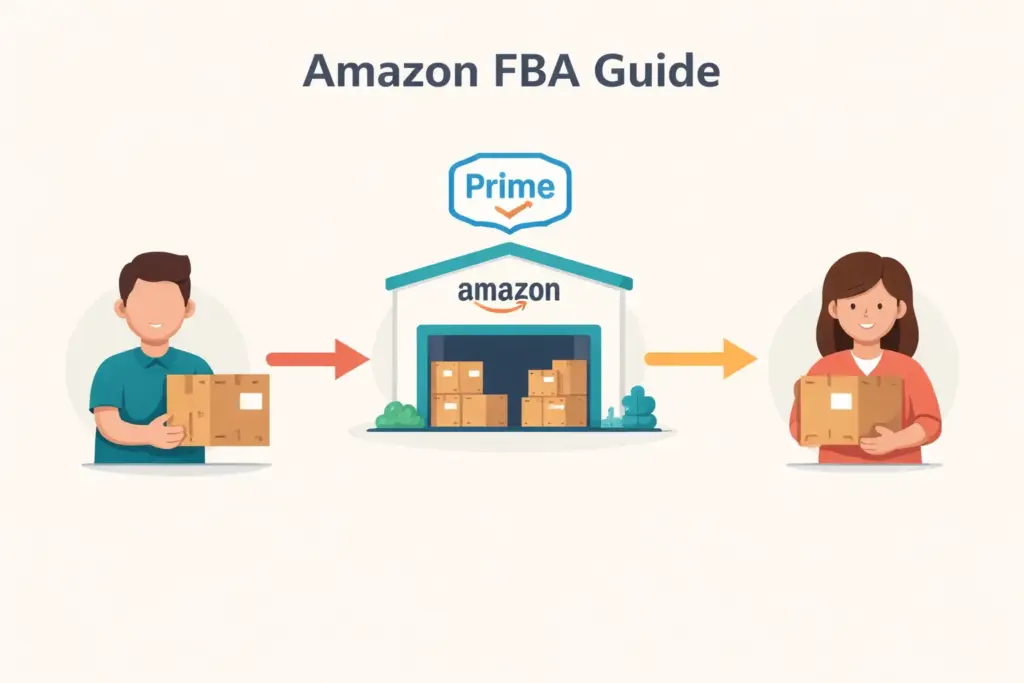
- Amazon FBA (Fulfillment by Amazon) means you send your products to Amazon's warehouses, and they handle storage, picking, packing, shipping, customer service, and returns. You focus on product selection, listing optimization, and marketing while Amazon handles the logistics.
- FBA fees include a referral fee (8-15% depending on category), a fulfillment fee ($3.22-$6.00+ per standard unit), and monthly storage fees ($0.87-2.40 per cubic foot depending on season). On a $25 product, total Amazon fees typically run $8-12, leaving $13-17 for product cost and profit.
- The Professional seller account costs $39.99/month (required for FBA). Individual accounts ($0.99 per sale) don't support FBA features like advertising and bulk listing tools. The Professional plan pays for itself at 40+ sales per month.
- FBA sellers get the Prime badge, which dramatically increases conversion rates. Prime members spend an average of $1,400/year versus $600 for non-Prime members, and the Prime badge signals fast, free shipping that buyers trust.
Amazon FBA (Fulfillment by Amazon) is a service where sellers send inventory to Amazon’s fulfillment centers, and Amazon stores, picks, packs, ships, and handles customer service and returns for every order. You source the products and create the listings. Amazon does everything between the customer clicking “Buy” and the package arriving at their door. Your products also qualify for Prime shipping, which is the single biggest conversion advantage on the platform.
With over 300 million active customer accounts and 200+ million Prime members globally, Amazon is the largest product search engine on the internet. More product searches start on Amazon than on Google. If you’re selling physical products online and you’re NOT on Amazon, you’re ignoring the largest buyer pool available.
This guide covers how FBA works, what it actually costs with real numbers, how to find and launch your first product, and the mistakes that sink most new sellers. If you’re still deciding between selling on Amazon versus building your own store, our business model comparison and platform guide cover that decision.
How Amazon FBA Works: The Process
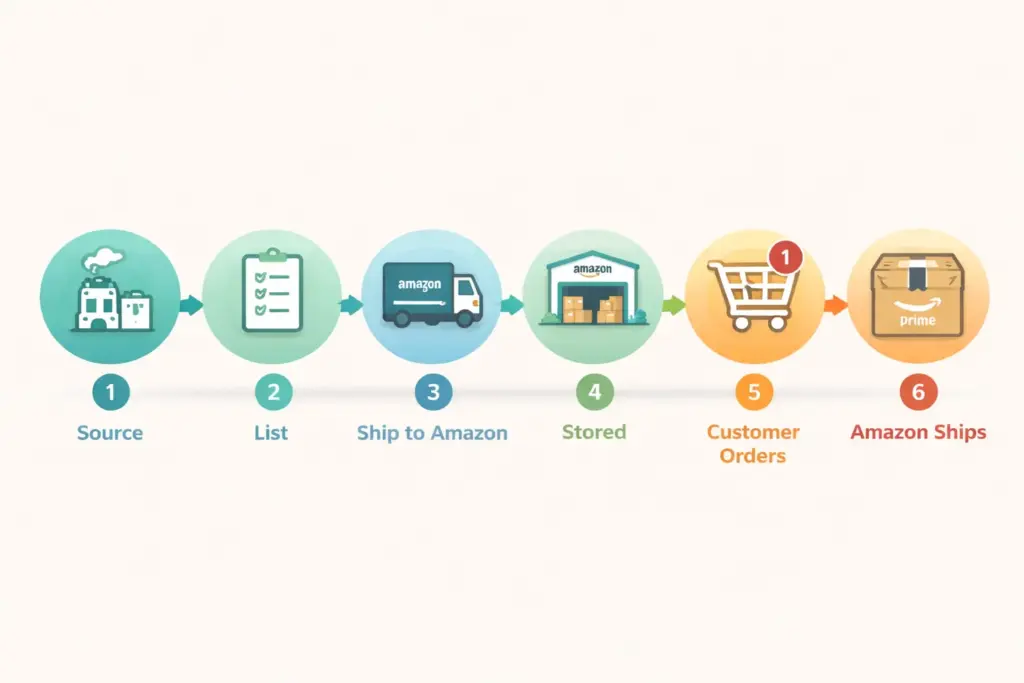
The FBA workflow has six steps:
- Source products. Find products to sell through private label manufacturing, wholesale purchasing, or retail/online arbitrage.
- Create your Amazon listing. Product title, bullet points, description, images, and backend keywords. If the product already exists on Amazon, you join the existing listing.
- Ship inventory to Amazon. Prepare products according to Amazon’s labeling and packaging requirements, then ship to the fulfillment center Amazon designates.
- Amazon stores your products. Inventory sits in Amazon’s warehouse until a customer orders.
- Customer orders. Amazon picks, packs, and ships the product with Prime two-day delivery. Your listing shows the Prime badge.
- Amazon handles post-sale. Customer service, returns, and refunds are managed by Amazon’s team.
You monitor sales, manage inventory levels (sending replenishment shipments before stock runs out), optimize listings, and run advertising campaigns. Everything physical is Amazon’s job.
Amazon FBA Fees: Real Cost Breakdown
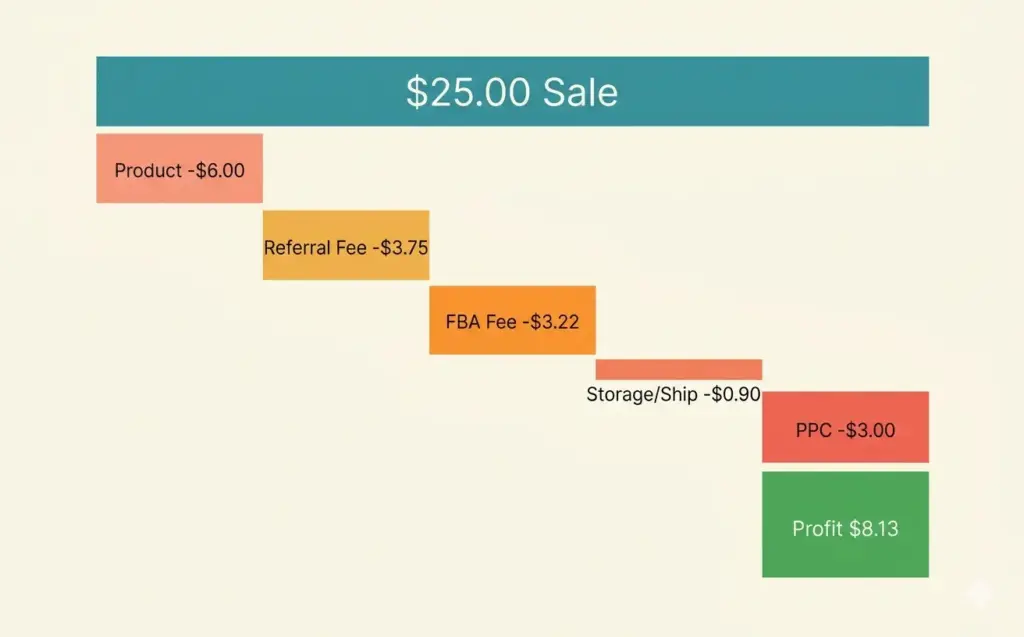
Understanding amazon fba fees is critical because they determine whether your product is profitable before you invest in inventory. Here are all the fees on a typical $25 product:
| Fee Type | Amount | Example ($25 product, 1 lb, standard size) |
|---|---|---|
| Referral fee | 8-15% (category dependent) | $3.75 (at 15%) |
| FBA fulfillment fee | $3.22-$6.00+ (size/weight) | $3.22 (small standard) |
| Monthly storage fee | $0.87-$2.40/cubic ft | ~$0.15 (small item) |
| Inbound shipping to Amazon | Varies by carrier | ~$0.50-1.00/unit |
| Total Amazon fees | ~$7.62-8.12 |
Now add your product cost. If you source at $6 per unit:
| Line Item | Amount |
|---|---|
| Selling price | $25.00 |
| Product cost | -$6.00 |
| Amazon fees (all-in) | -$8.12 |
| PPC advertising (estimated) | -$3.00 |
| Net profit per unit | $7.88 (31%) |
31% margin is healthy for FBA. The viability threshold: products need at least a $10 selling price, 3x markup over product cost, and a size/weight that keeps fulfillment fees under $5. Products under $15 selling price struggle to maintain margins after all fees. Our pricing strategy guide covers the full calculation methodology.
How to Start an Amazon FBA Business: Step by Step
Step 1: Create Your Amazon Seller Account
Register at sell.amazon.com. Choose the Professional plan ($39.99/month) which is required for FBA sellers who want advertising access, bulk listing tools, and Buy Box eligibility. You’ll need: business email, phone number, government ID, tax information (SSN or EIN), and a bank account for payouts.
Step 2: Product Research
This step determines your success more than anything else. The amazon fba for beginners mistake is choosing products based on personal interest rather than data. Use these criteria:
- Price range: $15-50 selling price (enough margin after fees, not so expensive that buyers hesitate)
- Size/weight: Small and light (under 2 lbs, fits in a shoebox) to minimize fulfillment fees
- Demand: BSR 1,000-50,000 in the main category (enough sales volume to be worthwhile)
- Competition: Top sellers have under 500 reviews (room for a new entrant to compete)
- Margin: 3x minimum markup from product cost to selling price
- Not dominated by major brands: Avoid categories where Nike, Apple, or other household names control page one
Our product research guide and low competition products article cover research methods in depth. Tools like Jungle Scout, Helium 10, and AMZScout provide BSR data, estimated sales volume, and competitor analysis.
Step 3: Source Your Product
Three sourcing models for FBA:
Private label (most common for serious FBA sellers): Find a manufacturer on Alibaba who makes a product similar to what you want. Customize it with your branding, packaging, and any product improvements. Order 500-1,000 units for your first batch. Cost: $2,000-5,000 for initial inventory plus $500-1,000 for branding and packaging design.
Wholesale: Buy existing branded products at wholesale prices from authorized distributors. No product customization but less risk because you’re selling products with proven demand. Our wholesale suppliers guide covers how to find authorized distributors.
Retail/online arbitrage: Buy discounted products from retail stores or other online retailers and resell on Amazon at a markup. Lowest startup cost but least scalable and Amazon has tightened restrictions on selling certain brands without authorization.
Step 4: Create Your Product Listing
Your listing is your salesperson. It needs to convince both Amazon’s search algorithm AND human buyers.
Title: Include primary keyword, brand name, key features, size/quantity. Amazon allows up to 200 characters. Front-load the most important keywords. Example: “Brand Name Organic Cotton T-Shirt for Men | Crew Neck | Preshrunk | 5 Colors | S-XXL”
Bullet points (5): Each bullet starts with a capitalized benefit, followed by supporting details. Focus on what the customer gets, not just product specs. “STAYS SOFT AFTER 50+ WASHES” beats “Made from 100% organic cotton.”
Product images (7-9): Main image on white background (Amazon requirement). Lifestyle images showing the product in use. Infographic images highlighting key features and dimensions. Comparison images versus competitors. Size chart image if applicable.
Backend keywords: 250 bytes of hidden search terms that help Amazon’s algorithm find your listing. Include synonyms, alternate spellings, Spanish keywords, and related search terms not in your visible listing.
Step 5: Ship to Amazon (FBA Inbound)
In Seller Central, create a shipping plan specifying which products and quantities you’re sending. Amazon assigns a fulfillment center destination. Label each unit with an FNSKU barcode (Amazon’s unique product identifier). Pack according to Amazon’s requirements (box weight limits, prep requirements for certain categories). Ship via your chosen carrier or use Amazon’s partnered carriers for discounted rates.
First-time sellers often underestimate prep requirements. Poly-bagging, bubble wrapping, suffocation warnings on bags, and correct labeling are all mandatory depending on your product type. Non-compliant shipments get rejected or incur prep fees.
Step 6: Launch and Optimize
Once inventory is received and your listing is live:
- Turn on PPC advertising. Start with an automatic campaign at $10-20/day to discover which search terms convert. After 2 weeks of data, create manual campaigns targeting your best-performing keywords.
- Generate initial reviews. Enroll in Amazon Vine (costs $200 for up to 30 reviews) or use the “Request a Review” button on each order. Never buy fake reviews; Amazon’s detection is sophisticated and penalties include permanent suspension.
- Monitor and adjust. Track your ACOS (Advertising Cost of Sale), conversion rate, and organic ranking. Adjust pricing, PPC bids, and listing copy based on data. The first 90 days are about gathering data and optimizing, not necessarily profitability.
FBA vs FBM: When to Use Each
| Factor | FBA (Fulfillment by Amazon) | FBM (Fulfillment by Merchant) |
|---|---|---|
| Shipping speed | Prime 1-2 day delivery | You set delivery times (3-7 days typical) |
| Customer service | Amazon handles | You handle |
| Storage | Amazon warehouse | Your storage |
| Prime eligibility | Automatic | Seller Fulfilled Prime (hard to qualify) |
| Fees | Higher (fulfillment + storage) | Lower (just referral fee) |
| Buy Box advantage | Strong advantage | Harder to win |
| Best for | Most products, especially fast-moving items | Large/heavy items, slow sellers, handmade goods |
Use FBA for your main products, especially anything that sells 10+ units per month. Use FBM for oversized items where FBA storage fees would destroy margins, very slow sellers where long-term storage fees accumulate, or handmade/custom products that ship directly from your workshop.
Common Amazon FBA Mistakes
Choosing products based on passion instead of data. “I love yoga so I’ll sell yoga mats” ignores that the yoga mat market is dominated by established brands with thousands of reviews. Use research tools, not personal interests, to select products.
Underestimating total costs. Product cost plus Amazon fees plus PPC plus photography plus samples plus shipping to Amazon. Many beginners budget only for inventory and are surprised when fees consume their margins. Calculate ALL costs before ordering inventory.
Ordering too much inventory first batch. Start with 200-500 units, not 2,000. Your first product might not sell as expected. A $3,000 lesson hurts less than a $15,000 one. Scale up after you’ve validated demand and optimized your listing.
Ignoring PPC from day one. New listings have zero organic ranking. Without advertising, Amazon’s algorithm doesn’t know your product exists. Budget $10-30/day for PPC during your launch period. It’s not optional spending; it’s the cost of visibility on the world’s largest product marketplace.
Poor listing quality. Generic photos, copied manufacturer descriptions, and keyword-stuffed titles signal “cheap product” to buyers. Invest in professional photography ($200-500 for a complete image set) and hire a listing copywriter ($100-300) if writing isn’t your strength. The listing is your only sales pitch. Make it count.
Frequently Asked Questions
Realistic startup costs for Amazon FBA include a $39.99/month seller account, $2,000–5,000 for your first inventory batch (private label), $200–500 for product photography, $200–500 for samples and shipping, and $300–500 for initial PPC advertising. Total investment typically ranges from $3,000 to $7,000 for a proper private label launch. Wholesale and arbitrage models can start lower, around $500–2,000.
Start by creating a Professional seller account, then research products using BSR data and competition analysis. Source products from Alibaba or wholesale suppliers, create an optimized listing with high-quality images, and ship inventory to Amazon’s fulfillment centers. Launch your product using PPC advertising. The full process from setup to first sale typically takes 2–4 months for private label products.
For a $25 standard-size product weighing about 1 lb, fees include a referral fee of roughly $3.75 (15%), a fulfillment fee of about $3.22, monthly storage around $0.15, and inbound shipping near $0.75. Total Amazon fees come to approximately $7.87 per unit (31.5% of the selling price). Products priced under $15 often struggle to maintain profitability after these fees.
Yes, Amazon FBA can still be profitable, but it requires stronger product research and marketing than in the past. Successful sellers typically achieve 25–40% net margins on well-researched private label products. Profitability depends on avoiding saturated niches, investing in listing quality, and managing PPC campaigns effectively. Treating FBA as a real business is essential for consistent results.
The best FBA products usually fall in the $15–50 price range, are small and lightweight (under 2 lbs), have a BSR between 1,000 and 50,000, and face limited competition (top listings under 500 reviews). A 3x markup from cost is ideal, and avoiding categories dominated by major brands is key. Popular categories include home and kitchen, health and beauty, pet supplies, and baby products.
FBA (Fulfillment by Amazon) means Amazon stores, packs, ships, and handles customer service for your products, and your listings are eligible for Prime. FBM (Fulfillment by Merchant) means you handle storage, shipping, and customer service yourself. While FBA has higher fees, it typically results in better conversion rates and higher chances of winning the Buy Box due to Prime eligibility.
Related Reads
- Best Selling Products Research
- High Demand Low Competition Products
- Private Label Products Guide
- Finding Wholesale Suppliers
- Amazon Dropshipping Guide
- Dropshipping vs Private Label vs Wholesale
Enjoying this? Get more like it every week.
One email per week with ecommerce strategies, tool picks, and seller insights. No spam.