

- A virtual assistant (VA) is a remote worker who handles repeatable, process-driven tasks for your ecommerce business: customer service, order processing, product listing, data entry, social media scheduling, and admin. A good VA typically frees 15 to 25 hours per week of founder time, which is why it's the most common first hire for growing ecommerce stores.
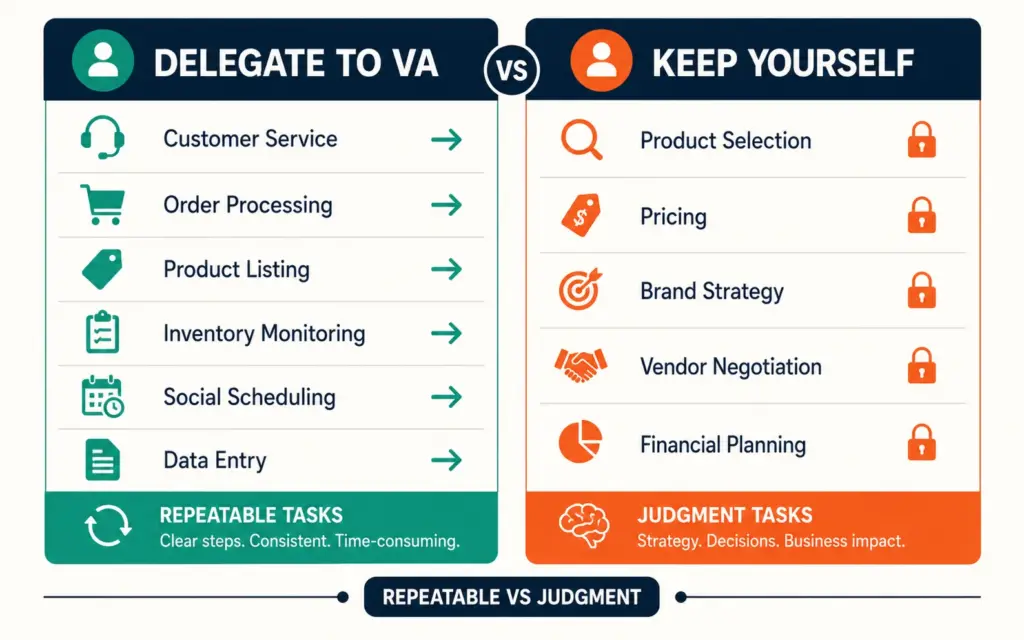
- Delegate the repeatable, documented tasks; keep the judgment tasks. Customer service, order and return processing, product uploads, inventory monitoring, social scheduling, and email management are VA-ready. Product selection, pricing, brand strategy, and vendor negotiation stay with you until you can afford experienced managers.
- Cost varies by location and experience: US-based VAs run $15 to $25/hour, while offshore VAs (Philippines, Latin America, India) run $5 to $12/hour. Many ecommerce founders start with an offshore VA part-time (10 to 20 hours/week) to test the working relationship before scaling hours.
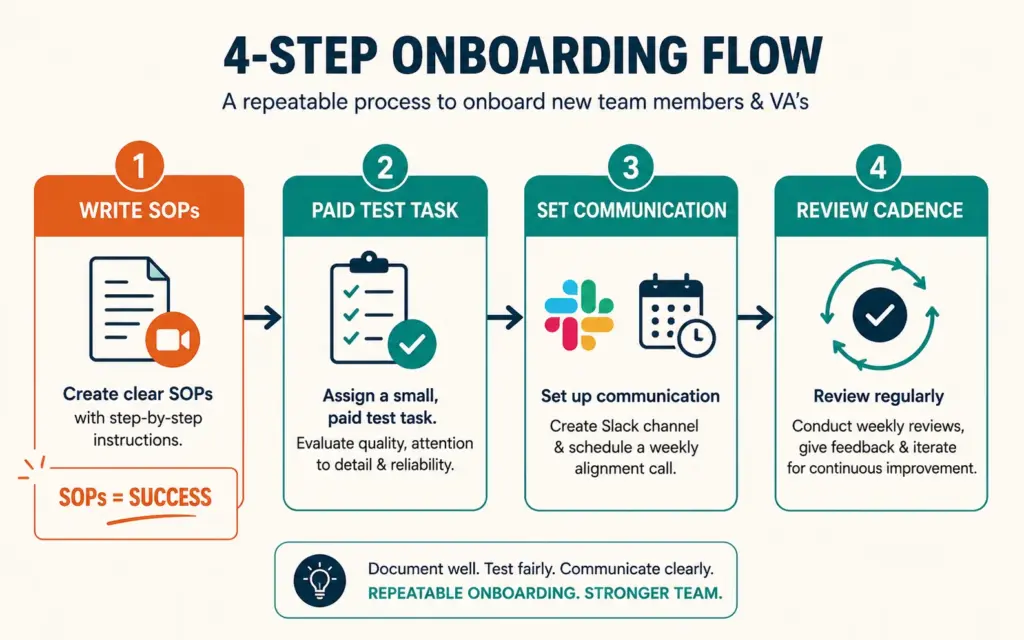
- The single biggest determinant of VA success is your SOPs. A VA handed a documented process with screen recordings and step-by-step instructions performs well from week one. A VA handed a vague "figure it out" mandate flounders and creates more work than they save. Write the process before you hire.
Virtual assistants are remote workers who take the repetitive, process-driven tasks off an ecommerce founder’s plate so the founder can focus on the work that actually grows the business. For most growing stores, a VA is the first hire, and for good reason: the founder doing everything hits a ceiling where customer emails, order processing, and admin consume the hours that should go to strategy, product development, and marketing. A VA breaks that ceiling by absorbing the repeatable work that doesn’t require your specific judgment, freeing your hours for the decisions only you can make.
The economics are compelling. A good VA frees 15 to 25 hours per week. At an offshore rate of $8/hour for 20 hours, that’s roughly $640/month to reclaim 80+ hours of founder time monthly. If your time is worth more than $8/hour applied to strategic work (it is), the math favors delegation as soon as your revenue supports it. This guide covers what to delegate, where to hire, what to pay, and how to onboard a VA without creating chaos. The hiring ecommerce team guide covers the broader hiring sequence; the VA is typically step one.
What to Delegate to a Virtual Assistant
The rule: delegate repeatable tasks with clear processes; keep judgment tasks that require your expertise. Run a time audit for one week, list every task, and sort them into these two buckets.
VA-Ready Tasks (Delegate These)
- Customer service: Responding to common inquiries, processing returns and refunds, updating customers on order status. The highest-volume time sink for most stores.
- Order processing: Fulfilling orders, generating shipping labels, tracking shipments, handling exceptions.
- Product listing: Uploading products, writing or formatting descriptions from templates, adding images, setting up variants.
- Inventory monitoring: Tracking stock levels, flagging low inventory, updating quantities.
- Social media scheduling: Posting pre-approved content, scheduling, basic community management.
- Data entry and admin: Spreadsheet updates, order reconciliation, basic reporting, email inbox management.
These tasks share a common trait: they follow a documented process and don’t require founder-level judgment. The standard operating procedures you write for each become the VA’s training manual. The order fulfillment process is a prime delegation candidate because it’s highly repeatable once documented.
Founder-Only Tasks (Keep These)
Product selection, pricing decisions, brand strategy, vendor and supplier negotiation, financial planning, and hiring decisions require context and judgment that can’t be captured in an SOP. These determine your business’s direction and stay with you until you can afford experienced managers to take specific pieces. Handing strategic decisions to someone without full business context, however capable they are at execution, tends to produce choices that look reasonable in isolation but don’t fit your broader positioning or margin structure. The sourcing manufacturers relationship, for example, is too strategic to hand to a VA in the early stages.
Where to Hire an Ecommerce Virtual Assistant
| Source | Type | Cost Range |
|---|---|---|
| Upwork / Fiverr | Freelance marketplaces, global | $5 to $25/hour |
| OnlineJobs.ph | Philippines-focused VA marketplace | $5 to $12/hour |
| Belay / Time Etc | US-based managed VA services | $18 to $30/hour |
| Specialized ecommerce VA agencies | Pre-vetted ecommerce VAs | $10 to $20/hour |
Offshore VAs (Philippines, Latin America, India) offer strong value at $5 to $12/hour and many have specific ecommerce and Shopify experience. The Philippines in particular has a large, English-proficient VA workforce experienced with Western ecommerce operations. According to Time Doctor’s VA hiring research, clearly defined tasks and a structured trial period are the strongest predictors of a successful long-term VA relationship. US-based VAs cost more ($15 to $30/hour) but offer timezone alignment and native English for customer-facing roles. Many founders use a hybrid: an offshore VA for back-office tasks and a US-based VA (or themselves) for customer-facing communication where timezone and native fluency matter. The outsourcing guide covers the full decision framework for what to outsource versus hire versus keep in-house.
How Much to Pay and How to Structure the Arrangement
Start part-time to test the relationship before committing to full-time. 10 to 20 hours/week lets you validate the VA’s reliability, communication, and quality while refining your SOPs. If it works, increase hours. If it doesn’t, you’ve limited your risk.
Payment structures: hourly (most common for VAs, pay for time worked), monthly retainer (fixed hours per month at an agreed rate), or per-task (for well-defined, repeatable tasks). Hourly works best when starting because it’s flexible. As the relationship matures and tasks become predictable, a monthly retainer provides stability for both sides. The financial planning and scaling model should include VA costs as a line item that scales with order volume, since more orders mean more customer service and fulfillment work to delegate.
Onboarding a VA: SOPs Are Everything
The difference between a VA who saves you time and a VA who costs you time is your documentation. A VA handed clear SOPs performs well from week one. A VA handed vague instructions creates errors, asks constant questions, and generates more work than they absorb.
Build SOPs Before You Hire
For each task you’ll delegate, document: the exact steps in order, the tools and logins needed, common scenarios and how to handle them, edge cases and when to escalate to you, and quality standards. Screen recordings (Loom is the standard tool) showing you performing the task are more effective than written instructions alone. A VA can watch you process a return three times and replicate it precisely. The standard operating procedures guide covers SOP structure in depth.
Start With a Paid Test Task
Before committing to ongoing hours, assign a small paid test task. This reveals their actual work quality, communication style, and ability to follow your SOPs. A VA who executes a test task cleanly and asks smart clarifying questions is worth hiring. One who ignores your instructions or delivers sloppy work at the test stage won’t improve with more responsibility. Pay fairly for the test task; asking someone to work for free signals a poor working relationship from the start and drives away the best candidates. A paid test of 2 to 3 hours costs little and tells you far more than any interview about how the person actually works, communicates, and handles ambiguity when they hit a step your instructions didn’t anticipate.
Set Clear Communication and Review Cadence
Establish how you’ll communicate (Slack, email, project management tool), how often you’ll check in (a weekly 30-minute call is standard), and how you’ll track their work (shared task board in Asana, Trello, or Notion). Don’t micromanage daily tasks. Set clear outcomes and review results weekly. The workflow automation tools can handle task assignment and progress tracking so your VA has a clear queue without constant direction from you.
Common Virtual Assistant Mistakes
Hiring before writing SOPs. If you can’t document a task, you can’t delegate it effectively. Write the process first, test it yourself, then hand it over. Hiring a VA to “figure things out” wastes both your time and theirs.
Delegating judgment tasks too early. A VA shouldn’t set your prices, choose your products, or negotiate with suppliers in the early stages. These require context they don’t have. Delegate execution, keep strategy.
Over-delegating customer-facing work without oversight. Customer service represents your brand voice. Give your VA templates, escalation rules, and clear brand voice guidelines. Review a sample of their customer interactions weekly, especially early on, to ensure quality and tone match your standards. The ecommerce customer retention impact of support quality means VA-handled customer service directly affects repeat purchase rates.
Not testing before committing. Skipping the paid test task and hiring full-time immediately is high-risk. A short paid trial reveals fit before you commit significant hours and money.
Poor timezone planning for customer-facing roles. If your VA handles customer service and works in a timezone 12 hours offset from your customers, response times may suffer. Match the VA’s working hours to your customers’ active hours for customer-facing roles, or use the offset advantage for overnight back-office work. According to Shopify’s virtual assistant guide, clear task documentation and a paid trial period are the two practices that most reliably predict a successful VA hire.
Frequently Asked Questions
VAs handle repeatable, documented tasks: customer service (responding to inquiries, processing returns), order processing and fulfillment, product listing and uploads, inventory monitoring, social media scheduling, data entry, and email management. Keep founder-only tasks (product selection, pricing, brand strategy, vendor negotiation) yourself. The test: if a task follows a documented process and doesn’t require your specific expertise, a VA can do it. If it requires judgment about your business’s direction, keep it.
US-based VAs cost $15 to $30/hour. Offshore VAs (Philippines, Latin America, India) cost $5 to $12/hour. Many ecommerce founders start with an offshore VA part-time (10 to 20 hours/week), spending $400 to $1,000/month to reclaim 40 to 80 hours of founder time monthly. Payment structures include hourly, monthly retainer, or per-task. Start hourly and part-time to test the relationship, then scale hours or move to a retainer as the arrangement proves out.
Options: Upwork and Fiverr (global freelance marketplaces), OnlineJobs.ph (Philippines-focused, strong for ecommerce VAs), Belay and Time Etc (US-based managed services), and specialized ecommerce VA agencies (pre-vetted). The Philippines has a large English-proficient VA workforce experienced with Western ecommerce. For customer-facing roles, prioritize timezone alignment and English fluency. For back-office tasks, offshore value is excellent. Always run a paid test task before committing.
SOPs are everything. Before hiring, document each task: exact steps, tools and logins, common scenarios, edge cases, escalation rules, and quality standards. Screen recordings (Loom) showing you perform the task work better than written instructions alone. Start with a small paid test task to verify quality and fit. Set clear communication channels, a weekly check-in cadence, and a shared task board. Review their work weekly early on. A VA with good SOPs performs well from week one.
For most ecommerce founders, yes. A VA handling customer service and order operations (the highest-volume repeatable tasks) frees 15 to 25 hours per week for strategic work only you can do. It’s lower risk than a full-time employee (no benefits, flexible hours, easy to adjust) and directly addresses the time bottleneck most founders hit. Make this hire when you’re spending 2+ hours daily on delegatable tasks and revenue consistently exceeds $10,000/month.
Three essentials: documented SOPs for every task (clear expectations), a project management tool (Asana, Trello, or Notion for task assignment and tracking), and a weekly 30-minute check-in to review work and address blockers. Don’t micromanage daily tasks. Set clear outcomes (“respond to all customer messages within 4 hours” or “process all returns same-day”) and review results weekly. Give feedback promptly and specifically. A well-managed VA becomes more valuable over time as they learn your business.
Related Reads
- Hiring Ecommerce Team
- Outsourcing Guide
- Standard Operating Procedures
- Order Fulfillment Process
- Workflow Automation Tools
- Financial Planning and Scaling
Enjoying this? Get more like it every week.
One email per week with ecommerce strategies, tool picks, and seller insights. No spam.