

- Etsy Ads promote your listings higher in Etsy search results on a cost-per-click basis. You set a daily budget ($1 to $25+ per day), choose which listings to advertise, and Etsy's algorithm decides when and where to show them. You can't set bids per keyword or choose specific search terms. Your listing's SEO (titles, tags, attributes) determines which searches trigger your ads.
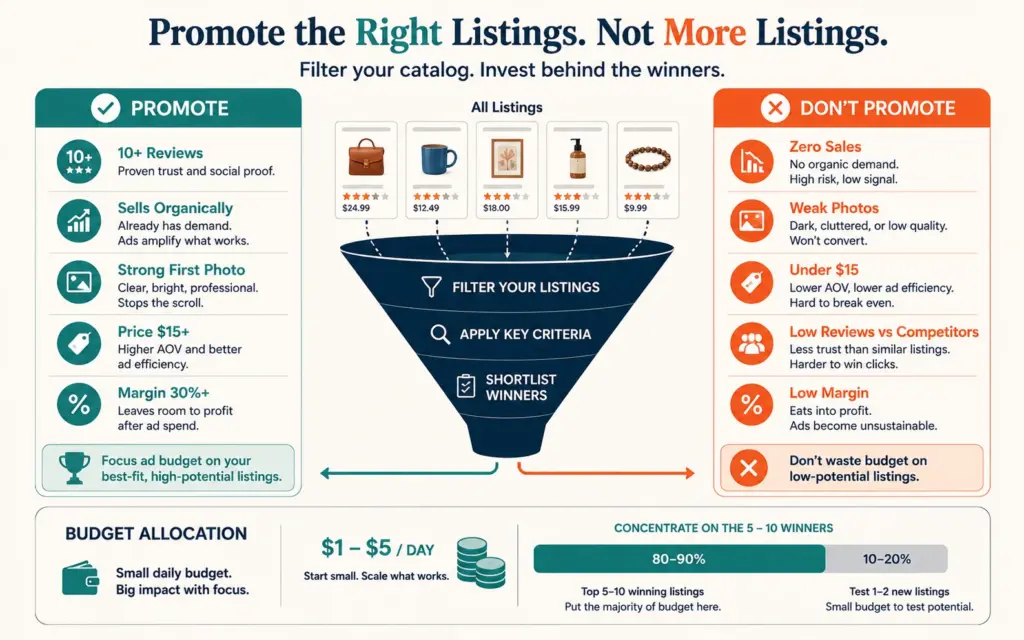
- The golden rule: only advertise listings that already sell organically. If a listing gets traffic from Etsy search and converts into sales without ads, it will convert with ads too. If a listing isn't selling organically, ads won't fix the underlying problem (weak photos, wrong price, low review count). Ads amplify performance. They don't create it.
- Start with $1 to $5 per day across your top 5 to 10 best-selling listings. Run for 30 days before judging results. Etsy's algorithm needs time to learn which placements convert for your specific products. Changing budget, listings, or titles too frequently resets the learning process.
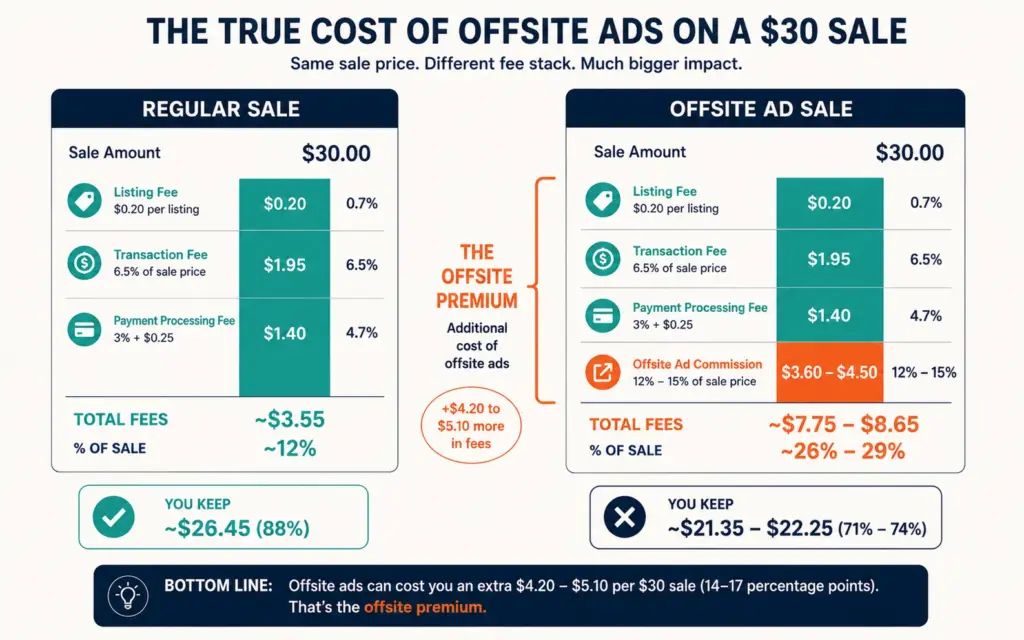
- Etsy Offsite Ads are a separate program. Etsy promotes your listings on Google, Facebook, and Pinterest. You pay 12 to 15% of the sale price only when a sale results from an offsite ad click within 30 days. Shops earning over $10,000/year cannot opt out. The commission stacks on top of regular Etsy fees, significantly impacting margins on ad-attributed sales.
This Etsy Ads guide covers the two advertising systems on Etsy, how they work, how much they cost, and how to use them without bleeding money on listings that aren’t ready for paid traffic. Etsy Ads (on-platform promoted listings) and Etsy Offsite Ads (external advertising on Google and social media) operate independently with completely different payment models. Most sellers conflate the two, which leads to confusion about costs and control.
The core principle is straightforward. According to Merch Titans’ Etsy Ads analysis, you should only run Etsy Ads on listings that already sell organically. If a listing converts from free Etsy search traffic, it will convert from paid traffic too. If a listing isn’t converting organically, throwing ad spend at it amplifies the loss, not the sales. Ads are an amplification tool, not a fix for a listing that isn’t working. The Etsy SEO guide covers the organic optimization that should happen before any ad spend.
How Etsy Ads Work: Budget, Bidding, and Listing Selection
Etsy Ads use a CPC (cost-per-click) model. You set a daily budget. Etsy shows your promoted listings in search results. You pay when someone clicks. CPC varies by niche: $0.10 to $0.20 in low-competition categories, $0.40 to $0.80 in competitive categories like personalized jewelry or wedding items.
The biggest limitation compared to Google or Meta ads: you cannot set keyword-level bids. Etsy’s algorithm decides which search queries trigger your ads based on your listing’s titles, tags, categories, and attributes. This means your listing SEO isn’t just an organic ranking factor. It’s your ad targeting. Weak titles and irrelevant tags cause your ads to appear for searches that don’t match your product, burning budget on clicks that will never convert.
Which Listings Should You Actually Promote With Etsy Ads?
Pull up your Etsy Stats. Identify your top 5 to 10 listings by revenue over the past 90 days. These are the listings with proven demand and conversion history. Promote these first. They’ve demonstrated that shoppers want to buy them. Ads simply put them in front of more shoppers.
Don’t promote: new listings with zero sales (no conversion data to build on), listings with poor photos (ads drive clicks, bad photos prevent purchases), listings priced below $15 (the CPC eats margin on low-price items), and listings in categories where your competitors have 500+ reviews and you have 5 (the click will happen but the conversion won’t because the buyer compares reviews before purchasing).
For each promoted listing, check: does it have 10+ reviews? Is the first photo scroll-stopping on mobile? Is the price competitive within Etsy search? Is the profit margin high enough that a $0.30 to $0.60 CPC still leaves profit after a sale? The Etsy pricing strategy should confirm that your per-unit margin can absorb the cost of 10 to 20 clicks per sale (typical Etsy conversion rate of 3 to 5% on ads).
Setting Your Daily Budget and Running the First 30 Days
Start at $1 to $5 per day total across all promoted listings. This is enough to generate data without significant risk. Etsy distributes your budget across your promoted listings based on which ones the algorithm thinks will perform best.
Run for 30 full days before making any decisions. Etsy’s algorithm takes time to learn which placements and search queries convert for your products. Sellers who change budgets, add or remove listings, or edit titles every 3 days prevent the algorithm from completing its learning cycle. Patience isn’t optional here. It’s the strategy.
After 30 days, evaluate each promoted listing individually in Etsy Ads Stats:
- ROAS above 3:1: The listing is profitable on ads. Increase its visibility by raising budget $1 to $2/day.
- ROAS 1:1 to 3:1: Breakeven to marginally profitable. Improve the listing (better photos, refined title/tags, competitive pricing) before increasing spend.
- ROAS below 1:1: Ads cost more than they generate. Remove this listing from ads. Fix the listing fundamentals or accept it’s not an ad-viable product.
The ROAS benchmarks for marketplace ads differ from DTC ad channels. Etsy buyers carry higher purchase intent than Facebook scrollers, so conversion rates are higher but CPC competition in hot categories pushes acquisition costs up.
Etsy Offsite Ads: The Program Most Sellers Misunderstand
Offsite Ads are a completely separate program from Etsy Ads. Etsy takes your listings and promotes them on Google, Facebook, Instagram, Pinterest, and Bing. You don’t choose which listings to promote, which platforms they appear on, or what the ads look like. Etsy handles everything.
The payment model: you pay nothing per click. Instead, Etsy charges a commission on any sale that results from an offsite ad click within 30 days. The commission rate: 15% of the total order value for shops earning under $10,000/year, 12% for shops earning $10,000+/year. This commission stacks on top of Etsy’s regular 6.5% transaction fee and 3% + $0.25 payment processing fee.
Total fees on an offsite-ad-attributed sale: $0.20 listing + 6.5% transaction + 3% + $0.25 processing + 12 to 15% offsite ad commission. On a $30 product, that’s approximately $7.75 to $8.65 in fees (26 to 29% of sale price). Compare that to $3.55 (12% of sale) on a non-offsite-ad sale. That 14 to 17% additional cost changes the profitability math significantly. The profit margin calculator should model both scenarios so you know your true margin on offsite-ad-attributed orders.
Can You Opt Out of Etsy Offsite Ads?
If your shop earned under $10,000 in the past 365 days: yes. Go to Settings > Offsite Ads > turn off. If your shop earned $10,000+ in the past year: no. Offsite Ads are mandatory. This is one of the most debated policies in the Etsy seller community because high-volume sellers can’t control whether 12% of their revenue on ad-attributed orders goes to Etsy for advertising they didn’t request.
The practical response: factor the offsite ad commission into your pricing. If 20% of your sales come through offsite ads (Etsy’s approximate attribution rate), your blended fee rate increases by about 2.5 to 3%. Price your products to maintain margin at this blended rate. According to StarterX’s Etsy Ads guide, the best approach is testing strong listings, tracking actual performance data, and scaling only when the numbers demonstrate profit after all fees including offsite ad commissions.
Optimizing Etsy Ads Performance Week Over Week
Weekly Review Rhythm That Keeps Budget Focused on Winners
Every week, spend 15 to 30 minutes reviewing your Etsy Ads dashboard:
- Check each promoted listing’s ROAS, clicks, orders, and spend for the past 7 days
- Pause any listing spending money with zero clicks (your thumbnail isn’t earning attention)
- Remove any listing with 30+ clicks and zero orders (clicks happen but the listing doesn’t convert)
- Check which search terms drive traffic in your Shop Stats > Search Analytics (this tells you whether your ads appear for relevant or irrelevant queries)
- If irrelevant searches are triggering your ads, refine your listing tags and title to better match buyer intent
Since Etsy doesn’t offer negative keywords, the only way to control which searches trigger your ads is through your listing’s SEO. Remove tags that attract the wrong traffic. Add tags that match how buyers actually search. The Etsy SEO guide covers the 13-tag strategy that maximizes relevant search matching and minimizes wasted ad impressions.
Scaling Ads Budget Without Killing the Return on Ad Spend
Only scale after 30 days of profitable data. Increase budget by $1 to $2/day increments every 1 to 2 weeks. Monitor ROAS after each increase. If ROAS drops below your profitability threshold, hold the budget steady until performance stabilizes.
Etsy added a “Listing Strategies” feature in June 2026 for sellers spending $25+/day. This gives slightly more control: choose between “Greater Visibility” (more reach, potentially lower ROAS), “More Orders” (optimize for purchases), or “Balanced” (the default). If you’re spending $25+/day, test the “More Orders” strategy first since it aligns with the conversion objective that produces the best ecommerce ROI. The ecommerce KPIs dashboard should track Etsy ad ROAS alongside organic conversion rate to ensure ads are adding incremental sales, not cannibalizing organic ones.
When Etsy Ads Are Not Worth Running at All
When your profit margins are below 30%. At average CPCs of $0.30 to $0.60 and conversion rates of 3 to 5%, acquiring a customer costs $6 to $20 through Etsy Ads. On a $20 product with 25% margin ($5 profit), that acquisition cost wipes out profit entirely. The ecommerce profit margins need to support CPC costs before ads are viable.
When your listings have fewer than 5 reviews. Shoppers who click an ad and land on a listing with zero reviews compare it to competitors with 200+ reviews and leave. You paid for the click. You didn’t get the sale. Build reviews through organic sales, Etsy’s “Request a Review” reminder, and exceptional packaging with a review request card first.
When your photos don’t stop the scroll. Your listing thumbnail competes with 40+ results on the Etsy search page. A dark, cluttered, or distant product photo gets scrolled past whether it’s organic or promoted. The product photography quality is the first gate. Fix that before paying for visibility.
When you haven’t optimized your listing SEO. Since Etsy Ads use your listing’s SEO to determine which searches trigger your ads, poor SEO means your ads appear for irrelevant queries. You pay for clicks from shoppers who aren’t looking for what you sell. Optimize titles, tags, and attributes first. Then turn on ads.
Frequently Asked Questions
Start at $1 to $5 per day total. Promote your top 5 to 10 best-selling listings only. Run for 30 days before evaluating. Scale profitable listings by $1 to $2/day every 1 to 2 weeks. Most Etsy sellers find their sweet spot between $5 to $15/day. Going above $25/day unlocks additional strategy options but requires careful ROAS monitoring. Never increase budget on listings that aren’t already profitable at the current spend level.
Etsy Ads promote your listings within Etsy search results on a cost-per-click basis. You control the budget and which listings to promote. Offsite Ads promote your listings on Google, Facebook, Instagram, and Pinterest. You don’t control anything. You pay a 12 to 15% commission on sales attributed to an offsite ad click within 30 days. Shops earning $10,000+/year cannot opt out of Offsite Ads. They’re completely separate programs with different payment models.
3:1 or higher for most product categories. At 3:1, every $1 in ad spend generates $3 in revenue. Whether that’s profitable depends on your margins: at 50% margin, 3:1 ROAS leaves $0.50 profit per $1 spent. At 30% margin, 3:1 ROAS leaves essentially nothing. Know your margin, calculate your break-even ROAS (1 divided by your margin percentage), and only scale listings exceeding that threshold.
No. Etsy doesn’t offer keyword-level targeting or negative keywords. Your ads appear based on your listing’s SEO: titles, tags, categories, and attributes. If your listing SEO matches a shopper’s search, your ad may appear. The only way to control which searches trigger your ads is to refine your listing’s titles and tags to match relevant buyer intent and remove tags that attract irrelevant traffic.
30 days minimum. Etsy’s algorithm needs time to learn which placements and search queries convert for your specific products. Changing budgets, listings, or titles every few days resets the learning process and prevents the algorithm from optimizing. After 30 days, evaluate each listing individually by ROAS. Scale winners, fix underperformers, and remove money-losers.
Just some. Promote your top 5 to 10 listings by revenue from the past 90 days. These have proven demand and conversion history. Promoting every listing spreads your budget thin across products that may not convert, wasting money on listings with weak photos, low reviews, or uncompetitive pricing. A $5/day budget focused on 5 proven winners outperforms $5/day spread across 50 untested listings every time.
Related Reads
- Etsy SEO Guide
- Etsy Pricing Strategy
- Etsy Star Seller
- Product Photography
- ROAS Benchmarks
- Ecommerce Profit Margins
Enjoying this? Get more like it every week.
One email per week with ecommerce strategies, tool picks, and seller insights. No spam.