

- A realistic ecommerce launch budget runs $500 to $2,000 for a lean dropshipping or print-on-demand start, $2,000 to $10,000 for a standard inventory or private-label store, and $10,000 to $50,000+ for a branded store with inventory, custom design, and paid ads. Software is usually the smallest slice, often under 15% of true first-year spend. Inventory and customer acquisition eat the rest.
- The platform fee ($29 to $39/month) is the least of your financial concerns and the most misleadingly marketed. The "pay a subscription, pick a free theme, you're in business" narrative ignores the real capital requirement: acquiring customers. With ecommerce customer acquisition costs averaging around $70, budgeting only for software leaves you with a functional website, zero traffic, and no capital to fix it.
- The most surprising and underestimated line item is marketing. If you expect to generate $10,000 in revenue, budget $2,000 to $3,000 for ads and promotions. Paid ads cost more than most founders expect, and this is where stores that budgeted only for tech quickly run out of runway.
- Plan for both one-time costs (legal setup, initial inventory, design) and monthly ongoing expenses (platform, apps, marketing) from day one. Also budget operating cash: payment processors hold funds, returns run 15 to 25% in some categories, and cash flow (not just profit margin) often determines whether a new store survives its first months.
Budgeting for launch is where most new ecommerce founders make their costliest mistake, and it’s not overspending. It’s spending in the wrong places. The platform marketing has done an exceptional job selling the low-cost dream: pay $29 to $39 a month, pick a free theme, and you’re in business. That’s technically true and practically misleading. The platform fee is the smallest of your real costs, and founders who budget only for software end up with a functional website, zero traffic, and no money left to acquire the customers who would make it a business.
The honest picture requires mapping your entire first-year capital requirement, not just the software subscription. According to Branvas’ ecommerce startup cost analysis, a realistic total startup cost ranges from $2,000 to $10,000 for a standard store, covering platform fees, essential apps, legal setup, professional photography, and the crucial first 90 days of marketing spend. This guide breaks down where your launch money actually needs to go and how to allocate limited capital where it drives sales. The ecommerce startup costs guide covers the full cost breakdown; this focuses on how to budget and prioritize.
Realistic Budget Ranges by Business Model
There’s no single correct number because a solo dropshipper and a funded private-label brand are both “starting an ecommerce business” with completely different budgets. Here are the realistic ranges:
- Lean start ($500 to $2,000): Dropshipping or print-on-demand. Near-zero inventory cost since you don’t hold stock. Budget goes to platform, a few apps, basic branding, and initial ad testing. A true sub-$200 start is possible but leaves almost nothing for customer acquisition, which is the constraint that actually determines whether the store grows. Without a marketing budget, even a well-built lean store simply sits there unseen.
- Standard store ($2,000 to $10,000): Inventory-based or private-label. Covers platform, apps, legal setup, professional photography, initial inventory, and 90 days of marketing. This is the realistic range for most serious launches.
- Branded store ($10,000 to $50,000+): Significant inventory, custom design, professional branding, and substantial paid ad budget. For founders building a competitive brand from the start with capital to invest.
Across all tiers, one pattern holds: software and platform fees make up a smaller share of true first-year spend than most people expect, often under 15%. Inventory and customer acquisition consume the majority. The dropshipping guide covers the lowest-capital model, while the private label guide covers the higher-investment path.
Where Your Launch Budget Actually Goes
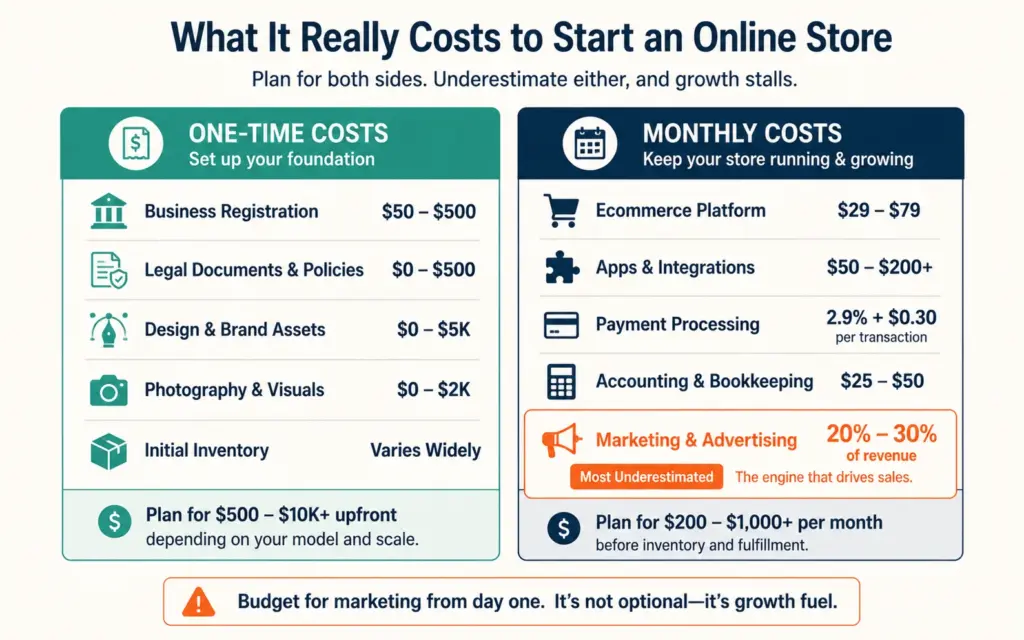
One-Time Startup Costs
- Business registration: LLC formation typically $50 to $500 depending on your state. Tax ID (EIN) is usually free. Note that some states, like California, charge an $800 minimum annual franchise tax regardless of profit, a cost founders frequently miss when they build their launch budget around one-time setup fees alone.
- Legal documents: Terms and conditions and privacy policy. Generators are free; a lawyer charges $200 to $500 for customized documents (important for GDPR/CCPA compliance).
- Store design: A free theme costs nothing, but professional design or a freelancer runs $500 to $5,000 depending on customization.
- Product photography: One of the highest-ROI investments. Professional photos build the trust that converts browsers to buyers, and on a product-based store they often return more per dollar than almost any other launch expense.
- Initial inventory: For inventory-based models, often the largest single cost. Dropshipping and print-on-demand avoid this.
The ecommerce legal setup covers the registration and legal foundation. Don’t skip the legal documents: they’re inexpensive with generators and protect you from compliance issues later.
Monthly Ongoing Costs
- Platform subscription: $29 to $79/month for Shopify tiers, lower for WooCommerce (though hosting adds cost).
- Apps and tools: Email marketing, reviews, and other apps add $50 to $200+/month.
- Payment processing: Roughly 2.9% + $0.30 per transaction. This scales with sales and usually exceeds your initial tech investment within the first year.
- Accounting software: QuickBooks or Xero at $25 to $50/month. Track every penny from day one.
- Marketing: The big one, covered below.
Marketing: The Line Item Everyone Underestimates
The most surprising cost for new founders is almost always the marketing budget. In an era where ecommerce customer acquisition costs average around $70, the idea that you can launch a profitable store with pocket change is a dangerous misconception. According to Spider Design’s budget breakdown, if you expect to make $10,000 in revenue, budget $2,000 to $3,000 for ads and promotions.
This is where stores that budgeted only for tech run out of runway. They build a beautiful website, launch, and discover that nobody comes because they allocated nothing to driving traffic. The pattern is so common it has a predictable shape: excitement and budget go into the store build, the launch happens, a trickle of sales arrives from friends and family, and then silence, because there was never a plan or budget to reach strangers who don’t already know the brand exists. A functional store with no marketing budget is a storefront on a deserted street. Plan your marketing budget as a percentage of expected revenue (20 to 30% is common early on) and treat it as essential, not optional. The ecommerce marketing strategy guide covers channel selection, and the ad spend ROI calculator helps you project whether your marketing budget can generate profitable returns at your margins.
Don’t Forget Operating Cash and Cash Flow
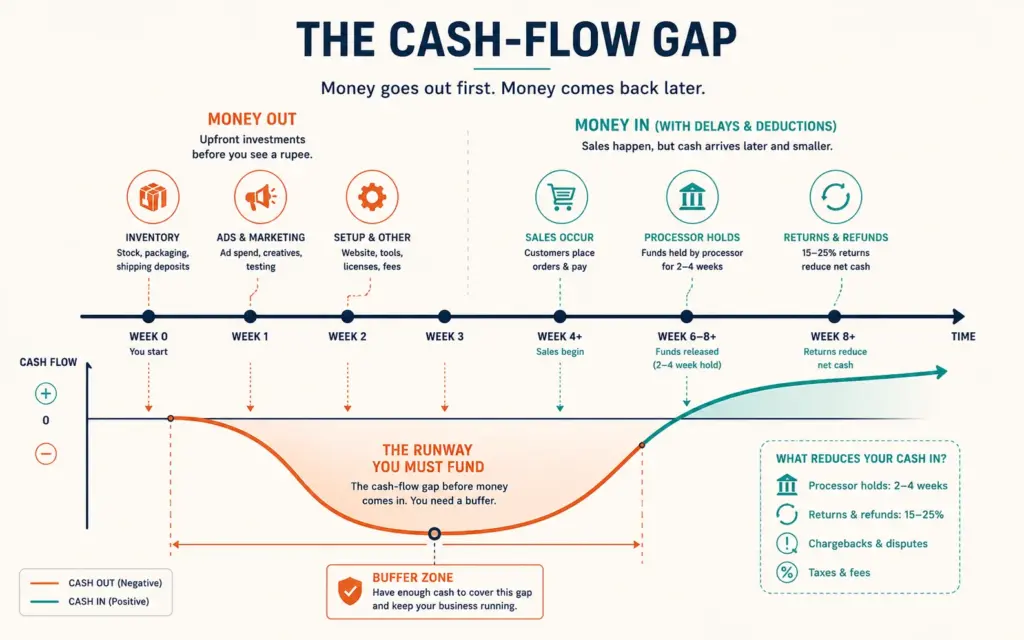
Beyond startup and monthly costs, you need operating cash to survive the gap between spending and getting paid. Three cash-flow realities catch new founders:
Payment processor holds. New stores often face payout delays as processors hold funds to manage risk. Budget 2 to 4 weeks of operating cash to absorb these holds.
Returns and refunds. Average online return rates run 15 to 20%, exceeding 25% in categories like apparel. Returns hit your unit economics and cash flow. Budget a refund buffer.
The timing gap. You pay for inventory, ads, and operations before revenue arrives. Cash flow, not just profit margin, often determines whether a new store survives its first months. A store can be profitable on paper and still fail because it ran out of cash before the profit materialized. This is why experienced founders separate the two questions entirely: is the business profitable per unit, and does the business have enough cash to reach the point where that per-unit profit adds up to sustainability? Both must be true.
Build a cash buffer beyond your startup costs. The cash flow management guide covers the working capital planning that keeps a growing store solvent. The profit margin calculator helps you understand your unit economics so you know how much cash each sale actually generates after all costs.
How to Allocate a Limited Launch Budget
If your budget is tight, spend where it drives sales and economize where it doesn’t:
Spend on: product photography (trust and conversion), a marketing budget large enough to test and acquire customers, and reliable inventory or supplier relationships. These directly generate revenue.
Economize on: custom design (a good free or low-cost theme works at launch), premium apps you don’t yet need (add them when a specific need arises), and elaborate branding (a clean, simple brand is enough to start). The domain and branding guide shows how to build a professional brand affordably.
The principle: many founders lose money not because they spent too little overall, but because they spent in the wrong places, over-investing in a beautiful website while under-investing in the marketing that brings customers to it. Start lean, test your product, and reinvest revenue into scaling what works. The first store checklist sequences your launch so you spend in the right order. As one common trajectory shows, a founder who recovers their startup investment within 5 to 6 months and grows to stable profitability did so by budgeting carefully and reinvesting deliberately, not by spending everything upfront.
Frequently Asked Questions
Realistic ranges: $500 to $2,000 for a lean dropshipping or print-on-demand start (near-zero inventory), $2,000 to $10,000 for a standard inventory or private-label store, and $10,000 to $50,000+ for a branded store with significant inventory and paid ads. Software is usually under 15% of true first-year spend; inventory and customer acquisition consume most of the budget. Below $500 you’re giving up essential trust signals and the marketing budget needed to get customers.
Marketing and customer acquisition. With ecommerce customer acquisition costs averaging around $70, this is the line item founders most underestimate. If you expect $10,000 in revenue, budget $2,000 to $3,000 for ads and promotions. Stores that budget only for software (platform, theme, apps) build a functional website but have no capital to drive traffic, resulting in zero sales and no runway to fix the problem. Marketing is essential, not optional.
A true $0 start is rare but dropshipping and print-on-demand can launch for under $200 using free themes and no inventory. However, launching that lean leaves nothing for customer acquisition, so growth is extremely slow without a marketing budget. Realistically, plan for at least $500 to $1,000 even for the leanest models, with most going to initial ad testing to find what converts. You can’t meaningfully avoid the customer acquisition cost that drives actual sales.
Spend on what drives sales: product photography (conversion), a marketing budget large enough to test and acquire customers (often 20 to 30% of expected revenue), and reliable inventory or suppliers. Economize on what doesn’t: custom design (free themes work at launch), premium apps you don’t yet need, and elaborate branding. Many founders fail not from spending too little, but from over-investing in a beautiful website while under-investing in the marketing that brings customers to it.
Cash flow, not just profit, determines survival. Three realities require a cash buffer: payment processors hold new-store funds (budget 2 to 4 weeks of operating cash), returns run 15 to 25% in some categories and hit your cash flow, and you pay for inventory, ads, and operations before revenue arrives. A store can be profitable on paper and still fail by running out of cash before profit materializes. Build a cash buffer beyond your startup and monthly costs.
Platform subscription ($29 to $79/month for Shopify, lower base for WooCommerce plus hosting), apps and tools ($50 to $200+/month for email, reviews, etc.), payment processing (roughly 2.9% + $0.30 per transaction, scaling with sales), accounting software ($25 to $50/month), and marketing (your largest ongoing cost, often 20 to 30% of revenue early on). Plan for both one-time startup costs and these recurring monthly expenses from day one so you’re not caught short.
Related Reads
- Ecommerce Startup Costs
- First Store Checklist
- Ecommerce Legal Setup
- Domain and Branding
- Ecommerce Marketing Strategy
- Cash Flow Management
Enjoying this? Get more like it every week.
One email per week with ecommerce strategies, tool picks, and seller insights. No spam.