
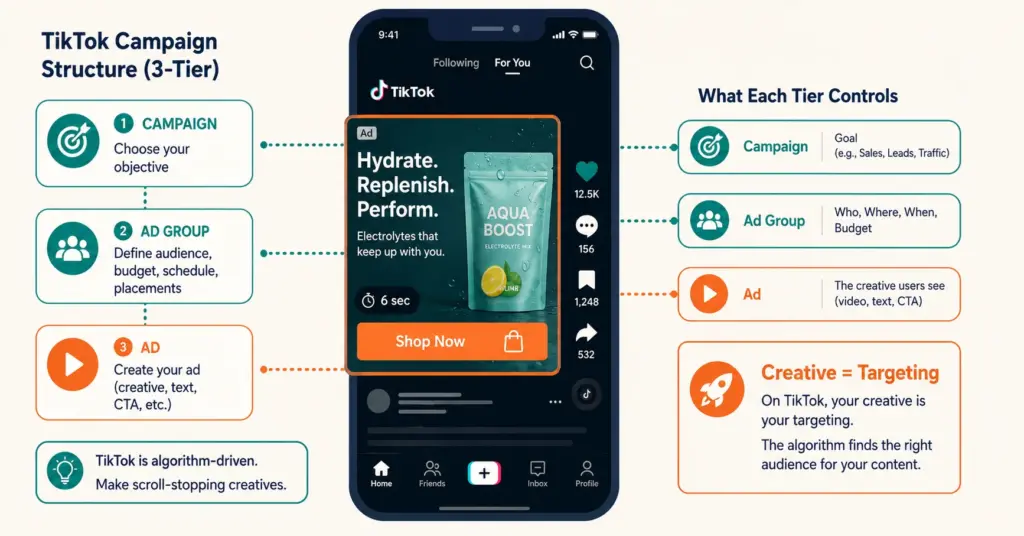
- TikTok advertising works differently from Meta and Google because the platform prioritizes entertainment-first content. An ad that looks like an ad gets scrolled past in under 2 seconds. An ad that looks like organic TikTok content (native format, trending audio, authentic presenter) earns the 6+ seconds of watch time that TikTok's algorithm needs to start distributing it widely.
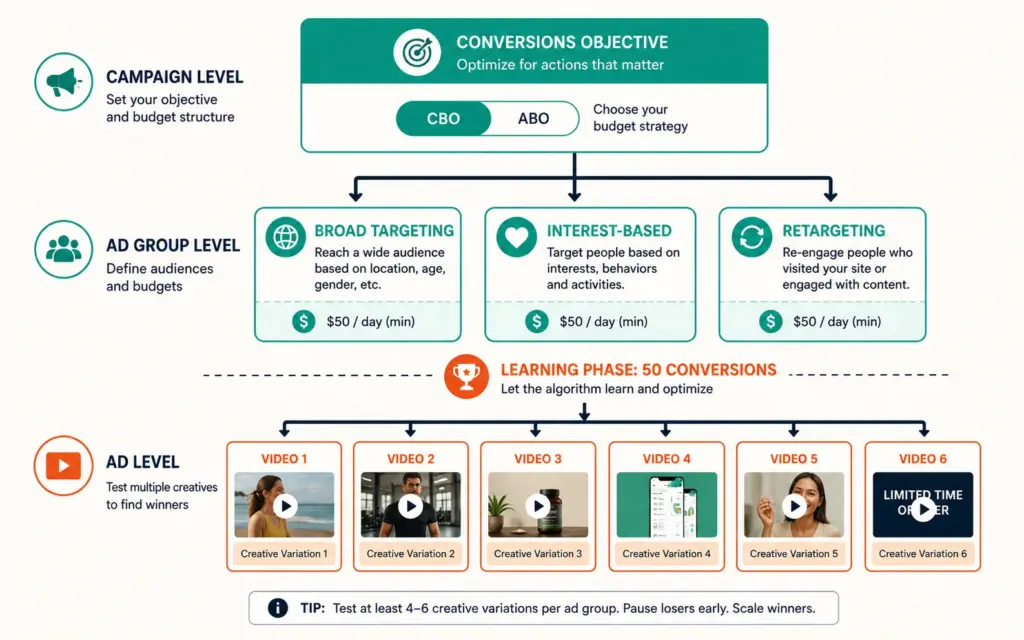
- Campaign structure for ecommerce: start with a Conversions objective, Lowest Cost bid strategy, and broad targeting. TikTok's algorithm needs data to optimize, and over-constraining your audience in week one starves it. Let the algorithm find your buyers for the first 50 conversions, then narrow based on what the data shows.
- Creative is the targeting on TikTok. The algorithm decides who sees your ad based primarily on how people interact with the creative, not your audience settings. Testing 4 to 6 creative variations per campaign is standard. Top ecommerce brands produce 20 to 50 new ad variations per month because TikTok penalizes creative fatigue faster than any other platform.
- Typical ecommerce benchmarks: CPC $0.80 to $2.50, CPM $5 to $15, CTR 1 to 3%, conversion rate 1 to 3% for cold traffic. ROAS target: 2:1 to 4:1 depending on margins. Minimum daily budget: $50 per ad group to exit learning phase within 7 days. Below $30/day per ad group, the algorithm can't gather enough data to optimize.
This TikTok ads guide covers what ecommerce sellers actually need to know about advertising on TikTok in 2026: how to set up campaigns that convert, what creative formats earn attention instead of getting scrolled, and how to scale spend without watching your CPA double overnight. TikTok now has over 170 million monthly active users in the US alone, with an average daily usage time of 95 minutes per user. 40% of those users treat TikTok as a search engine, actively looking for product recommendations and reviews.
The mistake most ecommerce brands make is importing their Meta ads playbook directly to TikTok. Polished product-on-white-background creative that converts on Facebook gets ignored on TikTok because it doesn’t match the platform’s content culture. According to Creatify’s TikTok ads analysis, the platform’s algorithm rewards fresh content and penalizes repeated reuse. Top brands generate 20 to 50 new creative variations per month. The TikTok marketing organic strategy should run alongside paid because organic content that performs well becomes your best ad creative.
Setting Up TikTok Ads Manager for Your Ecommerce Store
Create a TikTok for Business account at ads.tiktok.com. Install the TikTok Pixel on your store (Shopify has a native TikTok app that handles this in 5 minutes). The Pixel tracks page views, add-to-cart events, initiated checkouts, and completed purchases. Without it, TikTok can’t optimize for conversions and you’re flying blind on which ads produce sales.
Connect your product catalog through the TikTok Sales Channel app on Shopify. This enables Dynamic Showcase Ads (catalog-driven ads that automatically show relevant products to each viewer) and TikTok Shop integration. The tracking setup guide covers Pixel installation and event verification in detail.
Campaign Structure That Lets the Algorithm Work
TikTok Ads Manager uses a three-tier structure: Campaign (objective and budget) > Ad Group (targeting, placement, bid) > Ad (creative and copy). The logic is similar to Meta Business Manager, but the optimization approach differs.
Campaign level: choose Conversions for direct ecommerce sales
For ecommerce, start with the “Website Conversions” objective optimizing for “Complete Payment.” Don’t start with Traffic or Engagement objectives. They optimize for clicks and views, not purchases. You want TikTok finding people who buy, not people who click.
Use Campaign Budget Optimization (CBO) after you have 2+ ad groups with proven performance. For initial testing, use Ad Group Budget Optimization (ABO) so you control how much each audience or creative test receives. The ROAS benchmarks for TikTok ecommerce typically run 2:1 to 4:1 for well-optimized campaigns, lower than Google Shopping but higher than brand awareness channels.
Ad group level: start broad and let data narrow your audience
TikTok’s algorithm performs best with broad targeting initially. Set your ad group to: age 18 to 54, your shipping geography, and no interest targeting. That’s it. Let TikTok’s algorithm determine who engages with your creative. After 50 conversions (typically 7 to 14 days at $50/day), the algorithm has enough data to optimize effectively.
Once you have baseline performance data, create separate ad groups for testing: one with interest-based targeting in your product category, one with a lookalike audience based on your purchasers, one with your retargeting audience (site visitors who didn’t buy). Compare CPAs across ad groups after 7 days and shift budget to winners. The retargeting strategies approach applies to TikTok: viewers who watched 75%+ of your video ad but didn’t purchase are your warmest retargeting audience.
Minimum budgets that actually produce results
$50/day per ad group minimum. Below this, the ad group stays in “learning limited” status and never optimizes properly. For a single-product test: one campaign, two ad groups (broad + retargeting), $50/day each = $100/day total ($3,000/month). This is the minimum commitment for meaningful TikTok advertising data. Running $10/day produces inconclusive results over weeks.
Creative Formats That Convert on TikTok Ecommerce Ads
Creative is the variable that determines 80% of your TikTok ad performance. Targeting, bidding, and budget matter, but they can’t save bad creative. Good creative with broad targeting outperforms polished creative with perfect targeting every time on this platform.
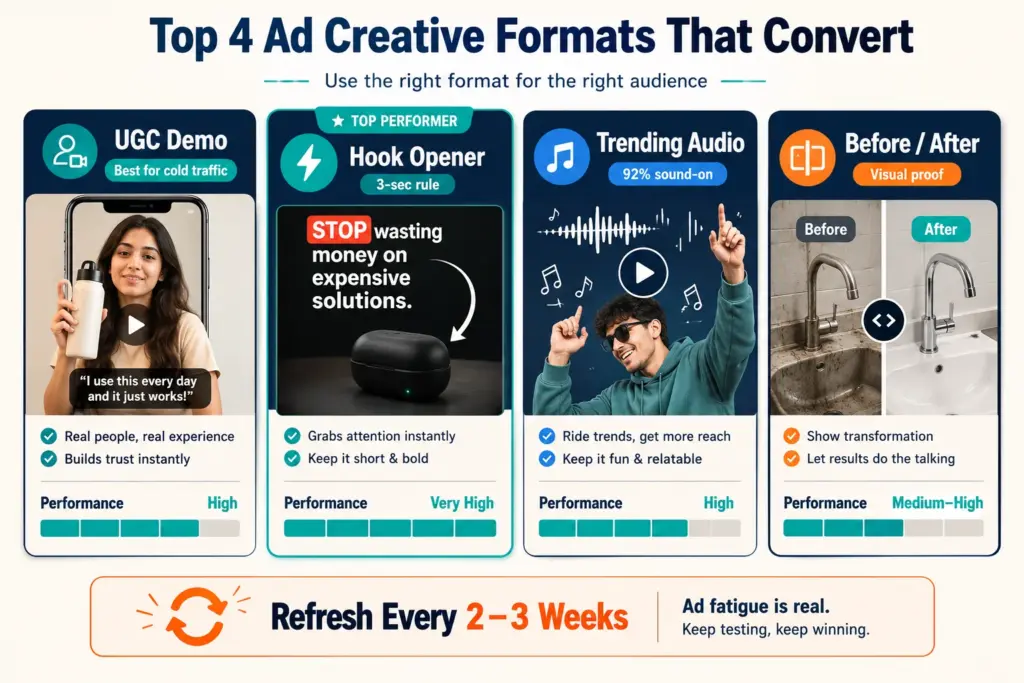
UGC-style product demonstrations perform best for cold traffic
A real person holding your product, showing it in use, and speaking directly to camera. Not scripted. Not studio-lit. Filmed on a phone in natural lighting. This format matches TikTok’s native content and earns the 6+ seconds of watch time that triggers algorithmic distribution. The UGC strategy for generating authentic customer content feeds directly into your TikTok ad creative pipeline.
Hook in the first 3 seconds or lose the viewer entirely
TikTok users scroll past content they don’t immediately find interesting. Your opening frame needs to stop the thumb. Effective hooks: a surprising result (“I can’t believe this actually worked”), a direct question (“Why does nobody talk about this?”), a visual transformation (before/after in the first 2 seconds), or pattern interruption (unexpected sound or movement). The ad creative tips guide covers hook frameworks that apply across short-form video platforms.
Sound is mandatory on TikTok ads unlike every other platform
92% of TikTok users watch with sound on. An ad without sound or with generic stock music performs dramatically worse than one with a voiceover, trending audio, or authentic environmental sound. Use TikTok Creative Center (ads.tiktok.com/creative_center) to find trending sounds available for commercial use. Match your product demo to a trending audio format for algorithmic boost.
Vertical 9:16 format only and keep it under 30 seconds
Horizontal video doesn’t work on TikTok. Shoot everything in 9:16 vertical at 1080×1920 resolution. Optimal length: 15 to 30 seconds for conversion campaigns. Under 15 seconds doesn’t give enough time to demonstrate and convert. Over 30 seconds loses most viewers before the CTA. According to Stackmatix’s TikTok ecommerce analysis, video completion rates above 40% indicate strong creative, and the completion threshold is much harder to hit on videos over 30 seconds.
Scaling TikTok Ads Without Breaking Performance
Increase budgets by 20% every 3 days not overnight
Doubling your budget overnight resets TikTok’s learning phase and typically spikes CPA for 3 to 5 days. Gradual 20% increases every 3 days let the algorithm adjust without losing optimization. Going from $50/day to $200/day should take about 2 weeks of incremental scaling.
Refresh creative every 2 to 3 weeks before fatigue kills performance
TikTok creative fatigues faster than any other platform. A winning ad that produces $15 CPA in week 1 might produce $35 CPA by week 3 as the algorithm exhausts its audience for that specific creative. Always have 2 to 3 new creative variations ready to replace fatiguing ads. Test new hooks, new presenters, new angles on the same product. The product doesn’t change. The creative wrapper does.
Separate prospecting and retargeting into different campaigns
Cold audiences and warm audiences behave differently. Mixing them in one campaign means TikTok over-serves the warm audience (easier conversions) and under-serves the cold audience (harder but more scalable). Run prospecting (cold, broad targeting) and retargeting (site visitors, video viewers) in separate campaigns with separate budgets. The Facebook ads for ecommerce campaign separation principle applies identically to TikTok.
Measuring TikTok Ad Performance for Ecommerce Stores
Primary metrics: ROAS (revenue / ad spend), CPA (cost per purchase), and purchase volume. These tell you whether ads are profitable and at what scale.
Creative health metrics: Video completion rate (target 40%+), CTR (target 1 to 3%), and hook rate (% of viewers who watch past 3 seconds, target 30%+). Low hook rate means your opening isn’t stopping thumbs. The product photography and lifestyle content you already have can be repurposed as TikTok ad creative with minor editing for vertical format. Low completion rate means the middle content isn’t holding attention. Low CTR means viewers watch but don’t click.
Attribution note: TikTok’s default attribution window is 7-day click and 1-day view. This means TikTok claims credit for purchases that happen within 7 days of an ad click or 1 day of an ad view. The ecommerce tools and tech stack for paid media should include TikTok alongside Meta and Google as a standard channel. Compare TikTok-reported ROAS against your GA4 or Shopify attribution to get an honest picture. TikTok tends to over-report by 20 to 40%. The attribution modeling approach should include TikTok as a separate channel with its own attribution adjustment.
Track these in your ecommerce KPIs dashboard alongside Meta and Google performance. Brands running both TikTok and Meta see an average 17% reduction in blended customer acquisition cost because the platforms reach different audience segments and reduce each other’s frequency fatigue.
Frequently Asked Questions
Typical ecommerce benchmarks in 2026: CPC $0.80 to $2.50, CPM $5 to $15, CPA varies by product price ($10 to $40 for products under $50). Minimum recommended daily budget: $50 per ad group to exit learning phase. Total monthly minimum for meaningful testing: $3,000 ($100/day across 2 ad groups). Below this, data accumulates too slowly for the algorithm to optimize and you can’t draw reliable conclusions about creative or audience performance.
UGC-style product demonstrations filmed on a phone in natural lighting with a real person speaking to camera. This format matches TikTok’s native content culture and earns longer watch times than polished studio content. Key requirements: strong hook in the first 3 seconds, sound on (92% of users watch with sound), vertical 9:16 format, and 15 to 30 second duration. Test 4 to 6 creative variations per campaign and refresh every 2 to 3 weeks before fatigue degrades performance.
Start broad. TikTok’s algorithm optimizes best when it has a large audience pool to learn from. Set age 18 to 54, your shipping geography, and no interest targeting for the first 50 conversions. The algorithm identifies your best customers faster through broad testing than you can through manual interest selection. After 50 conversions, test narrower audiences (interest-based, lookalike, retargeting) in separate ad groups and compare CPAs against your broad baseline.
Three key differences: creative matters more than targeting on TikTok (the algorithm uses creative engagement to find your audience), creative fatigues 2 to 3x faster (refresh every 2 to 3 weeks vs 4 to 6 weeks on Meta), and the content must feel native to the platform (polished studio ads that work on Meta get scrolled past on TikTok). Sound is mandatory on TikTok but optional on Meta. TikTok users are in discovery mode; Meta users are in social browsing mode. The purchase intent is different, which affects creative strategy.
The TikTok Pixel is a tracking code that monitors visitor behavior on your website: page views, add-to-cart events, checkouts, and purchases. Without it, TikTok can’t optimize your campaigns for conversions. Install through Shopify’s TikTok Sales Channel app (5-minute setup) or manually via TikTok Ads Manager. Verify that all events fire correctly using TikTok’s Pixel Helper browser extension before launching any campaigns.
2:1 to 4:1 ROAS for well-optimized TikTok ecommerce campaigns, measured against TikTok’s reported attribution. Adjusted for TikTok’s typical 20 to 40% over-reporting, real ROAS is closer to 1.5:1 to 3:1 when cross-referenced with GA4. Your target ROAS depends on your margins: at 60% gross margin, 2:1 TikTok-reported ROAS is profitable. At 30% margin, you need 3.5:1+ reported to break even after attribution adjustment.
Related Reads
- TikTok Marketing
- Facebook Ads for Ecommerce
- Ad Creative Tips
- UGC Strategy
- ROAS Benchmarks
- Attribution Modeling
Enjoying this? Get more like it every week.
One email per week with ecommerce strategies, tool picks, and seller insights. No spam.