
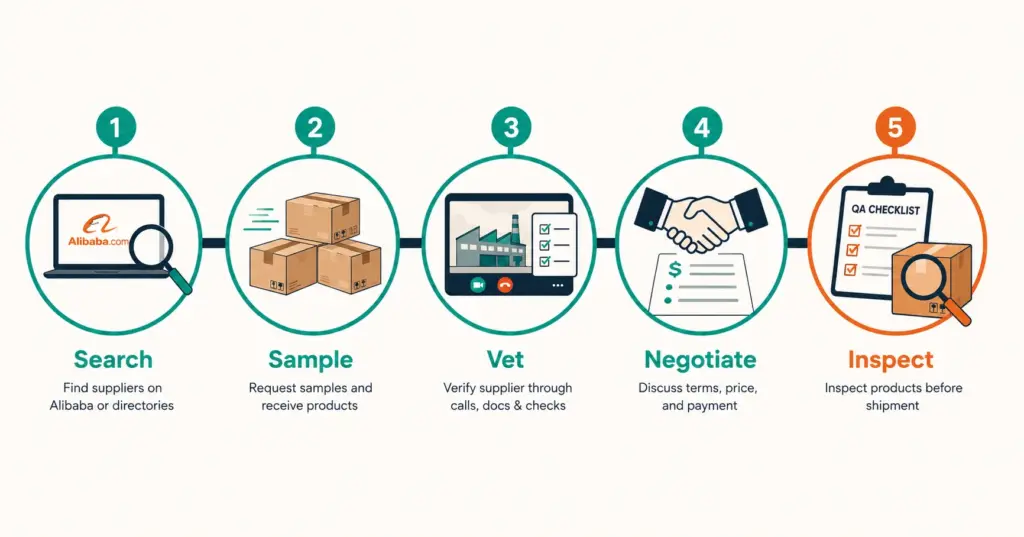
- Finding a manufacturer is not the hard part. Alibaba alone lists millions of suppliers. The hard part is vetting them: separating real factories from trading companies, evaluating quality before committing thousands of dollars, and negotiating terms that protect you if something goes wrong.
- The vetting process that works: request samples from 3 to 5 suppliers for the same product, compare quality side by side, verify the supplier is an actual factory (not a middleman) through business license checks and video calls, negotiate MOQ and payment terms before placing the first production order, and use a third-party inspection service before the shipment leaves the factory.
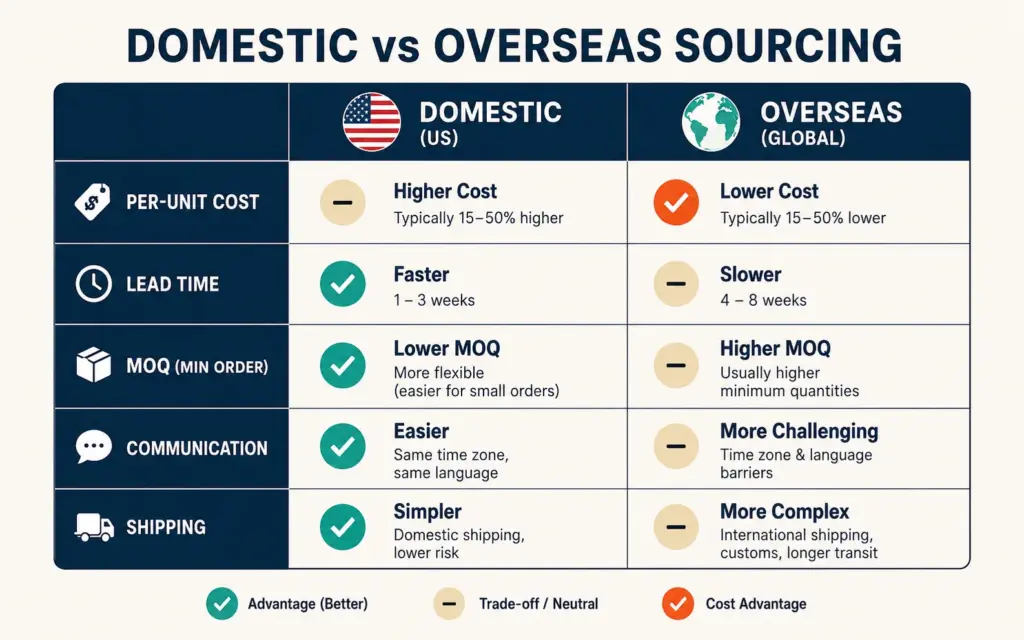
- Domestic (US/EU) manufacturers cost 30 to 60% more per unit but offer faster lead times (1 to 3 weeks vs 4 to 8 weeks overseas), easier communication, simpler logistics, and lower MOQs. Overseas manufacturers (primarily China, Vietnam, India) offer lower per-unit costs but require more vetting, longer lead times, and freight management. The right choice depends on your margin targets and volume expectations.
- The most expensive mistake in sourcing isn't paying too much per unit. It's placing a $5,000+ production order with a supplier you haven't properly vetted, receiving products that don't match the sample, and having no recourse because you paid in full upfront. The vetting process costs $200 to $500 in samples and inspection fees. Skipping it costs $5,000 to $25,000 in bad inventory.
Sourcing manufacturers is where your product idea becomes a physical product that lands in a customer’s hands. Everything before this step is planning. Everything after depends on whether the manufacturer you chose delivers quality products, on time, at the price you agreed on. Get this right and your supply chain runs smoothly for years. Get it wrong and you’re stuck with inventory you can’t sell, delays that lose customers, or quality issues that generate returns and kill your reviews.
Most first-time sellers start and end their manufacturer search on Alibaba. The ecommerce tools and tech stack for product-based businesses should include supplier management alongside your store platform and marketing tools. That’s fine as a starting point, but Alibaba is a marketplace of suppliers, not a curated directory of verified factories. According to Shopify’s sourcing guide, many listings on supplier platforms are trading companies (middlemen) rather than actual factories. Trading companies add 15 to 30% markup without adding production capability. The vetting process below helps you identify which suppliers are real factories and which are just forwarding your order to someone else.
Where to Find Manufacturers
Online directories (broadest selection)
Alibaba: The largest global supplier directory. Best for private label and custom manufacturing, primarily from Chinese factories. Filter by “Verified Supplier” and “Trade Assurance” for basic vetting. But verification badges aren’t guarantees of quality. They confirm the company exists and has paid for the badge. You still need to vet independently.
ThomasNet: US-based manufacturing directory. Best for domestic sourcing. Manufacturers listed here are verified US companies. Higher per-unit costs but faster lead times, no import duties, and easier communication. The Alibaba sourcing guide covers platform-specific tactics for navigating Alibaba’s search, filtering, and supplier communication.
Global Sources and Made-in-China: Alternatives to Alibaba with different supplier pools. Worth checking if Alibaba doesn’t surface the right category or if you want to cross-reference pricing from multiple platforms.
Trade shows (highest quality vetting)
Canton Fair (Guangzhou, twice yearly), ASD Market Week (Las Vegas), and industry-specific trade shows let you meet manufacturers face to face, inspect samples in person, and evaluate professionalism before placing an order. Trade show leads convert at higher rates because you’ve seen the product quality firsthand. The downside: travel costs and time commitment.
Competitor supplier research
US import records are public through the Freedom of Information Act. Tools like Jungle Scout’s Supplier Database, ImportYeti, and Panjiva let you search which factories manufacture products for specific brands. If a competitor sells a product similar to yours, you can identify their manufacturer and request a quote for your own version. This is legal and common in private label sourcing. The niche validation process should include supplier availability as part of assessing whether a niche is viable.
How to Vet a Manufacturer
Vetting separates reliable partners from expensive mistakes. Follow every step before committing to a production order.
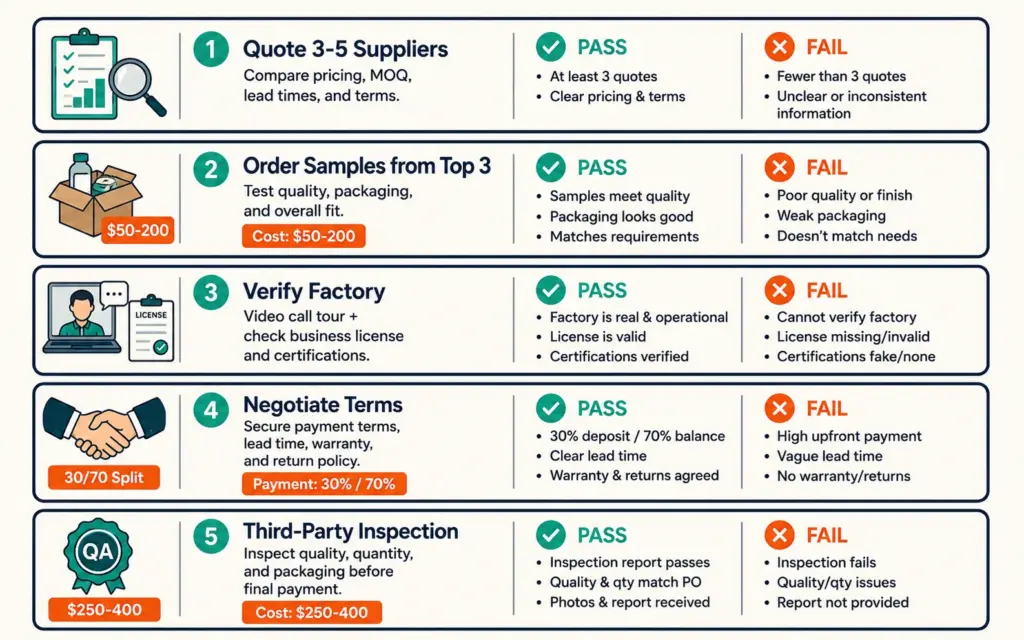
Step 1: Request quotes from 3 to 5 suppliers
For the same product specification, contact 3 to 5 suppliers. Compare pricing, MOQ (minimum order quantity), lead time, and payment terms. If one supplier is 40% cheaper than the others, that’s a red flag, not a deal. They’re either cutting quality corners, quoting a different specification, or baiting you with a low quote that will increase after you commit.
Step 2: Order samples from your top 3
Never place a production order without samples. Order samples from your top 3 suppliers ($50 to $200 per sample including shipping is normal). Compare quality side by side: materials, construction, finishing, packaging. The sample represents the BEST the supplier can produce. If the sample has issues, production will be worse.
Step 3: Verify the supplier is an actual factory
Ask for their business license (Chinese factories have a business license number you can verify online). Request a video call with a factory tour. A real factory will walk you through production lines via video. A trading company will make excuses about “the factory is in another city.” Ask directly: “Are you a factory or a trading company?” Honest trading companies will say so. Dishonest ones claim to be factories but can’t show you machinery.
Step 4: Negotiate terms that protect you
Payment terms: Never pay 100% upfront. Standard terms are 30% deposit, 70% before shipment. Some suppliers accept 30/70 with the balance paid after third-party inspection confirms quality. Push for this arrangement on your first order. After 3 to 5 successful orders, you earn use for better terms.
MOQ negotiation: First orders can often negotiate lower MOQs (50 to 100 units instead of 500+) at a slightly higher per-unit price. Suppliers want the relationship more than the margin on the first order. If they refuse to do a smaller first order, they may not value small to mid-size clients. The demand forecasting data for your product should inform how many units you actually need, not the supplier’s preferred MOQ.
Quality agreement: Define acceptable defect rates in writing (typically 2 to 3% for most consumer products). State what happens when defects exceed that threshold: replacement, refund, or discount on the next order. Get this in the purchase order before production starts.
Step 5: Use third-party inspection before shipment
Hire a third-party quality inspection service (QIMA, Asia Inspection, or V-Trust) to inspect your finished goods at the factory before they ship. Cost: $250 to $400 per inspection. The inspector checks a random sample against your specifications and reports defects. This is your last checkpoint. Catching quality issues before the shipment leaves costs $300 in inspection fees. Catching them after the inventory arrives at your warehouse costs $5,000+ in returns, replacements, and reputation damage.
According to Practical Ecommerce’s manufacturer guide, competitor supplier research through import data tools is one of the most underused sourcing strategies, yet it gives you direct access to factories with proven production capability in your product category.
Domestic vs Overseas Manufacturing
| Factor | Domestic (US/EU) | Overseas (China/Vietnam/India) |
|---|---|---|
| Per-unit cost | 30 to 60% higher | Lower |
| Lead time | 1 to 3 weeks | 4 to 8 weeks (plus shipping) |
| MOQ | Often lower (25 to 100 units) | Higher (100 to 1,000+ units) |
| Communication | Same language, same timezone | Language barriers, 12-hour time difference |
| Shipping | Ground shipping, 2 to 5 days | Ocean freight 3 to 6 weeks, air freight 5 to 10 days |
| Quality control | Easier to visit, local inspection | Requires third-party inspection services |
| Import duties | None | Varies by product (0 to 25%+) |
Choose domestic when: your margin supports the higher per-unit cost, you need fast turnaround, your product requires tight quality control, or “Made in USA/EU” is a brand differentiator. Choose overseas when: per-unit cost is critical to your pricing strategy, you’re ordering in volume (500+ units), and you have the lead time buffer to handle 6 to 10 week production and shipping cycles. The ecommerce pricing strategy should model both domestic and overseas unit costs to see which supports your target retail price and margin.
Many successful brands use a hybrid approach: overseas manufacturing for the primary product and domestic suppliers for packaging, printed materials, and fulfillment. This captures the cost advantage of overseas production while keeping logistics and quality-sensitive elements local. The order fulfillment process architecture should account for where products arrive (port, warehouse, 3PL) and the receiving timeline.
Common Sourcing Mistakes
Choosing the cheapest supplier. The lowest quote usually means the lowest quality, the least reliable delivery, or a trading company padding a hidden margin. Choose the supplier whose sample quality, communication responsiveness, and terms balance best with their pricing. A $0.50 per-unit savings that produces 10% defect rates costs you far more in returns and lost reviews.
Paying 100% upfront on a first order. No reputable factory requires full payment upfront from a new client. If a supplier insists on 100% before production, they’re either too small to finance production (risky) or planning to use your money without accountability. 30% deposit, 70% on completion is standard. Negotiate it.
Skipping the sample step. “The photos look great” is not quality control. Photos can be of a completely different product. Samples cost $50 to $200. Bad production orders cost $5,000 to $25,000. The math is obvious. The ecommerce profit margins analysis should include sample costs and inspection fees as standard pre-production expenses, not surprises.
Not having a backup supplier. Single-supplier dependency is a supply chain risk. If your only factory has a production delay, a quality failure, or a natural disaster, your business stops. Identify and sample-qualify at least one backup supplier for your primary product. You don’t need to order from them regularly. You need to know you can switch in 2 weeks if necessary. The financial planning and scaling model should include supplier diversification as a risk mitigation line item.
Frequently Asked Questions
Start with Alibaba (largest global directory, filter by Verified Supplier), ThomasNet (US manufacturers), or competitor supplier research using import data tools like ImportYeti or Jungle Scout’s Supplier Database. Contact 3 to 5 suppliers with your product specifications. Order samples from the top 3. Compare quality, pricing, MOQ, and communication responsiveness before committing to a production order.
Costs vary by product complexity, materials, and location. Simple consumer goods from Chinese factories: $1 to $10 per unit at MOQs of 100 to 1,000. Domestic US manufacturing: 30 to 60% higher per unit but lower MOQs. Additional costs: samples ($50 to $200 each), tooling/molds ($500 to $10,000 for custom products), third-party inspection ($250 to $400), and shipping (ocean freight $2,000 to $5,000 per container). Budget $2,000 to $10,000 for a first production run of a simple product.
Three verification methods: ask for their business license and verify it independently, request a video call with a live factory tour showing production lines and workers, and ask directly (“Are you a factory or a trading company?”). Trading companies add 15 to 30% markup. They’re not always bad (they can source from multiple factories), but you should know what you’re paying for. Real factories can show you their machinery and production process on video.
Standard: 30% deposit before production, 70% balance before shipment. Better: 30% deposit, 70% after third-party inspection confirms quality. Never pay 100% upfront on a first order. After 3 to 5 successful orders, you can negotiate better terms: 20/80 splits, net-30 payment after delivery, or letter of credit for large orders. Payment terms are negotiable. Suppliers who refuse any flexibility on a first order may not be reliable partners.
Domestic if: your margin supports 30 to 60% higher per-unit cost, you need fast turnaround (1 to 3 weeks), quality control is critical, or “Made in USA/EU” is a brand differentiator. Overseas if: per-unit cost drives your pricing strategy, you’re ordering 500+ units, and you can handle 6 to 10 week lead times. Many brands use a hybrid: overseas for the product, domestic for packaging and fulfillment.
For your first 3 to 5 orders with any supplier, yes. A third-party inspection ($250 to $400) catches defects before the shipment leaves the factory. Finding quality issues after inventory arrives at your warehouse costs $5,000+ in returns, replacements, and damaged reviews. Services like QIMA and Asia Inspection send inspectors to the factory to check a random sample against your specifications. After building trust with a supplier over multiple successful orders, you can reduce inspection frequency.
Related Reads
- Alibaba Sourcing Guide
- Niche Validation
- Ecommerce Pricing Strategy
- Demand Forecasting
- Ecommerce Profit Margins
- Order Fulfillment Process
Enjoying this? Get more like it every week.
One email per week with ecommerce strategies, tool picks, and seller insights. No spam.