
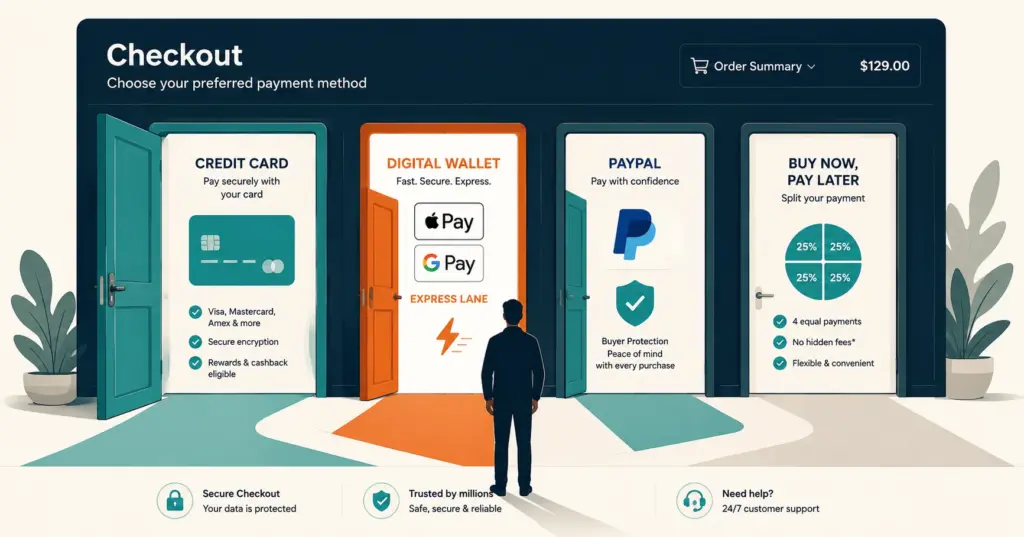
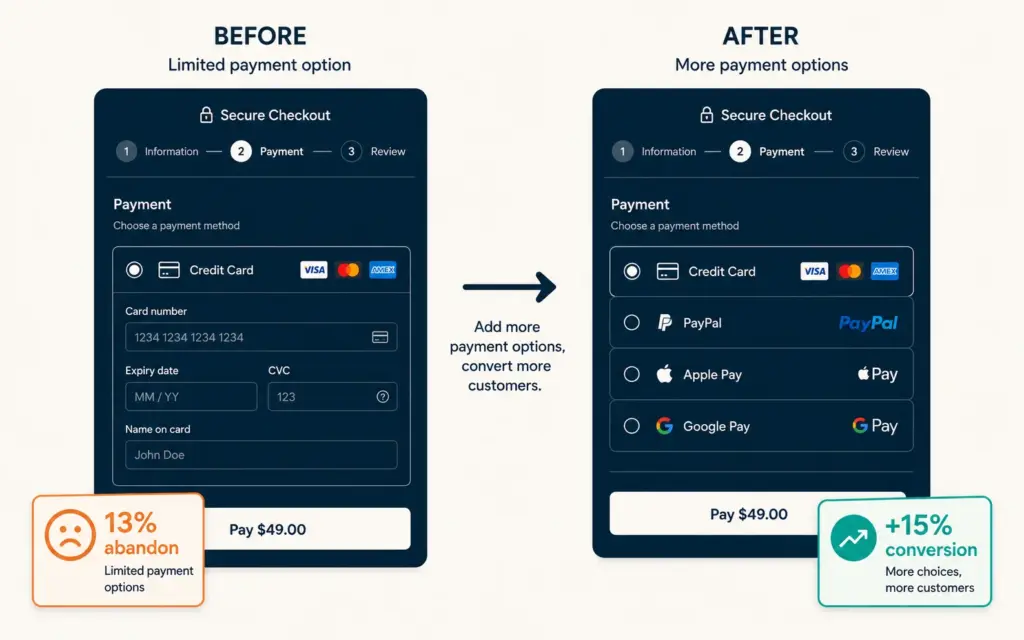
- Payment method availability directly impacts ecommerce conversion rates. 13% of online shoppers abandon checkout specifically because their preferred payment method isn't available. Adding the payment methods your customers expect isn't a convenience feature; it's a conversion rate optimization that reduces one of the top 5 checkout abandonment causes.
- The minimum viable payment stack for most ecommerce stores: credit/debit cards (Visa, Mastercard, Amex), a digital wallet (Apple Pay or Google Pay), PayPal, and a BNPL option (Shop Pay Installments, Klarna, or Afterpay). This combination covers 95%+ of US online shoppers' preferred payment methods.
- Buy Now Pay Later (BNPL) increases AOV 20 to 40% on orders over $100 because it removes the psychological barrier of a large single payment. BNPL users convert at 20 to 30% higher rates on qualifying products. The merchant cost (2 to 6% per transaction) is offset by the AOV and conversion lift.
- Express checkout buttons (Apple Pay, Google Pay, Shop Pay) placed on product pages and in the cart reduce checkout friction by skipping the address and payment form entirely. Stores with express checkout enabled report 1.7x higher mobile conversion rates than those requiring full form completion.
The payment methods available at your ecommerce checkout are a direct conversion lever that most store owners treat as a set-and-forget configuration choice. A customer who reaches checkout with purchase intent, enters their shipping information, and then discovers you don’t accept their preferred payment method doesn’t think “I’ll enter a different card.” They leave. According to Baymard Institute’s checkout research, 13% of online shoppers abandon specifically because their preferred payment option is unavailable, ranking it among the top 5 reasons for checkout abandonment alongside unexpected costs, account creation requirements, and complex checkout flows.
Payment method optimization sits at the intersection of checkout flow design and customer trust. Each payment option carries different trust signals for different customer segments: PayPal for first-time buyers who don’t trust entering card details on an unfamiliar site, Apple Pay for mobile shoppers who value speed, BNPL for price-sensitive buyers considering a higher-than-planned purchase, and traditional credit cards for shoppers with established online buying habits.
The Payment Methods That Matter for Ecommerce
Credit and debit cards (baseline requirement)
Visa, Mastercard, American Express, and Discover cover 99% of card-based transactions in the US. Every ecommerce store must accept all four major networks. Processing cost: 2.4 to 2.9% + $0.30 per transaction through standard processors (Stripe, Shopify Payments). Amex carries slightly higher interchange rates but refusing it excludes 20%+ of US cardholders, costing more in lost sales than saved processing fees.
PayPal (trust signal for unfamiliar stores)
PayPal serves two functions: a payment method for the 30% of online shoppers who prefer it, and a trust badge that signals buyer protection to first-time visitors. New ecommerce stores benefit disproportionately from PayPal because it transfers PayPal’s trust to your checkout. Customers know PayPal will resolve disputes if the product doesn’t arrive or doesn’t match the description. That assurance converts hesitant first-time buyers who wouldn’t enter card details on an unknown site. Processing cost: 2.59% + $0.49 per transaction (slightly higher than Stripe). The trust-building approach on your product pages should pair with PayPal availability at checkout for maximum first-purchase confidence.
Digital wallets (Apple Pay, Google Pay, Shop Pay)
Express checkout wallets let customers pay with a single tap or biometric confirmation, skipping the address form, card number entry, and billing fields entirely. The stored shipping address and payment method auto-populate from the customer’s wallet. The impact on mobile conversion is dramatic: Shopify reports that Shop Pay produces 1.7x higher conversion rates than standard checkout because it eliminates the mobile form-filling friction that kills 67% of mobile checkout attempts.
Implementation: Shopify Payments enables Shop Pay, Apple Pay, and Google Pay by default. WooCommerce requires the Stripe plugin with wallet payments enabled. No additional cost beyond standard processing rates. The WooCommerce payment plugin setup activates wallet payments in under 10 minutes.
Buy Now Pay Later (BNPL)
BNPL splits a purchase into 4 interest-free installments (typically over 6 weeks). A $200 purchase becomes four $50 payments. The customer gets the product immediately; you get paid in full immediately; the BNPL provider assumes the credit risk.
Impact: BNPL increases AOV 20 to 40% on orders over $100 and lifts conversion 20 to 30% on qualifying products. According to Afterpay’s merchant data, stores enabling BNPL see a 22% increase in checkout conversion and a 40% increase in average order value from BNPL users versus standard payment users.
Options: Shop Pay Installments (Shopify-native, 0% merchant fee), Klarna (2 to 5.99% per transaction), Afterpay (4 to 6% per transaction), Affirm (customizable terms, 5 to 30% per transaction). Shop Pay Installments is the most cost-effective for Shopify stores because there’s zero additional merchant fee. The AOV optimization strategy should factor in BNPL availability when projecting average order value improvements.
Where to Place Payment Options for Maximum Impact
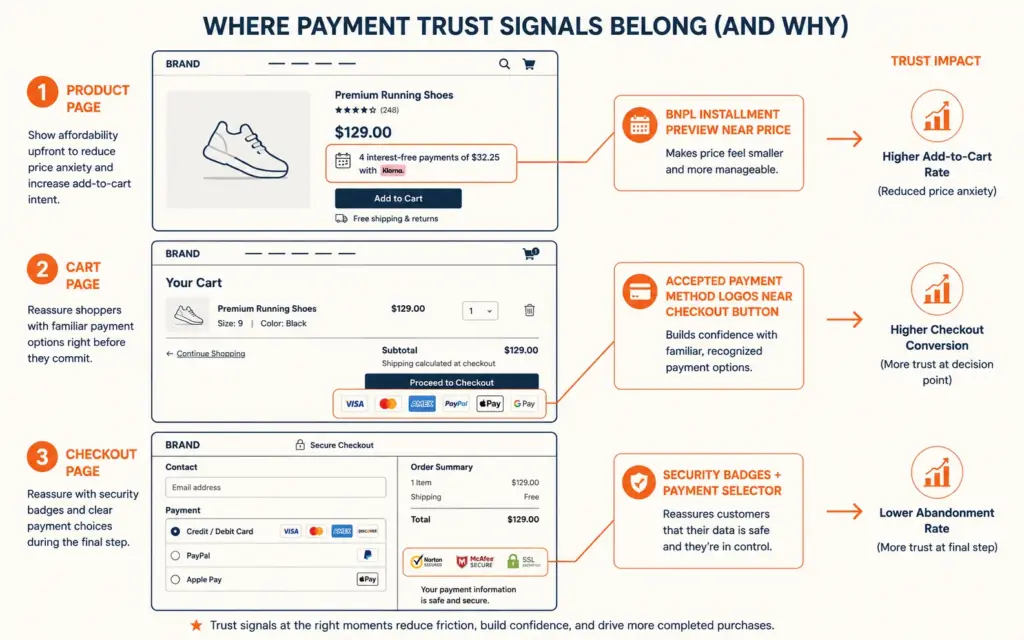
Product page: express checkout buttons
Place Apple Pay / Google Pay / Shop Pay buttons on the product page alongside or below “Add to Cart.” This creates a one-tap purchase path that bypasses the cart entirely. Shoppers who know what they want and have wallet payments configured can go from product page to purchase confirmation in under 10 seconds. This is particularly effective on mobile where form completion is the primary conversion killer.
Cart page: payment method display
Show accepted payment method icons (Visa, Mastercard, PayPal, Apple Pay, Klarna logos) on the cart page near the checkout button. This serves as both a trust signal and a practical preview of what’s available. Customers who see their preferred method displayed proceed to checkout with higher confidence. The cart abandonment recovery strategy should also reference payment flexibility in recovery emails: “Complete your order with PayPal, Apple Pay, or pay in 4 installments.”
Checkout page: payment selection with BNPL promotion
Present payment options in order of conversion impact: express wallets first (fastest), then credit card (most common), then PayPal (trust option), then BNPL (AOV driver). For orders over $75 to $100, actively promote the BNPL option with an installment breakdown: “Or 4 payments of $24.99 with Klarna.” This reframes the price from $99.99 (potentially hesitation-inducing) to $24.99 (trivially affordable). The visual emphasis on installment pricing at checkout lifts BNPL adoption 30 to 50%.
BNPL Economics for Store Owners
BNPL fees seem high (2 to 6% per transaction) compared to standard card processing (2.4 to 2.9%). The ROI calculation:
A store with $50,000/month revenue adds BNPL. 20% of orders shift to BNPL, and those orders average 35% higher AOV. Result: $10,000 of revenue now processes through BNPL at 5% fee ($500 cost). But BNPL AOV lift means $10,000 becomes $13,500 ($3,500 incremental revenue). Net gain: $3,500 revenue – $500 incremental fees = $3,000 additional gross revenue per month.
BNPL is most effective for products above $75 where the installment breakdown makes a meaningful psychological difference. Below $50, the benefit is minimal because four payments of $12.50 don’t meaningfully change the purchase decision. The margin structure of each product category determines whether the 2 to 6% BNPL fee is absorbed comfortably or eats into thin margins.
Payment Security and Trust Signals
Payment method trust extends beyond which options you accept. How you display security signals affects whether customers feel safe completing the transaction:
- SSL badge: The padlock icon and “https://” in the URL bar are baseline expectations. Without SSL, most browsers display a “Not Secure” warning that kills checkout conversion entirely. Every major ecommerce platform includes SSL by default.
- PCI compliance badge: Signals your payment handling meets industry security standards. Shopify, BigCommerce, and WooCommerce with Stripe all handle PCI compliance at the platform level.
- Money-back guarantee: “30-day money-back guarantee” near the payment selection reduces the perceived risk of trying a new product. This isn’t a payment method but it directly impacts payment completion rates.
- Accepted payment logos: Display all accepted payment method logos (card networks, PayPal, BNPL providers) as recognizable icons near the checkout button. Familiar logos create subconscious trust. For additional trust elements, the social proof placement at checkout compounds with payment security signals.
International Payment Considerations
Payment preferences vary dramatically by country. US shoppers default to credit cards. Dutch shoppers expect iDEAL (60%+ of online transactions). German shoppers prefer invoice payment (buy first, pay after receiving). Swedish shoppers use Swish (mobile payment) or Klarna. Brazilian shoppers rely on Boleto Bancário (bank slip payment).
If you ship internationally, the cross-border expansion approach should include activating local payment methods for each target market. A Dutch customer who doesn’t see iDEAL at checkout is as likely to abandon as a US customer who doesn’t see credit cards. Shopify Payments and Stripe both support most major international payment methods with simple toggle activation.
Common Payment Method Mistakes
Refusing American Express to save on fees. Amex’s slightly higher processing rate (0.3 to 0.5% more than Visa/Mastercard) costs less than losing the 20%+ of US consumers who carry Amex as their primary card. The lost revenue from declined Amex shoppers exceeds the fee savings within the first month for most stores.
Not enabling express checkout on mobile. Mobile accounts for 60 to 75% of ecommerce traffic. Mobile form completion rates are dramatically lower than desktop because typing addresses and card numbers on a phone is tedious. Apple Pay and Google Pay eliminate this entirely with biometric authentication. Every mobile checkout without express payment options leaves conversion on the table.
Hiding BNPL until the payment selection step. If customers don’t know BNPL is available until they reach checkout, they’ve already made their purchase decision based on the full price. Mentioning installment pricing on product pages and in the cart (“as low as $24.99/month”) reframes the price earlier in the decision process when it has the most impact on conversion and AOV. The product page layout should include installment pricing near the main price display.
Adding too many obscure payment options. Offering 12 payment methods creates decision fatigue. Stick to 4 to 6 options that collectively cover 95%+ of your customer base. Present them in conversion-priority order with the most common options prominently displayed. Niche methods (cryptocurrency, wire transfer) add complexity without meaningful conversion benefit for most consumer ecommerce stores.
Frequently Asked Questions
The minimum viable stack: credit/debit cards (Visa, Mastercard, Amex, Discover), one digital wallet (Apple Pay or Google Pay), PayPal, and a BNPL option (Shop Pay Installments, Klarna, or Afterpay). This combination covers 95%+ of US shoppers’ preferred payment methods. International stores should add local payment methods (iDEAL, Klarna, Boleto) for each target country.
Standard credit card processing: 2.4 to 2.9% + $0.30 per transaction (Stripe, Shopify Payments). PayPal: 2.59% + $0.49. Apple Pay and Google Pay process at the same rate as standard cards through your existing processor. BNPL providers: 2 to 6% per transaction (Shop Pay Installments is 0% additional for Shopify merchants). On a $50 order, standard processing costs approximately $1.75; BNPL costs $1.00 to $3.00.
Yes. BNPL increases AOV 20 to 40% on orders over $100 and lifts checkout conversion 20 to 30% among BNPL users. The installment breakdown reframes the price psychologically: $200 feels expensive but four payments of $50 feels manageable. The merchant cost (2 to 6% per transaction) is more than offset by the revenue gain. BNPL is most effective for products above $75 where installments meaningfully change the purchase decision.
Express checkout (Apple Pay, Google Pay, Shop Pay) lets customers complete a purchase with a single tap or biometric confirmation, auto-filling shipping address and payment from their stored wallet. It eliminates the form-filling friction that kills mobile checkout. Shopify reports Shop Pay produces 1.7x higher conversion than standard checkout. Express buttons should appear on product pages and the cart page, not just at checkout.
For most consumer ecommerce stores, no. Cryptocurrency represents under 1% of online payments, adds integration complexity, introduces price volatility risk, and the customer base requesting it is too small to justify setup cost. Exceptions: stores selling to crypto-native audiences (tech products, digital goods, specific hobby niches) where the customer demographic skews heavily toward crypto holders.
Four tactics: accept the 4 to 6 payment methods that cover 95%+ of your customers (eliminating “method not available” abandonment), enable express checkout on product pages and cart (reducing form friction), display payment security badges and accepted method logos at checkout (building trust), and promote BNPL installment pricing on product pages (reframing the price for hesitant buyers). Together these address 13% of checkout abandonment caused by payment issues.
Related Reads
- Reducing Friction in Your Checkout Flow
- Why Shoppers Leave Before Paying
- Designing the Page That Closes the Sale
- Choosing Your Payment Processor and Tools
- How Processing Fees Affect Your Margins
- Setting Up Payment Gateways From Scratch
Enjoying this? Get more like it every week.
One email per week with ecommerce strategies, tool picks, and seller insights. No spam.