
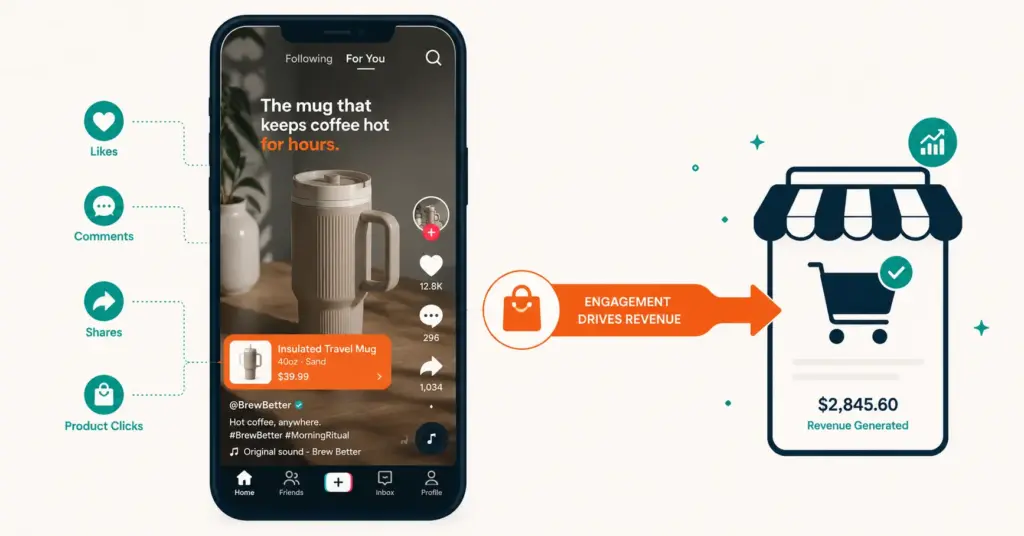
- TikTok marketing for ecommerce combines organic content, paid ads, and TikTok Shop to turn product discovery into direct sales. TikTok's algorithm surfaces content based on engagement quality rather than follower count, meaning new brands can reach millions of potential buyers with zero following and zero ad spend.
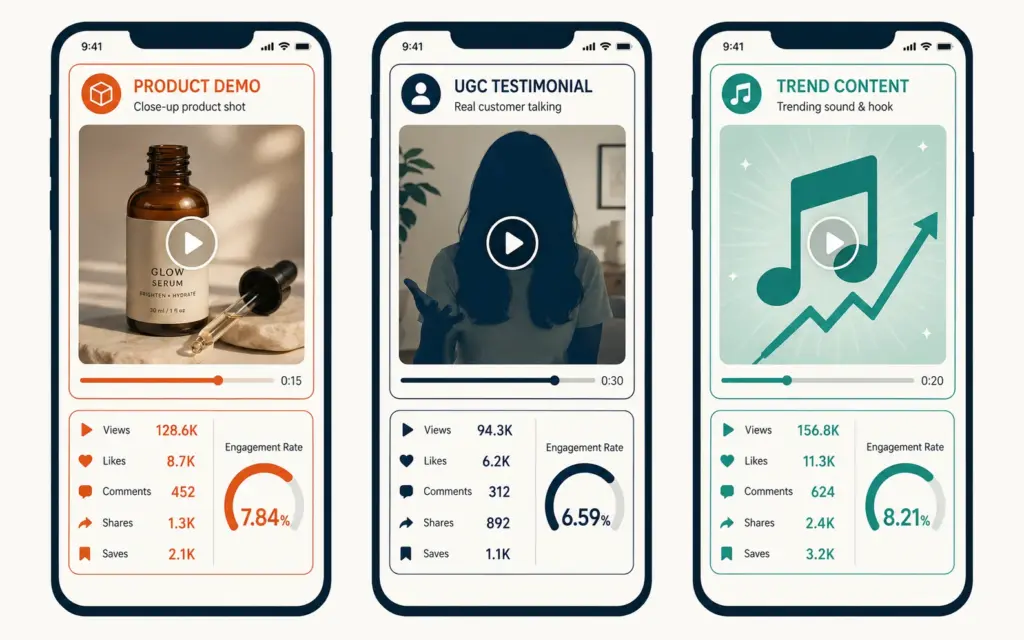
- The 3 TikTok content formats that drive ecommerce sales: product demonstrations (close-up, satisfying, showing the product working), UGC-style testimonials (real people using the product in authentic settings), and trend-riding content (popular sounds and formats adapted to feature your product).
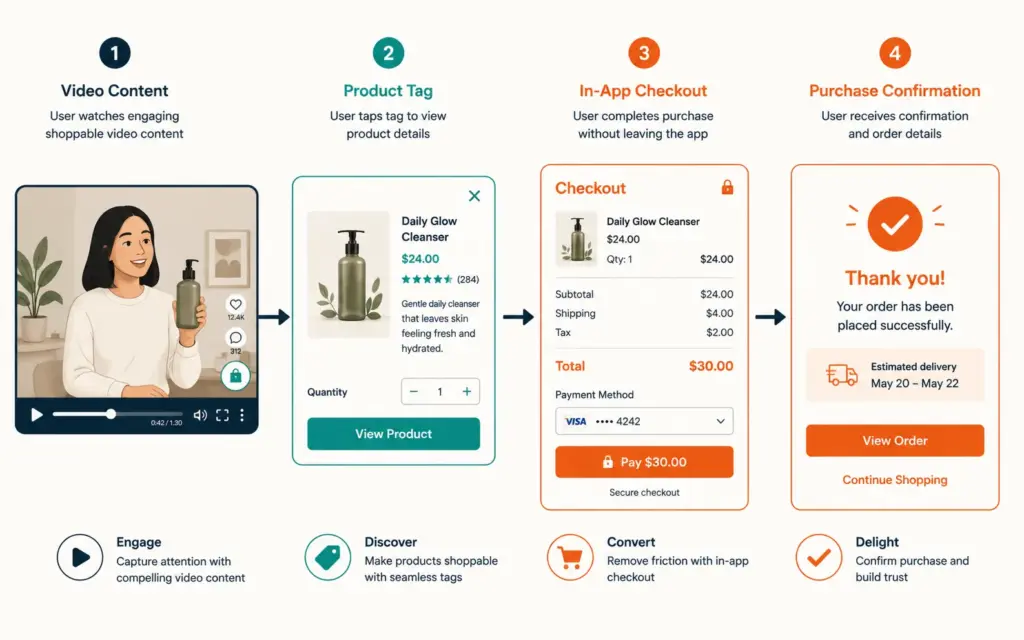
- TikTok Shop enables in-app purchasing directly from videos and live streams, eliminating the friction of redirecting users to an external website. Brands using TikTok Shop report 2 to 4x higher conversion rates versus link-in-bio traffic to external stores.
- Organic TikTok content has the highest potential reach-per-dollar of any social platform in 2026. A single viral product video can generate $10,000 to $100,000+ in revenue without any ad spend. The tradeoff: organic virality is unpredictable, so paid TikTok Ads provide consistent baseline traffic alongside organic efforts.
TikTok marketing for ecommerce is the strategy of using TikTok’s platform for product discovery, brand awareness, and direct sales through organic content, paid advertising, and TikTok Shop. With over 1.5 billion monthly active users and an algorithm that rewards content quality over follower count, TikTok offers ecommerce brands something no other platform does: the realistic possibility of reaching millions of potential buyers without spending on ads or building a following first. According to TikTok’s business research, 44% of TikTok users have purchased a product after seeing it on the platform, and the hashtag #TikTokMadeMeBuyIt has accumulated over 80 billion views.
The platform has evolved from entertainment to a genuine shopping destination. TikTok Shop enables in-app purchases directly from videos. Live shopping events let brands sell in real-time. And paid TikTok Ads use the same engaging format as organic content, making them less intrusive and more effective than traditional display advertising. For broader paid ad strategy, see our ad creative tips guide.
This guide covers the organic content strategy that builds product awareness, the paid TikTok Ads structure that scales profitably, TikTok Shop setup and optimization, influencer partnership frameworks, and the measurement approach that attributes TikTok activity to actual revenue.
How Does Organic TikTok Marketing Work for Ecommerce?
TikTok’s algorithm evaluates every video independently, meaning a brand-new account with zero followers can go viral on their first post if the content resonates. The algorithm prioritizes watch time (percentage of video viewed), engagement rate (likes, comments, shares, saves), and content relevance signals.
The 3 content formats that sell products on TikTok
1. Product demonstrations. Close-up videos showing the product in action. Satisfying textures, before-after transformations, and unexpected use cases perform best. A 15-second video of a cleaning product removing a stain, a knife slicing effortlessly through food, or a skincare product absorbing instantly creates “I need that” reactions that drive immediate purchase intent. Keep demonstrations under 30 seconds for maximum completion rate.
2. UGC-style testimonials. Real people (customers, creators, or founders) talking directly to camera about their experience with the product. “I’ve been using this for 3 weeks and here’s what happened” format builds trust through apparent authenticity. The production should look casual: phone-shot, natural lighting, conversational tone. Over-produced testimonials underperform because they look like ads in a feed of authentic content.
3. Trend-riding content. Adapting trending sounds, formats, and challenges to feature your product. TikTok’s Discover page and Creative Center show trending content daily. Speed matters: trends have a 3 to 7 day window before they saturate. Brands that jump on trends within 48 hours get 5 to 10x the reach of late adopters. The product integration must feel natural; forced trend-product connections feel cringe and get scrolled past.
Organic posting strategy
- Frequency: 1 to 3 posts per day. TikTok rewards consistent posting with algorithmic favor. Quality matters, but volume also matters because the algorithm tests each video independently. Your 50th video might go viral while your first 49 get 200 views each.
- Timing: Post when your target audience is active. For US consumers: 7 to 9 AM, 12 to 1 PM, and 7 to 10 PM local time. Test different times and check analytics for your specific audience patterns.
- Hashtags: Use 3 to 5 relevant hashtags per post. Mix broad (#ecommerce, #onlineshopping) with niche (#kitchentools, #skincareroutine). Don’t overstuff; TikTok penalizes posts with 15+ hashtags.
- Captions: Keep under 150 characters. Use the caption to add context the video doesn’t cover, prompt engagement (“Would you try this?”), or include a CTA (“Link in bio” or “Available in TikTok Shop”).
How Do TikTok Ads Work for Ecommerce?
TikTok Ads use the same full-screen vertical video format as organic content. When done well, ads are indistinguishable from organic posts in the feed, which dramatically reduces ad avoidance behavior compared to platforms with clearly demarcated ad formats.
TikTok ad campaign structure for ecommerce
| Campaign Type | Budget Allocation | Objective | Best Creative |
|---|---|---|---|
| Prospecting (Smart Performance) | 50 to 60% | Website conversions or TikTok Shop purchases | Product demo, UGC, founder talking head |
| Retargeting | 20 to 25% | Website conversions | Testimonials, social proof, limited offers |
| Spark Ads (boosted organic) | 15 to 25% | Boost high-performing organic posts | Already-proven organic content |
Smart Performance Campaigns
TikTok’s equivalent of Meta’s Advantage+ Shopping. The algorithm handles targeting, bidding, and placement optimization. Upload 5 to 10 creative variations, set daily budget, choose conversion event (purchase or add-to-cart), and let the algorithm optimize. Smart Performance typically outperforms manual campaigns by 10 to 25% on CPA after the 3 to 5 day learning phase.
Spark Ads
Spark Ads boost organic posts (yours or a creator’s) as paid ads while keeping the original engagement metrics (likes, comments, shares). This is the most cost-effective TikTok ad format for ecommerce because you’re paying to amplify content that already proved it resonates organically. Use Spark Ads on any organic post that exceeds your average engagement rate by 2x+.
Starting budget
Minimum viable TikTok Ads budget: $50 to $100/day ($1,500 to $3,000/month). Below $50/day, the algorithm doesn’t get enough conversion data to optimize effectively. TikTok recommends 50 conversions per week per ad group for stable optimization. At a 2% conversion rate and $50/day budget, that requires approximately $1,750 in spending before the algorithm stabilizes. For budget planning across channels, see our customer acquisition cost guide.
How Do I Set Up TikTok Shop?
TikTok Shop enables in-app purchasing directly from videos, live streams, and a dedicated shop tab on your profile. Buyers never leave TikTok, eliminating the friction of external website redirects. Brands using TikTok Shop report 2 to 4x higher conversion rates versus link-in-bio traffic.
TikTok Shop setup process
- Apply for TikTok Shop Seller Center: Register at seller.tiktok.com with your business information, tax ID, and bank details. Approval typically takes 1 to 3 business days.
- Upload product catalog: Add products with images, descriptions, pricing, and inventory. Connect your Shopify or WooCommerce store for automatic sync (recommended) or upload manually.
- Set up shipping templates: Configure shipping methods, delivery timeframes, and return policies. TikTok Shop requires sellers to ship within 3 business days.
- Tag products in videos: After approval, tag products in new and existing TikTok videos. Viewers tap the product tag, see price and details, and purchase without leaving the app.
- Enable LIVE shopping: During live streams, pin products for real-time purchasing. Live shopping converts at 3 to 10x the rate of standard video shopping because the real-time interaction builds urgency and trust.
TikTok Shop commission structure
TikTok charges 5% commission on shop sales (reduced from 8% for new sellers in the first 90 days in some markets). Compare this to Amazon’s 8 to 15% referral fees. The lower commission plus higher conversion rates from in-app checkout make TikTok Shop economically attractive for products with 40%+ gross margin. For margin analysis, use our profit margin calculator.
How Do I Work with TikTok Influencers and Creators?
Creator partnership models
- Gifted product (free product, no payment): Send products to 20 to 50 micro-creators (1,000 to 50,000 followers) with no obligation to post. 30 to 50% will create content voluntarily. Cost: product value only. Best for products under $50.
- Paid UGC ($50 to $200/video): Commission specific content from creators through platforms like Billo, Insense, or direct outreach. You own the content and use it in paid ads. No posting requirement on their channel.
- Affiliate partnerships (commission per sale): TikTok Shop’s affiliate program lets creators earn 10 to 20% commission on sales they drive. Zero upfront cost; creators are incentivized by performance. The TikTok Shop affiliate marketplace connects sellers with active creators.
- Sponsored posts ($200 to $5,000+): Pay creators to post about your product on their channel. Pricing scales with follower count and engagement rate. Micro-influencers (10k to 50k followers) typically deliver the best cost-per-engagement. For influencer strategy depth, see our influencer marketing guide.
Creator selection criteria
Engagement rate matters more than follower count. According to Later’s influencer marketing research, TikTok creators with 10,000 to 50,000 followers generate 2 to 3x higher engagement rates than creators with 500,000+ followers. A creator with 20,000 followers and 8% engagement rate (1,600 engagements per post) outperforms a creator with 200,000 followers and 1% engagement rate (2,000 engagements, but at 10x the cost).
Evaluate creators on: content quality (do their videos look like something your target buyer would watch?), audience demographics (check TikTok Creator Marketplace for audience age, gender, and location data), previous brand partnerships (do they promote too many products, diluting authenticity?), and engagement authenticity (are comments genuine or bot-generated?).
How Do I Measure TikTok Marketing ROI?
The TikTok measurement challenge
TikTok’s attribution is less mature than Meta’s. Many TikTok-influenced purchases happen on Google (user sees product on TikTok, searches the product name on Google, buys on your website). This “TikTok-to-Google” path means TikTok often gets zero attribution credit for sales it actually initiated. GA4 credits Google organic or paid; Meta credits itself if retargeting fires; TikTok gets nothing.
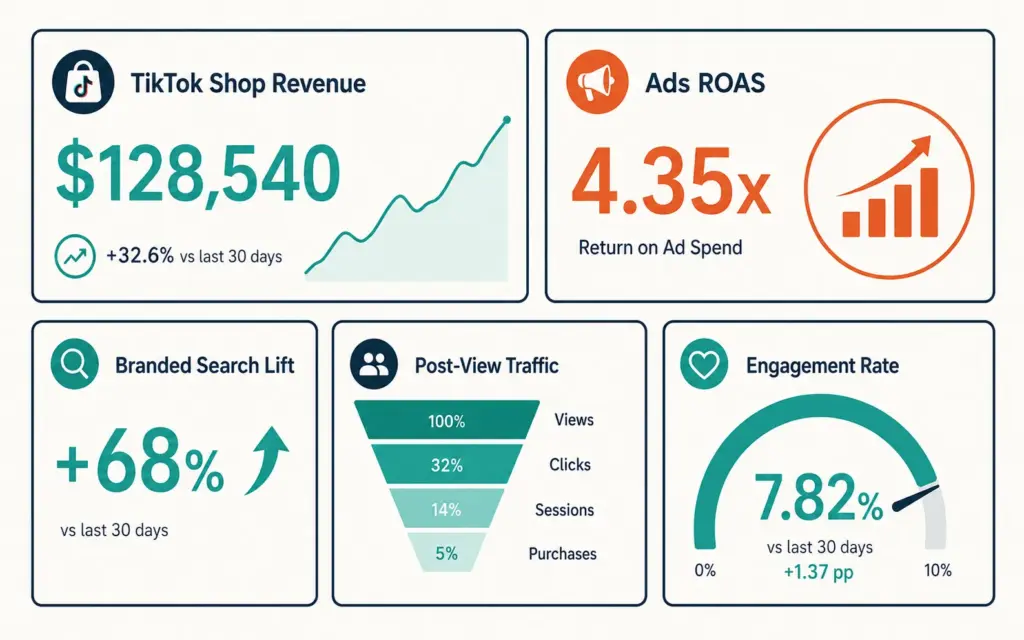
The 5 TikTok metrics for ecommerce
- TikTok Shop revenue: Direct, measurable, fully attributed to TikTok. Track in Seller Center.
- TikTok Ads ROAS: In-platform reported ROAS with 7-day click, 1-day view attribution. Comparable to Meta’s reporting. For attribution methodology, see our attribution modeling guide.
- Branded search lift: Compare Google brand search volume before and after TikTok activity. Google Trends and Search Console show whether TikTok content drives brand searches. A 20%+ lift in brand search volume within 30 days of TikTok campaign launch indicates strong TikTok-to-Google pipeline.
- Post-view website traffic: TikTok Pixel tracks users who viewed your ad and later visited your site. This captures the consideration path between TikTok exposure and website purchase. For tracking implementation, see our tracking setup guide.
- Content engagement rate: Average engagement (likes + comments + shares + saves / views) across your content. Benchmark: 3 to 5% for branded content, 5 to 10% for high-performing ecommerce content. Below 2% signals content quality issues.
Common TikTok Marketing Mistakes for Ecommerce
Repurposing Instagram content without adaptation
Instagram Reels and TikTok have different content expectations. Polished, aspirational Instagram content underperforms on TikTok where authenticity, humor, and rawness drive engagement. Shoot TikTok-first content: vertical, casual, trending-sound-adapted. Cross-post to Reels afterward, not the reverse.
Focusing on follower count over content quality
TikTok’s algorithm evaluates each video independently. A 500-follower account with great content gets more views than a 50,000-follower account with mediocre content. Stop chasing followers. Focus on creating 1 to 3 high-quality posts daily. Followers accumulate as a byproduct of good content, not as a prerequisite for reach.
Treating TikTok ads like Facebook ads
Meta ads can use professional studio creative and perform well. TikTok ads that look like ads get scrolled past immediately. TikTok’s creative best practice: “Make TikToks, not ads.” Use native-looking content, trending sounds, and creator-style production. Overly branded, corporate-looking video consistently underperforms on the platform. For Facebook-specific strategy comparison, see our Facebook ads ecommerce guide.
Ignoring TikTok Shop
Directing TikTok users to an external website adds 3 to 5 friction steps (click link, load page, browse, add to cart, checkout). TikTok Shop removes all of these by keeping the purchase within the app. If you sell physical products and TikTok Shop is available in your market, the conversion advantage is too significant to ignore. For broader checkout optimization, see our checkout optimization guide.
Giving up after 30 days with low views
Most TikTok accounts produce 30 to 50 videos before one breaks through. The algorithm needs content data to understand your niche and audience. Brands that post consistently for 90+ days before evaluating results outperform those that abandon after 30 days of low views. TikTok marketing is a volume game with exponential upside when a video connects.
Frequently Asked Questions
Yes for most consumer product brands. TikTok offers the highest organic reach potential of any platform in 2026, with 44% of users reporting they’ve purchased products discovered on TikTok. The platform is particularly effective for visually demonstrable products (beauty, kitchen, fashion, gadgets). Brands that commit to 90+ days of consistent content (1 to 3 posts daily) and combine organic with paid TikTok Ads see the strongest results.
Minimum viable budget is $50 to $100/day ($1,500 to $3,000/month). Below $50/day, the algorithm doesn’t get enough conversion data to optimize. Allocate 50 to 60% to Smart Performance campaigns for prospecting, 20 to 25% to retargeting, and 15 to 25% to Spark Ads boosting top organic content. TikTok recommends 50 conversions per week per ad group for stable optimization.
TikTok Shop enables in-app purchasing directly from TikTok videos and live streams. Buyers see a product tag on a video, tap it, and complete the purchase without leaving TikTok. Commission is 5% per sale. Setup requires Seller Center registration, product catalog upload, and shipping configuration. TikTok Shop converts 2 to 4x higher than link-in-bio external traffic because it eliminates the friction of redirecting to an external website.
Post 1 to 3 times daily. TikTok rewards consistency with algorithmic distribution. Each video is evaluated independently, so volume increases your chances of a breakout post. Quality matters, but a perfectly polished post once per week significantly underperforms three decent posts per day. Most successful ecommerce TikTok accounts post 30 to 50 videos before their first viral hit.
Three formats consistently drive ecommerce sales: product demonstrations (close-up, satisfying, showing the product working), UGC-style testimonials (real people sharing authentic experiences), and trend-adapted content (popular sounds and formats featuring your product). Product demo videos under 30 seconds with a clear result or transformation perform best. Over-produced, corporate-looking content underperforms on TikTok.
Use TikTok Creator Marketplace (in TikTok Ads Manager) for data-driven creator search with audience demographics and engagement metrics. Platforms like Billo and Insense connect brands with UGC creators at $50 to $200 per video. For unpaid partnerships, gift products to 20 to 50 micro-creators (1,000 to 50,000 followers) and expect 30 to 50% to post voluntarily. Prioritize engagement rate (5%+) over follower count.
Related Reads
- Ad Creative Tips
- Influencer Marketing Guide
- Facebook Ads for Ecommerce
- Retargeting Strategies
- Attribution Modeling
- Customer Acquisition Cost
Enjoying this? Get more like it every week.
One email per week with ecommerce strategies, tool picks, and seller insights. No spam.