
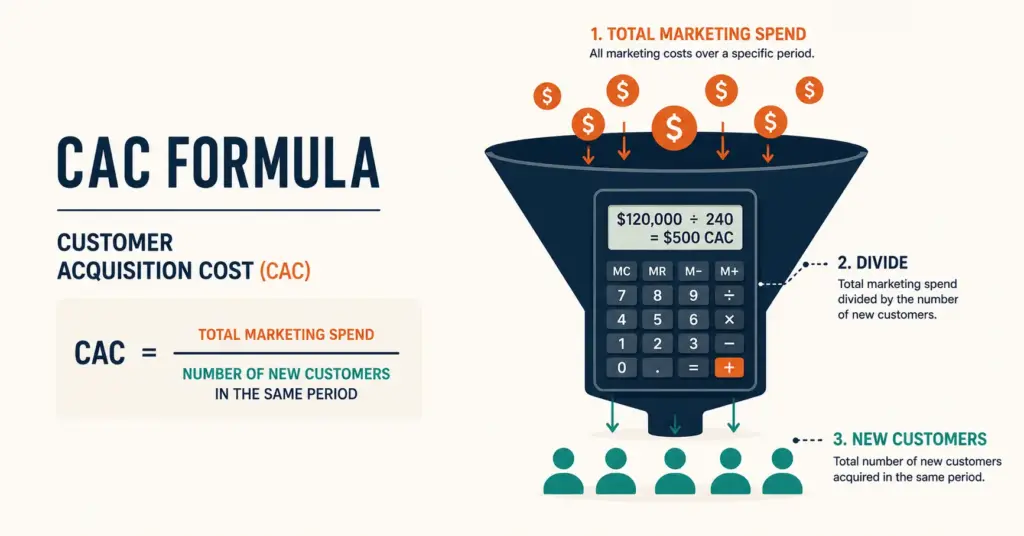
- Customer acquisition cost (CAC) is the total cost of acquiring a new customer: all marketing and sales spend divided by the number of new customers gained. The formula is simple but the inputs require discipline. Ecommerce CAC ranges from $10 to $200+ depending on product, channel, and price point.
- CAC alone is meaningless without customer lifetime value (LTV). A $50 CAC is cheap if LTV is $300 (6:1 ratio) and expensive if LTV is $60 (1.2:1 ratio). Target a CAC to LTV ratio of 3:1 or better for sustainable growth.
- The 7 tactics that reduce CAC without cutting growth: improve conversion rate (same spend, more customers), build organic channels (SEO, content, social), optimize ad creative and targeting, launch referral programs, increase email and SMS revenue, retarget efficiently, and reduce wasted ad spend through better attribution.
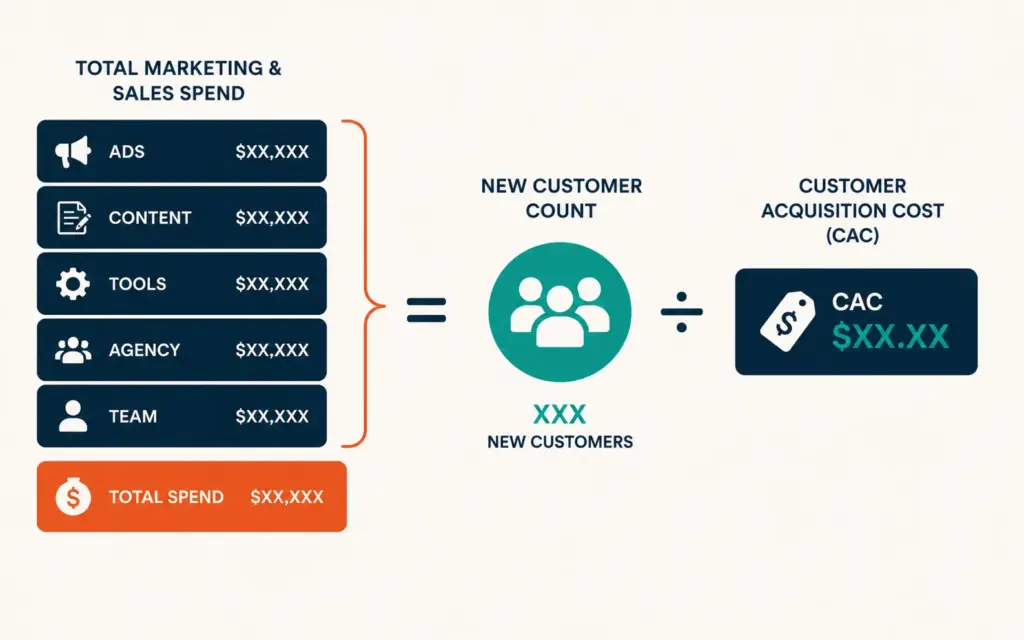
- Most ecommerce brands undercount CAC by excluding agency fees, software costs, and team salaries from the calculation. Full-loaded CAC includes every dollar spent to acquire a customer, not just ad spend.
Customer acquisition cost (CAC) is the total cost of converting a new visitor into a paying customer. The basic formula: total marketing and sales spend in a period divided by the number of new customers acquired in that period. A store that spends $10,000 on marketing in January and acquires 200 new customers has a CAC of $50. That $50 includes every dollar that contributed to acquisition: ad spend, content production, email tools, agency fees, and the salary portion of anyone working on acquisition. According to ProfitWell’s CAC benchmarks, ecommerce CAC has increased 60% over the past 5 years due to rising ad costs and increased competition.
CAC is the metric that determines whether growth is profitable or just revenue on a treadmill. A store growing 50% year-over-year with a $120 CAC on a $60 average order is growing itself into bankruptcy. A store growing 20% with a $25 CAC on the same $60 order is building a sustainable business. The growth rate is less important than the relationship between what you spend to get a customer and what that customer is worth over time. For the broader metrics framework, see our ecommerce KPIs guide.
This guide covers how to calculate CAC correctly (most brands get it wrong), channel-level benchmarks, the CAC to LTV ratio that determines sustainability, and the 7 tactics that reduce acquisition cost without sacrificing growth.
How Do I Calculate Customer Acquisition Cost?
The basic CAC formula
CAC = Total acquisition spend / Number of new customers acquired
The formula is simple. Getting the inputs right is where most brands fail.
What counts as “acquisition spend”
Full-loaded CAC includes everything that contributes to acquiring customers:
- Paid advertising: Meta ads, Google Ads, TikTok ads, Pinterest ads, influencer payments
- Content and SEO: Writer salaries or freelance costs, SEO tool subscriptions, content agency fees
- Marketing software: Email platform (Klaviyo), analytics tools (Triple Whale), design tools (Canva Pro)
- Agency fees: Paid media management, SEO agency, creative agency retainers
- Team salaries: Marketing team compensation (or the % of founder time spent on marketing)
- Promotions: Discount costs on first-purchase offers (if you offer 15% off first order, that’s an acquisition cost)
What counts as “new customer”
Only first-time purchasers. Repeat purchases from existing customers are retention revenue, not acquisition. Most analytics platforms separate new vs returning customers. Shopify reports this under Analytics > Reports > Customers Over Time. GA4 tracks new vs returning users natively. If you can’t distinguish new from returning customers in your data, your CAC calculation will undercount by 20 to 40%. For tracking setup, see our tracking setup guide.
Channel-level CAC
Blended CAC (total spend / total new customers) gives you the overall picture. Channel-level CAC tells you where to invest more and where to cut:
- Meta Ads CAC: Meta ad spend / new customers from Meta
- Google Ads CAC: Google ad spend / new customers from Google
- Organic CAC: Content and SEO spend / new customers from organic search
- Email CAC: Email platform cost / new customers from email (typically very low because email mostly drives repeat, not acquisition)
Compare channel CAC monthly. Shift budget from high-CAC channels to low-CAC channels, unless the high-CAC channel serves a specific strategic purpose (brand awareness, category entry). For channel measurement depth, see our attribution modeling guide.
What is a Good CAC for Ecommerce?
CAC benchmarks vary dramatically by product category, price point, and business model:
| Category | Typical CAC Range | Average Order Value | Typical CAC:AOV Ratio |
|---|---|---|---|
| Fashion and apparel | $15 to $50 | $50 to $100 | 1:2 to 1:4 |
| Beauty and skincare | $20 to $60 | $40 to $80 | 1:1.5 to 1:3 |
| Home and kitchen | $25 to $75 | $60 to $150 | 1:2 to 1:3 |
| Electronics and tech | $30 to $100 | $100 to $500 | 1:3 to 1:7 |
| Supplements and health | $30 to $80 | $40 to $70 | 1:1 to 1:2 |
| Subscription boxes | $40 to $120 | $30 to $60/month | Payback in 2 to 4 months |
| Luxury and premium | $50 to $200+ | $200 to $1,000+ | 1:3 to 1:10 |
CAC is meaningless without LTV
A $100 CAC is cheap for a subscription brand with $600 LTV (6:1 ratio). The same $100 CAC is unsustainable for a single-purchase brand with $80 AOV and 50% gross margin ($40 gross profit minus $100 CAC = negative $60 per customer). Always evaluate CAC relative to customer lifetime value, not in isolation.
How Does the CAC to LTV Ratio Work?
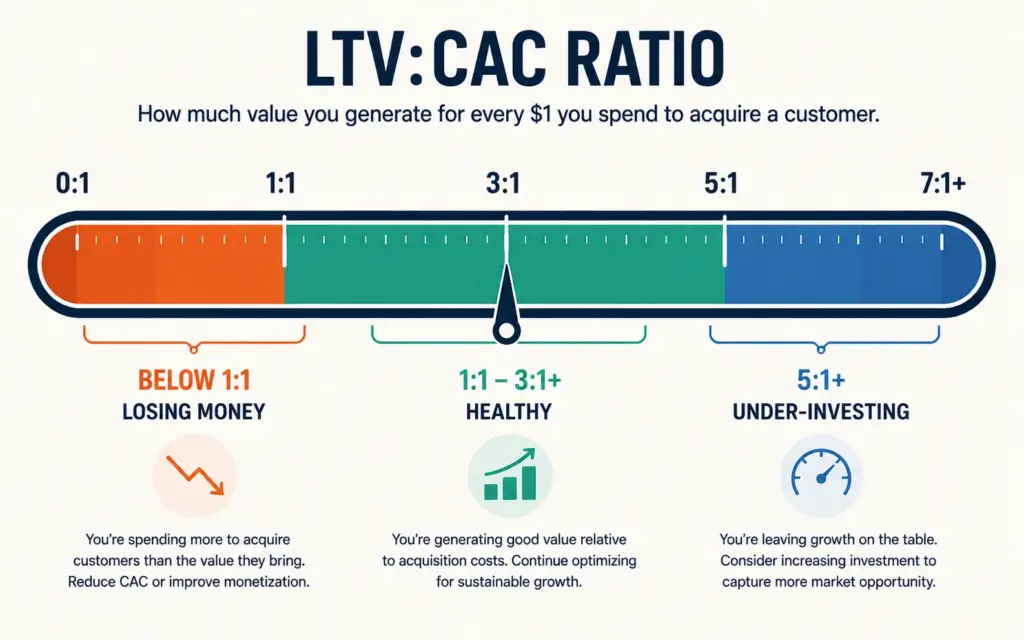
The CAC to LTV ratio (or LTV:CAC ratio) is the most important profitability metric in ecommerce. It answers: for every dollar spent acquiring a customer, how many dollars of gross profit does that customer generate over their lifetime?
LTV:CAC ratio benchmarks
- Below 1:1: Losing money on every customer. Unsustainable. Reduce CAC or increase LTV immediately.
- 1:1 to 2:1: Marginal. Covering acquisition cost but not generating profit after operating expenses. Tighten targeting, improve retention.
- 3:1: Healthy. The standard target for sustainable ecommerce growth. Every $1 of CAC produces $3 of gross profit over the customer lifetime.
- 5:1 or higher: Very efficient, but potentially under-investing in growth. If LTV:CAC is 8:1, you could increase ad spend significantly and still maintain profitable acquisition.
Calculating LTV
LTV = Average order value x Purchase frequency x Average customer lifespan x Gross margin %
Example: $60 AOV x 2.5 purchases per year x 3-year lifespan x 50% gross margin = $225 LTV. With a $50 CAC, LTV:CAC = 4.5:1. Healthy. For retention tactics that increase purchase frequency and lifespan, see our customer retention guide.
CAC payback period
The CAC payback period measures how many months it takes to recover the acquisition cost from a customer’s purchases. Formula: CAC / (AOV x Gross margin % x Monthly purchase frequency).
Example: $50 CAC / ($60 x 50% x 0.2 purchases/month) = 8.3 months to payback. Under 12 months is acceptable for most funded brands. Under 6 months is ideal. Over 12 months means your cash flow is financing customer acquisition for too long, creating working capital pressure.
How Do I Reduce Customer Acquisition Cost?
1. Improve conversion rate
The fastest CAC reduction requires no additional ad spend. If your site converts at 2% and you improve to 2.5%, you get 25% more customers from the same traffic, reducing effective CAC by 20%. A 1-percentage-point conversion rate improvement on 50,000 monthly visitors produces 500 additional customers per month at zero incremental acquisition cost. For conversion depth, see our checkout optimization guide and product page design guide.
2. Build organic channels
Organic search, content marketing, social media, and word-of-mouth have near-zero marginal acquisition cost per customer. The investment is upfront (content creation, SEO optimization) but the cost per customer decreases over time as traffic compounds. Stores with 40%+ organic traffic consistently report blended CAC 30 to 50% lower than ad-dependent stores. For content strategy, see our content marketing guide.
3. Optimize ad creative and targeting
Ad creative quality drives 50 to 70% of campaign performance. Better creative reduces CPA 20 to 40% without budget changes. Test 10 to 20 creative variations per month, kill underperformers fast, and scale winners. Similarly, audience refinement (excluding low-intent segments, focusing on high-converting lookalikes) concentrates spend on likely buyers. For creative depth, see our ad creative tips guide.
4. Launch a referral program
Referred customers have 25 to 50% lower CAC than ad-acquired customers and 16 to 25% higher LTV. According to ReferralCandy’s marketing research, referred customers have a 37% higher retention rate. A simple referral program (“Give $10, Get $10”) costs $10 to $20 per referred customer versus $30 to $80 for ad-acquired. Tools like ReferralCandy, Yotpo, or Smile.io automate the process for $50 to $200/month.
5. Increase email and SMS revenue share
Email and SMS re-engage existing visitors and warm leads at near-zero incremental cost per conversion. Stores generating 25 to 35% of revenue from email effectively reduce blended CAC because those conversions required no additional ad spend. Welcome flows, abandoned cart sequences, and post-purchase upsells are the three highest-ROI email automations. For email strategy, see our email marketing strategy guide.
6. Retarget efficiently
Retargeting converts at 3 to 5x the rate of prospecting at lower cost per conversion. Allocating 15 to 25% of ad budget to retargeting reduces blended CAC by concentrating spend on high-intent audiences (cart abandoners, product viewers). But retargeting without frequency caps and exclusion rules wastes budget. For the full retargeting playbook, see our retargeting strategies guide.
7. Eliminate wasted ad spend
Most ecommerce brands waste 15 to 30% of ad spend on low-performing placements, audiences, or channels. Monthly channel-level CAC analysis identifies where money is wasted: channels with CAC above 50% of AOV on single-purchase products, audiences with zero conversions after 500+ impressions, or campaigns running for 30+ days without positive ROAS. Cut the waste, reallocate to proven winners. For measurement depth, see our GA4 ecommerce setup guide.
How Do I Track CAC Over Time?
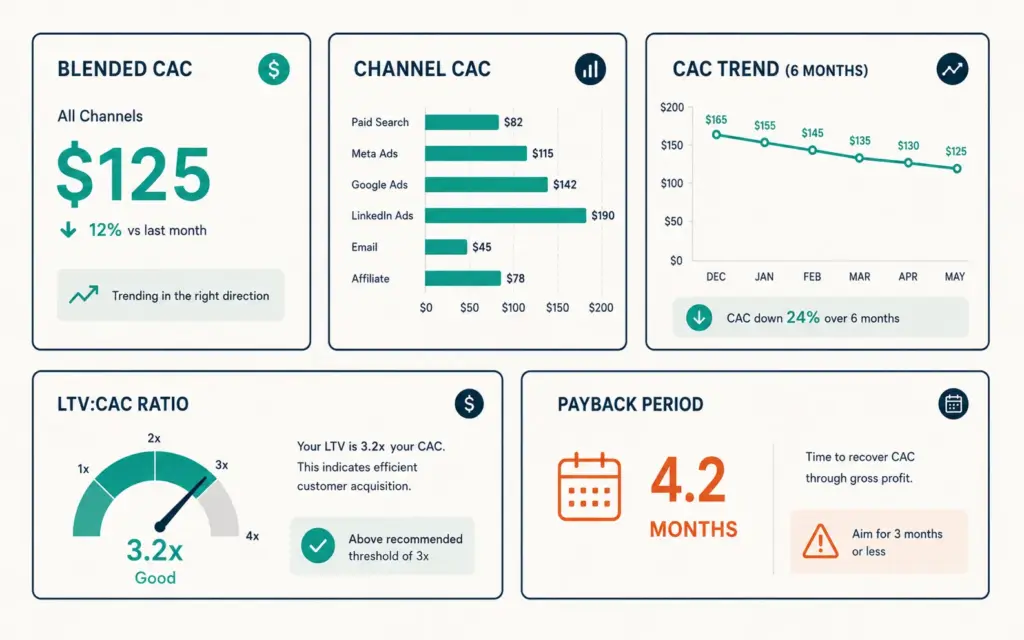
Monthly CAC dashboard
Track these metrics monthly, compare quarter-over-quarter:
- Blended CAC: Total marketing spend / new customers. The top-level health metric.
- Channel CAC: Per-channel spend / per-channel new customers. Identifies where to invest and where to cut.
- CAC trend: Is CAC rising, stable, or falling over 6 months? Rising CAC with stable revenue signals market saturation or creative fatigue.
- LTV:CAC ratio: Quarterly calculation. Below 3:1 triggers immediate action.
- CAC payback period: Months to recover acquisition cost. Above 12 months triggers retention and pricing review.
Common tracking mistakes
Underreporting CAC by excluding agency fees, tool costs, or team salaries from the calculation. Overreporting CAC by including retention spend (email to existing customers) in acquisition costs. Confusing ROAS (revenue return) with CAC (customer acquisition cost); a 4:1 ROAS doesn’t mean CAC is sustainable if most revenue comes from repeat purchasers you already acquired. For analytics architecture, see our ecommerce tech stack guide.
Frequently Asked Questions
Customer acquisition cost is the total cost of converting a new visitor into a paying customer. The formula: total marketing and sales spend divided by the number of new customers acquired. Full-loaded CAC includes ad spend, content production, marketing tools, agency fees, team salaries, and first-purchase promotions. Ecommerce CAC typically ranges from $10 to $200+ depending on product, channel, and price point.
Target a LTV:CAC ratio of 3:1 or better. This means every $1 spent acquiring a customer generates $3 or more in gross profit over their lifetime. Below 1:1 means losing money per customer. Between 1:1 and 2:1 is marginal. Above 5:1 is very efficient but may indicate underinvestment in growth. Calculate LTV as average order value times purchase frequency times customer lifespan times gross margin percentage.
The 7 fastest CAC reduction tactics: improve site conversion rate (25% more customers from same spend), build organic channels (SEO, content), optimize ad creative (20 to 40% CPA reduction), launch referral programs (25 to 50% lower CAC per referred customer), increase email and SMS revenue share, retarget efficiently, and eliminate wasted ad spend through monthly channel analysis. Conversion rate improvement produces the fastest results because it requires no additional spend.
CAC payback period measures how many months it takes to recover the acquisition cost from a customer’s purchases. Formula: CAC divided by (AOV times gross margin times monthly purchase frequency). Under 6 months is ideal for most ecommerce brands. Under 12 months is acceptable. Over 12 months creates working capital pressure because cash is tied up financing acquisition for too long before generating profit.
Both. Blended CAC (total spend / total new customers) gives the overall health picture. Channel-level CAC (channel spend / channel new customers) identifies where to invest more and where to cut. Compare channel CAC monthly and shift budget from high-CAC channels to low-CAC channels unless the high-CAC channel serves a specific strategic purpose like brand awareness or market entry.
Common reasons for rising CAC: ad creative fatigue (same ads running too long), increasing competition in your category driving up CPMs, audience saturation on your primary platform, iOS tracking changes reducing ad optimization accuracy, or scaling spend past the efficient frontier (diminishing returns at higher budgets). Address by refreshing creative monthly, diversifying channels, improving conversion rate, and implementing server-side tracking.
Related Reads
- Ecommerce KPIs Guide
- Attribution Modeling
- Tracking Setup Guide
- GA4 Ecommerce Setup
- Customer Retention Guide
- Retargeting Strategies
Enjoying this? Get more like it every week.
One email per week with ecommerce strategies, tool picks, and seller insights. No spam.