
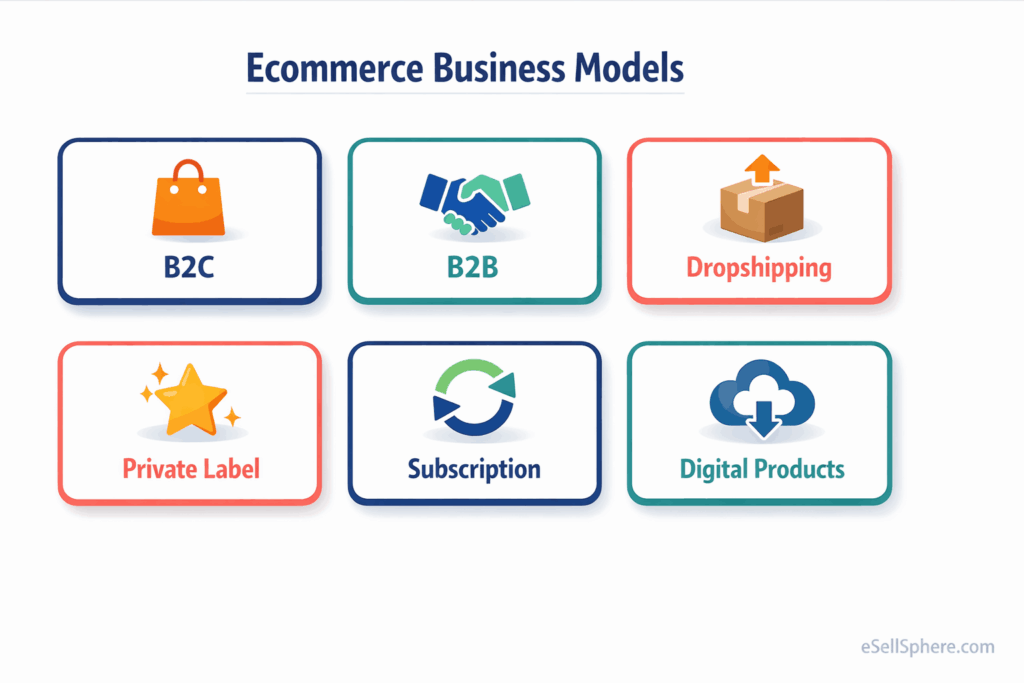
- There are two layers to picking your model: WHO you sell to (B2C, B2B, C2C) and HOW you fulfill orders (dropshipping, private label, wholesale, subscription, digital).
- B2C is where most new sellers start and accounts for the majority of ecommerce revenue. B2B is less glamorous but often more profitable per transaction with longer customer relationships.
- Dropshipping has the lowest startup cost ($100-$500) but the thinnest margins (10-30%). Private label has the highest margins (50-80%) but requires $2,000-$10,000 upfront.
- Subscription models are the gold standard for predictable revenue. Even if your core model is something else, bolting on a subscription component can transform your cash flow.
- Pick based on your budget, risk tolerance, and skills - not what's trending on YouTube. The "best" model is the one you can actually execute.
Here’s a mistake I see constantly: someone decides to “start an ecommerce business” and immediately jumps into picking products and building a website. They skip the most fundamental question entirely. What kind of ecommerce business are you actually building?
An ecommerce business model is the framework that defines who you sell to, how you source and deliver products, and how you generate revenue from online sales. The major models include B2C (business-to-consumer), B2B (business-to-business), C2C (consumer-to-consumer), and variations like DTC (direct-to-consumer), along with fulfillment methods like dropshipping, private label, wholesale, and subscription. Global ecommerce sales are projected to reach $6.88 trillion in 2026, but that revenue isn’t distributed equally across models. Choosing the right one shapes everything from your startup costs to your long-term profitability.
If you’re following our complete guide to starting an ecommerce business, this decision comes before you pick products, before you choose a platform, before you spend a dollar on inventory. Get this wrong and you’ll build a business that fights you at every step. Get it right and the rest of the decisions start falling into place.
Let me break this down into the two decisions you actually need to make.
The Two Layers: Who You Sell To + How You Deliver
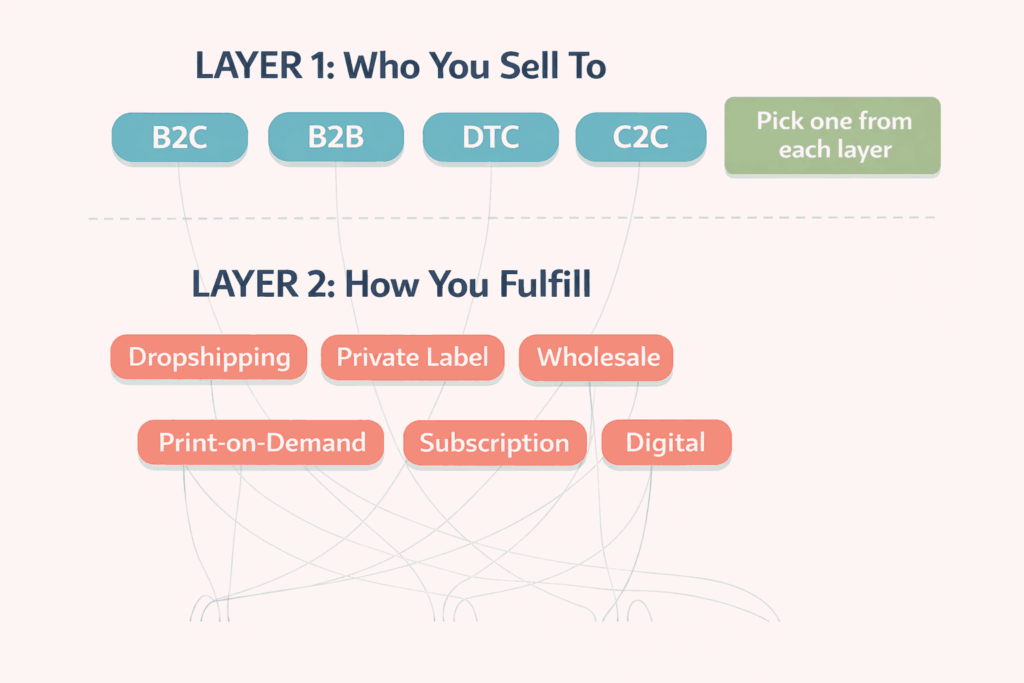
Most guides dump B2C, dropshipping, and subscription models into one list like they’re the same type of decision. They’re not. You’re actually making two choices:
Layer 1: Who’s your customer? This determines your market, sales cycle, order size, and marketing approach. Your options are B2C, B2B, C2C, DTC, and a few others.
Layer 2: How do you fulfill orders? This determines your startup costs, margins, and operations. Your options are dropshipping, private label, wholesale, print-on-demand, subscription, and digital products.
A DTC skincare brand using private label manufacturing is a completely different business than a B2B office supplies company using wholesale distribution, even though both are “ecommerce.” Understanding both layers is what separates sellers who build sustainable businesses from those who quit after six months.
Layer 1: Ecommerce Models by Customer Type
B2C (Business-to-Consumer): The Most Common Model
This is what most people picture when they think “online store.” You sell products directly to individual customers. Amazon, Target, any Shopify store selling to regular people. It’s the entry point for most new sellers.
B2C works because the buying cycle is short. Someone sees your product, decides they want it, and buys it in minutes. No procurement committees, no purchase orders, no 6-month sales cycles. The trade-off is that individual orders tend to be smaller and customer loyalty is harder to build.
Best for: First-time sellers, consumer products, anyone with a product idea they want to test quickly.
B2B (Business-to-Business): Bigger Orders, Longer Relationships
B2B ecommerce is the less glamorous cousin that quietly makes more money. The global B2B ecommerce market is expected to exceed $32 trillion by 2026, dwarfing B2C by a massive margin. Companies like Alibaba, Grainger, and Amazon Business run on this model.
The sales cycle is longer (4-7 months is normal) and requires more relationship building. But when a B2B customer places an order, it’s usually large, recurring, and far less price-sensitive than consumer purchases. A single B2B client can be worth more than hundreds of B2C customers.
Best for: Sellers with industry expertise, products that businesses need on a recurring basis, people comfortable with longer sales cycles.
DTC (Direct-to-Consumer): Owning the Relationship
DTC is technically a subset of B2C, but it deserves its own section because the strategy is fundamentally different. DTC brands manufacture (or private label) their own products and sell directly to consumers through their own website. No Amazon. No retail middlemen. No wholesale margin giveaways.
Brands like Warby Parker, Dollar Shave Club, and Allbirds proved that cutting out middlemen creates both higher margins and stronger brand loyalty. The downside? You own every part of the experience: manufacturing, marketing, fulfillment, customer service. That’s more work but also more control.
Best for: Brand builders who want full control, sellers with unique products, anyone focused on long-term customer relationships over quick transactions.
C2C (Consumer-to-Consumer): Marketplace Selling
C2C platforms let individuals sell to each other. Think eBay, Facebook Marketplace, Poshmark, Mercari. The platform handles the infrastructure and you handle the selling.
This is often where people start before building their own store. It’s low-risk because you’re selling existing items (thrifted finds, used goods, handmade products) without needing inventory investment. The limitation is that you’re building the platform’s brand, not yours.
Best for: Side hustlers, resellers, people testing demand before investing in a full store. For more on reselling, check our products to resell guide.
| Model | Avg. Order Size | Sales Cycle | Customer Loyalty | Examples |
|---|---|---|---|---|
| B2C | $50-$150 | Minutes to days | Medium | Amazon, Target, Shopify stores |
| B2B | $500-$50,000+ | 4-7 months | Very High | Alibaba, Grainger, Amazon Business |
| DTC | $30-$200 | Minutes to days | High | Warby Parker, Allbirds, Glossier |
| C2C | $15-$100 | Minutes | Low | eBay, Poshmark, Facebook Marketplace |
Layer 2: Ecommerce Models by Fulfillment Method
This is where the rubber meets the road. Your fulfillment model determines how much money you need to start, what your margins look like, and how much operational complexity you’re signing up for.
Dropshipping: Lowest Risk, Lowest Margin
You list products on your store. When someone buys, your supplier ships directly to the customer. You never touch the inventory. The appeal is obvious: you can start for under $500 and test products without financial risk.
The reality is more nuanced. Margins are thin (10-30%), shipping times can be long (especially from overseas suppliers), and you have zero control over product quality and packaging. I’ve seen dropshipping work well as a testing ground. I’ve rarely seen it work well as a long-term standalone model unless you eventually transition to holding your own inventory.
For a deep dive on this model, read our complete dropshipping guide.
Startup cost: $100-$500
Margins: 10-30%
Best for: Testing product ideas, learning ecommerce fundamentals, limited budget
Private Label: Highest Margins, Highest Investment
You find a manufacturer, customize a product with your branding, and sell it as your own. This is how most serious ecommerce brands operate. Think of every Amazon “brand” you’ve never heard of that somehow has 10,000 reviews. Most of them are private label.
Margins are excellent (50-80%) because you control the product, the pricing, and the brand story. The barrier is upfront investment. A first order from a manufacturer typically runs $2,000-$10,000 depending on the product. And if the product doesn’t sell, you’re sitting on inventory.
Startup cost: $2,000-$10,000
Margins: 50-80%
Best for: Brand builders, sellers ready to invest, anyone targeting Amazon FBA
Wholesale/Reselling: Proven Products, Established Demand
Buy existing branded products in bulk at wholesale prices, sell them individually at retail prices. You’re not creating anything new. You’re being a smart middleman.
The advantage is that you’re selling products with proven demand and existing brand recognition. The disadvantage is that anyone else can sell the same products, so you’re competing on price, service, and speed rather than brand differentiation.
Startup cost: $1,000-$5,000
Margins: 20-50%
Best for: Sellers who want to skip product development, marketplace sellers, those with supplier relationships
Print-on-Demand: Creative Freedom, Zero Inventory
Similar to dropshipping, but for custom-designed products. You create designs, put them on t-shirts/mugs/phone cases/posters, and the POD service prints and ships when someone orders. Printful, Printify, and Gooten are the big players.
The margins are better than dropshipping (30-50%) because your designs add unique value. The limitation is that product quality is only as good as your POD partner, and you’re restricted to their product catalog.
Startup cost: $0-$300
Margins: 30-50%
Best for: Designers, artists, niche community brands, people who want creative control without inventory
Subscription: The Predictable Revenue Dream
Charge customers on a recurring basis (monthly, quarterly) for curated boxes, replenishment products, or access to digital content. The subscription ecommerce market is projected to approach $1 trillion by 2026. For good reason. Predictable revenue changes everything about how you plan and grow a business.
Subscription works for two types of products: “restock” items people need regularly (coffee, supplements, razors) and “discovery” items people enjoy receiving (snack boxes, beauty samples, book clubs). The key metric is churn rate. If more than 10% of subscribers cancel each month, the model breaks down fast.
Startup cost: $500-$5,000
Margins: 40-60%
Best for: Consumable products, curated experiences, any product with a natural repurchase cycle
Digital Products: Maximum Margin, Minimum Overhead
Sell things that don’t physically exist: online courses, templates, ebooks, software, design assets, music. Once you create the product, there’s no manufacturing, no shipping, no inventory. Every sale after the first is nearly pure profit.
Margins are insane (80-95%). But marketing digital products requires a different skill set. You’re selling outcomes and expertise, not tangible objects. Content marketing, email lists, and personal branding matter more here than ad spend.
Curious about this path? Our guide on digital products to sell covers the best opportunities.
Startup cost: $0-$500
Margins: 80-95%
Best for: Experts, educators, designers, anyone with knowledge or skills people will pay for
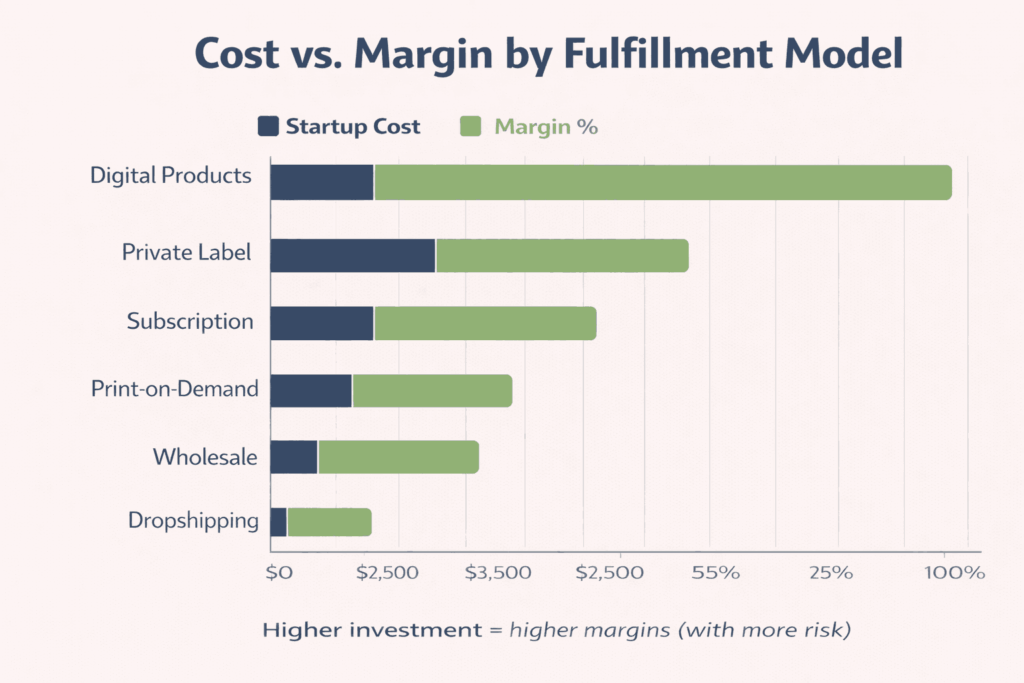
| Fulfillment Model | Startup Cost | Margins | Complexity | Inventory Risk |
|---|---|---|---|---|
| Dropshipping | $100-$500 | 10-30% | Low | None |
| Private Label | $2K-$10K | 50-80% | High | High |
| Wholesale | $1K-$5K | 20-50% | Medium | Medium |
| Print-on-Demand | $0-$300 | 30-50% | Low | None |
| Subscription | $500-$5K | 40-60% | Medium-High | Medium |
| Digital Products | $0-$500 | 80-95% | Low | None |
How to Pick the Right Model (Decision Framework)
Don’t pick a model because some YouTube guru told you it’s “the best.” Pick based on these four factors:
1. What’s your budget? Under $500? You’re looking at dropshipping, print-on-demand, or digital products. $2,000-$10,000? Private label and wholesale open up. This isn’t about what’s “best.” It’s about what’s realistic for where you are right now.
2. What skills do you already have? Good at design? Print-on-demand or digital products. Good at sales and relationships? B2B wholesale. Good at marketing and brand building? DTC private label. Play to your strengths instead of learning everything from scratch.
3. How much time can you invest? Dropshipping and POD are lower time commitment. Private label and subscription require serious upfront work before your first sale. Be honest about your availability, especially if this is a side project.
4. What’s your risk tolerance? If losing $5,000 would wreck you financially, don’t start with private label. Build up with a lower-risk model first, learn the fundamentals, then reinvest profits into a higher-margin model.
Here’s my honest take: most successful ecommerce sellers don’t stick with their first model forever. They start with dropshipping or POD, learn what sells, then graduate to private label or wholesale once they have data. The first model is a learning tool. The second model is the business.
Models You Can Combine (And Should)
Here’s something the “pick one model” advice misses: the most profitable ecommerce businesses combine multiple models. A few examples:
- DTC + Subscription: Sell your private label coffee directly to consumers with a monthly subscription option. One-time buyers get you traffic. Subscribers give you predictable revenue.
- B2C + B2B: Sell candles to consumers on your website and simultaneously sell in bulk to boutique retailers. Same product, two revenue streams.
- Private Label + Digital: Sell a physical fitness product and pair it with a digital training program. The digital add-on is nearly pure profit and increases the perceived value of the physical product.
- Dropshipping to Private Label: Test 20 products via dropshipping. Find the 2-3 winners. Private label those winners with your branding and 3x your margins.
Don’t start with multiple models. But plan to expand into combinations once your first model is profitable.
Frequently Asked Questions
What is the most profitable ecommerce business model?
Digital products offer the highest margins (80-95%) since there’s no manufacturing, shipping, or inventory. For physical products, private label/DTC typically delivers the best margins (50-80%). However, profitability depends on execution, not just the model. A well-run dropshipping store can outperform a poorly managed private label brand. Choose the model that matches your skills and budget first.
What are the main types of ecommerce business models?
There are two layers. Customer models define who you sell to: B2C (business-to-consumer), B2B (business-to-business), DTC (direct-to-consumer), and C2C (consumer-to-consumer). Fulfillment models define how you deliver: dropshipping, private label, wholesale, print-on-demand, subscription, and digital products. Most ecommerce businesses combine one customer model with one or more fulfillment methods.
Is dropshipping still worth it in 2026?
Dropshipping still works as a testing and learning tool, but it’s harder to build a sustainable standalone business on 10-30% margins with long shipping times. The smart approach is using dropshipping to validate product ideas cheaply, then transitioning winning products to private label or wholesale for better margins and faster shipping. Many successful sellers started with dropshipping but didn’t stay there.
What’s the difference between B2C and DTC?
B2C is any business selling to consumers, including through marketplaces like Amazon and retail partners. DTC specifically means selling your own branded products directly to consumers through your own channels (website, social media). DTC offers higher margins and full brand control but requires handling manufacturing, marketing, fulfillment, and customer service yourself. All DTC is B2C, but not all B2C is DTC.
How much money do I need to start each ecommerce model?
Dropshipping and digital products: $0-$500. Print-on-demand: $0-$300. Wholesale/reselling: $1,000-$5,000. Private label: $2,000-$10,000. Subscription boxes: $500-$5,000. These ranges cover platform fees, initial inventory (where applicable), basic branding, and initial marketing. The biggest variable across all models is advertising budget, which should be $500-$1,000 minimum for testing.
Can I switch ecommerce business models later?
Absolutely, and most sellers do. Starting with a low-risk model like dropshipping or print-on-demand, then upgrading to private label or wholesale once you understand your market, is one of the smartest approaches. The key is choosing a niche you’ll stick with even as the model changes. Your audience and brand can stay the same even if your fulfillment method evolves.
Stop Comparing, Start Building
I could give you a 50-page analysis of every ecommerce model variation. But here’s what I’ve learned from watching thousands of sellers: the ones who succeed pick a model, start selling, and iterate based on real data. The ones who fail spend months comparing models in spreadsheets and never launch anything.
Pick the model that fits your budget and skills today. You can always evolve. What you can’t do is recover the months you spent overthinking instead of selling.
Next step: once you’ve chosen your model, you need to set up your business legally and figure out your ecommerce startup costs. And if you’re leaning toward dropshipping, our complete dropshipping guide walks you through everything from supplier sourcing to your first sale.
Not sure which model fits you best? Download our free Ecommerce Business Model Quiz – answer 8 questions about your budget, skills, time, and goals, and we’ll recommend the model most likely to work for your specific situation.
Take the Free Business Model Quiz
Related reads: Complete Guide to Starting an Ecommerce Business | Ecommerce Legal Setup (LLC, Taxes, Licenses) | Ecommerce Startup Costs | How to Start Dropshipping | Digital Products to Sell Online | Best Ecommerce Platforms Compared
Enjoying this? Get more like it every week.
One email per week with ecommerce strategies, tool picks, and seller insights. No spam.