
- Dropshipping, private label, and wholesale are three different ecommerce sourcing models with fundamentally different cost structures, margin profiles, and risk levels. Choosing the wrong one for your budget and goals is the most expensive mistake new sellers make.
- Dropshipping costs $100-500 to start with 15-30% margins. Private label costs $2,000-10,000+ with 40-70% margins. Wholesale costs $1,000-5,000 with 25-50% margins. Higher upfront investment consistently correlates with higher long-term margins.
- Start with dropshipping to validate product demand with minimal risk, then transition your best-selling products to private label or wholesale for higher margins and brand control.
- 64% of US consumers purchased a private label product in the past six months according to Bazaarvoice research, showing that brand ownership creates real competitive advantages over generic reselling.
Dropshipping vs ecommerce is a misleading framing because dropshipping IS ecommerce. The real comparison is between dropshipping, private label, and wholesale, three distinct sourcing models that all fall under the ecommerce umbrella but work very differently in terms of startup costs, profit margins, brand control, and operational complexity. Picking the wrong model for your budget and goals is the most expensive mistake new sellers make.
Most comparison articles cover only two models at a time (dropshipping vs private label, or dropshipping vs wholesale), which forces you to read three different articles to get the full picture. This guide puts all three side by side with real numbers so you can make the decision in one place.
If you’re starting an ecommerce business and don’t know which sourcing model to choose, this comparison will save you months of trial and error. And spoiler: many successful sellers don’t choose just one. They combine models strategically, which I’ll cover at the end.
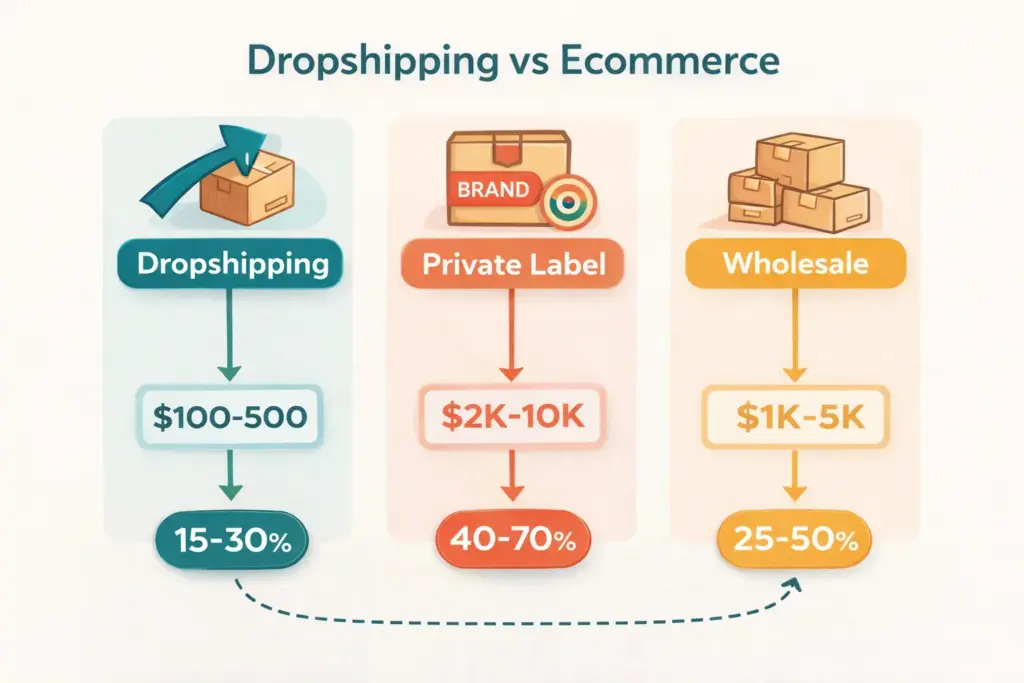
Dropshipping vs Private Label vs Wholesale: The Full Comparison
Here’s every important metric compared across all three ecommerce business models:
| Factor | Dropshipping | Private Label | Wholesale |
|---|---|---|---|
| Startup cost | $100-500 | $2,000-10,000+ | $1,000-5,000 |
| Typical margins | 15-30% | 40-70% | 25-50% |
| Inventory required? | No | Yes (bulk orders) | Yes (bulk orders) |
| Brand ownership | None (sell others’ products) | Full (your brand, your product) | Partial (resell existing brands) |
| Product control | None | Complete (specs, packaging, design) | Limited (sell as-is) |
| Time to first sale | 1-3 weeks | 2-6 months | 2-4 weeks |
| Competition level | Very high (same products, many sellers) | Low (unique products) | Medium (brand-authorized sellers) |
| Shipping speed | Slow (if overseas supplier) | Fast (your inventory, your shipping) | Fast (your inventory, your shipping) |
| Scalability | Easy to scale width (more products) | Harder to scale (capital intensive) | Moderate (capital + storage needed) |
| Risk level | Low (no inventory commitment) | High (unsold inventory risk) | Medium (inventory commitment) |
| Long-term equity | Low (no brand, no moat) | Very high (brand is an asset) | Medium (distribution relationships) |
How Dropshipping Works
Dropshipping is the lowest-barrier entry into ecommerce. You list products on your store, and when a customer buys, your supplier ships directly to them. You never touch the product. The difference between your retail price and the supplier’s wholesale price (minus fees) is your profit.
The Real Economics of Dropshipping
On a $30 product sourced from AliExpress at $8:
| Line Item | Amount |
|---|---|
| Selling price | $30.00 |
| Product cost | -$8.00 |
| Shipping (supplier to customer) | -$3.00 |
| Platform fees (Shopify + payment) | -$1.60 |
| Ad spend per sale (estimated) | -$10.00 |
| Net profit | $7.40 (25%) |
That $7.40 looks healthy until you factor in returns (5-10% of orders), refunds, and customer service time. Real-world dropshipping margins often land at 15-20% after everything is accounted for.
When Dropshipping Makes Sense
You’re testing product ideas before committing capital. You have under $500 to invest. You want to learn the mechanics of selling online with minimal risk. You’re comfortable with lower margins in exchange for zero inventory risk.
When Dropshipping Doesn’t Work
You’re competing purely on price (Amazon will always beat you). Your niche requires fast shipping (2-3 week delivery kills repeat purchases). You want to build a brand people recognize and come back to. You need margins above 30% to cover your business costs.
How Private Label Works
Private label means you work with a manufacturer to produce products under your own brand. You define the product specifications, design the packaging, and control the entire customer experience. A Bazaarvoice study found that 64% of US consumers purchased a private label product in the past six months, showing the demand for branded alternatives to name brands.
The Real Economics of Private Label
On a $30 private label product manufactured at $5 per unit (500-unit order):
| Line Item | Amount |
|---|---|
| Selling price | $30.00 |
| Product cost (manufactured) | -$5.00 |
| Shipping to warehouse | -$1.00 |
| Fulfillment (self or FBA) | -$4.00 |
| Platform fees | -$1.60 |
| Ad spend per sale | -$6.00 |
| Net profit | $12.40 (41%) |
Nearly double the dropshipping profit on the same selling price. The difference comes from lower per-unit cost (bulk manufacturing vs. single-unit wholesale) and the ability to command higher prices because customers perceive branded products as more valuable.
When Private Label Makes Sense
You have $2,000+ to invest upfront. You’ve validated demand through dropshipping or market research. You want to build a brand that has real equity and can be sold as a business asset. You’re targeting a niche where branding and product quality create differentiation.
When Private Label Doesn’t Work
You’re not sure what products will sell (test with dropshipping first). You can’t afford to lose your initial inventory investment if the product doesn’t take off. You want quick results; private label takes 2-6 months from concept to first sale. You’re entering a category with strict regulations (supplements, cosmetics) without understanding the compliance requirements.
How Wholesale Ecommerce Works
With wholesale, you buy existing branded products in bulk at discounted prices and resell them at retail markup. You don’t create the product or the brand. You’re a distribution channel for someone else’s brand. Think of it as the online version of a traditional retail store.
The Real Economics of Wholesale
On a $30 product purchased wholesale at $15 per unit:
| Line Item | Amount |
|---|---|
| Selling price | $30.00 |
| Product cost (wholesale) | -$15.00 |
| Fulfillment (self or FBA) | -$4.00 |
| Platform fees | -$1.60 |
| Ad spend per sale | -$3.00 |
| Net profit | $6.40 (21%) |
Lower margins than private label because your product cost is higher (you’re buying at wholesale, not manufacturing cost). But ad spend is often lower because you’re selling recognized brands that customers already trust.
When Wholesale Makes Sense
You want to sell established brands without product development risk. You have storage space and capital for bulk purchasing. You prefer a faster launch than private label without the razor-thin margins of dropshipping. You’re building an Amazon FBA business leveraging existing brand recognition.
When Wholesale Doesn’t Work
You’re competing against the brand itself or authorized retailers with better pricing. You can’t meet minimum order quantities (often 100-500+ units). You don’t have storage space for inventory. You want to build long-term brand equity (wholesale builds distribution, not brand).
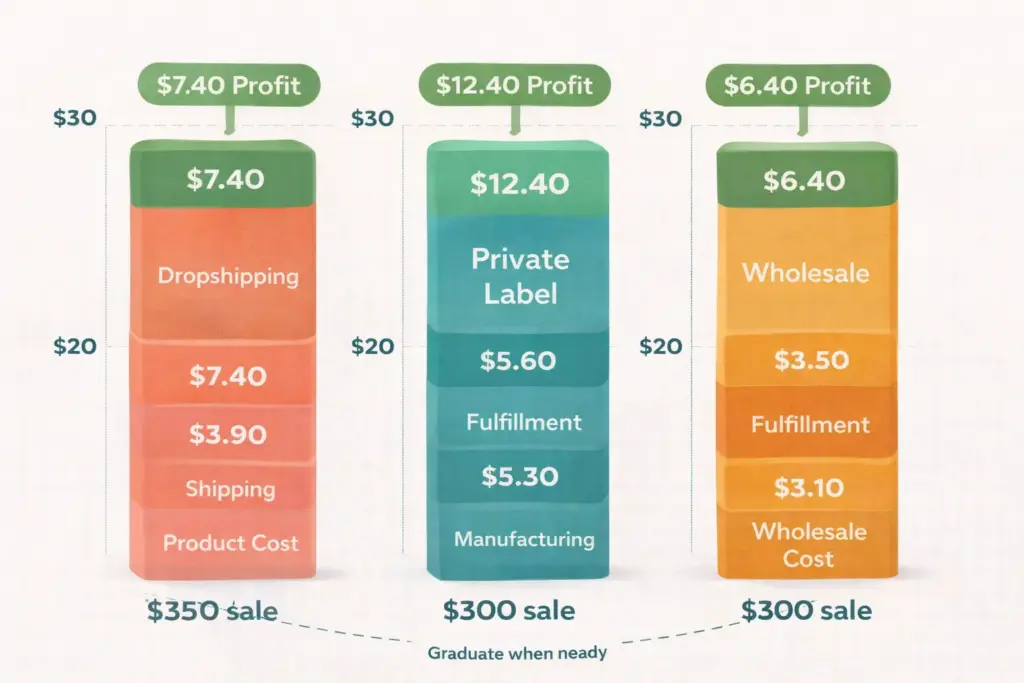
The Hybrid Approach: Why Smart Sellers Combine Models
The most successful ecommerce sellers I’ve seen don’t pick one model and stick with it forever. They use a progression that minimizes risk and maximizes long-term value:
Phase 1: Dropship to validate. Start with dropshipping to test 10-20 product ideas with zero inventory risk. Run small ad tests. Track which products sell consistently and which ones customers love (check reviews and repeat orders).
Phase 2: Wholesale your winners. Once you know a product sells, source it wholesale for better margins. You’ve already proven demand, so buying 100-200 units isn’t a gamble. Your margins jump from 15-25% to 25-40%.
Phase 3: Private label your best sellers. Your top 2-3 products become private label products. Work with a manufacturer to produce your own version with improved specs (based on customer feedback), your branding, and your packaging. Platforms like Alibaba connect you with thousands of factories that handle private label production runs. Margins climb to 40-70%, and you now own a brand asset.
This progression works because each phase builds on data from the previous one. You’re never guessing. You’re investing in products that have already proven they sell.
Choosing Your Model: A Decision Framework
Answer these four questions and the right model becomes obvious:
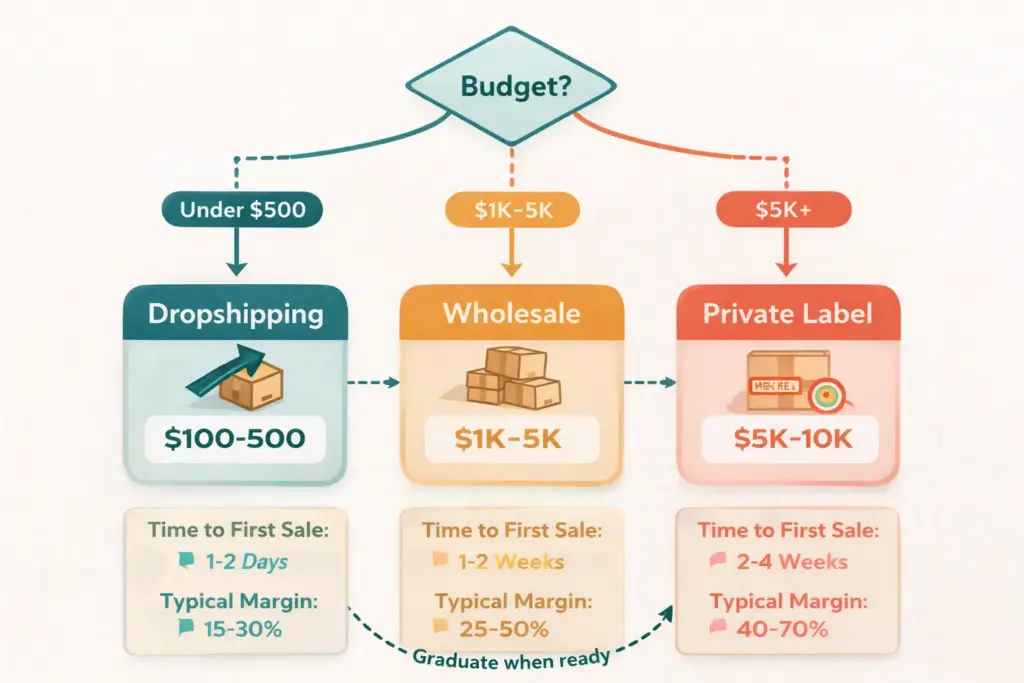
What’s your budget? Under $500? Start with dropshipping. $1,000-5,000? Wholesale is accessible. Over $5,000? Private label is on the table. Check our startup costs guide for detailed breakdowns.
How fast do you need revenue? Dropshipping can generate first sales in 1-3 weeks. Wholesale takes 2-4 weeks to source and list. Private label takes 2-6 months from concept to first sale.
What’s your risk tolerance? Dropshipping has almost zero financial risk. Wholesale risks unsold inventory. Private label risks your entire production run if the product doesn’t resonate. Match your model to what you can afford to lose.
What’s your long-term goal? Building a brand you can eventually sell? Private label. Building a cash-flow business? Wholesale or dropshipping. Testing the ecommerce waters before committing? Dropshipping. Choose the right ecommerce platform and marketing approach to match whichever model you pick.
Common Mistakes in Choosing a Sourcing Model
Starting with private label when you haven’t validated demand. Ordering 1,000 custom-manufactured units of a product nobody wants is an expensive way to learn that product research matters. Validate demand through dropshipping or thorough best seller research before manufacturing anything.
Staying in dropshipping too long. Dropshipping is a training wheel, not a destination. The margins are thin, you have no competitive moat, and anyone can copy your exact store. Use it to learn, then graduate to models with better margins and brand ownership.
Ignoring the total cost of wholesale. The product cost isn’t the only expense. Storage, shipping to your warehouse, insurance, picking/packing, and shrinkage (damaged or lost inventory) all reduce your real margin. Factor every cost before buying in bulk.
Choosing based on someone else’s success story. The fact that someone made $100K dropshipping phone cases doesn’t mean you will too. Models work differently for different niches, audiences, and skill sets. Choose based on your budget, goals, and honest assessment of your capabilities.
Frequently Asked Questions
What is the difference between dropshipping vs ecommerce?
Dropshipping is one type of ecommerce, not a separate thing. The real comparison is between dropshipping, private label, and wholesale, which are three different ways to source products for an online store. Dropshipping means your supplier ships directly to customers. Private label means you manufacture your own branded products. Wholesale means you buy existing products in bulk and resell them.
Which is more profitable: dropshipping vs ecommerce with private label?
Private label is more profitable per sale, with typical margins of 40-70% versus dropshipping’s 15-30%. However, private label requires $2,000-10,000+ upfront investment and 2-6 months to launch, while dropshipping can start for under $500 in weeks. Private label builds long-term brand equity that dropshipping doesn’t.
Can I switch from dropshipping to private label?
Yes, and this is the recommended path. Start with dropshipping to test products with zero inventory risk. Once you identify your best sellers, transition those specific products to private label manufacturing for higher margins and brand ownership. Many successful ecommerce brands started exactly this way.
Is dropshipping vs ecommerce wholesale better for beginners?
Dropshipping is better for absolute beginners because it requires less capital ($100-500 vs. $1,000-5,000) and carries no inventory risk. Wholesale is better for beginners who have some capital and want faster shipping and higher margins from day one. Both are viable starting points depending on your budget.
What are the risks of each ecommerce model?
Dropshipping risks: thin margins, slow shipping, no brand differentiation, supplier reliability issues. Private label risks: unsold inventory, high upfront investment, manufacturing quality problems, longer time to market. Wholesale risks: inventory that doesn’t sell, storage costs, brand authorization requirements, price competition from other authorized sellers.
Can I combine dropshipping with wholesale or private label?
Absolutely. Many successful stores run all three models simultaneously. They dropship to test new products, wholesale established brands for reliable revenue, and private label their best sellers for maximum margins. The hybrid approach reduces risk while building long-term brand value. Our ecommerce business models guide covers the combinations in detail.
Related Reads
- How to Start Dropshipping
- Private Label Products Guide
- Finding Wholesale Suppliers
- White Label Products Guide
- Ecommerce Business Models Explained
- Ecommerce Startup Costs Breakdown
Enjoying this? Get more like it every week.
One email per week with ecommerce strategies, tool picks, and seller insights. No spam.