
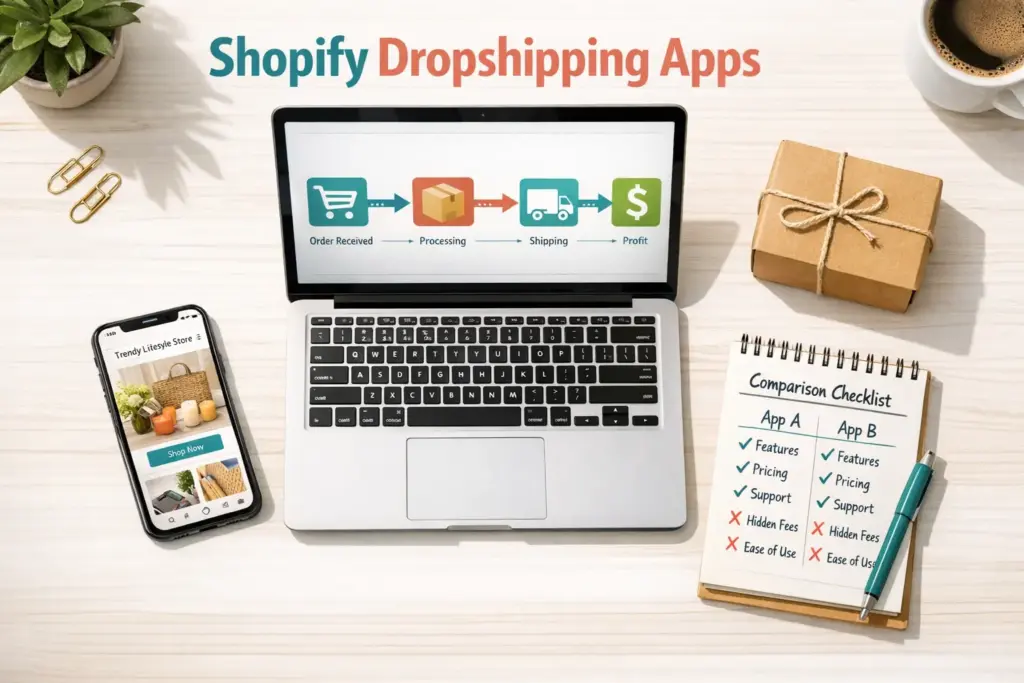
- The best Shopify dropshipping apps in 2026 are DSers for AliExpress sourcing, Spocket for US/EU suppliers, Zendrop for branded packaging and faster shipping, and AutoDS for full automation across multiple supplier networks.
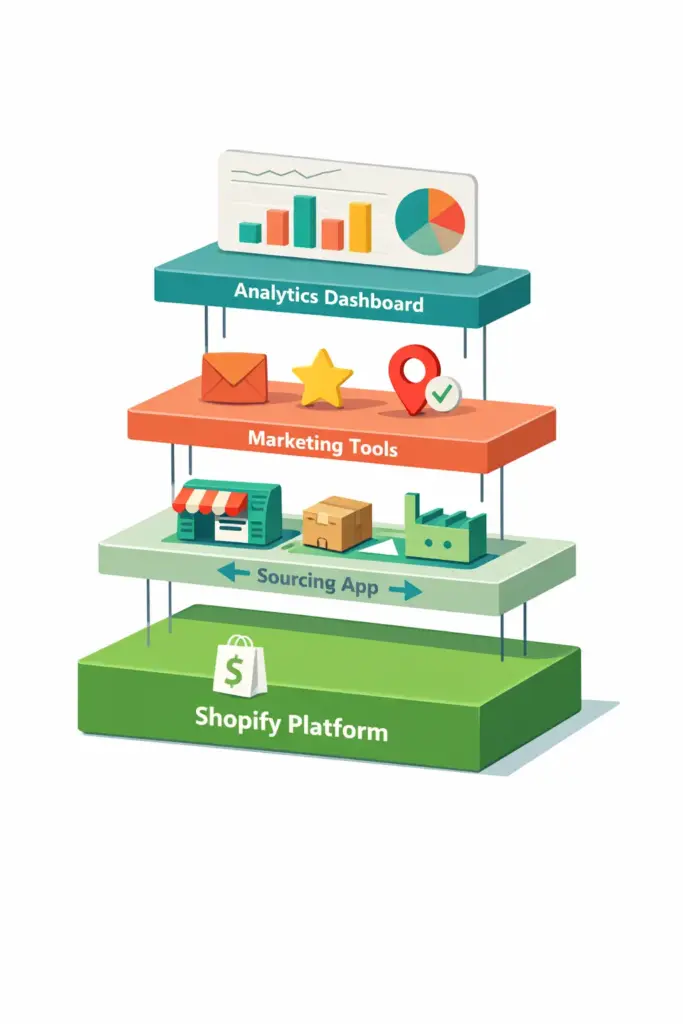
- No single app does everything. Successful Shopify dropshipping stores build a focused tech stack where each app handles a specific job: sourcing, fulfillment, reviews, email, and analytics.
- Automation can cut fulfillment errors by roughly 40% according to Shopify's trends data, but the wrong app combination creates inventory conflicts and sync issues that cost more than they save.
- A realistic monthly cost for a Shopify dropshipping store (platform + apps + marketing) runs $150-500 before ad spend, not the "$0 startup" that most courses promise.
Shopify dropshipping apps are third-party integrations that connect your Shopify store to supplier networks, automate product imports, sync inventory in real time, and forward orders for fulfillment without you touching a single package. They turn Shopify from a basic storefront into a complete dropshipping operations hub where sourcing, pricing, and order management run on autopilot.
The problem? There are over 2,000 apps in the Shopify App Store ecosystem, and most “best dropshipping apps” articles just list ten options without telling you which one fits your specific situation. A beginner importing phone cases from AliExpress has completely different needs than an established seller routing 500 daily orders across four suppliers. Picking the wrong app doesn’t just waste your subscription fee. It creates inventory sync issues, shipping delays, and customer service headaches that can tank your store.
I’ve organized this guide by use case rather than arbitrary ranking. Find your situation below, pick the app that matches, and skip the ones that don’t. If you’re brand new to the model, start with our complete how to start dropshipping guide first, then come back here for the Shopify-specific setup.
Quick Comparison: Best Shopify Dropshipping Apps
Before diving into details, here’s the landscape at a glance. Each app excels in a different area, so the “best” one depends entirely on how you source products and where your customers are located.
| App | Best For | Supplier Region | Free Plan? | Paid From | Shopify Rating |
|---|---|---|---|---|---|
| DSers | AliExpress sourcing, beginners | China (AliExpress) | Yes (3,000 products) | $19.90/mo | 5.0 stars |
| Spocket | US/EU fast shipping | US, EU, global | Yes (limited) | $39.99/mo | 4.7 stars |
| Zendrop | Branded packaging, US fulfillment | US, global warehouses | Yes (limited) | $49/mo | 4.6 stars |
| AutoDS | Full automation, multi-supplier | Multiple (25+ sources) | No ($1 trial) | $26.90/mo | 4.8 stars |
| CJdropshipping | Quality control, global warehouses | 16 countries | Yes | Usage-based | 4.9 stars |
| Printful | Print on demand, custom products | US, EU, global | Yes (pay per order) | Per order | 4.7 stars |
| Shopify Collective | Partnering with US Shopify brands | US (Shopify brands) | Yes (built-in) | Free | N/A |
| Syncee | Global supplier marketplace | US, EU, Asia | Yes (25 products) | $29/mo | 4.7 stars |
| Spark Shipping | Enterprise, multi-supplier routing | Custom suppliers | No | $99/mo | 4.4 stars |
Best Shopify Dropshipping Apps for AliExpress Sourcing
DSers: The Official AliExpress Partner
DSers replaced Oberlo (which Shopify shut down in 2022) as the official AliExpress dropshipping solution. If your strategy revolves around sourcing from Chinese suppliers through AliExpress, this is the default choice for good reason.
The DSers dropshipping app lets you process hundreds of orders in bulk with a few clicks, find alternative suppliers for the same product to compare prices, and manage multiple Shopify stores from one dashboard. It holds a 5.0-star rating with over 25,000 reviews on the Shopify App Store. The DSers Chrome extension adds an import button directly to AliExpress product pages, so you can browse suppliers and push products to your store without switching tabs.
What I like: The free plan is genuinely useful (3,000 products, basic bulk ordering). Most competing apps cap their free tiers at 25-50 products, making them useless for real testing. DSers gives you enough room to build a functional store before paying anything.
The honest catch: You’re still dealing with AliExpress shipping times (2-3 weeks to the US). No app can fix that. If your customers expect Amazon-speed delivery, DSers alone won’t solve the problem regardless of how good the automation is.
Best for: Beginners testing product ideas with low upfront investment. Sellers comfortable with longer shipping times who compete on product uniqueness rather than delivery speed.
Best Shopify Dropshipping Apps for Fast US/EU Shipping
Spocket: Verified US and EU Suppliers
Spocket focuses on connecting Shopify dropshipping stores with verified suppliers in the United States and European Union. The result is shipping times that actually compete with domestic ecommerce, typically 2-7 days instead of the 2-3 weeks from China-based suppliers.
The trade-off is price. Products sourced through Spocket cost more than their AliExpress equivalents because you’re paying for proximity and quality control. That means you need higher retail prices and stronger branding to maintain margins.
What I like: AI-powered product recommendations based on your store’s performance data. The supplier vetting process is strict, which reduces the “mystery package” problem that plagues AliExpress-based stores.
The honest catch: The free plan is extremely limited. You’re realistically looking at $39.99/month minimum to do anything meaningful, which is steep for a brand new store testing product-market fit.
Best for: Sellers targeting US or European customers who demand fast shipping. Stores positioning themselves as premium rather than budget.
Zendrop: Branded Packaging and Custom Experience
Zendrop positions itself as the answer to the biggest complaint about dropshipping: it looks and feels like dropshipping. Through branded invoicing, custom packaging options, and a US-based warehouse network, Zendrop lets you create a customer experience that feels like a legitimate brand rather than a middleman.
Shipping times run 2-7 days for US orders through their domestic warehouse network, a massive improvement over AliExpress. The product catalog covers health, beauty, electronics, home goods, and more.
What I like: The branded packaging genuinely changes how customers perceive your store. Unboxing experience matters, and Zendrop is one of the few dropshipping Shopify apps that lets you control it without managing your own warehouse.
The honest catch: $49/month starting price is the highest entry point on this list. You need consistent order volume to justify the cost. If you’re selling fewer than 30 orders per month, the per-order economics don’t work out.
Best for: Established sellers upgrading from AliExpress who want to build a recognizable brand. Stores where repeat purchases depend on customer experience.
Best Shopify Dropshipping Apps for Full Automation
AutoDS: Set-and-Scale Automation
AutoDS started as an auto-fulfillment tool and evolved into a complete business management platform. It connects to over 25 supplier sources (not just AliExpress), handles product research, imports, price monitoring, stock updates, and order fulfillment from a single dashboard.
The standout feature is automated price and stock monitoring. When a supplier changes their price or runs out of stock, AutoDS adjusts your listing automatically. Without this, you’d be manually checking hundreds of products daily or risk selling items that are out of stock.
What I like: The multi-supplier support means you’re not locked into one sourcing network. You can pull products from AliExpress, Amazon, Walmart, and other platforms simultaneously. That diversification protects your business if one supplier channel has issues.
The honest catch: No free plan. The $1 trial is short, and the learning curve is steeper than simpler apps like DSers. If you’re processing fewer than 50 orders per month, you probably don’t need this level of automation yet.
Best for: Sellers processing 100+ orders per month who need to automate everything. Stores sourcing from multiple supplier networks simultaneously.
CJdropshipping: Quality Control and Global Warehouses
CJdropshipping differentiates itself through warehousing services, quality inspections, and custom manufacturing capabilities. With warehouses in 16 countries, they offer a middle ground between cheap Chinese sourcing and expensive US-based fulfillment.
The quality inspection service is the real differentiator. Products undergo checks before shipping, which reduces the return rate problem that kills so many Shopify dropshipping stores. If you’ve been burned by AliExpress quality inconsistency, CJ’s inspection process addresses that directly.
What I like: Custom manufacturing for sellers who want to private label products. You can start with standard dropshipping and graduate to branded products without switching platforms.
The honest catch: The interface isn’t as polished as DSers or Spocket. Setup takes longer, and the communication with their team can be slow. If you want plug-and-play simplicity, this isn’t it.
Best for: Sellers prioritizing product quality over setup speed. Stores planning to transition from generic dropshipping to private label products eventually.
Best Shopify Dropshipping Apps for Custom and Print on Demand
Printful: Custom Products Without Inventory
Printful isn’t traditional dropshipping. It’s print on demand, meaning you design custom products (apparel, accessories, home decor) and Printful prints, packages, and ships each order individually. No inventory, no bulk purchasing, no unsold stock risk.
The quality is consistently high, the Shopify integration is clean, and the product catalog keeps expanding. For sellers who want to build a brand around original designs rather than reselling existing products, Printful is the standard.
What I like: Zero upfront cost. You pay per order, so there’s no monthly subscription eating into your margins before you make a sale.
The honest catch: Higher per-unit costs than traditional dropshipping. A custom t-shirt might cost $12-15 to produce through Printful versus $3-5 through an AliExpress supplier. Your retail pricing needs to reflect that reality.
Best for: Designers and creative sellers who compete on unique designs. Niche stores where customization is the product.
Shopify Collective: Partner with US Brands
Shopify Collective is Shopify’s own built-in feature that lets you sell products from other Shopify brands without holding inventory. The partner brand handles fulfillment and shipping directly to your customer. It’s free, native to Shopify, and gives you access to products from established brands with proven quality.
What I like: No app to install, no monthly fee, and the supplier quality is inherently higher because you’re partnering with real Shopify brands, not anonymous factories.
The honest catch: Limited to US-based Shopify brands. The product selection is narrower than open marketplaces like AliExpress or Spocket. And the margins can be tighter since you’re working with brands that set their own wholesale pricing.
Best for: Curated stores that want brand credibility from day one. Sellers who prefer working with established brands over anonymous suppliers.
How to Set Up Shopify Dropshipping (Complete Walkthrough)
Choosing apps is step two. Step one is getting your Shopify store ready for dropshipping. Here’s the setup process from scratch.
Step 1: Create Your Shopify Store
Sign up for Shopify (Basic plan at $39/month is enough to start). Pick a theme, set up your domain, and configure your payment gateway. Browse the Shopify App Store dropshipping category to see the full range of available apps. For platform comparisons, check our best ecommerce platform guide.
Step 2: Install Your Primary Dropshipping App
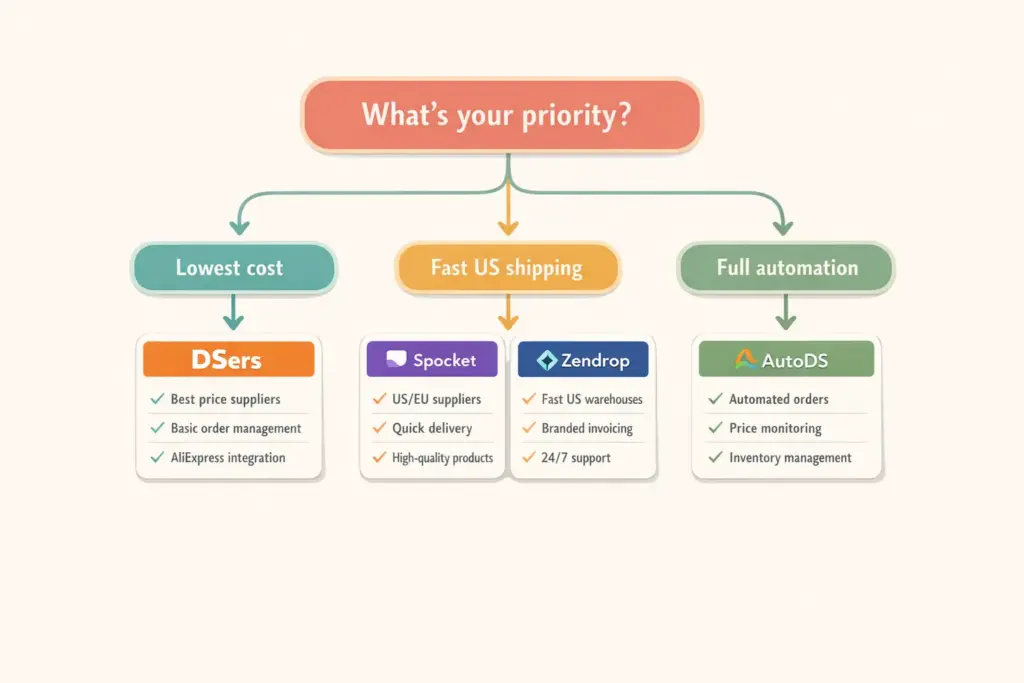
Based on the comparison above, pick one primary sourcing app. Don’t install three apps hoping to “test them all.” Overlapping inventory creates sync conflicts. Start with one:
- Budget-conscious and sourcing from AliExpress? Install DSers.
- Need fast US/EU shipping? Install Spocket or Zendrop.
- Want full automation across multiple sources? Install AutoDS.
- Selling custom-designed products? Install Printful.
Step 3: Import Products and Set Pricing
Browse your app’s supplier catalog and import products to your store. Before publishing, edit every listing: rewrite the title for SEO, replace the supplier’s generic description with your own copy, and set pricing that accounts for all costs. Our pricing strategy guide covers the math in detail.
A good rule of thumb: your retail price should be at least 2.5-3x your product cost to cover ads, shipping, fees, and returns while maintaining a healthy margin.
Step 4: Configure Automation Settings
Set up automatic order forwarding so when a customer buys, the order goes to your supplier without manual intervention. Enable inventory sync so out-of-stock products are automatically hidden from your store. Configure tracking number sync so customers get shipping updates without you copying and pasting tracking codes.
Step 5: Add Supporting Apps
Your dropshipping app handles sourcing and fulfillment. You still need apps for marketing and customer experience. The full ecommerce tools and tech stack guide covers this in depth, but the essentials are:
- Reviews: Loox or Judge.me for social proof (critical for new stores)
- Email marketing: Klaviyo or Omnisend for abandoned cart recovery and post-purchase sequences
- Order tracking: AfterShip for branded tracking pages that reduce “where’s my order” support tickets
- Analytics: A profit tracking tool to monitor actual margins after all costs
Real Monthly Cost of a Shopify Dropshipping Store
The “start for free” promise of dropshipping is misleading. Here’s what a functional Shopify dropshipping store actually costs per month once you factor in everything:
| Expense | Starter Store | Scaling Store |
|---|---|---|
| Shopify plan | $39/month (Basic) | $105/month (Shopify) |
| Dropshipping app | $0-20/month | $27-49/month |
| Email marketing app | $0-16/month | $30-60/month |
| Reviews app | $0-10/month | $10-25/month |
| Order tracking | $0/month (free tier) | $11-25/month |
| Domain | $1-2/month (annual) | $1-2/month |
| Theme | $0 (free) or $15/month (amortized) | $15/month (amortized) |
| Monthly overhead (before ads) | $40-65 | $200-270 |
| Ad budget | $200-500/month | $1,000-5,000/month |
| Total monthly investment | $240-565 | $1,200-5,270 |
These numbers matter because they determine your break-even point. If your average order profit (after product cost and shipping) is $12, and your monthly overhead is $300, you need 25 orders per month just to cover costs before you’re actually making money. Understanding your startup costs prevents the surprise of running out of cash in month three.
Common Shopify Dropshipping Mistakes
Installing too many apps at once. Each app adds monthly cost and potential conflicts. Start with your dropshipping app plus one email marketing tool. Add more only when you have enough order volume to justify the expense.
Using supplier-provided product descriptions. Every other dropshipper using the same supplier has identical listings. Write your own descriptions, take your own product photos (or commission them), and differentiate your store through content, not just product selection.
Ignoring shipping times in your marketing. If your product takes 15-20 days to arrive, don’t hide that fact. Set clear expectations in your product pages and shipping policy. Customers forgive slow shipping when they’re informed. They leave angry reviews when they’re surprised.
Not testing products before selling them. Order samples of every product you plan to sell. You need to know what the customer experience actually feels like. Some AliExpress products look great in photos but arrive as cheap junk. Finding out before your customer does saves your reviews and your reputation.
Treating Shopify dropshipping as passive income. It’s a real business that requires active marketing effort, customer service, and ongoing optimization. The automation tools above save time, but they don’t replace the business decisions only you can make.
Shopify Dropshipping vs. Other Platforms
Shopify is the most popular platform for dropshipping, but it’s not the only option. Here’s how it compares:
Shopify vs. WooCommerce: WooCommerce is cheaper (self-hosted, no monthly platform fee) but requires more technical setup. Shopify’s app ecosystem for dropshipping is significantly larger and better integrated. For most dropshippers, Shopify’s ease of use justifies the monthly cost.
Shopify vs. marketplace selling: Selling on Amazon or eBay gives you access to existing traffic but limits your branding and takes a larger percentage of each sale. Shopify gives you full brand control and customer data, but you need to drive your own traffic.
The best ecommerce platform for your dropshipping business depends on your technical comfort level, budget, and whether you prioritize ease of use or flexibility.
Frequently Asked Questions
What are the best Shopify dropshipping apps for beginners?
DSers is the best starting point for beginners because it’s free for up to 3,000 products, integrates directly with AliExpress, and has the lowest learning curve. Spocket is the best alternative if you need faster US/EU shipping but are willing to pay $39.99/month from the start.
What Shopify dropshipping apps work with US suppliers?
Spocket, Zendrop, and Shopify Collective all connect you with US-based suppliers offering 2-7 day domestic shipping. CJdropshipping also has US warehouses for selected products. These apps cost more per order than AliExpress-based options, but the faster delivery improves customer satisfaction and reduces refund requests.
How much do Shopify dropshipping apps cost per month?
Free plans are available from DSers, Spocket, CJdropshipping, and Syncee, though all have feature or product limits. Paid plans range from $19.90/month (DSers) to $99/month (Spark Shipping for enterprise). Most functional stores spend $20-50/month on their primary dropshipping app plus $40-100/month on supporting apps for email, reviews, and tracking.
Is the DSers Chrome extension necessary for Shopify dropshipping apps?
The DSers Chrome extension isn’t required but significantly speeds up product sourcing. It adds an import button directly to AliExpress product pages so you can browse suppliers in their native interface and push products to your Shopify store with one click instead of searching within the DSers dashboard.
Can I use multiple Shopify dropshipping apps at the same time?
You can, but proceed carefully. Using two sourcing apps (like DSers and Spocket) works if each handles a different product category. Using two apps for the same products creates inventory sync conflicts and duplicate orders. Start with one primary app and only add a second when you have a clear, non-overlapping use case.
Is Shopify dropshipping still profitable in 2026?
Yes, but the bar is higher than it was five years ago. Customers expect faster shipping, professional packaging, and real brand identity. The “import random AliExpress products and run Facebook ads” playbook doesn’t work anymore. Sellers who treat dropshipping as a real business with proper automation, vetted suppliers, and genuine branding are consistently profitable.
Related Reads
- How to Start Dropshipping: Complete Guide
- Dropshipping Suppliers Directory
- Best Dropshipping Products to Sell
- Amazon Dropshipping Guide
- AliExpress Sourcing Guide
- Best Ecommerce Platform Comparison
Enjoying this? Get more like it every week.
One email per week with ecommerce strategies, tool picks, and seller insights. No spam.