
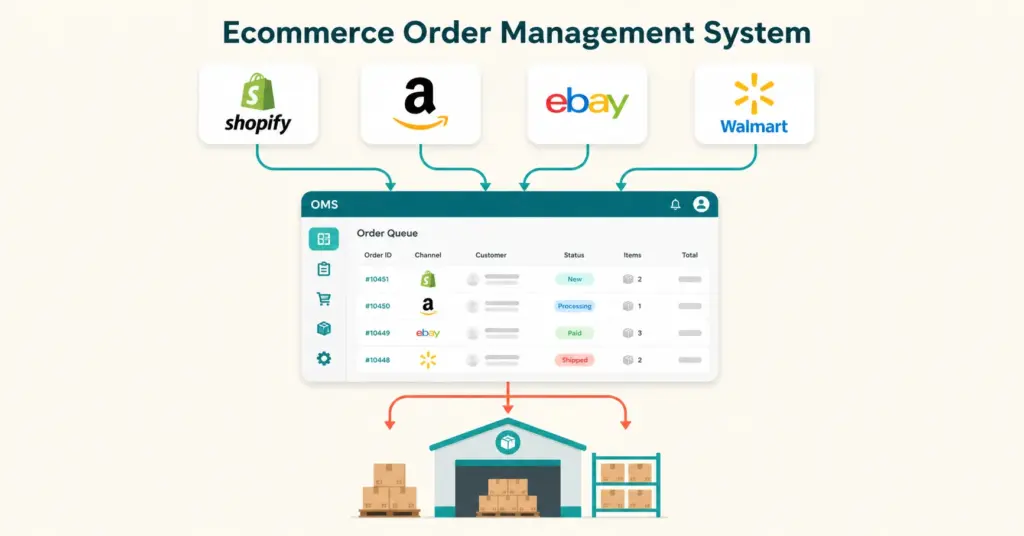
- Ecommerce order management systems (OMS) consolidate orders from all your sales channels (Shopify, Amazon, eBay, Walmart, B2B) into one platform for unified processing, inventory allocation, fulfillment routing, and reporting. OMS becomes essential when orders flow through 2+ channels and manual reconciliation between channels becomes impossible.
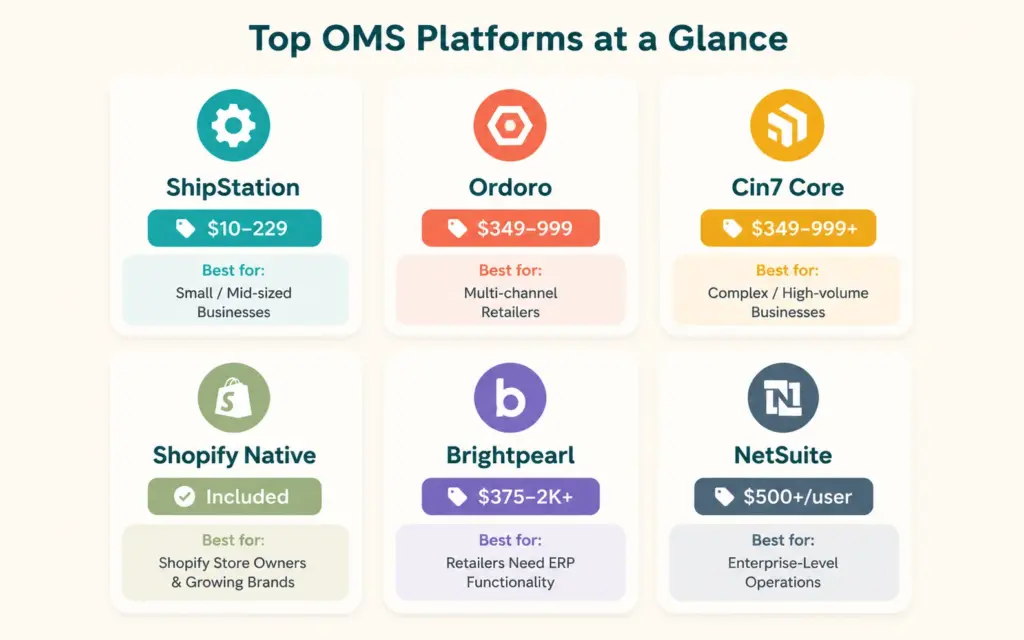
- Top OMS options by store size: ShipStation ($9.99-229/mo) for small-to-mid stores prioritizing shipping, Ordoro ($349-999/mo) for mid-market multi-channel operations, Cin7 Core/Omni ($349-999+/mo) for advanced inventory and order management combined, Shopify's native OMS for Shopify-first businesses, and Brightpearl or NetSuite for enterprise.
- The right OMS integrates with your sales channels, accounting (QuickBooks or Xero), shipping carriers, and warehouse systems. Integration gaps create manual work that defeats the purpose. Evaluate platform connections before committing.
- Before buying specialized OMS, check if your ecommerce platform's native OMS handles your needs. Shopify, BigCommerce, and WooCommerce all have improving order management features. Dedicated OMS only makes sense when native capability falls short of actual needs.
Ecommerce order management system (OMS) is specialized software that consolidates orders from multiple sales channels (your own store, Amazon, eBay, Walmart, wholesale B2B, phone orders) into a single platform for unified processing, inventory allocation, fulfillment routing, tracking updates, and reporting, with the goal of eliminating the chaos of managing each channel separately and the data inconsistencies that manual order handling creates. OMS becomes critical infrastructure when an ecommerce business sells through multiple channels and needs reliable visibility into order status, inventory availability, and operational performance.
The problem OMS solves is familiar to any multi-channel ecommerce operator: order comes in on Shopify, inventory allocated but different inventory shows on Amazon, Amazon sells the same unit, both orders ship, customer service gets two complaints, and the accounting system shows reconciliation nightmares. Without OMS, avoiding this scenario requires hourly manual reconciliation. With OMS, everything updates in real-time across channels automatically.
This guide covers top OMS options, when specialized OMS is justified, and how to evaluate which fits your operations. For inventory management specifically, our inventory guide covers related but distinct capabilities.
What OMS Does vs Inventory Management vs ERP
These three categories overlap but serve different primary purposes:
| System Type | Primary Purpose | Typical Price Range |
|---|---|---|
| Order Management System (OMS) | Process orders across channels, route fulfillment | $10-1,000/mo |
| Inventory Management System (IMS) | Track stock across locations, reorder alerts, forecasting | $100-2,000/mo |
| ERP | Integrate all business functions (orders, inventory, accounting, CRM, HR) | $500-2,000+/user/mo |
Modern tools blur these lines. ShipStation is primarily OMS but includes basic inventory features. Cin7 Core is marketed as inventory management but handles comprehensive order management. Brightpearl is ERP that excels at OMS and IMS. Evaluate tools by what they actually do rather than how they’re categorized.
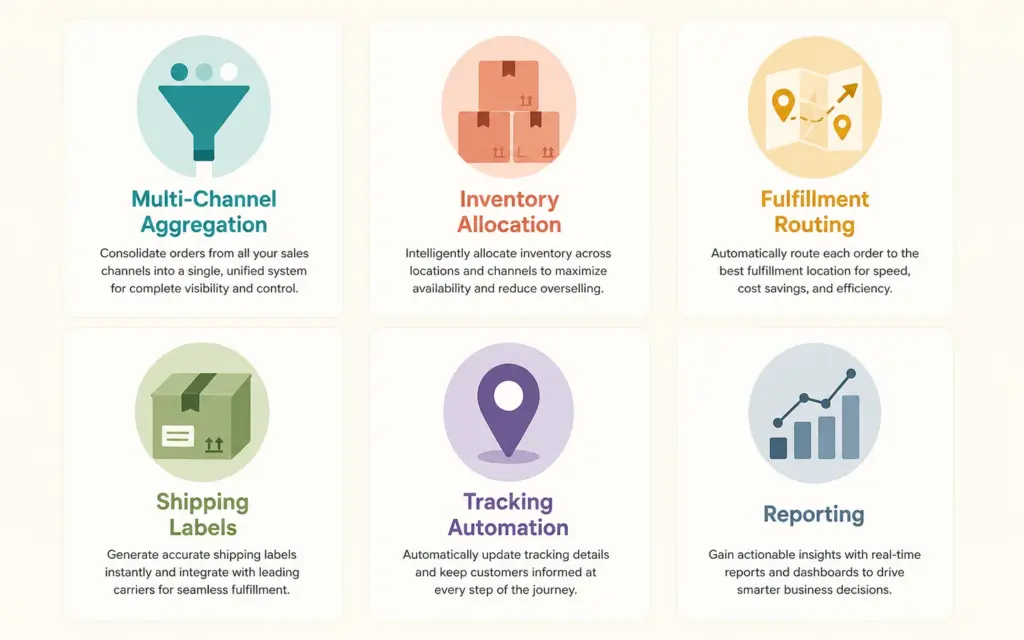
Core OMS Capabilities
Any OMS worth considering should handle these functions well:
Multi-Channel Order Aggregation
Pulls orders from all sales channels (Shopify, BigCommerce, WooCommerce, Amazon, eBay, Walmart, Etsy, B2B portals) into one unified queue. No toggling between platforms to see orders; everything flows to one system.
Inventory Allocation Across Channels
Deducts inventory from shared pool as orders come in, pushes updated stock levels back to all channels. Prevents overselling when the same SKU sells simultaneously across channels. This is the core integration that makes multi-channel operations viable.
Automated Fulfillment Routing
Rules-based order routing: “Ship California orders from West Coast warehouse,” “Ship orders under 1 pound via USPS,” “Route Amazon FBA-eligible products to FBA.” Automation eliminates manual routing decisions on every order.
Shipping Label Generation
Access to discounted carrier rates, batch label printing, automatic carrier selection based on package dimensions and destination. Integrates with USPS, UPS, FedEx, DHL, and often regional carriers.
Tracking Automation
Tracking numbers automatically update source channels. Customers receive tracking emails without manual work. Returns and refunds processing workflows.
Reporting and Analytics
Order volume by channel, fulfillment performance metrics, shipping cost analysis, return rate tracking. The visibility across channels that manual reconciliation never provides.
Top Ecommerce OMS Options Compared
ShipStation (Best for Small-to-Mid Stores)
ShipStation is the most widely-used OMS for small-to-mid ecommerce businesses. Primarily focused on shipping operations but handles order aggregation well across 200+ integrations.
Pricing:
- Starter: $9.99/mo (50 shipments)
- Bronze: $29.99/mo (500 shipments)
- Silver: $59.99/mo (1,500 shipments)
- Gold: $99.99/mo (3,000 shipments)
- Platinum: $149.99/mo (6,000 shipments)
- Enterprise: $229.99/mo (unlimited)
Strengths: Best carrier rate access, simple interface, extensive integrations, automation rules, strong customer support. Limitations: Less extensive inventory management than dedicated systems, limited warehouse management for multi-location.
Best for: Stores processing 100-5,000 orders/month primarily through 1-3 sales channels. Our shipping strategies guide covers how ShipStation fits in broader shipping operations.
Ordoro (Best for Mid-Market Multi-Channel)
Ordoro focuses specifically on multi-channel ecommerce operations with better inventory management and dropshipping support than ShipStation. Middle-market pricing with middle-market feature depth.
Pricing: $349-999/month based on features, plus $0.20-0.50 per order at volume
Strengths: Strong inventory across channels, excellent dropshipping workflow, barcode scanning for pick/pack, kitting and bundling support, purchase order management. Limitations: Steeper learning curve than ShipStation, higher base price.
Best for: Multi-channel stores ($1-10M revenue) where ShipStation limits are felt. Particularly strong for dropshipping or hybrid dropship-plus-inventory operations.
Cin7 Core (Best for Complex Inventory + Orders)
Cin7 Core (formerly DEAR Systems) combines comprehensive inventory management with strong order management. Stronger than ShipStation or Ordoro on the inventory side while matching them on order handling.
Pricing: $349-999+/month based on features and users
Strengths: Excellent inventory forecasting, strong B2B/wholesale support, multi-warehouse handling, manufacturing support (BOM), accounting-grade financial tracking. Limitations: More complex than pure OMS options, requires training investment.
Best for: Stores where inventory complexity matches order complexity, mixed B2B and DTC operations, stores with manufacturing or kitting needs.
Shopify Native OMS
Shopify’s built-in order management has improved dramatically. For Shopify-primary operations, native OMS often handles needs without third-party tools. Shopify Plus adds multi-location inventory, enhanced automation (Shopify Flow), and deeper reporting.
Pricing: Included in Shopify plans ($29-2,000/month)
Strengths: Free with Shopify, zero integration friction, improves continuously. Limitations: Primarily serves Shopify orders well; weaker for true multi-channel operations across non-Shopify channels.
Best for: Shopify-first businesses where Amazon/eBay is secondary. See our Shopify guide for native capabilities.
Brightpearl (Mid-Market ERP with Strong OMS)
Brightpearl is mid-market ERP with OMS as one component. When order management needs to integrate deeply with accounting, B2B operations, and warehouse management, Brightpearl consolidates everything.
Pricing: $375-2,000+/month
Best for: $5-50M revenue ecommerce where ERP integration matters. Our ERP guide covers Brightpearl in context with other options.
NetSuite (Enterprise)
NetSuite’s OMS capabilities match its overall enterprise positioning. Expensive but handles the most complex multi-channel, multi-brand, multi-subsidiary operations.
Pricing: $500-2,000+/user/month plus implementation
Best for: Enterprise ecommerce ($10M+), publicly traded companies, complex multi-entity operations.
When You Actually Need Specialized OMS
Before investing in standalone OMS, evaluate whether your platform’s native capability suffices. Triggers for dedicated OMS investment:
Multi-Channel Order Volume
Processing 100+ orders per week across 2+ channels. Below that volume, manual workflow between channels is manageable. Above it, manual workflow consumes unreasonable time.
Inventory Sync Problems
Frequent overselling incidents where the same inventory sold across channels before updates synced. Every oversell is a customer service problem, refund cost, and trust-damaging event.
Complex Fulfillment Routing
Shipping from multiple warehouses, using multiple 3PLs, mixing FBA and non-FBA fulfillment, or complex rules (different carriers for different products, different warehouses for different regions).
Accounting Reconciliation Pain
If monthly bookkeeping takes 10+ hours reconciling orders across channels, OMS with accounting integration saves that time. Connect with our accounting tools guide for the other side of this equation.
Customer Service Inconsistency
Support teams can’t easily see orders across all channels, leading to wrong information provided to customers. OMS with unified customer view fixes this.
OMS Integration Considerations
An OMS is only as good as its integrations. Before committing, verify connections to:
Required Integrations
- Your ecommerce platform(s): Shopify, BigCommerce, WooCommerce, Magento, etc.
- Marketplaces you sell on: Amazon (especially FBA), eBay, Walmart, Etsy
- Shipping carriers: USPS, UPS, FedEx, DHL, regional carriers
- Accounting software: QuickBooks, Xero integration prevents manual data entry
- Warehouse management: 3PL integrations (ShipBob, ShipMonk), in-house WMS if applicable
Common Integration Gaps to Check
- Platform-specific marketplaces (regional Amazon sites, Walmart Canada)
- B2B platforms (Faire, Handshake wholesale)
- Point-of-sale integration if operating physical stores
- EDI support for enterprise B2B relationships
- International carriers for cross-border shipping
Missing integrations mean manual workarounds that defeat the purpose of OMS adoption. Verify your exact stack’s connections before signing contracts.
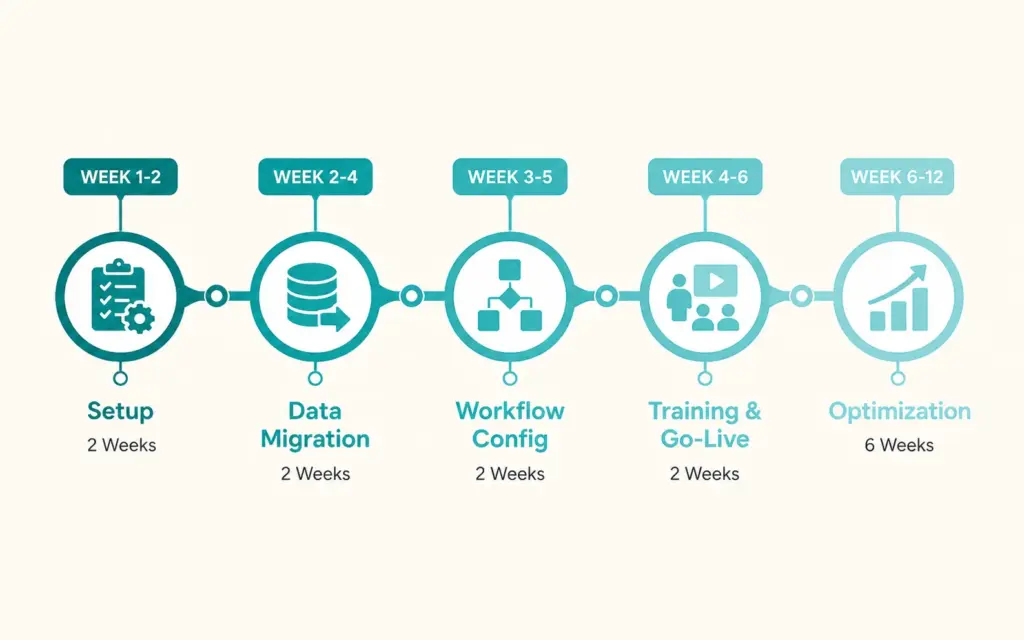
OMS Implementation Process
Week 1-2: Platform Setup
Account setup, basic configuration, user creation. Connect sales channels one at a time starting with the smallest to test integration before committing your highest-volume channel.
Week 2-4: Data Migration
Import historical orders for reporting continuity, current inventory levels, product catalog. Verify accuracy through sample checks.
Week 3-5: Workflow Configuration
Set up fulfillment rules, shipping carrier selection automation, tagging conventions, notification preferences. Test with sample orders before processing real orders.
Week 4-6: Team Training and Go-Live
Train fulfillment team on new workflows, run parallel processing (old system plus new system) for 1-2 weeks, then switch fully to OMS.
Week 6-12: Optimization
Identify workflow inefficiencies, add automation rules, refine reporting, onboard additional channels. Most stores continue refining OMS workflows for 3-6 months post-launch.
Common OMS Mistakes
Choosing based on price alone. Saving $500/month on a cheaper OMS that doesn’t match your workflow creates thousands of dollars in manual work. Evaluate total cost including time.
Not testing with real workflows before committing. OMS looks good in demos; the friction shows when processing real orders. Use free trials or pilot periods to validate actual workflow fit.
Over-automating too quickly. Complex automation rules created upfront often don’t match reality. Start with manual processing, identify patterns, then automate tested patterns.
Skipping accounting integration. OMS without accounting integration creates double-entry work and reconciliation problems. Verify QuickBooks or Xero integration works properly before relying on it.
Not training the team adequately. OMS value depends on consistent team usage. Shortcuts and workarounds from undertrained staff undermine the system’s benefits.
Connect OMS decisions with your broader multi-channel strategy and inventory sync tools.
Frequently Asked Questions
An ecommerce order management system (OMS) is software that consolidates orders from multiple sales channels (your store, Amazon, eBay, Walmart, wholesale) into one platform for unified processing, inventory allocation across channels, fulfillment routing, shipping label generation, and reporting. OMS eliminates the manual reconciliation between channels that creates overselling, inventory inconsistencies, and operational chaos for multi-channel sellers.
The best OMS depends on business size. ShipStation ($9.99-229/mo) works for small-to-mid stores prioritizing shipping operations and 1-3 channels. Ordoro ($349-999/mo) suits mid-market multi-channel operations with dropshipping support. Cin7 Core ($349-999+/mo) combines strong inventory with order management. Shopify native OMS works for Shopify-first operations. Brightpearl or NetSuite for enterprise. Match the system to actual scale and channel complexity.
Consider dedicated OMS when: processing 100+ orders weekly across 2+ channels, experiencing inventory overselling between channels, managing complex fulfillment (multiple warehouses, 3PLs, or routing rules), spending 10+ hours monthly on cross-channel accounting reconciliation, or providing inconsistent customer service because reps can’t see orders across channels. Below these thresholds, platform-native OMS usually suffices.
OMS pricing ranges widely: ShipStation $9.99-229/month, Ordoro $349-999/month, Cin7 Core $349-999+/month, Brightpearl $375-2,000+/month, NetSuite $500-2,000+/user/month. Most mid-market ecommerce businesses spend $100-1,000/month on OMS. Consider total cost including integrations, implementation services, and training time. Calculate ROI by time saved plus reduced manual errors.
OMS focuses on order processing, fulfillment routing, and shipping across channels. Inventory management systems (IMS) focus on stock tracking, reorder alerts, forecasting, and warehouse management. Modern tools often combine both: Cin7 Core excels at IMS with strong OMS, Ordoro does OMS with decent IMS, ShipStation is primarily OMS. For stores needing both, look for integrated systems or compatible specialized tools.
Yes, for Shopify-primary operations. Shopify’s native OMS handles order processing, basic inventory, shipping integration, and reporting adequately for single-channel businesses. Shopify Plus adds multi-location inventory and Shopify Flow automation. You need dedicated OMS when selling significantly on non-Shopify channels (Amazon, eBay, B2B), managing multiple warehouses with complex rules, or scaling beyond what native reporting provides.
Related Reads
- Inventory Management Guide
- Inventory Sync Tools
- Multi-Channel Strategy
- Shipping Strategies
- ERP for Ecommerce
- Ecommerce Accounting Tools
Enjoying this? Get more like it every week.
One email per week with ecommerce strategies, tool picks, and seller insights. No spam.