
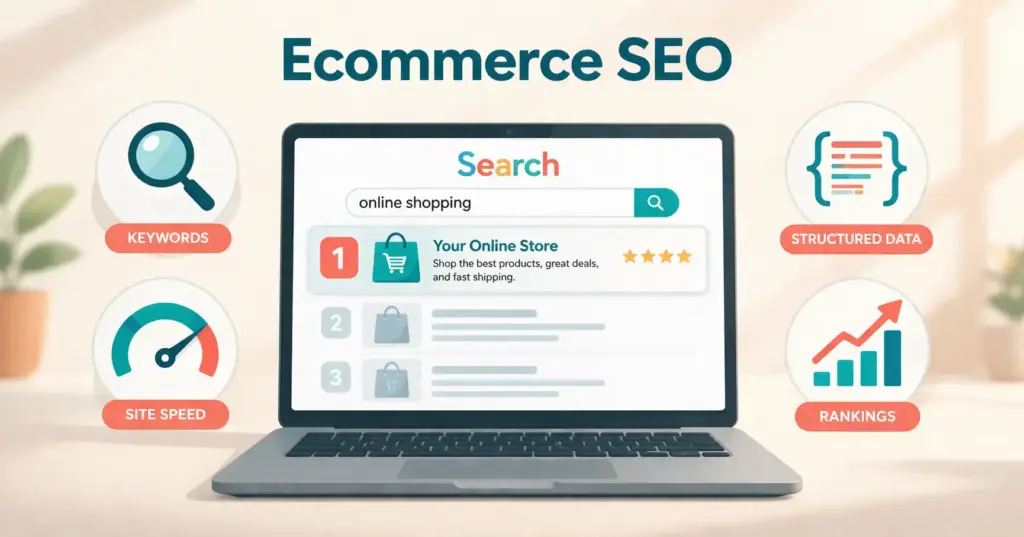
- Ecommerce SEO is different from regular SEO because online stores face unique challenges: hundreds or thousands of product pages, duplicate content from variants and filters, competition with Amazon and Walmart in search results, and the need to optimize both category pages and individual product listings.
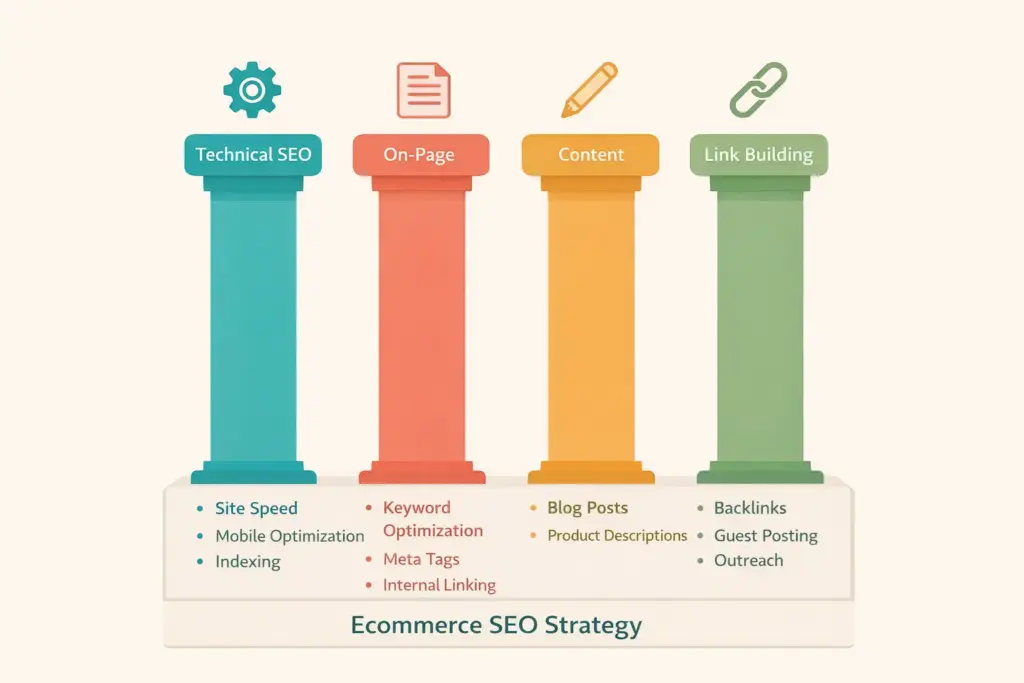
- The core ecommerce seo strategy has four pillars: technical SEO (site speed, crawlability, structured data), on-page optimization (product and category pages), content marketing (buying guides, blog posts), and link building (authority signals).
- DIY ecommerce SEO costs $0-200/month in tools and works well for stores under 500 products. An ecommerce seo agency typically charges $1,500-5,000/month and makes sense when your store exceeds 1,000 products or when organic revenue justifies the investment.
- 37.5% of all online purchases start with an organic search, making SEO one of the highest-ROI marketing channels for ecommerce. Unlike paid ads, organic traffic compounds over time rather than disappearing when you stop paying.
Ecommerce SEO services encompass the specialized search engine optimization work needed to make online stores visible in Google search results, covering everything from product page optimization and site architecture to technical crawlability, structured data markup, and content strategy tailored to commercial search intent. Unlike general SEO, seo for ecommerce sites requires handling hundreds or thousands of product pages, managing duplicate content from product variants and filters, and competing directly with Amazon, Walmart, and eBay for the same search queries.
Here’s the core question most store owners face: should you learn ecommerce SEO and do it yourself, or hire an ecommerce seo agency? The honest answer is both, at different stages. The fundamentals are learnable and should be handled in-house because nobody understands your products and customers better than you. The technical and competitive elements often justify hiring an ecommerce seo expert once your store generates enough revenue to fund the investment.
This guide teaches the complete ecommerce seo strategy you need regardless of whether you execute it yourself or hire help. If you’re still building your ecommerce business, bookmark this and come back when your store is live and generating initial sales.
Why Ecommerce SEO Is Different From Regular SEO
General SEO focuses on ranking blog posts and service pages. SEO ecommerce is a different discipline because online stores have structural challenges that blogs and service businesses don’t:
Scale. A store with 500 products has 500+ pages that need unique titles, descriptions, and metadata. A blog might have 50 posts. The optimization workload is 10x larger.
Duplicate content. Product variants (sizes, colors), filter URLs, and pagination create thousands of near-duplicate pages that confuse search engines. Managing this through canonical tags, noindex directives, and URL parameter handling is a technical challenge unique to ecommerce.
Commercial competition. Product keywords pit you against Amazon, Walmart, Target, and other retail giants who have massive domain authority. Ranking for “wireless headphones” is exponentially harder than ranking for “how to choose wireless headphones.”
Transactional intent. Ecommerce pages need to rank AND convert. A blog post can succeed by attracting traffic. A product page fails if it attracts traffic but nobody buys. Your ecommerce seo strategy must account for both visibility and conversion simultaneously.
The Four Pillars of Ecommerce SEO Strategy
Every ecommerce seo company structures their work around these four areas. Understanding them lets you evaluate whether you need help, which areas to prioritize, and what results to expect.
Pillar 1: Technical SEO (The Foundation)
Technical SEO ensures search engines can crawl, understand, and index your store correctly. Without this foundation, no amount of content or link building matters.
Site speed. A one-second delay in page load reduces conversions by up to 20%. Pages loading under 2 seconds see bounce rates around 9% versus 38% for 5-second loads. Run your store through Google PageSpeed Insights and aim for 70+ mobile score. Common speed killers on ecommerce sites: uncompressed product images, too many apps/plugins, and heavy theme code.
Crawlability and indexation. Submit your XML sitemap through Google Search Console. Use robots.txt to block faceted navigation URLs and filter pages from being crawled. Set canonical tags on product variants so Google knows which version to rank. For stores with 1,000+ products, crawl budget management becomes critical.
Structured data (Schema markup). Product schema tells Google your product’s name, price, availability, reviews, and shipping information. This data powers rich results in search (star ratings, price displays, stock status) that dramatically improve click-through rates. Every product page should have Product and Offer schema markup at minimum.
Mobile optimization. Over 60% of ecommerce traffic comes from mobile devices. Google uses mobile-first indexing, meaning it evaluates your mobile site version for rankings. Tap targets need to be large enough, text needs to be readable without zooming, and checkout must work flawlessly on a 5-inch screen.
Pillar 2: On-Page Optimization (Product and Category Pages)
This is the highest-impact work for most stores. Every product and category page is a potential search result entry point.
Product page optimization:
- Unique title tags with primary product keyword, brand (if applicable), and a differentiator (e.g., “Organic Cotton Crew Neck T-Shirt | Unisex | 12 Colors”)
- Unique meta descriptions that include the product keyword and a compelling reason to click
- Original product descriptions (never copy manufacturer descriptions that dozens of other retailers also use)
- High-quality images with descriptive alt text containing relevant keywords
- Customer reviews displayed on-page (user-generated content adds unique text Google values)
- FAQ sections addressing common buyer questions about the product
Category page optimization:
- Category pages target broader keywords (“wireless headphones”) while product pages target specific ones (“Sony WH-1000XM5 noise cancelling headphones”)
- Add 200-400 words of unique category description above or below the product grid
- Use breadcrumb navigation showing the full category hierarchy
- Internal links to top-selling products and related categories
This is where your ecommerce platform choice matters. Some platforms make on-page SEO straightforward (Shopify, WooCommerce with Rank Math), while others make it unnecessarily complex.
Pillar 3: Content Marketing (The Traffic Multiplier)
Product and category pages target buyers ready to purchase. Content marketing captures people earlier in the buying journey when they’re researching, comparing, and deciding. This audience is larger and less competitive to reach.
Buying guides (“How to Choose the Right Running Shoes”) attract shoppers who haven’t decided what to buy yet. Link these guides to your relevant product category pages.
Comparison content (“Product A vs Product B: Which Is Better for X?”) targets high-intent searchers actively deciding between options. These pages convert at higher rates than general blog posts.
How-to tutorials using your products (“5 Ways to Style an Oversized T-Shirt”) attract traffic and showcase your products in context. These work especially well on platforms where video content also ranks in search results.
Problem-solving content (“How to Fix a Squeaky Door” if you sell WD-40 or lubricants) targets the moment someone needs your product category. This is the content strategy that turns an online store into an authority site. Our marketing hub covers content strategy for ecommerce in depth. Our ecommerce business ideas guide covers how content-first strategies build lasting competitive advantages.
Pillar 4: Link Building (The Authority Signal)
Backlinks from other websites tell Google your store is trustworthy and authoritative. More quality backlinks generally correlate with higher rankings. For ecommerce sites, effective link building strategies include:
- Supplier and brand pages. Get listed on your suppliers’ “Where to Buy” or “Authorized Retailers” pages. Free, relevant, and high-authority.
- Digital PR. Create original research, data studies, or industry surveys that journalists and bloggers want to reference and link to.
- Resource pages. Find industry resource pages and pitch your buying guides or comparison content as additions.
- Guest contributions. Write expert content for industry publications with natural links back to your store’s relevant pages.
Avoid buying links or participating in link schemes. Google’s algorithms detect these patterns, and penalties can remove your store from search results entirely.
DIY Ecommerce SEO: What You Can Do Yourself
Most of the high-impact SEO work for stores under 500 products can be handled by the store owner. Here’s the priority order:
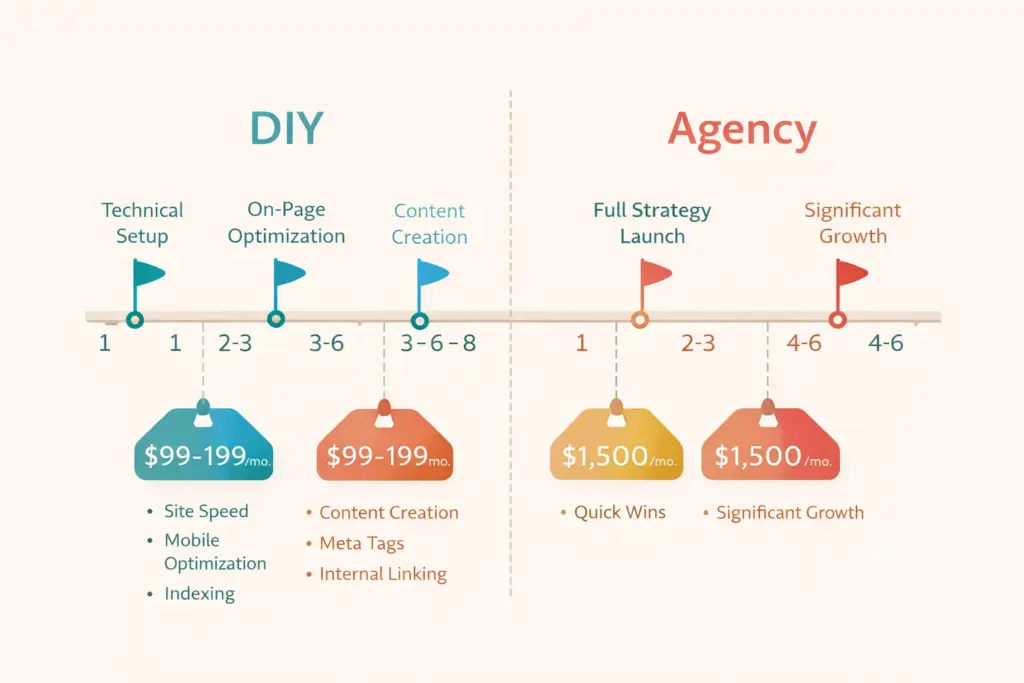
Week 1-2: Technical foundation. Set up Google Search Console. Submit your sitemap. Install a speed optimization app. Verify mobile usability. Add Product schema markup (many ecommerce tools and SEO plugins handle this automatically).
Week 3-4: Product page optimization. Rewrite product titles and meta descriptions with relevant keywords. Replace manufacturer copy with original descriptions. Add alt text to all product images. Install a reviews app and start collecting customer reviews.
Month 2-3: Category page optimization. Add unique category descriptions. Set up proper canonical tags and handle duplicate content from filters and variants. Optimize internal linking between related categories and products.
Month 3+: Content creation. Start publishing one buying guide or comparison article per week targeting keywords your potential customers search before purchasing. Link these articles to your product and category pages.
Ongoing: Monitor and adjust. Check Google Search Console weekly for crawl errors, indexation issues, and keyword performance. Track which pages generate the most organic traffic and revenue. Double down on what works.
When to Hire an Ecommerce SEO Agency
DIY works until it doesn’t. Here are the signals that it’s time to bring in an ecommerce seo consultant or agency:
Your store has 1,000+ products. At this scale, manual optimization becomes impractical. You need automated systems, template-level changes, and technical solutions that an ecommerce seo expert can implement efficiently.
You’re losing rankings to competitors. If competitors are outranking you despite having similar products, they likely have a professional SEO operation. Matching their effort level requires expertise you may not have in-house.
Organic revenue justifies the investment. If your store generates $10,000+/month from organic traffic, spending $2,000-4,000/month on an agency to grow that channel by 30-50% is a strong ROI. If organic brings in $500/month, the math doesn’t work yet.
You need technical fixes you can’t make. Site speed issues rooted in server configuration, JavaScript rendering problems, complex redirect chains from a platform migration, or indexation issues with faceted navigation often require technical SEO expertise.
Ecommerce SEO Packages: What Agencies Actually Deliver
Typical ecommerce seo packages from legitimate agencies include these deliverables. Knowing what to expect helps you evaluate proposals and avoid overpaying.
| Package Level | Monthly Cost | What’s Included | Best For |
|---|---|---|---|
| Basic / Starter | $500-1,500/mo | Technical audit, on-page optimization for top 20-50 pages, monthly reporting | Small stores under 200 products |
| Growth | $1,500-3,500/mo | Everything above + content creation (2-4 articles/month), link building, category optimization | Mid-size stores, 200-2,000 products |
| Enterprise | $3,500-10,000+/mo | Full-service: technical SEO, content strategy, link building, conversion optimization, international SEO | Large stores with 2,000+ products |
Red flags when evaluating an ecommerce seo company:
- Guarantees specific rankings (“We’ll get you to #1 for X keyword”). No legitimate agency can guarantee rankings because Google’s algorithm isn’t controllable.
- Won’t explain their strategy. If they can’t tell you specifically what they’ll do each month, they’re likely doing very little.
- Focuses on vanity metrics (traffic) instead of revenue metrics (organic revenue, conversion rate from organic traffic).
- Requires long-term contracts before showing any results. Month-to-month arrangements protect you.
DIY vs Agency: Cost Comparison
| Cost Category | DIY | Agency (Growth Tier) |
|---|---|---|
| SEO tools (Ahrefs, SEMrush, or similar) | $99-199/mo | Included |
| Content creation | Your time (5-10 hrs/week) | $800-2,000/mo (2-4 articles) |
| Technical fixes | Your time + learning curve | Included |
| Link building | Your time (3-5 hrs/week) | $500-1,500/mo |
| Monthly reporting | Free (Google tools) | Included |
| Total monthly cost | $99-199 + your time | $1,500-3,500 |
| Time to see results | 4-8 months | 3-6 months |
The agency is faster because they’ve done it before and can execute the full strategy from day one. DIY is cheaper but slower because you’re learning while implementing. The right choice depends on whether your bottleneck is budget (DIY) or time and expertise (agency). Your pricing strategy needs to account for marketing costs regardless of which path you choose.
Frequently Asked Questions
What are ecommerce seo services and what do they include?
Ecommerce SEO services are specialized search optimization for online stores. They typically include technical site audits, product and category page optimization, keyword research, content creation (buying guides, blog posts), structured data markup, link building, and monthly performance reporting. The goal is increasing organic search traffic that converts into sales.
How much do ecommerce seo packages cost?
Ecommerce seo packages range from $500-1,500/month for basic optimization to $3,500-10,000+/month for full-service enterprise plans. The right budget depends on your store’s size, competition level, and current organic revenue. A reasonable starting point is reinvesting 10-15% of your organic revenue into SEO growth.
Should I hire an ecommerce seo agency or do it myself?
Start with DIY if your store has under 500 products and generates under $5,000/month in organic revenue. The fundamentals of product page optimization, technical setup, and content creation are learnable. Hire an ecommerce seo agency when your store exceeds 1,000 products, when competitors with professional SEO are outranking you, or when organic revenue is high enough to justify the investment.
What should I look for in an ecommerce seo consultant?
Look for an ecommerce seo consultant with documented case studies showing organic revenue growth (not just traffic growth) for stores similar to yours. They should explain their specific strategy, offer month-to-month contracts, report on revenue metrics, and have experience with your ecommerce platform. Avoid anyone guaranteeing specific keyword rankings.
How long does ecommerce seo strategy take to show results?
Technical fixes can impact rankings within 2-4 weeks. On-page optimization typically shows results in 1-3 months. Content marketing and link building take 4-8 months to generate meaningful traffic. Most ecommerce seo experts set expectations of 6-12 months for significant organic revenue growth, though quick wins often appear within the first 90 days.
What’s the difference between ecommerce seo and regular seo?
Ecommerce SEO handles challenges regular SEO doesn’t: optimizing hundreds or thousands of product pages, managing duplicate content from variants and filters, competing with marketplace giants like Amazon, implementing Product schema for rich results, and optimizing for both search rankings and purchase conversion simultaneously.
Related Reads
- Ecommerce Storefront Launch Checklist
- Best Ecommerce Platform Comparison
- Ecommerce Tools and Tech Stack
- Ecommerce Web Design Guide
- Ecommerce Website Templates
- Ecommerce Startup Costs Breakdown
Enjoying this? Get more like it every week.
One email per week with ecommerce strategies, tool picks, and seller insights. No spam.