
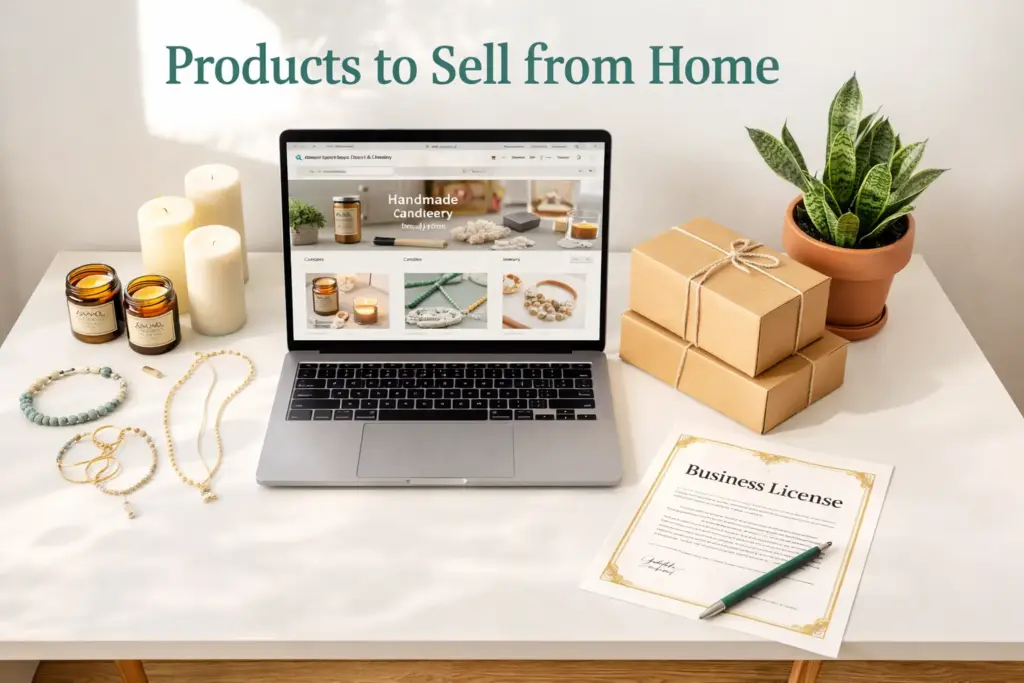
- The best products to sell from home fit your available space, don't require commercial zoning, and can be shipped without specialized equipment. Digital products, small handmade goods, and lightweight resale items all work well from a spare room or garage.
- Most US cities and counties require a home based business license, home occupation permit, and seller's permit to legally sell products from a residential address, even for online-only businesses.
- Home occupation permits typically restrict signage, customer foot traffic, employee count, and noise levels. Violating these rules can result in fines or a forced shutdown by your local zoning office.
- Digital products (80-95% margins) and print on demand (20-40% margins) are the most home-friendly business models because they require zero physical inventory storage and no shipping supplies.
A home based business license is a government-issued permit that authorizes you to legally operate a business from your residential address, covering requirements like zoning compliance, sales tax collection, and local business registration that apply whether you sell products online, at craft fairs, or directly from your home. Getting this license right before you start selling saves you from fines, forced shutdowns, and tax headaches down the road.
But a license without a product is just paperwork. And a product without a license is a liability. This guide covers both sides: 30 profitable products to sell from home that actually work within the constraints of a home setup, and every permit and license you need to sell them legally.
Most articles about home businesses either give you a product list and ignore the legal stuff, or they drone on about permits without telling you what to actually sell. If you’re figuring out how to start an ecommerce business from home, you need both answers in one place. That’s what this guide delivers.
Home Based Business License and Permit Requirements
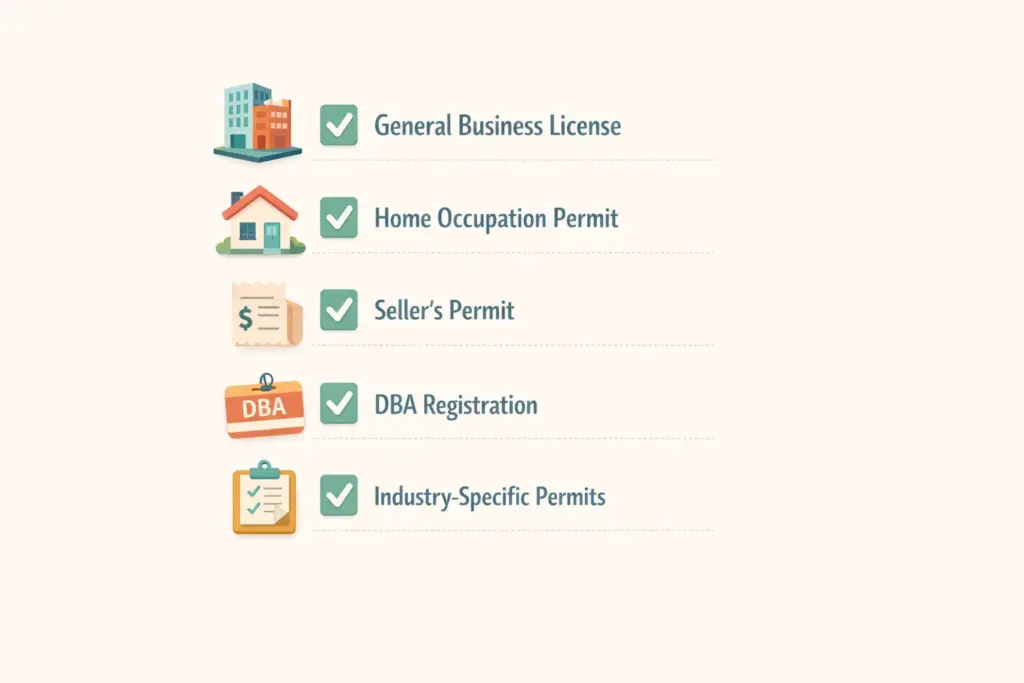
Before picking products, let’s clear the legal hurdle. Nearly every city and county in the US requires some form of home based business permit to operate commercially from a residential address. The exact requirements vary by location, but here are the licenses most home sellers need.
General Business License
Most municipalities require a general business license (sometimes called a business tax certificate) for any business operating within their boundaries. This applies even if you sell exclusively online. It’s typically a simple application with your business name, structure, address, and a small annual fee ($25-100 in most areas).
Check your city or county’s government website, or contact your local clerk’s office. You’ll usually need your legal business structure (LLC, sole proprietorship, etc.) set up first.
Home Occupation Permit
This is the permit for home based business that specifically addresses zoning. Your local government wants to confirm that your business won’t disrupt the neighborhood. Home occupation permits typically restrict:
- Customer foot traffic to your residence
- Employees working from your home (many permits cap at 0-1)
- Commercial signage on your property
- Excessive deliveries or shipping pickups
- Noise, fumes, or hazardous materials
For most ecommerce sellers working from a spare room or garage, these restrictions aren’t a problem. You’re shipping packages via USPS pickup, not running a retail storefront. But if you’re producing food, storing large amounts of inventory, or running a workshop with power tools, check your local zoning rules carefully before investing in equipment.
Seller’s Permit (Sales Tax License)
If you sell taxable physical goods, you need a seller’s permit from your state. This authorizes you to collect sales tax from customers and remit it to your state’s revenue department. In most states, this is free to obtain but mandatory. Not collecting sales tax when required can result in back-tax penalties plus interest.
Marketplaces like Amazon and Etsy now handle sales tax collection in most states as marketplace facilitators. But if you sell through your own website (Shopify, WooCommerce), you’re responsible for collecting and remitting sales tax in states where you have nexus. The SBA licensing guide has state-by-state resources to help you find your requirements.
DBA (Doing Business As) Registration
If you’re a sole proprietor selling under a business name (not your personal name), most states require a DBA filing. This lets you open a business bank account and operate under your brand name legally. Filing costs $10-50 in most counties.
Special Industry Permits
Certain product categories require additional permits:
| Product Type | Additional Permit Needed | Where to Check |
|---|---|---|
| Food, baked goods, beverages | Cottage food license or food handler’s permit | State health department |
| Cosmetics, skincare, soap | May need FDA registration if sold interstate | FDA.gov |
| Candles, home fragrance | Fire safety compliance (varies by locality) | Local fire marshal |
| Supplements, health products | FDA registration, GMP compliance | FDA.gov |
| Alcohol | Federal and state liquor licenses | TTB.gov + state alcohol board |
| Pet food and treats | State feed control registration | State agriculture department |
If your product falls into a regulated category, research the compliance requirements before investing in production. Getting shut down after building a customer base is far more painful than spending a few weeks on permits before your first sale.
Products to Sell from Home: Zero Inventory Required
These things to sell from home require no physical storage because the product is either digital or produced by a partner when an order comes in. They’re the most home-friendly options available.
Digital Products
Digital products are the ultimate home business because there’s nothing to store, nothing to ship, and margins run 80-95%. Here are the specific types that sell consistently:
- Notion and spreadsheet templates. Budget trackers, project management dashboards, content calendars. Cost to create: your time. Selling price: $9-49.
- Printable planners and journals. Design once, sell forever on Etsy or Gumroad. Cost: $0 (using Canva). Selling price: $5-25.
- Online courses. The global online learning market exceeds $200 billion. If you have teachable expertise, courses are the most scalable product you can build from home.
- Ebooks and guides. Niche how-to content on topics like gardening, cooking, fitness, or finance. Write once, sell indefinitely.
- Design assets. Lightroom presets, fonts, icon packs, social media templates. Designers buy these to save time on repetitive work.
Print on Demand Products
Print on demand lets you sell custom-designed products (t-shirts, mugs, posters, phone cases) without touching inventory. A production partner prints and ships each order directly to your customer. You design, market, and handle customer service from your couch.
Margins are lower than digital products (20-40% typically), but the product range is enormous. Custom apparel and mugs are the top sellers, with personalized and niche designs outperforming generic ones by a wide margin.
Dropshipped Products
Dropshipping connects your online store to suppliers who ship directly to your customers. You never see the product. The trade-off is thinner margins (15-30%), but it lets you test dozens of product ideas from home without any inventory investment. Lightweight accessories, gadgets, and home goods work best for this model.
Products to Make and Sell from Home
If you want to make stuff to sell from home, these categories work well within a home workshop or kitchen. Each requires relatively little space and can be produced in small batches.
Candles and Home Fragrance
Soy candles cost $3-5 per unit to make and sell for $18-35. The equipment fits on a kitchen counter: wax, wicks, fragrance oils, a double boiler, and jars. Check your local fire code requirements before producing candles at home, as some municipalities have restrictions on open-flame production in residential areas.
Soap and Bath Products
Handmade soap costs roughly $3 per bar to produce and retails for $5-10. Bath bombs, body scrubs, and shower steamers expand your product line with the same basic skills and ingredients. The bundling opportunity is strong: gift sets combining soap, bath bombs, and scrubs push average order values from $10 to $30+ with minimal extra effort.
Jewelry
Beaded bracelets, resin pieces, wire-wrapped stones, and stamped metal jewelry all sell well on Etsy. Material costs are low ($1-5 per piece), and the finished product is small enough to store and ship from a desk drawer. Personalized jewelry (name necklaces, birthstone pieces) commands the highest prices because it can’t be replicated by mass-market sellers.
Baked Goods and Food Products
Most states have cottage food laws that allow home-based food production and sales within certain limits. Typical restrictions include annual revenue caps ($25,000-75,000 depending on the state), direct-to-consumer sales only (no wholesale), and labeling requirements. Custom cookies, specialty jams, granola, and baked goods are popular choices. Check your state’s cottage food laws before starting.
Personalized and Engraved Items
A Cricut machine ($200-400) or entry-level laser engraver ($300-500) pays for itself quickly when you’re adding $10-20 in perceived value per item. Custom cutting boards, engraved glassware, personalized ornaments, and monogrammed leather goods are all strong sellers. Made-to-order production means zero unsold inventory sitting in your garage.
For more ideas on what you can create, our things to make and sell guide covers 30 options organized by skill level.
Wholesale Items to Sell from Home
Buying wholesale items to sell from home means purchasing products in bulk at discounted prices and reselling them individually at retail markup. This requires storage space, but the product selection is much broader than what you can make yourself.
What Works for Home-Based Wholesale
The products that work best for home resellers are small, lightweight, and non-perishable. Think accessories, beauty products, phone cases, pet supplies, and organizational items. Avoid heavy, bulky, or fragile products unless you have dedicated garage or basement storage with shelving.
Start small: 10-25 units of a single product to test demand before committing to bulk orders. Our wholesale suppliers guide covers where to find legitimate suppliers and how to negotiate minimum order quantities that work for home-based operations.
Retail Arbitrage from Home
Retail arbitrage involves buying clearance and discounted products from retail stores and reselling them online at market price. Books, toys, electronics accessories, and brand-name health products are the most profitable categories. The “warehouse” is your spare room, and the investment per product can be as low as $2-5.
Thrift and Vintage Reselling
Vintage clothing, retro electronics, collectible items, and brand-name goods found at thrift stores, estate sales, and garage sales can be flipped for 3-10x what you paid. eBay, Poshmark, and Mercari are the primary platforms. This model requires almost no startup capital but does require an eye for what’s valuable and the patience to photograph and list each item individually.
How Can I Start a Home Based Business: Step by Step
Here’s the practical sequence for anyone asking how can I start a home based business selling products:
Step 1: Pick Your Product and Business Model
Use the categories above to find a product that matches your skills, budget, and available space. Digital products and POD need zero space. Handmade goods need a small workspace. Wholesale reselling needs dedicated storage.
Step 2: Research Your Local License Requirements
Search “[your city/county] home based business license” or visit your local government website. Identify which permits you need: general business license, home occupation permit, seller’s permit, and any industry-specific licenses for your product type.
Step 3: Set Up Your Legal Structure
Register your business entity (LLC recommended for liability protection), get your EIN from the IRS (free), file your DBA if using a business name, and open a business bank account. Our legal setup guide walks through each step.
Step 4: Apply for Permits and Licenses
Apply for your general business license, home occupation permit, and seller’s permit. Most applications can be completed online. Expect $50-200 total in filing fees for a basic home ecommerce business. Processing typically takes a few days to a few weeks.
Step 5: Build Your Sales Channel
Choose where to sell: your own website via Shopify or WooCommerce, marketplace platforms like Etsy or Amazon, social media direct sales, or local craft fairs and farmers markets. Many home sellers start on Etsy or a marketplace to access existing traffic, then build their own site as the business grows.
Step 6: Launch and Test
Start with a small product catalog (5-15 items), invest $50-100 in initial marketing, and measure what sells. Don’t order 500 units of anything before you’ve proven demand. Test, learn, iterate. Understanding your startup costs keeps you from overinvesting before the market validates your product.
Home Business Mistakes That Cost Money
Selling without permits. Operating without a home occupation permit might go unnoticed for months, but a single neighbor complaint to your zoning office can shut you down and trigger fines. Get legal before you get busy.
Ignoring sales tax obligations. Not collecting sales tax when required doesn’t mean you don’t owe it. Your state can come back with a bill for back taxes plus penalties. Register for your seller’s permit and set up tax collection from day one.
Overbuying inventory. A spare bedroom can hold maybe 200-500 small products comfortably. Beyond that, you’re living in a warehouse. Start lean, reorder based on actual sales data, and only scale storage when revenue justifies renting a small storage unit or garage space.
Underpricing handmade products. If a candle takes 45 minutes to make, costs $4 in materials, and you sell it for $12, your effective hourly wage is about $10 after platform fees and shipping supplies. Price your products to pay yourself a real wage on top of materials and overhead. Our pricing strategy guide has the math frameworks.
Mixing personal and business finances. Open a separate business bank account from day one. Mixing personal and business transactions makes tax time a nightmare and weakens your LLC liability protection.
Frequently Asked Questions
Do I need a home based business license to sell online?
In most US cities and counties, yes. A general business license and seller’s permit are required for virtually all businesses selling taxable goods, including online-only businesses operating from home. Many areas also require a home occupation permit. Check your local government website for specific requirements in your area.
How much does a home based business license cost?
A general business license typically costs $25-100 per year. A home occupation permit runs $0-100 depending on your municipality. A seller’s permit is free in most states. Total initial licensing costs for a home ecommerce business usually fall between $50-200, though some cities charge more.
What is a home based business permit and how do I get one?
A home based business permit (home occupation permit) is a zoning approval that confirms your business activities are compatible with residential use. Apply through your city or county planning/zoning department. The application asks about your business type, expected traffic, storage needs, and employee count. Most are approved within days to weeks.
What are the best products to sell from home without a home based business license?
Digital products (templates, printables, ebooks) require zero inventory and have 80-95% margins. Print on demand lets you sell custom apparel and mugs without touching inventory. For physical products, candles, soap, and jewelry are beginner-friendly because materials are affordable and the workspace needed is minimal. That said, you still need a home based business license in most areas regardless of what you sell.
Can I sell food products from home legally?
Most states have cottage food laws that allow home-based food sales within limits. Typical restrictions include annual revenue caps ($25,000-75,000), direct-to-consumer sales only, required labeling, and product type restrictions (usually shelf-stable items only, no dairy or meat). Check your state’s specific cottage food law before starting.
What wholesale items to sell from home are most profitable?
Small, lightweight, non-perishable products work best for home-based wholesale reselling. Phone accessories, beauty products, pet supplies, and organizational items offer strong margins without requiring much storage space. Start with 10-25 units per product to test demand before committing to bulk orders.
Related Reads
- What to Sell Online: Product Ideas by Business Model
- Things to Make and Sell: 30 Ideas by Skill Level
- Digital Products to Sell Online
- Legal Setup: LLC, Tax, and Business Structure
- How to Sell Things Online
- Ecommerce Startup Costs Breakdown
Enjoying this? Get more like it every week.
One email per week with ecommerce strategies, tool picks, and seller insights. No spam.