
- A business plan for an online business needs ecommerce-specific sections that generic templates miss: customer acquisition costs, platform/tech stack decisions, fulfillment logistics, and unit economics per product.
- 9 out of 10 ecommerce failures trace back to poor planning, according to founder surveys. A solid plan forces you to pressure-test your idea before spending money on inventory and ads.
- You don't always need a 30-page document. Bootstrapped sellers can use a lean one-page business plan that covers the essentials in an afternoon.
- The financial projections section matters most. If your unit economics don't work on paper (revenue minus product cost, shipping, fees, ads, and returns), they won't work in practice either.
A template startup business plan is a structured document that maps out your ecommerce company’s goals, market opportunity, operations, and financial projections so you can validate your idea, secure funding, and build a clear path to profitability before spending money on inventory or ads. For online stores specifically, it needs to cover digital-first elements like customer acquisition costs, platform fees, and fulfillment models that generic templates skip entirely.
Here’s the uncomfortable truth most “just start selling” advice ignores: 9 out of 10 ecommerce businesses fail, and founder surveys consistently point to poor planning as the root cause. Not bad products. Not bad luck. Bad planning. A solid business plan for online business forces you to pressure-test your numbers and identify problems before they become expensive lessons. If you’re in the early stages of starting an ecommerce business, this is the foundation everything else builds on.
This guide walks through every section of an ecommerce business plan with real examples and practical guidance. I’ve also included a lean one-page alternative at the end for bootstrapped sellers who need clarity without the corporate formality. Global ecommerce is projected to reach $6.88 trillion in 2026 (Statista), and the sellers who capture a piece of that aren’t winging it. They’re planning.
Do You Actually Need a Template Startup Business Plan?
Depends on your situation. If you’re seeking investment from angel investors or applying for a business loan, absolutely. Banks and investors won’t write a check without a comprehensive plan that demonstrates market understanding, financial projections, and a clear path to profitability.
If you’re bootstrapping a Shopify store with your own savings? You still need one, but it doesn’t have to be 40 pages. Even a lean one-page plan forces you to answer critical questions: Who’s your customer? What does it cost to acquire them? What are your margins after all expenses? How much runway do you have before you need to be profitable?
Skipping the plan doesn’t save time. It just moves the hard thinking from “before you spend money” to “after you’ve already spent it.” One of those is planning. The other is damage control. According to a Small Business Administration study, businesses with formal plans grow 30% faster than those without.
Business Plan Template for a Startup Business: Section by Section
Below is the complete structure of a business plan template for a startup business in ecommerce. Each section includes what to write, why it matters, and the ecommerce-specific elements that generic templates miss.
Section 1: Executive Summary
Write this last, even though it appears first. The executive summary is a 1-2 page overview of your entire plan. It should be compelling enough that someone who reads nothing else still understands your business, your market, and your path to profitability.
Your executive summary should cover:
- Business concept. What you sell, who you sell to, and why they buy from you instead of Amazon or a competitor.
- Problem and solution. What specific pain point does your product or store address? “People need skincare” isn’t a problem statement. “Women with rosacea-prone skin can’t find clean beauty products that don’t trigger flare-ups” is.
- Business model. Are you doing dropshipping, private label, print on demand, or selling your own handmade products? Each ecommerce business model has different economics.
- Revenue projections. High-level numbers: expected revenue for Year 1, break-even timeline, and target net margin.
- Funding needs. How much capital you need and what you’ll spend it on (inventory, marketing, platform costs, etc.).
Keep it tight. If your executive summary runs past two pages, you’re including too much detail that belongs in later sections.
Section 2: Company Description
This section establishes who you are and what your company does. For an ecommerce startup, include:
Legal structure. Are you an LLC, sole proprietorship, S-Corp, or C-Corp? Your legal setup affects taxes, liability, and how investors perceive your business. Most ecommerce startups begin as LLCs for the liability protection and tax flexibility.
Mission statement. One to two sentences describing your purpose. Skip the corporate fluff. “We help busy parents find safe, organic baby products without spending hours researching ingredients” works better than “We synergize sustainable commerce solutions.”
Unique value proposition. What makes you different? Price alone isn’t a UVP unless you have a structural cost advantage. Curation, expertise, customer experience, brand story, and product quality are stronger differentiators for most online sellers.
Section 3: Market Analysis
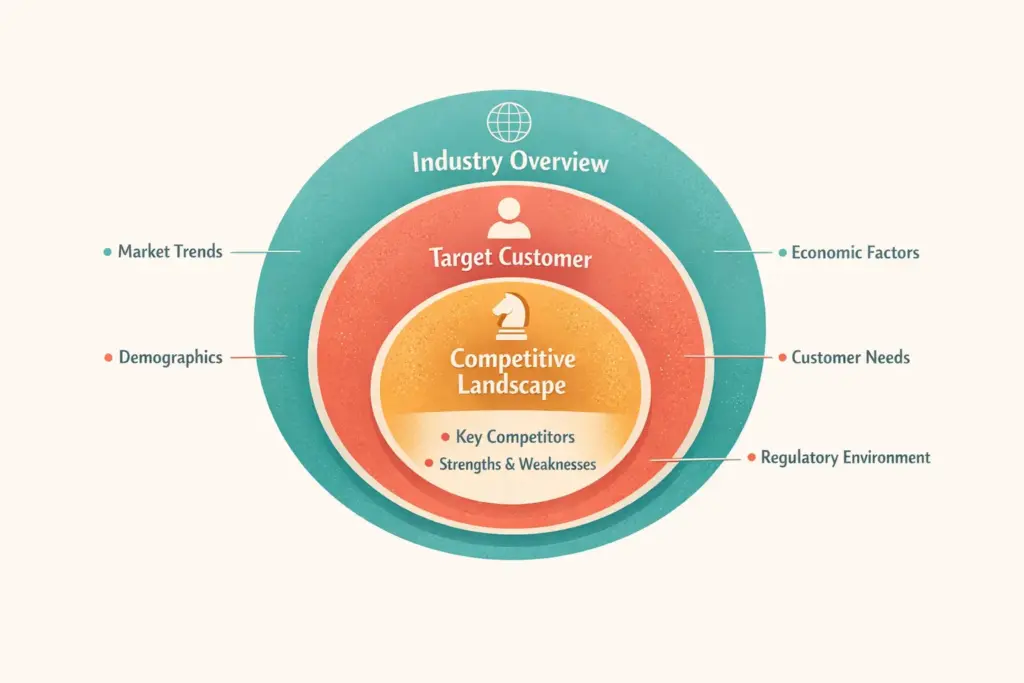
This is where you prove that people actually want what you’re selling. A strong market analysis covers three layers: industry overview, target market, and competitive landscape.
Industry overview. Size of your market, growth trajectory, and major trends. Use credible sources. Global ecommerce is projected to reach $6.88 trillion in 2026 (Statista). But your relevant market is much smaller. If you’re selling organic dog treats in the US, your addressable market is the US pet food market ($58.1 billion), narrowed further to the organic/premium segment.
Target customer profile. Demographics (age, income, location) and psychographics (values, pain points, buying behavior). Be specific. “Women aged 25-40” is too broad. “Health-conscious millennial moms who shop online for organic baby products and are willing to pay premium prices for clean ingredient lists” gives you something to build marketing strategies around.
Competitive analysis. Identify your top 3-5 direct competitors and 2-3 indirect competitors. For each, document their pricing, product range, strengths, weaknesses, and customer reviews. What are customers complaining about? That’s where your opportunity lives.
| Competitor | Price Range | Strengths | Weaknesses | Your Advantage |
|---|---|---|---|---|
| [Competitor A] | $XX-$XX | Brand recognition, large catalog | Slow shipping, generic products | Faster fulfillment, niche focus |
| [Competitor B] | $XX-$XX | Low prices, Amazon presence | Poor reviews on quality | Premium quality, better packaging |
| [Competitor C] | $XX-$XX | Strong social media following | Limited product range | Broader curated selection |
Section 4: Products and Services
Detail exactly what you’re selling and why it will succeed. For ecommerce, this goes beyond just listing products.
Product catalog overview. What products will you launch with? How many SKUs? Will you expand the catalog over time, and if so, based on what criteria?
Sourcing and supply chain. Where do your products come from? Are you manufacturing, buying wholesale, private labeling, or using print on demand? What’s your backup if your primary supplier fails? Detail your lead times, minimum order quantities, and quality control process.
Pricing strategy. How did you set your prices? Cost-plus, competitive, or value-based? What margins does each pricing approach deliver after all costs? Our ecommerce pricing strategy guide covers the frameworks in depth.
Product differentiation. What makes your products different from what’s already available? If the answer is “nothing, but we’ll be cheaper,” you need a stronger strategy. Differentiation can come from ingredients, design, packaging, bundling, customization, customer service, or brand story.
Section 5: Marketing and Sales Strategy
This section explains how you’ll attract customers and convert them into buyers. For a business plan template for startups, this is often the weakest section because founders underestimate how much customer acquisition costs.
Customer acquisition channels. Where will your customers come from? Common ecommerce channels include paid advertising (Facebook/Meta, Google, TikTok), search engine optimization, social media marketing, email marketing, influencer partnerships, and marketplace presence on Amazon or Etsy.
Customer acquisition cost (CAC) estimate. How much will it cost to acquire one customer through each channel? If you’re spending $30 on ads to sell a $25 product, the math doesn’t work regardless of how good your product is. Benchmark CAC for ecommerce ranges from $10-50 depending on niche and channel, but your specific numbers depend on your product price point and conversion rates.
Customer lifetime value (LTV). If your product has repeat purchase potential (supplements, skincare, coffee, pet food), your LTV can be 3-5x the first purchase value. That changes the CAC math entirely. A $30 acquisition cost is fine if the customer spends $200 over their lifetime.
Content strategy. Organic traffic is free once you build it. Detail your content plan: blog posts, product guides, comparison articles, and educational content that attracts your target audience through search.
Section 6: Operations and Logistics
This section covers how your business actually runs day to day. Investors and lenders pay close attention here because operational mistakes are the silent killer of ecommerce businesses.
Ecommerce platform. Which platform will you build on? Shopify, WooCommerce, BigCommerce, or something else? Justify your choice based on your business model, technical requirements, and budget. Our ecommerce platform comparison breaks down the options.
Fulfillment model. Are you self-fulfilling (packing and shipping from your location), using a 3PL (third-party logistics provider), or using Amazon FBA? Each has different cost structures, speed, and scalability implications.
Tech stack. List the tools and software you’ll use: email marketing platform, analytics tools, customer support system, accounting software, inventory management. Include monthly costs for each.
Shipping and returns. Free shipping threshold, flat rate, or real-time calculated rates? Domestic only or international? Shipping costs are one of the top reasons shoppers abandon carts, so this decision directly affects conversion rates. Also detail your return policy, expected return rate, and cost per return.
Section 7: Management Team
If you’re a solo founder, this section can be brief. List your relevant experience and skills. If you’re building a team, detail each key role, who fills it, and what they bring.
Don’t fake this section. A solo founder with relevant industry experience is more credible than a “team” of friends with no ecommerce background. If you have skill gaps (design, marketing, finance), acknowledge them and explain how you’ll fill those gaps through contractors, courses, or future hires.
Section 8: Financial Plan (The Section That Matters Most)
Everything above is theory. The financial plan is where theory meets math. For a 5 year business plan template, you need projections that are ambitious enough to be interesting but grounded enough to be believable.
Startup costs. Every dollar needed before your first sale:
| Expense Category | Bootstrapped Store | Funded Store |
|---|---|---|
| Platform/hosting | $29-79/month | $79-299/month |
| Domain and branding | $100-500 | $1,000-5,000 |
| Initial inventory | $500-2,000 | $5,000-20,000 |
| Product photography | $0-200 (DIY) | $500-2,000 |
| Website design/theme | $0-180 | $2,000-10,000 |
| Marketing launch budget | $200-1,000 | $2,000-10,000 |
| Legal (LLC, trademarks) | $100-500 | $500-3,000 |
| Apps and tools | $50-150/month | $200-500/month |
| Total estimated range | $1,000-4,500 | $11,000-50,000+ |
Our ecommerce startup costs guide has detailed breakdowns for every business model.
Revenue projections. Month-by-month for Year 1, quarterly for Years 2-3, and annual for Years 4-5. Base your projections on realistic assumptions: website traffic, conversion rate (1-3% is typical for new ecommerce stores), average order value, and repeat purchase rate. The Shopify business plan guide includes sample projection tables you can adapt.
Unit economics. Break down the profit per product sold:
| Line Item | Example (Private Label) | Example (Dropshipping) |
|---|---|---|
| Selling price | $39.99 | $29.99 |
| Product cost | -$8.00 | -$15.00 |
| Shipping cost | -$4.50 | -$0 (supplier ships) |
| Platform/payment fees | -$2.40 | -$1.80 |
| Ad spend per sale | -$8.00 | -$6.00 |
| Returns/refunds (est.) | -$1.60 | -$1.50 |
| Net profit per unit | $15.49 (39%) | $5.69 (19%) |
If your unit economics don’t show profit on paper, no amount of volume will fix the problem. Fix the math first.
Cash flow projection. Month-by-month cash flow for at least 12 months. When does money come in versus when does it go out? Ecommerce has a cash flow timing challenge: you often pay for inventory and ads 30-60 days before customers pay you. This gap has killed businesses that looked profitable on the income statement.
Break-even analysis. How many units do you need to sell monthly to cover all fixed and variable costs? At what month do you expect to reach break-even? This is the number investors and lenders care about most.
Lean One-Page Business Plan for Online Business
Not everyone needs a 30-page document. If you’re self-funding a small online store and don’t need investor or bank approval, a lean one-page plan can provide the same clarity in a fraction of the time.
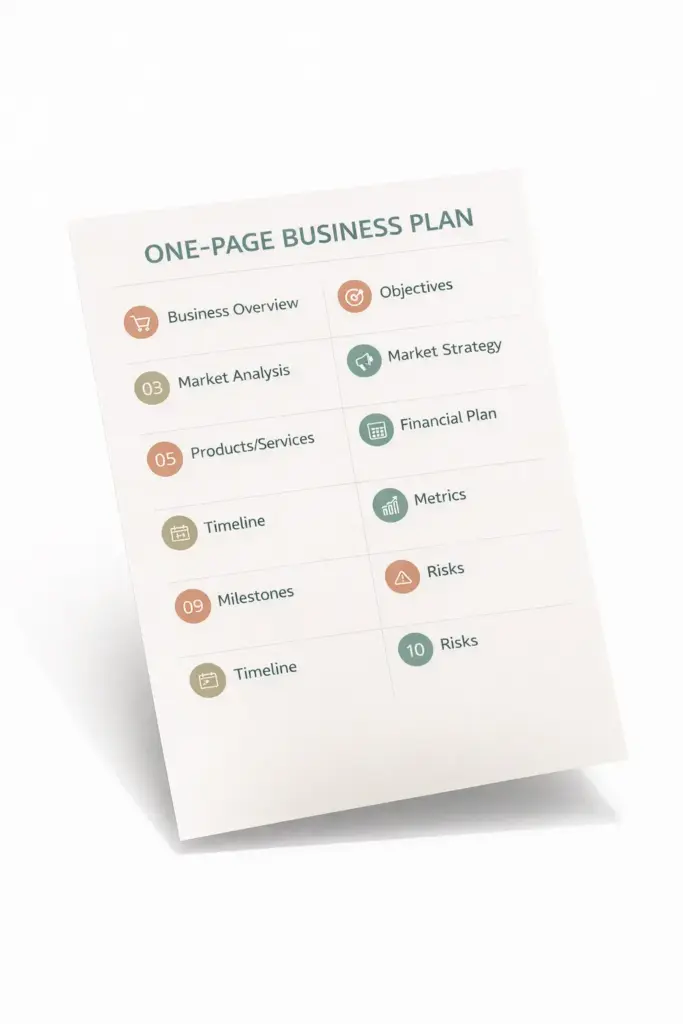
Your lean business plan for online business should answer these ten questions on a single page:
- What am I selling? (Products, model, niche)
- Who’s buying? (Specific customer profile)
- Why me? (What makes my store different)
- Where will customers find me? (Top 2-3 marketing channels)
- What’s my pricing? (Price points and margin targets)
- What are my startup costs? (Total investment needed)
- What’s my monthly overhead? (Platform, tools, subscriptions)
- How many sales to break even? (Units per month at current margins)
- What does success look like at 6 months? (Revenue target, customer count)
- What’s the biggest risk? (And how will I handle it)
You can answer these in an afternoon. Tape the result above your desk. It’ll keep you focused better than a 40-page document you wrote once and never opened again.
Shopify Business Plan Template Considerations
If you’re building on Shopify specifically, your Shopify business plan template should address a few platform-specific elements that generic templates skip:
Plan tier and costs. Shopify’s plans range from Basic ($39/month) to Advanced ($399/month), plus transaction fees that vary by plan. Your financial projections need to account for the specific tier you’ll use and when you’ll need to upgrade as volume grows.
App costs. Most Shopify stores need 5-15 apps for email marketing, reviews, upsells, SEO, analytics, and other functions. App costs can add $100-500/month on top of your Shopify subscription. List the apps you’ll need and their monthly fees in your operations section.
Theme and customization. Will you use a free theme, purchase a premium theme ($180-350), or invest in custom development ($2,000-15,000)? Our ecommerce website templates guide covers the decision framework.
Shopify Payments vs. third-party processors. Using Shopify Payments eliminates the additional 0.5-2% transaction fee that Shopify charges when you use external payment gateways. This affects your per-unit economics.
Common Template Startup Business Plan Mistakes
Projecting hockey-stick growth without justification. “Month 1: $1,000. Month 6: $50,000. Month 12: $200,000.” Unless you can explain exactly what drives each jump (ad spend increase, influencer launch, seasonal peak), those projections are fiction. Investors see through this instantly.
Ignoring customer acquisition costs. Your plan shows $100K in revenue but doesn’t account for the $40K in ads needed to generate it. That’s not a $100K business. It’s a $60K business at best, and probably less after other costs.
Copying a competitor’s model without understanding their economics. Just because a competitor sells at $19.99 doesn’t mean that price works for you. They might have bulk sourcing discounts, warehouse infrastructure, or VC funding that lets them operate at a loss. Your plan needs to reflect your cost structure, not theirs.
No contingency planning. What happens if your primary supplier doubles their prices? What if Facebook ad costs jump 30% (they have before)? What if your first product launch flops? A plan without “what if” scenarios is just a wish list.
Overcomplicating it. A 50-page plan filled with market research you copied from Statista doesn’t impress anyone. A 10-page plan with clear thinking, honest numbers, and a realistic timeline does. Focus on depth of analysis, not length of document.
Putting Your Plan Into Action
A business plan is a living document, not a one-time exercise. Review and update it quarterly, or whenever something significant changes: a new competitor enters, your costs shift, or you discover that a marketing channel works better than expected.
Once your plan is solid, the next steps are straightforward:
- Validate your product idea with real customer feedback (not just friends and family)
- Set up your legal structure and business banking
- Build your store on the right platform
- Source your first products or create your initial digital product catalog
- Launch with a small, focused marketing push and measure everything
The plan doesn’t guarantee success. Nothing does. But it dramatically reduces the chance of failure by making you answer hard questions before your money is on the line instead of after.
Frequently Asked Questions
What should a template startup business plan include for ecommerce?
A template startup business plan for ecommerce should include eight core sections: executive summary, company description, market analysis, products and services, marketing and sales strategy, operations and logistics, management team, and financial plan. The ecommerce-specific elements that generic templates miss are customer acquisition costs, platform decisions, fulfillment models, and unit economics per product.
How do I write a template startup business plan with no experience?
Start with the lean one-page plan covering ten essential questions: what you’re selling, who’s buying, your startup costs, monthly overhead, and break-even point. Use free tools like Google Trends and Amazon Best Sellers to validate demand. You don’t need an MBA. You need honest answers to hard questions about your numbers.
What financial projections does a template startup business plan need?
Include startup costs, month-by-month revenue projections for Year 1, unit economics (profit per product sold), cash flow projections, and break-even analysis. For investor-facing plans, add a 3-5 year income statement, balance sheet, and cash flow statement. The unit economics table is the most important because it proves whether your model can actually generate profit.
Is there a free business plan template for Shopify stores?
Shopify offers a free business plan template on their blog, and SCORE and HubSpot also provide free downloadable templates. For Shopify-specific plans, make sure your template includes sections for app costs ($100-500/month), theme investment, Shopify Payments versus third-party processor fees, and plan tier selection, since these directly affect your monthly overhead.
How long should a business plan for online business be?
For investors or lenders, aim for 15-25 pages with detailed financials. For personal planning and bootstrapped businesses, 5-10 pages covers the essentials. A lean one-page plan works for solo founders who need clarity without formality. Length matters less than the realism of your financial projections and the quality of your thinking.
How often should I update my ecommerce business plan?
Review quarterly at minimum. Update whenever significant changes occur: new competitor entry, supplier price changes, or marketing channel performance shifts. Startups in their first year may benefit from monthly reviews since assumptions change rapidly as you learn from real customer behavior and sales data.
Related Reads
- How to Start an Ecommerce Business
- Ecommerce Startup Costs Breakdown
- Ecommerce Business Models Explained
- Legal Setup: LLC, Tax, and Business Structure
- Best Ecommerce Platform Comparison
- Ecommerce Pricing Strategy Guide
Enjoying this? Get more like it every week.
One email per week with ecommerce strategies, tool picks, and seller insights. No spam.