

- Customer service tools centralize and speed up support as your store grows. Early on, a personal inbox works, but as orders climb, tickets pile up across email, chat, social, and marketplaces, and managing them manually becomes chaotic and slow. A help desk consolidates every channel into one system so nothing gets lost and responses stay fast.
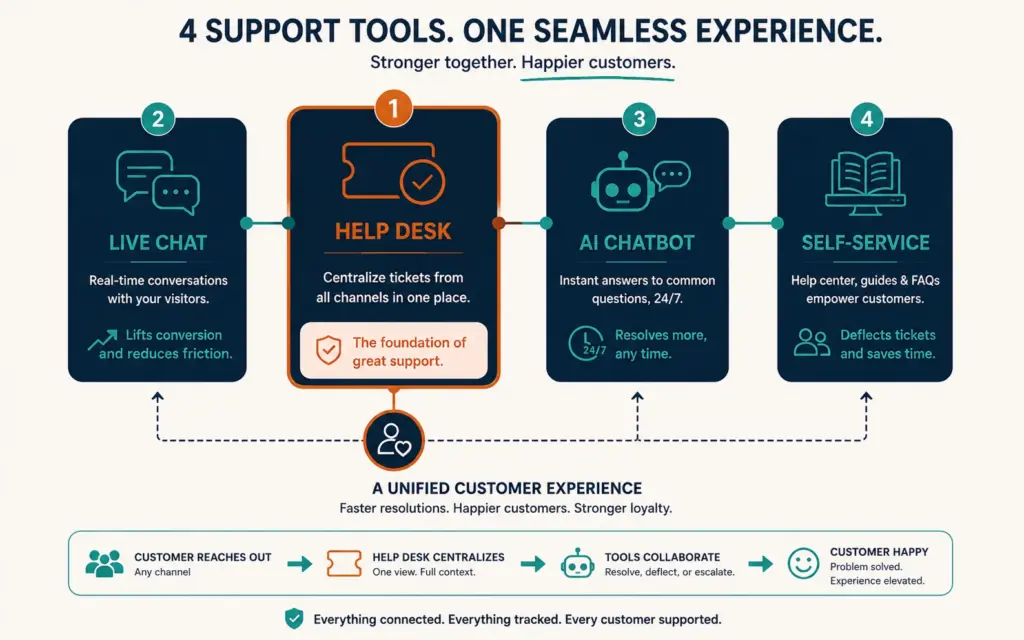
- The core tool categories: help desks (centralize tickets from all channels), live chat (real-time on-site support that lifts conversion), AI chatbots (handle common questions automatically, 24/7), and self-service (help centers and FAQs that deflect tickets before they're created). Most growing stores combine several.
- Gorgias is the leading ecommerce-specific help desk, built around Shopify and other store integrations so agents see order and customer data alongside each ticket. Zendesk is the broader, more powerful enterprise option. For smaller stores, simpler tools like Help Scout or the built-in support features of your platform may suffice.
- AI is transforming ecommerce support: modern AI chatbots and AI-assisted agents resolve common questions (order status, returns, product questions) automatically, freeing human agents for complex issues. This lets small teams handle far more volume, but the AI must be set up well and handed off cleanly to humans when it can't help.
Customer service tools are the systems that let an ecommerce store handle support fast and consistently as it grows. When you’re starting out, a personal email inbox handles your handful of daily questions fine. But as orders climb, support requests multiply and spread across channels: email, on-site chat, social media DMs, and marketplace messages. Managing them manually, hunting through inboxes and switching between platforms, becomes slow and chaotic, and slow support directly costs you sales and repeat customers. Every hour a question goes unanswered is an hour a frustrated customer spends reconsidering their purchase or telling others about the poor experience. Customer service tools solve this by centralizing every channel, automating common responses, and letting a small team handle far more volume without dropping the ball. According to Gorgias’s customer service research, fast and helpful support is one of the strongest drivers of repeat purchases, which makes support tooling a revenue investment rather than just a cost.
Good support isn’t just damage control; it’s a retention and conversion driver. Fast, helpful service turns first-time buyers into repeat customers and resolves the doubts that cause cart abandonment. A shopper who gets a quick, helpful answer to a pre-purchase question is more likely to buy and more likely to come back, which means support quality feeds directly into both conversion and retention. This guide covers the tool categories (help desks, live chat, AI chatbots, self-service), the leading platforms, and how to choose by store size. The customer service for ecommerce guide covers support strategy; this focuses on the tools that deliver it.
The Categories of Customer Service Tools
Ecommerce support tools fall into a few categories, and most growing stores combine several:
Help Desks: Centralize Every Ticket
A help desk consolidates support requests from all channels (email, chat, social, marketplaces) into one system, so every ticket lands in a single queue that agents work through. Nothing gets lost in a personal inbox, responses are tracked, and multiple agents can collaborate. The help desk is the foundation of scaled support: it turns scattered messages into an organized, trackable workflow where every request has a clear owner and status, so nothing sits forgotten in someone’s inbox for three days. For ecommerce specifically, the best help desks pull in order and customer data alongside each ticket so agents can answer without switching systems.
Live Chat: Real-Time Support That Lifts Conversion
Live chat puts a chat widget on your store so visitors get real-time answers while they shop. It’s particularly valuable for conversion: a shopper with a pre-purchase question (sizing, shipping, compatibility) who gets an instant answer is far more likely to buy than one who leaves to find the answer elsewhere. The conversion rate optimization impact of live chat is real, since it removes doubt at the moment of decision.
AI Chatbots and Self-Service: Deflect and Automate
AI chatbots handle common questions automatically, around the clock, without a human agent. Self-service (help centers, FAQ pages) lets customers find answers themselves, deflecting tickets before they’re created. Together, these handle the high-volume, repetitive questions (order status, returns, common product questions) that would otherwise consume agent time. The AI customer service guide covers the AI layer in depth, including how to set up automation that helps customers rather than frustrating them.
The Leading Customer Service Platforms
| Tool | Best For | Note |
|---|---|---|
| Gorgias | Ecommerce, Shopify stores | Order data in every ticket |
| Zendesk | Larger/enterprise support | Powerful, broader use |
| Help Scout | Small to mid stores | Simple, clean, affordable |
| Tidio | Live chat + chatbot | Chat-focused, budget-friendly |
| Re:amaze | Multichannel support | Good value for growing stores |
Gorgias is the leading ecommerce-specific help desk, built around Shopify and other store integrations so agents see order history, customer data, and account details alongside every ticket. That integration lets agents resolve issues (refunds, order edits, tracking) without leaving the help desk, which dramatically speeds up ecommerce support. It’s the go-to for Shopify stores at scale, precisely because the order-data integration removes the constant context-switching that slows down support on general-purpose tools.
Zendesk is the broader, more powerful enterprise option, used across many industries beyond ecommerce. It’s more complex and typically suits larger operations with sophisticated support needs. For smaller stores, simpler and more affordable tools like Help Scout (clean, straightforward) or Tidio (live chat and chatbot focused) often suffice. The ecommerce tools and tech stack should match the support tool to your volume and channels: an ecommerce-native help desk like Gorgias for Shopify stores handling real ticket volume, simpler tools for smaller operations.
How AI Is Transforming Ecommerce Support
AI is reshaping customer service, letting small teams handle volume that used to require large ones. Modern AI chatbots and AI-assisted agents resolve common questions automatically: order status (“where’s my order?”), returns and exchanges, shipping questions, and straightforward product questions. This handles the repetitive high-volume tickets that make up much of support, freeing human agents for the complex, nuanced issues that genuinely need a person.
The impact is significant: a small team augmented with AI can deliver fast, 24/7 support at a volume that would otherwise require many more agents. But AI support has to be set up well. It needs accurate information (connected to your order system and knowledge base), and critically, it needs clean handoff to humans when it can’t resolve an issue. A chatbot that traps customers in unhelpful loops with no path to a human is worse than no chatbot. The best implementations use AI for what it does well (instant answers to common questions) and hand off smoothly to human agents for everything else. According to Zendesk’s analysis of AI in support, the highest customer satisfaction comes from AI that resolves simple issues instantly while making the path to a human effortless when the issue is complex. The ecommerce automation principle applies: automate the repetitive, keep humans for the judgment-heavy, and make the transition between them smooth for the customer.
Choosing Customer Service Tools by Store Size
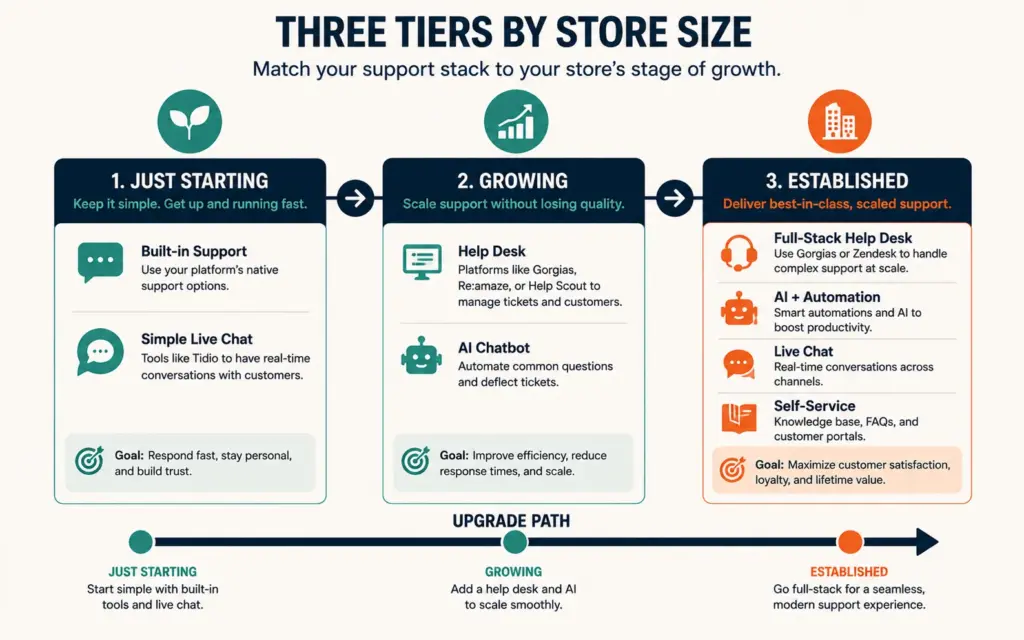
Just starting (low volume): Your platform’s built-in support features and a personal inbox may be enough. Add a simple live chat tool (like Tidio’s free tier) to capture pre-purchase questions. Don’t over-invest in tooling before you have the volume to need it.
Growing (rising ticket volume): This is when a help desk becomes worth it. An ecommerce-native tool like Gorgias (if on Shopify) or a value option like Re:amaze or Help Scout centralizes your channels and keeps response times fast as volume climbs. Add AI chatbot capability to deflect common questions.
Established (high volume): A full help desk with AI, live chat, and self-service working together. Gorgias for ecommerce depth or Zendesk for broader enterprise needs. At this scale, the tooling investment pays for itself by letting your team handle volume efficiently.
The principle: match your tools to your actual support volume and channels, and add capability as you grow rather than buying enterprise tooling prematurely. Watch your support metrics to know when to upgrade. The ecommerce KPIs to monitor include first response time, resolution time, and ticket volume per order, since rising volume and slowing response times signal you need better tooling. The hiring ecommerce team decision interacts with tooling: good tools and AI let you scale support with fewer hires, so invest in tooling before adding headcount. The ecommerce customer retention that great service drives makes support tooling a growth investment, not just a cost center.
Frequently Asked Questions
It depends on size. Most growing stores combine a help desk (centralizes tickets from email, chat, social, and marketplaces into one queue), live chat (real-time on-site support that lifts conversion), AI chatbots (handle common questions automatically, 24/7), and self-service (help centers and FAQs that deflect tickets). Small stores may only need built-in platform support plus simple live chat. As volume grows, a help desk becomes essential to keep response times fast and prevent tickets from getting lost across scattered channels.
Gorgias is built specifically for ecommerce, integrating deeply with Shopify and other stores so agents see order history and customer data in every ticket and can process refunds or order edits without leaving the help desk. This makes it the go-to for Shopify stores at scale. Zendesk is broader and more powerful, used across many industries, and suits larger enterprise operations with complex support needs. For most ecommerce stores, Gorgias’s store-native integration makes support faster; Zendesk fits when you need enterprise breadth beyond ecommerce.
Not at first, but you will as you grow. When you’re starting with low volume, a personal inbox and your platform’s built-in support features work fine. A help desk becomes worth it once support requests multiply and spread across channels (email, chat, social, marketplaces), because managing them manually gets slow and chaotic, and tickets get lost. A help desk consolidates everything into one trackable queue so responses stay fast and nothing falls through the cracks. The signal to adopt one is rising ticket volume and slowing response times.
AI handles a large share of it well: common repetitive questions like order status, returns, shipping, and straightforward product questions, automatically and 24/7. This frees human agents for complex, nuanced issues that need a person. A small team augmented with AI can handle volume that would otherwise require many more agents. But AI must be set up well, connected to accurate order and knowledge-base data, and critically, it needs clean handoff to a human when it can’t resolve an issue. A chatbot that traps customers with no path to a human is worse than none.
Yes, live chat lifts conversion by removing doubt at the moment of decision. A shopper with a pre-purchase question (sizing, shipping time, product compatibility) who gets an instant answer through live chat is far more likely to buy than one who has to leave the page to find the answer elsewhere, and may not return. Live chat catches these ready-to-buy shoppers and resolves their last hesitation immediately. It’s valuable both as a support channel and as a conversion tool, which is why many stores add it even before a full help desk.
For small stores, start with your platform’s built-in support and a simple live chat tool like Tidio (which has a free tier and combines chat with a basic chatbot). Help Scout offers clean, affordable help desk functionality for small to mid-size stores. Re:amaze provides good multichannel value for growing stores. Avoid over-investing in enterprise tools like Zendesk before you have the volume to justify them. Match your tooling to your actual support volume, and upgrade to an ecommerce-native help desk like Gorgias as ticket volume grows.
Related Reads
- Customer Service for Ecommerce
- AI Customer Service
- Ecommerce Tools and Tech Stack
- Ecommerce Automation
- Hiring Ecommerce Team
- Ecommerce Customer Retention
Enjoying this? Get more like it every week.
One email per week with ecommerce strategies, tool picks, and seller insights. No spam.