
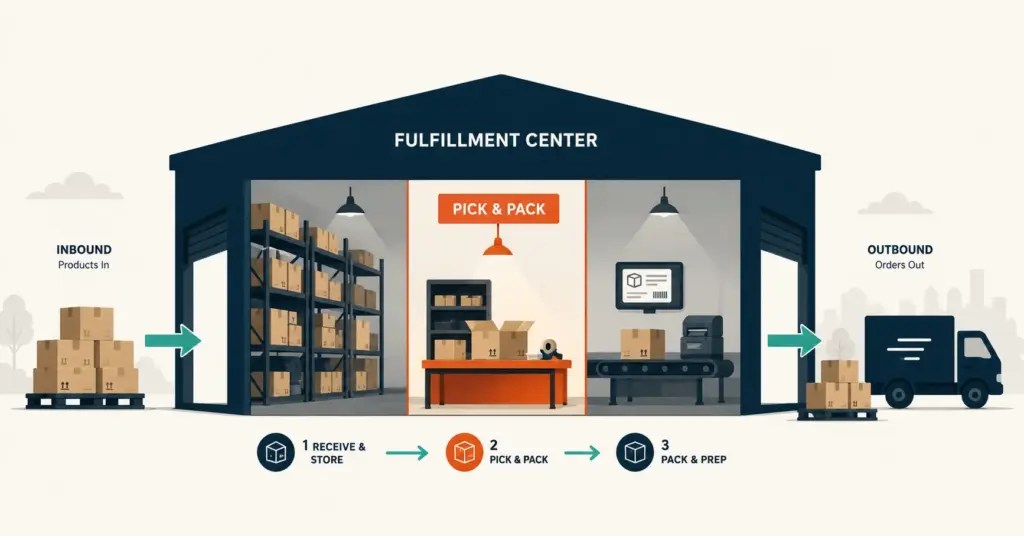
- A 3PL (third-party logistics) provider stores your inventory, picks, packs, and ships orders on your behalf. Ecommerce stores typically transition to 3PL when self-fulfillment exceeds 100 to 300 orders per day or when shipping operations consume more than 20 hours per week of labor.
- 3PL costs average $3 to $8 per order for pick, pack, and ship, plus $15 to $40 per pallet per month for storage. Total 3PL cost typically runs 10 to 18% of order value. The transition makes financial sense when this percentage is lower than your internal fulfillment cost including labor, rent, materials, and opportunity cost.
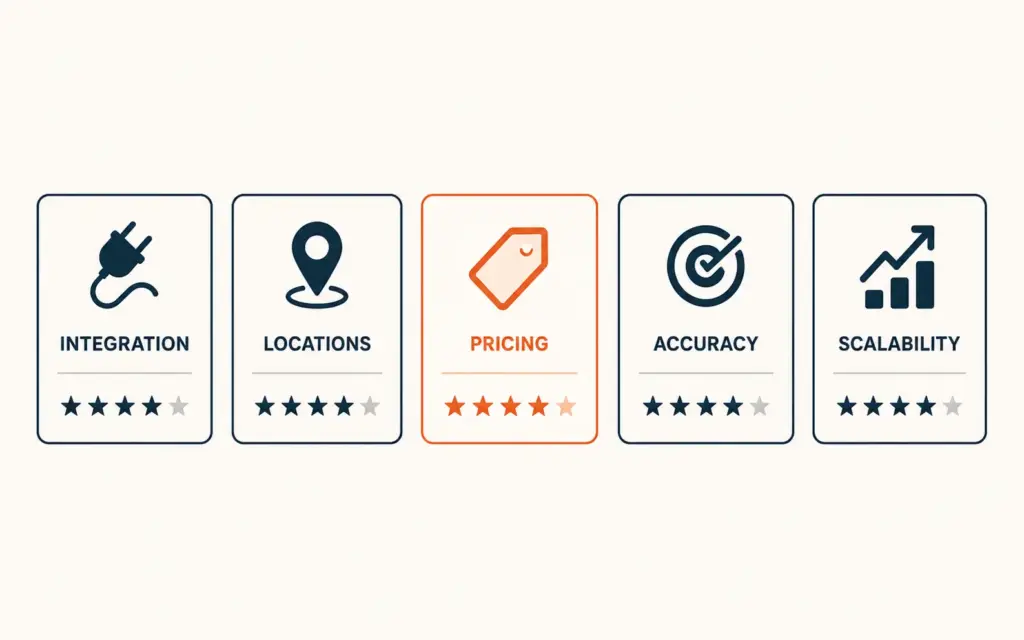
- The 5 evaluation criteria that separate good 3PLs from bad ones: integration quality with your platform, geographic warehouse coverage, transparent pricing without hidden fees, error rate guarantees below 0.5%, and scalability for seasonal peaks.
- The most common 3PL mistake is choosing based on price alone. The cheapest provider with 3% error rates costs more than a mid-price provider with 0.3% error rates once returns, re-ships, and lost customers are factored in.
This 3PL guide covers everything about third-party logistics providers that store your inventory in their warehouse, picks and packs orders when customers buy, and ships them through carrier networks on your behalf. For ecommerce stores growing past self-fulfillment capacity, 3PL eliminates the operational ceiling of packing orders in a garage, spare room, or small warehouse. According to Armstrong & Associates’ 3PL market research, over 90% of Fortune 500 companies use 3PL services, and the model has expanded to serve ecommerce businesses shipping as few as 100 orders per month.
The transition decision hinges on math, not prestige. 3PL makes sense when the per-order cost of outsourced fulfillment is lower than your fully loaded internal cost (labor, rent, materials, equipment, insurance, opportunity cost of your time). For most stores, this crossover point arrives between 100 and 300 daily orders, though product complexity, fragility, and customization requirements shift the threshold. For broader fulfillment strategy, see our shipping strategies guide.
This guide covers how 3PL works mechanically, when to outsource vs self-fulfill, the cost structure and hidden fees to watch for, the 5 evaluation criteria that prevent provider mistakes, and the transition process that minimizes disruption.
How Does 3PL Ecommerce Fulfillment Work?
The 3PL fulfillment process follows 5 operational steps:
- Inventory receiving: You ship products from your supplier or warehouse to the 3PL’s fulfillment center. The 3PL inspects, counts, and stores inventory in their system. Receiving fees typically run $25 to $50 per pallet or $0.25 to $0.50 per unit for case-level receiving.
- Storage: Products sit in the 3PL’s warehouse until ordered. Storage fees charge by pallet ($15 to $40/month), shelf bin ($3 to $10/month), or cubic foot ($0.50 to $1.50/month) depending on product size and facility location.
- Order integration: When a customer orders on your Shopify, WooCommerce, or marketplace listing, the order automatically syncs to the 3PL’s warehouse management system (WMS) via API integration. No manual order forwarding.
- Pick, pack, ship: Warehouse staff pick the items from shelves, pack them in appropriate packaging with your branded inserts (if applicable), generate a shipping label, and hand off to the carrier. Pick and pack fees run $2 to $5 per order plus $0.50 to $1.00 per additional item.
- Shipping: The 3PL ships through negotiated carrier rates (typically 15 to 30% below retail rates due to volume discounts). Shipping cost passes through to you at the 3PL’s negotiated rate or a slight markup.
What a 3PL does NOT do
3PLs handle physical logistics. They don’t manage your marketing, customer service, product development, or merchandising. Some 3PLs offer value-added services like product photography, kitting (combining multiple items into bundles), labeling, and light assembly, but these are optional add-ons with separate pricing.
When Should I Switch from Self-Fulfillment to 3PL?
The transition signals that indicate 3PL is worth evaluating:
| Signal | What It Means | Threshold |
|---|---|---|
| Order volume exceeds capacity | You can’t ship same-day on all orders | 100+ orders/day consistently |
| Fulfillment consumes your time | Packing replaces growth work | 20+ hours/week on fulfillment |
| Error rate rising | Wrong items, missing items, late shipments | Above 1% error rate |
| Seasonal peaks overwhelm | Holiday surges cause multi-day delays | 3x volume spikes you can’t staff for |
| Geographic expansion needed | Shipping from one location is too slow | Average transit time above 4 days |
| Space constraints | Inventory outgrows your facility | Lease renewal decision approaching |
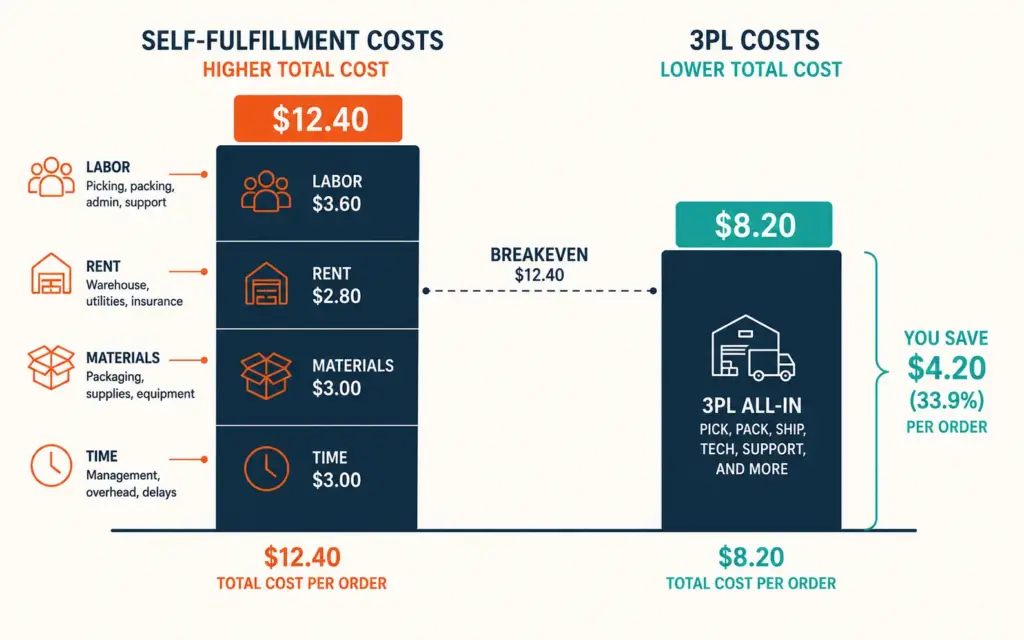
The self-fulfillment vs 3PL cost comparison
Calculate your fully loaded self-fulfillment cost per order:
- Labor: Hourly wage x hours per order (typically 3 to 8 minutes per order = $0.75 to $3.00 at $15/hour)
- Facility: Monthly rent / monthly orders
- Materials: Boxes, tape, fill, labels per order ($0.50 to $2.00)
- Equipment: Printers, scales, shelving amortized per order
- Your time opportunity cost: Hours spent fulfilling x your effective hourly revenue rate
If your total exceeds $5 to $8 per order, 3PL likely saves money. If it’s under $3, self-fulfillment is still more economical. The gray zone ($3 to $5) depends on whether your time has higher value spent on growth activities. For margin calculation, use our profit margin calculator.
How Much Does 3PL Cost?
3PL pricing structures vary but typically include these components:
| Fee Type | Typical Range | What It Covers |
|---|---|---|
| Receiving | $25 to $50/pallet or $0.25 to $0.50/unit | Unloading, inspecting, shelving inbound inventory |
| Storage | $15 to $40/pallet/month | Warehouse space for your inventory |
| Pick and pack | $2.00 to $5.00/order + $0.50 to $1.00/additional item | Pulling items, packing, labeling |
| Shipping | Carrier pass-through + 0 to 10% markup | Actual carrier cost at 3PL negotiated rates |
| Packaging materials | $0.30 to $1.50/order | Boxes, mailers, fill, tape |
| Returns processing | $2.00 to $5.00/return | Receiving, inspecting, restocking returns |
| Account management | $0 to $500/month | Dedicated account manager (volume-dependent) |
Hidden fees to ask about
- Minimum monthly fees: Some 3PLs charge $250 to $1,000/month minimum regardless of order volume. Problematic for low-volume months or seasonal businesses.
- Long-term storage fees: Inventory sitting longer than 90 to 180 days may incur additional charges of $5 to $15/pallet/month.
- Special handling: Fragile items, oversized products, kitting, and custom packaging often carry $1 to $5 per-order surcharges.
- Integration fees: Custom API work beyond standard Shopify/WooCommerce integrations can cost $500 to $5,000 one-time.
- Inventory shrinkage policy: What happens when the 3PL loses or damages your inventory? Understand the reimbursement policy before signing.
How Do I Evaluate and Choose a 3PL Provider?
The 5 evaluation criteria
- Platform integration quality: Native Shopify, WooCommerce, or BigCommerce integration that syncs orders automatically, updates tracking, and adjusts inventory in real-time. Test the integration during the trial period. Broken or delayed syncs cause overselling and customer complaints. See our ecommerce tech stack guide for integration architecture.
- Warehouse locations: Multiple fulfillment centers across the US (East Coast, West Coast, Central) enable 2-day ground shipping to 95%+ of the country. Single-location 3PLs mean 4 to 5 day transit to the opposite coast. For most DTC brands, 2 locations (East + West) cover the majority of demand efficiently.
- Transparent pricing: All-in pricing quotes with no hidden fees. Request a sample invoice showing exactly what you’d pay for 500 orders in a typical month. Providers who can’t produce a clear sample invoice are hiding fee complexity.
- Error rate guarantee: Industry standard is 99.5%+ order accuracy (under 0.5% error rate). Top 3PLs achieve 99.8%+. Request the provider’s actual error rate data for the past 6 months. Providers who can’t share this data likely don’t track it, which is a red flag.
- Scalability for peaks: Can the 3PL handle 3 to 5x your normal volume during Black Friday, holiday season, or viral moments? Ask about peak-season staffing plans, capacity limits, and whether they guarantee same-day shipping during peaks. For broader operations scaling, see our ecommerce automation guide.
Top 3PL providers for ecommerce in 2026
| Provider | Best For | Starting Cost | Locations |
|---|---|---|---|
| ShipBob | DTC brands, Shopify integration | No minimum, pay per order | 40+ US, CA, UK, EU, AU |
| Deliverr (Shopify Fulfillment) | Shopify stores, marketplace sellers | No minimum | US nationwide |
| Red Stag Fulfillment | Heavy, oversized, high-value products | $250/month minimum | US (TN, UT) |
| ShipMonk | Subscription boxes, mid-volume DTC | No minimum | US (FL, CA, PA) |
| Fulfillment by Amazon (FBA) | Amazon-primary sellers | Per-unit fees | US nationwide, global |
Request quotes from 3 to 4 providers. Provide identical data to each (monthly orders, SKU count, average dimensions, top destinations) for apples-to-apples comparison. According to Shopify’s fulfillment guide, the average ecommerce brand evaluates 3 to 5 providers over 4 to 6 weeks before selecting.
How Do I Transition from Self-Fulfillment to 3PL?
The transition process that minimizes disruption:
The 6-week transition plan
- Week 1 to 2: Setup and integration. Connect your ecommerce platform to the 3PL’s WMS. Test with sample orders. Configure shipping preferences, packaging requirements, and branded insert instructions.
- Week 3: Ship initial inventory. Send 4 to 8 weeks of inventory to the 3PL’s warehouse. Keep a small buffer of your highest-velocity SKUs in your current facility for emergency self-ship.
- Week 4: Parallel operations. Run both self-fulfillment and 3PL simultaneously for 5 to 7 days. Route 20 to 30% of orders through the 3PL while monitoring accuracy, speed, and tracking updates.
- Week 5: Full cutover. Route 100% of orders through the 3PL. Monitor error rates, transit times, and customer feedback daily.
- Week 6: Optimization. Adjust packaging preferences, carrier routing, and inventory replenishment schedules based on week-5 data. Establish recurring inventory shipment cadence.
Critical transition risks
- Inventory count discrepancies: Your count and the 3PL’s receiving count rarely match exactly. Establish a variance threshold (typically 1 to 2%) and a reconciliation process before shipping inventory.
- Integration failures: Test the order sync with 50+ orders before going live. Common failures: orders not transmitting, tracking not updating on your storefront, inventory not decrementing. Test before peak season, not during.
- Customer communication: Update your shipping confirmation emails with accurate expected delivery windows from the 3PL’s locations, not your old location. For email flow updates, see our email marketing strategy guide.
What is the Difference Between 3PL and FBA?
Fulfillment by Amazon (FBA) is technically a 3PL, but operates differently:
| Factor | 3PL (ShipBob, ShipMonk, etc.) | FBA |
|---|---|---|
| Branding | Your branded packaging and inserts | Amazon-branded packaging only |
| Channel support | Shopify, WooCommerce, Amazon, Walmart, all channels | Amazon primarily (MCF for others at premium) |
| Prime eligibility | No (unless using Seller Fulfilled Prime) | Yes, automatic Prime badge |
| Storage fees | $15 to $40/pallet/month, no seasonal spike | $0.78/cuft standard, $2.40/cuft Q4 (3x increase) |
| Data ownership | Full customer data access | Amazon restricts customer data |
| Returns | Custom return policy and processing | Amazon’s return policy applies |
Most multi-channel sellers use FBA for Amazon orders and a separate 3PL for Shopify and other channels. This preserves branding on DTC orders while leveraging Prime eligibility on Amazon. For Amazon-specific FBA depth, see our Amazon FBA guide.
Common 3PL Mistakes
Choosing on price alone
The cheapest 3PL with 3% error rates costs more than a mid-price 3PL with 0.3% error rates. Each fulfillment error costs $10 to $25 in return shipping, re-ship costs, and customer service time. At 1,000 orders/month, a 3% error rate produces 30 errors costing $300 to $750/month. A 0.3% rate produces 3 errors costing $30 to $75. The “expensive” 3PL is cheaper.
Not testing the integration before going live
Broken order sync during a live launch creates missing orders, double shipments, and inventory mismatches that take weeks to reconcile. Run 50+ test orders through the integration before routing real customer orders.
Sending all inventory at once
Shipping 6 months of inventory to a new 3PL before validating their service locks your capital in an unproven relationship. Start with 4 to 6 weeks of inventory, validate performance, then increase. Keep 2 weeks of safety stock accessible until you trust the provider.
Ignoring inventory shrinkage policies
3PL warehouses lose and damage inventory. The question is how much and how they compensate you. Understand the shrinkage threshold (typically 0.5 to 1% is “acceptable”), the claims process, and the reimbursement timeline. Providers that won’t commit to a shrinkage policy in writing aren’t worth the risk. For inventory management depth, see our inventory management guide.
Not negotiating after 6 months
Most 3PL contracts allow rate renegotiation at 6 or 12 months. Once you’ve proven volume consistency, your negotiating position improves. Request rate reviews every 6 months and compare against competitive quotes. Loyalty without negotiating power costs you 10 to 20% more than necessary. For broader margin protection, see our ecommerce profit margins guide.
Frequently Asked Questions
A 3PL (third-party logistics) provider stores your inventory in their warehouse, picks and packs orders when customers buy from your store, and ships them through carrier networks. Orders sync automatically from your ecommerce platform (Shopify, WooCommerce, Amazon) to the 3PL’s warehouse management system. The 3PL handles the physical logistics; you handle marketing, products, and customer relationships. Costs average $3 to $8 per order for pick, pack, and ship plus $15 to $40 per pallet per month for storage.
3PL costs include receiving ($25 to $50/pallet), storage ($15 to $40/pallet/month), pick and pack ($2 to $5/order plus $0.50 to $1/additional item), shipping (carrier pass-through at negotiated rates), and packaging materials ($0.30 to $1.50/order). Total all-in cost typically runs $5 to $12 per single-item order or 10 to 18% of order value. Request sample invoices from 3 to 4 providers for accurate comparison.
Evaluate 3PL when self-fulfillment exceeds 100 to 300 orders per day, fulfillment consumes more than 20 hours per week, error rates exceed 1%, seasonal peaks cause multi-day shipping delays, or your time has higher value spent on growth activities than packing boxes. Calculate your fully loaded self-fulfillment cost per order (labor + rent + materials + opportunity cost) and compare against 3PL quotes.
ShipBob and ShipMonk are the strongest options for small ecommerce businesses because they have no monthly minimums, native Shopify and WooCommerce integrations, and transparent per-order pricing. ShipBob offers 40+ fulfillment center locations for faster delivery nationwide. ShipMonk specializes in subscription boxes and mid-volume DTC brands. Both support Amazon multi-channel fulfillment alongside your direct store.
With 3PL, you own the inventory and the 3PL stores and ships it for you. With dropshipping, you never own inventory; the supplier ships directly to customers. 3PL gives you control over product quality, packaging, and branding. Dropshipping eliminates inventory investment but sacrifices quality control and shipping speed. Most ecommerce brands start with dropshipping or self-fulfillment, then graduate to 3PL as volume grows and quality control becomes critical.
A well-planned 3PL transition takes 4 to 6 weeks: 1 to 2 weeks for integration setup and testing, 1 week for initial inventory shipment, 1 week of parallel operations (running both self-fulfillment and 3PL), then full cutover with 1 week of close monitoring. Rushing the transition creates integration failures, inventory discrepancies, and customer service issues that take weeks to resolve.
Related Reads
- Shipping Strategies Guide
- Inventory Management Guide
- Warehouse Optimization
- Ecommerce Profit Margins
- Ecommerce Automation
- Amazon FBA Guide
Enjoying this? Get more like it every week.
One email per week with ecommerce strategies, tool picks, and seller insights. No spam.