
- A high profit margin product isn't just one with a high price tag. It's a product where your selling price is significantly higher than ALL costs combined: product, shipping, platform fees, packaging, returns, and marketing.
- Healthy ecommerce benchmarks: 60-70% gross margin, 10-20% net profit margin after all expenses. If your net margin is under 10%, rising ad costs or one bad return policy change could make you unprofitable overnight.
- Products with the highest consistent margins: digital products (90%+ margin), jewelry and accessories (60-80%), beauty and skincare (55-80%), custom/personalized items (50-70%), and specialty/niche products (40-60%).
- The three factors that create pricing power: perceived value (does it feel premium?), specificity (does it solve one problem for one audience?), and scarcity (is it hard to find elsewhere?). Products with all three command the highest margins.
Revenue is vanity. Profit is sanity. I’ve talked to sellers doing $50K/month in revenue who take home less than someone doing $8K/month, because their margins were paper-thin and their ad costs were eating everything.
If you’re asking “what can I sell to make money,” the answer isn’t a specific product. It’s understanding what makes a product profitable and then finding products that match that criteria in a niche you can actually compete in. A $15 product with 70% margins beats a $200 product with 8% margins every single time when you factor in marketing costs, returns, and the stress of running a business on razor-thin math.
This guide will show you which products consistently deliver high margins, but more importantly, it’ll teach you WHY they’re profitable so you can evaluate any product through a margin-first lens. If you’re still deciding what direction to take your business, our complete guide to starting an ecommerce business covers the fundamentals.
Understanding Profit Margins (The Math You Actually Need)
Before looking at any product, you need to understand the difference between gross margin and net margin – because one lies to you and the other tells the truth.
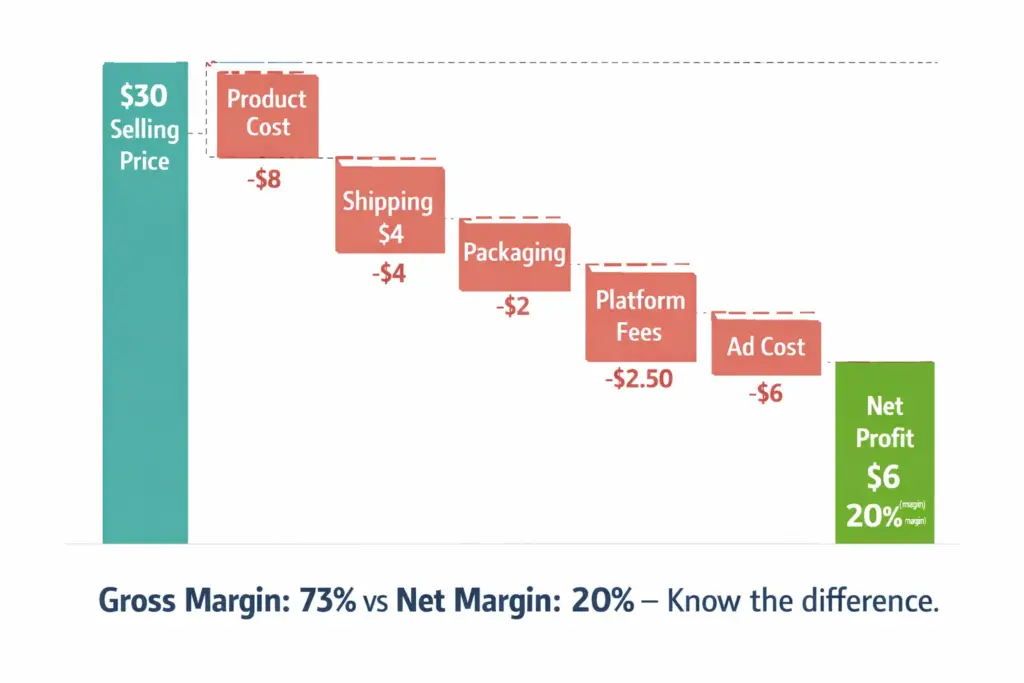
Gross margin = (Selling price – Product cost) / Selling price x 100. If you sell a candle for $30 and the candle costs $8 to make, your gross margin is 73%. Looks amazing. But that number doesn’t include shipping, packaging, platform fees, ad spend, or returns.
Net margin = (Selling price – ALL costs) / Selling price x 100. That same $30 candle after $4 shipping, $2 packaging, $2.50 in platform fees, $6 in ad costs, and a 5% return rate? Your net margin drops to roughly 23%. Still good – but dramatically different from 73%.
Healthy ecommerce benchmarks to target: 60-70% gross margin, 10-20% net profit margin. If your net margin is below 10%, you’re one bad month of ad performance or one competitor price war away from losing money.
What Makes a Product High-Margin?
It’s not random. Three factors consistently create pricing power:
1. Perceived value exceeds actual cost. Jewelry costs pennies to produce but sells for $20-$200+ because the perceived value (beauty, status, emotion, gifting) far exceeds the material cost. Skincare works the same way. A $4 serum sold in premium packaging with good branding commands $30-$50. Products where buyers pay for how it makes them feel, not what it literally costs to make, have the widest margin spread.
2. Specificity creates willingness to pay. A generic phone case sells for $8 in a race to the bottom. A phone case designed specifically for nurses with a nursing humor design sells for $25 with zero price resistance. Niche targeting lets you charge more because the buyer feels “this was made for me” and has fewer comparison options. Our profitable niches guide dives deep into finding these specific audiences.
3. Scarcity or uniqueness reduces competition. If buyers can find your exact product on Amazon for less, they will. Products that are custom, handmade, personalized, or proprietary can’t be directly price-compared. A mass-produced mug competes on price. A mug with a custom illustration of someone’s pet competes on emotion. The custom mug wins on margins every time.
Highest Margin Products by Business Model
What sells profitably depends on how you’re selling. Here are the best margin opportunities organized by the business model you’re actually using.
Digital Products (80-95% Margin)
Digital products have the highest margins in ecommerce because the cost of goods sold is essentially zero after creation. You make it once and sell it infinitely with no inventory, shipping, or restock costs.
What works: Online courses ($50-$500, near-zero marginal cost), ebooks and guides ($10-$50), templates and presets (Canva templates, Lightroom presets, spreadsheet templates at $5-$30), printable planners and journals ($3-$15), digital art and design assets ($5-$100), and software tools or plugins ($10-$200/month for SaaS).
The catch: No marginal product cost doesn’t mean no cost. You invest time upfront creating the product, and you still need to drive traffic. Marketing costs are your main expense. But once a digital product is created and the marketing engine works, it’s the closest thing to passive income in ecommerce. See our digital products guide for the full breakdown.
Handmade and Custom Products (50-75% Margin)
What works: Handmade jewelry ($2-$10 material cost, $25-$80 selling price), custom candles ($3-$8 to make, $20-$40 retail), personalized gifts (engraved items, custom portraits, monogrammed goods), handmade soap and skincare ($2-$5 to make, $12-$25 retail), and custom art (pet portraits, family illustrations, $30-$150+).
Why margins are high: Buyers pay for craftsmanship, uniqueness, and the “made for me” factor. These products resist price comparison because no two are identical. The constraint is time – your production capacity limits scalability unless you hire or systematize.
Print on Demand (30-55% Margin)
What works: Wall art and canvas prints ($3-$20 cost, $20-$80 retail – highest POD margins), all-over-print apparel ($15-$25 cost, $40-$80 retail), mugs ($5-$7 cost, $18-$28 retail), stickers ($1-$3 cost, $4-$10 retail, high volume), and notebooks/journals ($4-$6 cost, $12-$20 retail).
Why margins vary: Your design quality and niche targeting determine whether you sell at commodity prices or premium prices. Generic designs compete on price and earn 20-30% margins. Niche-specific designs that speak to an identity command 45-55% margins because the audience has fewer alternatives. Our print on demand guide covers this in detail.
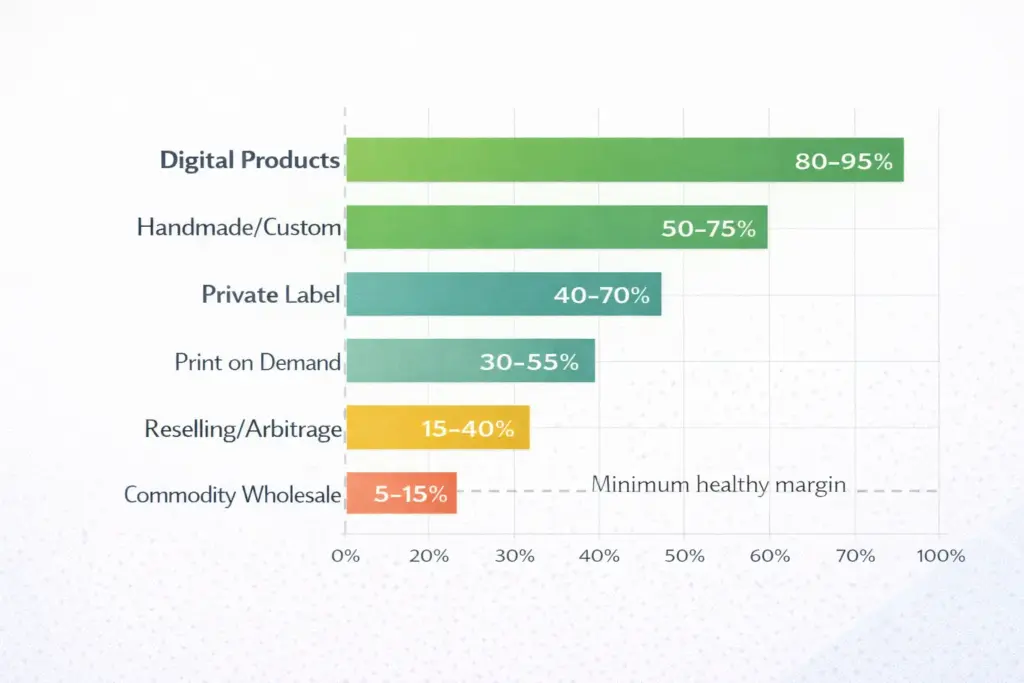
Private Label (40-70% Margin)
What works: Beauty and skincare (average 55% margin, some reaching 80%), health supplements (50-65% margin), pet products (40-60% margin), and specialty food/beverage (45-60% margin).
Why margins are high: You’re selling YOUR brand at retail markup, not competing on a commodity listing. Private label beauty products might cost $3-$8 to manufacture but sell for $25-$50 under your brand with premium packaging. The investment is higher upfront (minimum orders, branding, packaging design), but the long-term margin structure is excellent. See our private label guide for details.
Reselling and Arbitrage (15-40% Margin)
What works: Vintage and collectibles (highly variable, 50-200%+ on the right finds), refurbished electronics (25-40%), clearance and liquidation inventory (30-50% if sourced well), and thrift-to-resell clothing (40-70% on brand names).
Why margins vary wildly: Reselling margins are entirely dependent on your sourcing ability. Someone who finds a $5 thrift store jacket that sells for $80 online has incredible margins. But someone buying from wholesale liquidation pallets hoping for good items might break even. The skill is in the sourcing, not the selling. Our products to resell guide covers how to find inventory worth flipping.
Commodity/Wholesale Reselling (5-15% Margin)
Selling the same products everyone else sells (electronics, household goods, generic supplements) at competitive prices. Margins are thin because price is the only differentiator. This model only works at very high volume. It’s where most new sellers end up by accident and wonder why they’re barely breaking even despite strong revenue numbers.
Products to Avoid (Margin Traps)
Some products look profitable on paper but consistently underperform on net margin:
Heavy or bulky items with free shipping expectations. A $40 product that costs $15 to ship kills your margin. Buyers expect free shipping, so that $15 comes out of your pocket.
Products with high return rates. Clothing (especially sized apparel) has 20-30% return rates. If your margins are 40% but 25% of orders come back, the math doesn’t work. Products that don’t require sizing (accessories, home decor, art) have return rates under 5%.
Trending gadgets in saturated markets. That viral TikTok product everyone is selling? By the time you source it, 500 other sellers have listed it. The price drops. Your margins collapse. Only the first sellers to market profit from viral trends.
Products competing directly with Amazon Basics or major brands. If Amazon sells a nearly identical product with Prime shipping and thousands of reviews, you cannot win on price. You’ll either sell at a loss or not sell at all.
How to Evaluate Any Product’s Margin Potential
Use this quick formula before investing in any product:
Step 1: Find the realistic selling price. Search the product on the platform you’ll sell on. Sort by “sold” listings. That’s what buyers actually pay, not what sellers wish they’d pay.
Step 2: Calculate ALL costs. Product cost + shipping to customer + platform fees + packaging + estimated ad cost per sale ($5-$10 for most products if running ads) + return rate adjustment (multiply total cost by 1.05 for low-return products, 1.20 for clothing).
Step 3: Check the margin. If (Selling price – All costs) / Selling price is above 30%, it’s worth testing. Above 50%, it’s a strong candidate. Below 20%, walk away unless you’re selling at massive volume.
Frequently Asked Questions
What can I sell to make money fast?
For fast income: sell items you already own (clothing, electronics, household items) on Facebook Marketplace, eBay, or Mercari. Zero product cost means 100% of the sale is profit minus platform fees. For a fast-launching business: digital products, print on demand, or Etsy handmade items require minimal upfront investment.
What are the most profitable products to sell online?
By margin percentage: digital products (80-95%), handmade jewelry and custom goods (50-75%), beauty and skincare (55-80%), and private label supplements (50-65%). By total profit potential at scale: private label brands on Amazon, subscription-based products, and high-ticket items like electronics accessories.
What is a good profit margin for an online store?
Target 60-70% gross margin and 10-20% net profit margin after all expenses. A net margin above 20% is excellent. Below 10% is risky because any increase in ad costs, returns, or platform fees could push you into negative territory.
What products have the highest markup?
Jewelry (5-10x markup), digital products (near-infinite markup after creation cost), sunglasses and eyewear (10-20x markup), beauty products (5-8x markup), and greeting cards/stationery (3-5x markup). High markup doesn’t always mean high profit because some categories have high marketing or return costs.
Is it better to sell cheap products with high volume or expensive products with low volume?
Neither extreme is ideal. The sweet spot is $20-$80 products with 40%+ net margins. Below $15, shipping and platform fees eat your margin. Above $100, buyers research more and convert less. Mid-range products balance impulse buying, healthy margins, and manageable customer acquisition costs.
Related reads: Complete Guide to Starting an Ecommerce Business | Profitable Ecommerce Niches | Trending Products to Sell | Digital Products to Sell | Print on Demand Guide | Private Label Products Guide
Enjoying this? Get more like it every week.
One email per week with ecommerce strategies, tool picks, and seller insights. No spam.