
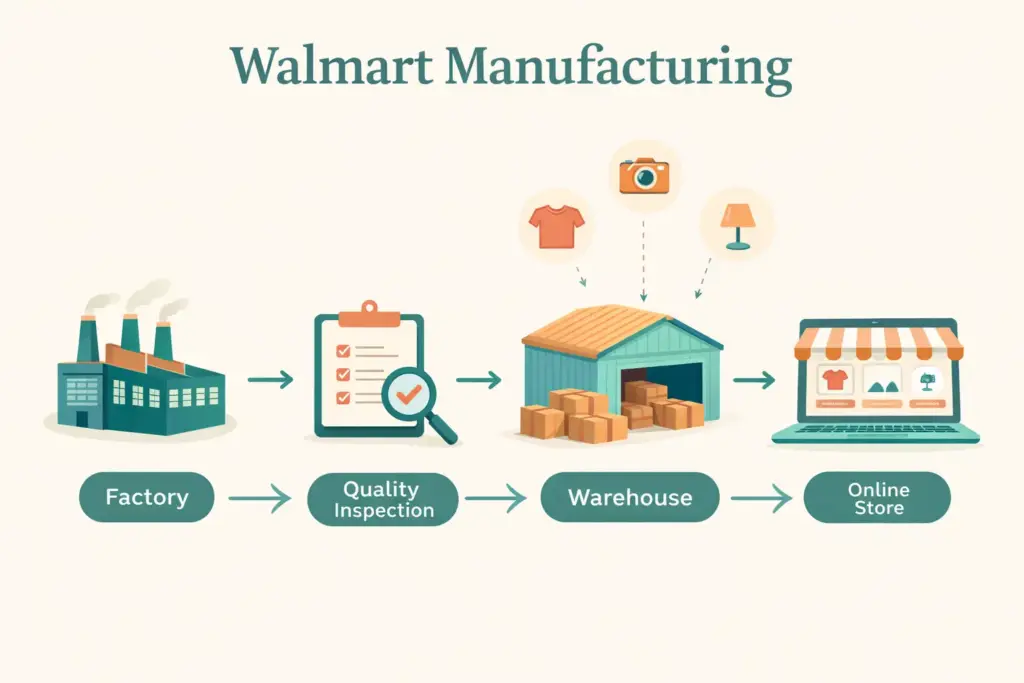
- Walmart manufacturing relies on a global network of vetted suppliers with strict quality standards, cost negotiation, and massive volume buying power. Small ecommerce sellers can apply the same sourcing principles at a smaller scale using platforms like Alibaba, Thomasnet, and Global Sources.
- The US wholesale industry generated roughly $9.7 trillion in total goods sales, and platforms like Thomasnet list over 500,000 North American manufacturers, making domestic sourcing more accessible than ever for small brands.
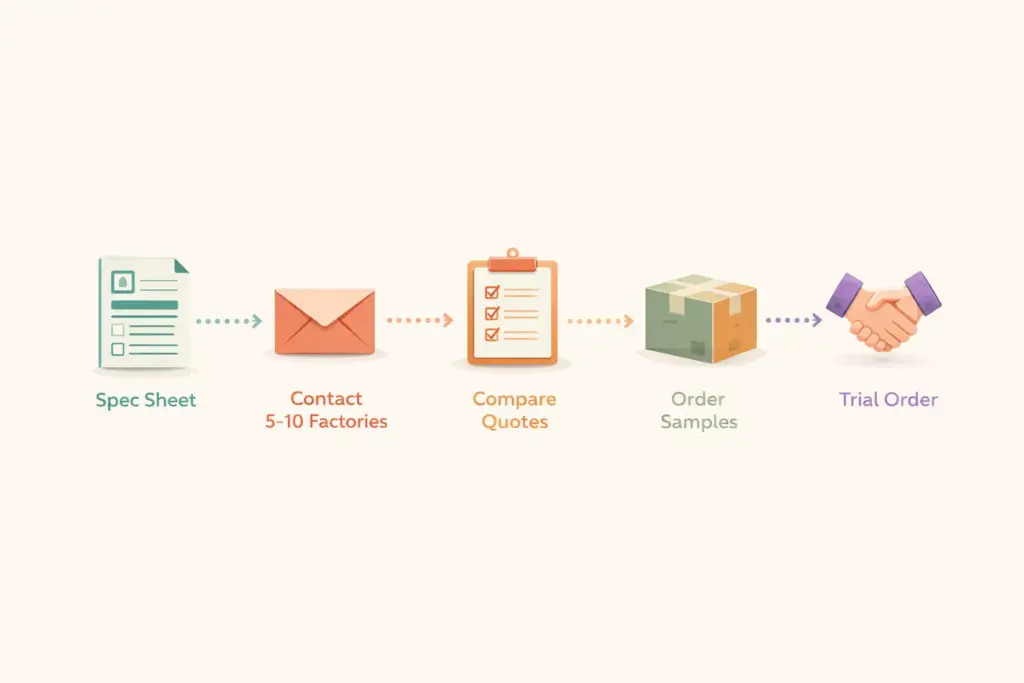
- Finding suppliers starts with a one-page product spec sheet, then requesting quotes from 5-10 manufacturers, ordering samples, and negotiating MOQs before committing to production runs.
- Domestic manufacturing offers faster lead times and better quality control but higher unit costs. Overseas manufacturing (China, India, Vietnam) offers lower costs but longer lead times and more communication friction.
Walmart manufacturing refers to the sourcing and production model Walmart uses to supply its stores with thousands of products, from private brand goods made to Walmart’s exact specifications by contracted factories to branded products negotiated at scale from global manufacturers. It’s the largest retail supply chain on earth, and the principles behind it apply directly to ecommerce sellers looking to source their own products, just at a different scale.
You don’t need Walmart’s buying power to find reliable manufacturers. The same sourcing platforms, vetting processes, and negotiation frameworks that major retailers use are available to independent sellers today. Whether you’re starting an ecommerce business and need your first supplier, or you’re scaling up from dropshipping to private label products, this guide walks you through finding, evaluating, and partnering with manufacturers who can actually deliver.
The US wholesale industry generated roughly $9.7 trillion in goods sales according to recent data, and sourcing platforms now list hundreds of thousands of manufacturers you can contact directly. The barrier isn’t access anymore. It’s knowing how to vet suppliers, negotiate terms, and avoid the costly mistakes that sink first-time sourcing attempts.
How Walmart Manufacturing Actually Works
Understanding the Walmart manufacturing model gives you a blueprint for sourcing at any scale. Walmart doesn’t manufacture most products itself. Instead, it contracts with a massive network of domestic and international manufacturers who produce goods to Walmart’s specifications.
Private Brand Manufacturing
Walmart’s private brands (Great Value, Equate, Mainstays) are produced through private brand manufacturing partnerships. Walmart provides the product specifications, packaging design, and quality standards. The manufacturer handles production. This is exactly the same model available to ecommerce sellers through private label programs on Alibaba, Thomasnet, and direct factory partnerships.
The key lesson: Walmart doesn’t accept whatever a factory offers. They define the product, then find a factory that can build it to spec. Small sellers should do the same. Start with a clear product brief before reaching out to any manufacturer.
Walmart’s Supplier Vetting Process
Walmart requires suppliers to meet strict compliance standards: quality certifications, ethical manufacturing practices, environmental standards, and consistent delivery timelines. They audit factories regularly and drop suppliers who fail to meet standards.
You can’t audit factories the way Walmart does, but you can apply the same principle: never commit to a manufacturer without samples, references, and verification of their business credentials. The cost of a $50 sample order is nothing compared to the cost of receiving 1,000 defective units.
How Hot Topic and Other Retailers Source Products
Hot topic manufacturing follows a similar pattern to Walmart but with a niche focus. Hot Topic sources licensed merchandise and trend-driven products from specialized manufacturers, often working with smaller production runs and faster turnaround times than mass-market retailers. For ecommerce sellers targeting niche audiences, this model is more relevant than Walmart’s mass-market approach. You need manufacturers who handle smaller MOQs (minimum order quantities) and can adapt quickly to trend shifts.
How to Find Suppliers: Sourcing Platforms and Directories
The first step in sourcing products for your ecommerce store is knowing where to look. Here are the platforms that connect small and mid-sized sellers with manufacturers worldwide.
Alibaba (International Manufacturing)
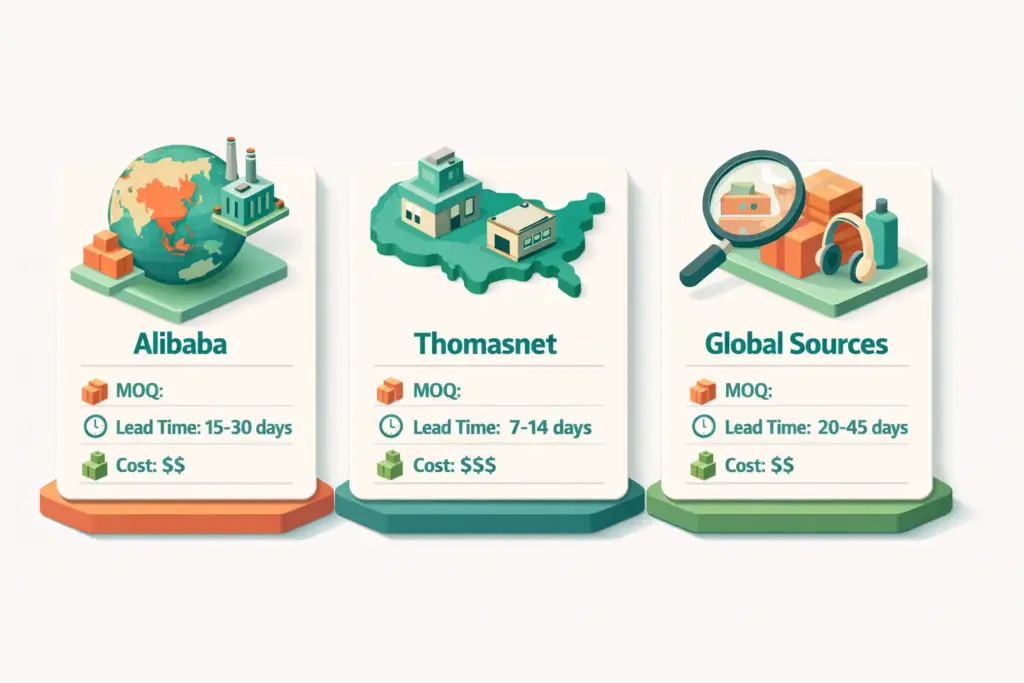
Alibaba is the world’s largest B2B marketplace, connecting buyers with over 2.8 million suppliers across 5,900+ product categories. Most suppliers are based in China, though the platform includes manufacturers from India, Vietnam, Turkey, and other countries. It’s the default starting point for ecommerce sellers looking for overseas manufacturing at competitive prices.
Best for: Private label products, custom manufacturing, bulk wholesale. MOQs typically range from 50-500 units for initial orders, though many suppliers negotiate lower quantities for first-time buyers. Our AliExpress sourcing guide covers the consumer-facing sister platform for smaller orders.
Thomasnet (Domestic Manufacturing)
Thomasnet lists over 500,000 North American manufacturers, wholesalers, distributors, and service companies across more than six million industrial products. If you want to source domestically for faster shipping, better quality control, and “Made in USA” branding, this is your primary directory.
Best for: US-based private label manufacturing, custom products, and sellers who want shorter lead times and easier communication. MOQs are typically higher than Chinese manufacturers, but quality control is more predictable.
Global Sources and IndiaMART
Global Sources focuses on verified manufacturers in Asia, particularly for electronics, fashion, and home products. IndiaMART connects buyers with Indian manufacturers, which is increasingly relevant as brands diversify supply chains away from China-only dependence. India and Vietnam offer competitive pricing with growing manufacturing infrastructure.
Trade Shows
Nothing replaces meeting manufacturers face-to-face. Canton Fair (China), ASD Market Week (Las Vegas), and NY NOW are the largest trade shows for product sourcing. You can touch samples, negotiate directly, and build relationships that online platforms can’t replicate. The cost of attending ($1,000-3,000 including travel) pays for itself if you find even one reliable supplier.
Sourcing Agents
If the idea of negotiating directly with Chinese factories feels overwhelming, a sourcing agent acts as your intermediary. They find manufacturers, negotiate pricing, arrange samples, conduct quality inspections, and coordinate shipping. Typical fees run 3-10% of the order value. CJdropshipping and other platforms offer sourcing agent services built into their platforms.
| Platform | Region Focus | Best For | Typical MOQ | Cost |
|---|---|---|---|---|
| Alibaba | China, Asia | Private label, bulk wholesale | 50-500 units | Free to browse |
| Thomasnet | North America | Domestic manufacturing, custom products | 100-1,000 units | Free |
| Global Sources | Asia (verified) | Electronics, fashion, home | 100-500 units | Free to browse |
| IndiaMART | India | Textiles, jewelry, food products | 50-500 units | Free to browse |
| Faire | US, EU | Wholesale from indie brands | Varies by brand | Free for retailers |
| SaleHoo | Global directory | Verified wholesalers and dropshippers | Varies | $67/year |
Step-by-Step: Finding and Vetting a Manufacturer
Whether you’re sourcing a shirt manufacturing partner for a custom apparel line or finding a factory for kitchen gadgets, the vetting process follows the same steps.
Step 1: Create a Product Spec Sheet
Before contacting any manufacturer, write a one-page brief that includes: product description, materials, dimensions, colors, packaging requirements, target unit cost, expected order volume, and any certifications needed (FDA, CE, ISO). This ensures every factory quotes the same product, making price comparison meaningful.
Step 2: Contact 5-10 Potential Manufacturers
Send your spec sheet to at least five manufacturers from different platforms. On Alibaba, use the “Contact Supplier” button and include your spec sheet as an attachment. On Thomasnet, send RFIs (requests for information) directly through supplier profiles. Don’t settle for the first response. The range in pricing, MOQs, and lead times will surprise you.
Step 3: Evaluate Responses
Compare quotes on these criteria:
- Unit price at your target volume (and how price scales with higher volumes)
- Minimum order quantity for first orders vs. reorders
- Lead time from order to shipment (typically 15-45 days for overseas, 5-20 days domestic)
- Sample availability and cost (reputable manufacturers always offer samples)
- Communication quality during the quoting process (slow or vague responses now mean problems later)
- Certifications and compliance relevant to your product category
Step 4: Order Samples
Never skip this step. Order samples from your top 2-3 candidates. Expect to pay $20-100 per sample plus shipping. Evaluate the samples against your spec sheet: materials, construction quality, dimensions, packaging. If the sample doesn’t match your specs, the bulk order won’t either.
Step 5: Negotiate Terms and Place a Trial Order
Once you’ve chosen a manufacturer, negotiate your first order terms. Push for lower MOQs on the initial run (many manufacturers accept 50-100 units for first orders even if their standard MOQ is higher). Agree on payment terms (30% deposit with 70% before shipping is standard), quality inspection procedures, and what happens if the order doesn’t meet specifications.
Your first order is a trial. Treat it as a test of the manufacturer’s reliability, not a commitment to a long-term partnership. If the trial order arrives on time, matches your specs, and passes your quality check, you’ve found a keeper.
Domestic vs. Overseas Manufacturing
This decision affects your unit economics, shipping times, quality control, and brand positioning. Here’s the honest comparison:
| Factor | Domestic (US/EU) | Overseas (China/India/Vietnam) |
|---|---|---|
| Unit cost | 2-5x higher | Lowest available |
| Lead time | 1-3 weeks | 4-8 weeks (plus shipping) |
| MOQ | Often higher | Often lower for first orders |
| Quality control | Easier to verify and visit | Requires third-party inspection or agent |
| Communication | Same language and timezone | Language barriers, timezone gaps |
| Shipping cost | Lower (domestic freight) | Higher (ocean/air freight + customs) |
| Brand positioning | “Made in USA” premium | No branding advantage |
| IP protection | Stronger legal enforcement | Harder to enforce, higher copying risk |
My recommendation for most new ecommerce sellers: start overseas for your first product to keep unit costs low while you validate demand. Once you have proven sales and can forecast volumes, consider moving to domestic manufacturing if the brand positioning and quality control benefits justify the higher cost. Many successful brands use a hybrid approach, sourcing some products domestically and others overseas.
How to Find Manufacturers That Dropship
If you’re wondering how to find manufacturers that dropship, the short answer is: most traditional manufacturers don’t. Dropshipping requires per-order fulfillment, which conflicts with how factories typically operate (batch production and bulk shipping).
However, several platforms connect you with manufacturers who have adapted their operations to support dropshipping:
- CJdropshipping. Warehouses in 16 countries, quality inspections, and custom manufacturing that transitions into dropshipping fulfillment.
- Printful and Printify. For custom-designed products, these print on demand platforms are effectively manufacturing-on-demand partners.
- Spocket and Syncee. Connect you with wholesale suppliers and manufacturers who offer per-order dropshipping, primarily in US/EU.
For a complete walkthrough, our dropshipping suppliers directory lists verified suppliers by product category and region.
Common Sourcing Mistakes That Cost Money
Ordering bulk before testing samples. I’ve talked to sellers who placed $5,000 orders based on product photos alone. Half of them received products that didn’t match expectations. Always sample first. Always.
Choosing the cheapest quote automatically. The lowest price often means lowest quality, hidden fees, or a manufacturer that cuts corners on materials. The second or third cheapest quote, from a manufacturer with strong communication and verified credentials, is usually the better bet.
Not having a written agreement. Verbal promises mean nothing in international manufacturing. Get everything in writing: product specs, pricing, payment terms, delivery timeline, quality standards, and what happens if the order is defective. This protects both parties.
Single-supplier dependency. If your only manufacturer has a production delay, your entire business stops. Identify a backup supplier early, even if you don’t place orders with them immediately. Knowing you have an alternative gives you negotiating power and business continuity.
Ignoring import duties and tariffs. Products imported into the US are subject to tariffs that can add 5-25% to your landed cost depending on the product category and country of origin. Factor these costs into your pricing strategy before committing to overseas sourcing.
Sourcing Products for Different Business Models
Your business model determines which sourcing approach works best:
Private label sellers need manufacturers who can produce custom-spec products with your branding. Alibaba, Thomasnet, and direct factory relationships are your primary channels. This is the closest to the Walmart manufacturing model at a smaller scale.
White label sellers buy existing products from manufacturers and add their own branding. This requires less product development but limits differentiation. Many Alibaba suppliers offer white label options with low MOQs.
Wholesale resellers buy finished branded products at bulk prices and resell at retail markup. Platforms like Faire, Wholesale Central, and direct brand partnerships are the primary sourcing channels.
Dropshippers need suppliers who handle per-order fulfillment. Dedicated platforms like DSers, Spocket, and CJdropshipping are purpose-built for this model. See our dropshipping guide for the full setup process.
No matter which model you choose, the right tools and tech stack will make managing supplier relationships, inventory, and orders significantly easier as you scale. Strong marketing then turns those sourced products into actual revenue.
Frequently Asked Questions
How does Walmart manufacturing work for private brands?
Walmart contracts with domestic and international manufacturers who produce products to Walmart’s exact specifications, packaging designs, and quality standards. The manufacturer handles production while Walmart controls the product definition and branding. This private brand manufacturing model is the same approach small ecommerce sellers use through Alibaba and Thomasnet at smaller scale.
How do I find suppliers for my ecommerce products?
Start with sourcing platforms: Alibaba for international manufacturers, Thomasnet for North American suppliers, and Global Sources or IndiaMART for alternatives. Create a product spec sheet, contact 5-10 potential manufacturers, compare quotes on price, MOQ, and lead time, then order samples before committing to bulk production.
What is the walmart manufacturing model for private label?
Walmart defines the product specifications, packaging, and quality standards, then contracts factories to produce goods under Walmart’s brand names like Great Value and Equate. Ecommerce sellers replicate this by writing product briefs, sourcing factories on platforms like Alibaba, and ordering custom-branded products. The principle is identical: you design the product, the factory builds it.
Should I use domestic or overseas manufacturers like those in the walmart manufacturing supply chain?
Overseas manufacturing (China, India, Vietnam) offers 2-5x lower unit costs but longer lead times and communication challenges. Domestic manufacturing provides faster delivery, easier quality control, and “Made in USA” branding at higher unit costs. Most new sellers start overseas to minimize risk while validating demand, then consider domestic manufacturing as they scale.
How do I find manufacturers that dropship products?
Most traditional manufacturers don’t dropship because they operate on batch production. Platforms like CJdropshipping, Spocket, and Syncee connect you with manufacturers and suppliers who have adapted to per-order fulfillment. Print on demand platforms like Printful effectively serve as manufacturing-on-demand dropshipping partners for custom products.
How much does it cost to source products from a manufacturer?
Sample orders cost $20-100 per product plus shipping. First production runs typically require $500-5,000 depending on MOQs and unit costs. Sourcing agents charge 3-10% of order value. Import duties add 5-25% to landed costs for overseas products. Budget at least $1,000-2,000 for your first manufacturer-sourced product from initial samples through first inventory order.
Related Reads
- Private Label Products Guide
- White Label Products Guide
- Finding Wholesale Suppliers
- AliExpress Sourcing Guide
- Dropshipping Suppliers Directory
- How to Start Dropshipping
Enjoying this? Get more like it every week.
One email per week with ecommerce strategies, tool picks, and seller insights. No spam.