
- Print on demand lets you sell custom-designed products without inventory. Your provider prints and ships each item only after a customer orders it.
- The global POD market reached nearly $11 billion in 2025 and is projected to grow at 23.6% annually through 2033 (Grand View Research). It's one of the fastest-growing ecommerce models.
- Realistic margins run 30-50% per product. A t-shirt that costs $12-15 from your provider sells for $25-35. Your profit: $10-20 per sale minus platform and ad costs.
- What separates profitable POD stores from dead ones: niche targeting, design quality, and marketing. The product catalog is the same for everyone. Your designs and audience are your only competitive advantage.
Someone asked me last week whether print on demand is “still worth it.” I pulled up a Shopify store selling custom dog breed t-shirts. The owner designs in Canva, uses Printful for fulfillment, and does $8K/month in revenue with zero inventory. She started nine months ago with no design background.
Print on demand (POD) is an ecommerce fulfillment model where products are manufactured, printed with your custom designs, and shipped to customers only after an order is placed. You never hold inventory. Your POD provider handles printing, packaging, and shipping while you focus on creating designs and driving traffic. The global POD market reached nearly $11 billion in 2025 and is projected to grow at 23.6% CAGR through 2033 (Grand View Research). It’s not a fad. It’s a structural shift in how products get made and sold.
If you’ve been looking at different ways to start an ecommerce business and the idea of managing inventory sounds awful, POD is built for you. It sits between dropshipping (generic products, no customization) and private label (full customization, big upfront investment). Your designs are the product. Everything else is handled.
How Print on Demand Actually Works
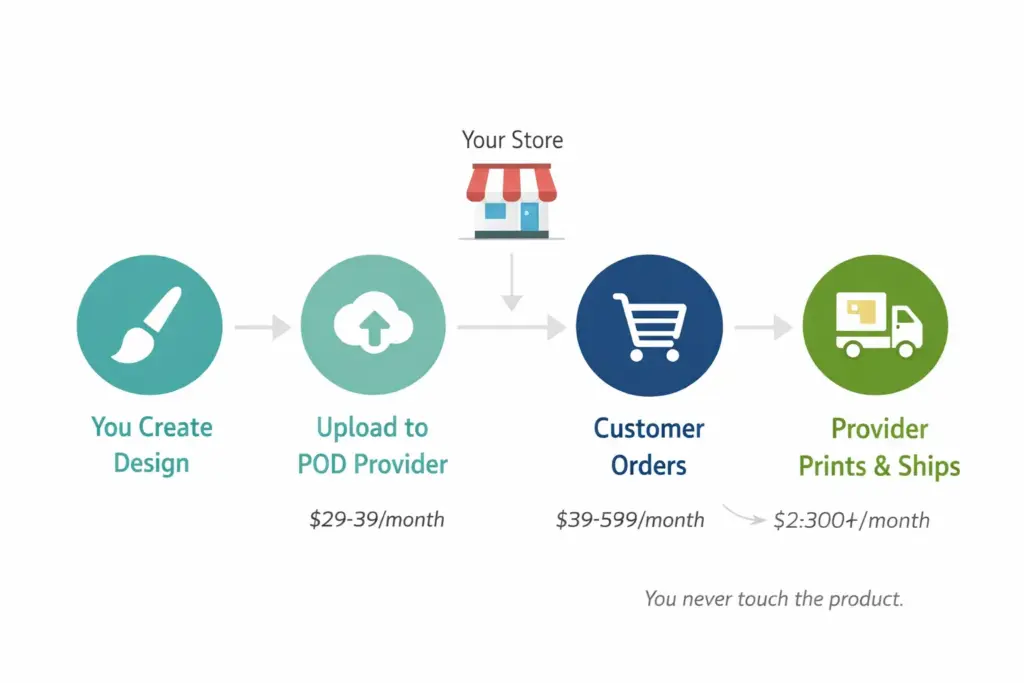
The process is dead simple:
Step 1: You create a design (or hire someone to create one). Could be a graphic, a slogan, an illustration, a pattern.
Step 2: You upload that design to a POD provider (Printful, Printify, etc.) and apply it to products in their catalog: t-shirts, hoodies, mugs, phone cases, posters, tote bags, stickers, whatever they offer.
Step 3: You list those products in your online store (Shopify, Etsy, Amazon, your own website). When a customer places an order, it automatically routes to your POD provider.
Step 4: The provider prints your design on the product, packages it, and ships it directly to the customer. Your branding goes on the packaging (with most providers). The customer never knows a third party fulfilled the order.
You pay the provider’s base cost per item (e.g., $12 for a t-shirt) plus shipping. You charge the customer retail price (e.g., $28). The difference is your gross profit. No upfront inventory cost. No minimum orders. No warehouse.
Best Print on Demand Providers Compared
This is where every other guide gets biased because they’re written by the providers themselves. Here’s my honest take on each major POD platform based on what I’ve seen sellers actually experience:
| Provider | Best For | Product Range | Base T-Shirt Cost | Avg. Shipping (US) | Key Strength |
|---|---|---|---|---|---|
| Printful | Quality and branding | 340+ products | $11-$14 | $4-$6 | In-house printing, best quality control |
| Printify | Lowest prices | 900+ products | $6-$10 | $4-$7 | Multiple print providers, price competition |
| Gooten | Global fulfillment | 150+ products | $8-$12 | $4-$6 | Strong international shipping network |
| Gelato | International sellers | 100+ products | $9-$13 | $4-$7 | Local production in 32 countries |
| Amazon Merch | Amazon traffic | Limited (apparel focus) | N/A (royalty model) | Free (Prime) | Massive built-in audience |
| Redbubble | Artists (marketplace) | 70+ products | Set by platform | Varies | Built-in marketplace traffic |
My recommendation: Start with Printify if margins are your priority (cheapest base costs). Go with Printful if quality and brand experience matter more (they print in-house, giving more consistency). Use both simultaneously if you want to A/B test quality and pricing for different product lines.
One thing nobody tells you: quality varies between print providers within Printify’s network. The same t-shirt design printed by Provider A might look different from Provider B. Always order samples from your chosen provider before listing anything for sale.
What Actually Sells in Print on Demand
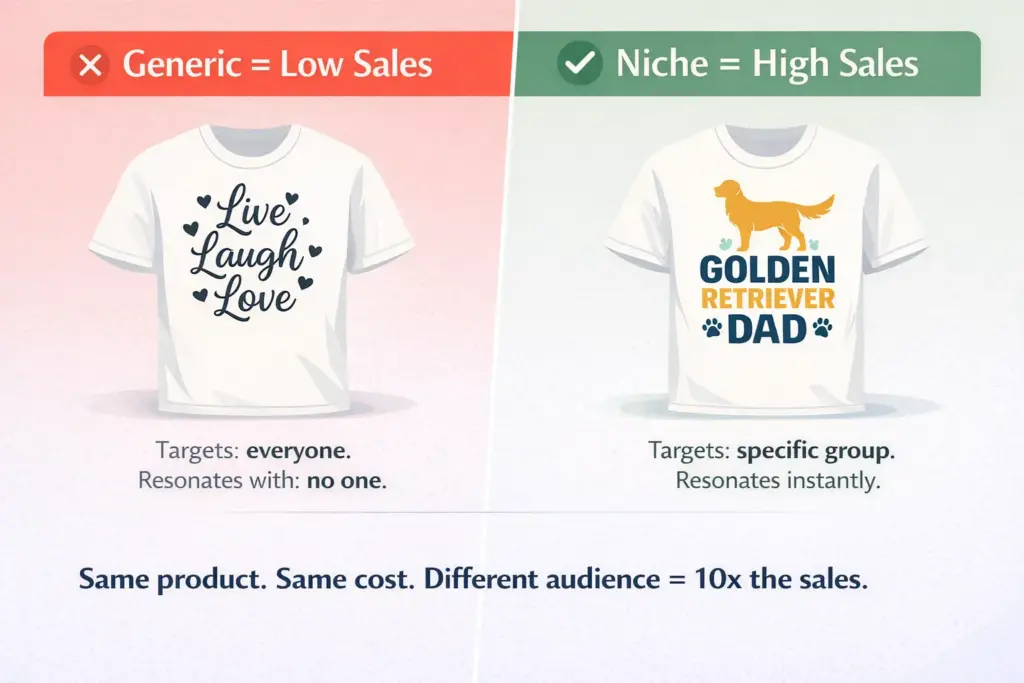
Here’s where most POD sellers fail. They list generic motivational quotes on a black t-shirt and wonder why nobody buys. The products that sell share one trait: they speak to a specific identity or community.
Products with the best POD margins:
All-over print apparel. Hoodies, leggings, and rash guards with full-coverage designs command $40-$80 retail prices with $15-$25 base costs. The all-over printing makes them feel premium and harder to replicate than a simple front-print tee.
Wall art and posters. Extremely high margins. A poster costs $3-$8 to produce, sells for $15-$40. Canvas prints cost $10-$20, sell for $40-$80. Shopify data shows wall art consistently has the highest profit margins in POD. The key: designs that people want to display, not just “nice graphics.”
Stickers. Tiny product, tiny cost ($1-$3 per sheet), high volume potential. Sticker buyers often purchase multiple designs in one order. Price per sheet: $4-$8. The real play: sticker packs themed around niches (plant mom stickers, coding humor stickers, nurse life stickers).
Mugs. The $5 product that sells for $18-$25. Everyone drinks coffee. Personalized mugs for professions, hobbies, relationships, and inside jokes sell consistently year-round with a spike during gifting seasons.
Phone cases. Low base cost ($5-$8), retail at $18-$30. New phone models create demand waves. The downside: you need to stock multiple phone model options or risk alienating buyers with different devices.
What doesn’t sell well: Generic motivational quotes that could be found anywhere. Designs that aren’t specific to any group or identity. Low-resolution or amateur-looking graphics. Products that compete directly with Amazon Basics on price (you’ll lose).
The Real Margin Math
POD margins are better than dropshipping but tighter than most people expect after accounting for all costs. Here’s honest math on a t-shirt (the most common POD product):
| Cost Component | Amount |
|---|---|
| Base product cost (Printify) | $8.50 |
| Shipping to customer (US) | $4.50 |
| Your retail price | $28.00 |
| Gross profit per sale | $15.00 |
| Etsy fees (if selling on Etsy, ~10%) | -$2.80 |
| Ad cost per sale (if running ads, ~$5-8 avg) | -$6.50 |
| Net profit per sale (with ads + Etsy) | $5.70 |
| Net profit per sale (organic traffic, own store) | $12.50 |
That gap between $5.70 and $12.50 is why the sellers making real money in POD eventually move to their own Shopify store and drive traffic through organic content (TikTok, Instagram, Pinterest, SEO) rather than paying for every sale through Etsy and Facebook ads.
Higher-priced products (hoodies at $45-$55, canvas prints at $50-$80) deliver significantly better per-unit profit even with the same percentage margin. This is why experienced POD sellers move toward premium products rather than competing on the cheapest t-shirts.
How to Start: The No-Fluff Version
1. Pick a niche audience, not a product. “T-shirts” is not a niche. “T-shirts for ICU nurses who love dark humor” is a niche. The niche determines your designs, your marketing message, and which platforms you sell on. Our profitable niches guide covers how to find and validate one.
2. Create 10-20 designs before launching. A store with 3 designs looks dead. A store with 20+ designs across multiple products looks like a real brand. You don’t need to be a designer. Canva (free), Kittl, or hiring a freelancer on Fiverr ($5-$30 per design) all work.
3. Choose your provider and order samples. Pick Printful or Printify. Apply your designs to 3-4 product types. Order at least one sample of each to check print quality, fabric feel, and packaging. This costs $30-$60 and saves you from selling something you’d be embarrassed to receive.
4. List on a marketplace first. Etsy is the fastest path to your first sale because buyers are already there searching. Once you’ve validated that designs sell, expand to your own Shopify store and other channels. See our platform comparison for the full breakdown.
5. Market where your niche lives. If you sell to dog owners, post on Instagram and TikTok with dog content. If you sell to gamers, Reddit and Discord communities. If you sell to home decor buyers, Pinterest. The platform should match the audience, not the other way around.
Print on Demand vs Dropshipping vs Private Label
Quick comparison since sellers always ask which model to choose:
| Factor | Print on Demand | Dropshipping | Private Label |
|---|---|---|---|
| Startup cost | $0-$300 | $100-$500 | $2,000-$10,000 |
| Margins | 30-50% | 10-30% | 50-80% |
| Product uniqueness | Your designs (medium) | None (low) | Full control (high) |
| Inventory risk | Zero | Zero | High |
| Shipping speed | 3-7 days (domestic POD) | 7-21 days (overseas) | 2-5 days (FBA/warehouse) |
| Best for | Designers, niche brands | Testing products | Building brands at scale |
Many sellers combine POD with other models. A private label supplement brand might use POD for branded merch (t-shirts, stickers) as add-ons. A dropshipper might test niche designs via POD before committing to bulk screen printing. It doesn’t have to be one or the other. For a full comparison of all models, see our ecommerce business models guide.
Frequently Asked Questions
What is print on demand?
A fulfillment model where your POD provider prints your custom designs on products (t-shirts, mugs, posters, etc.) and ships them to customers only after an order is placed. You never hold inventory or handle shipping.
Is print on demand profitable?
Yes, with realistic margins of 30-50% per product. A t-shirt selling for $28 with $13 in base costs nets $15 gross profit. Profitability depends on niche targeting, design quality, and whether you rely on paid ads or organic traffic.
How much does it cost to start print on demand?
$0-$300. Most POD providers charge nothing upfront. You pay per item only when a customer orders. Optional costs: Etsy listing fees ($0.20/listing), Shopify subscription ($39/month), design tools, and sample orders ($30-$60).
Which is the best print on demand site?
Printify for lowest base costs and largest product catalog. Printful for best print quality and brand control. Amazon Merch for built-in traffic (if approved). Etsy + Printify/Printful is the most common beginner setup.
Can you do print on demand on Amazon?
Yes, through Amazon Merch on Demand (apparel) and Amazon KDP (books). Merch is invite-only with a waitlist. KDP is open to anyone for self-publishing paperbacks, hardcovers, and ebooks. Both give you access to Amazon’s massive audience.
Do you need design skills for print on demand?
Not necessarily. Canva (free) handles basic designs. Kittl offers POD-specific templates. Fiverr freelancers create custom designs for $5-$30. However, unique and high-quality designs are your primary competitive advantage, so investing in design quality pays off directly.
Related reads: Complete Guide to Starting an Ecommerce Business | How to Start Dropshipping | Private Label Products Guide | Things to Make and Sell | Digital Products to Sell | Ecommerce Business Models
Enjoying this? Get more like it every week.
One email per week with ecommerce strategies, tool picks, and seller insights. No spam.