
- An LLC isn't legally required to sell online, but it protects your personal assets from business lawsuits and debts - and most serious ecommerce sellers form one.
- LLC filing fees range from $35 (Montana) to $500 (Massachusetts), with an average cost of $132 across all states. Many states have zero annual renewal fees.
- Every ecommerce business needs an EIN (free from IRS), a sales tax permit in states where you have nexus, and potentially a local business license.
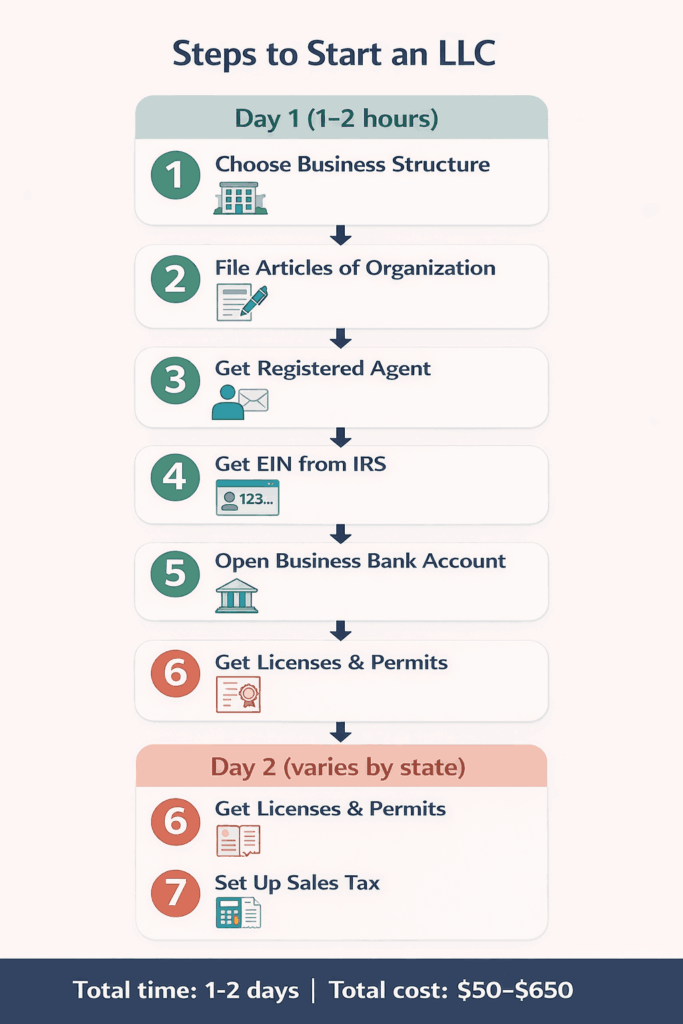
- The 7-step legal setup process takes most sellers 1-2 days: choose structure, pick a state, file articles, get EIN, open business bank account, get permits, set up sales tax.
- Don't overthink this. Spending weeks on legal research instead of launching costs you more than any filing fee ever will.
Let’s get something out of the way: the legal side of starting an ecommerce business is the part everyone dreads. And honestly? It’s way less complicated than most people make it.
Ecommerce legal setup is the process of choosing a business structure (LLC, sole proprietorship, or corporation), registering with your state, obtaining tax IDs and permits, and establishing sales tax compliance for your online store. For most new sellers, the entire process takes 1-2 days and costs between $50 and $500 depending on your state. It’s not the glamorous part of building a store, but skipping it can cost you everything if something goes wrong.
I’ve seen sellers run their stores for years as sole proprietors, thinking they’d “get around to” the legal stuff eventually. Then a customer slips on their product, or a supplier dispute goes sideways, and suddenly their personal savings account is on the line. Don’t be that person. If you’re following our complete guide to starting an ecommerce business, this is the step that protects everything you build after it.
Do You Actually Need an LLC for Ecommerce?
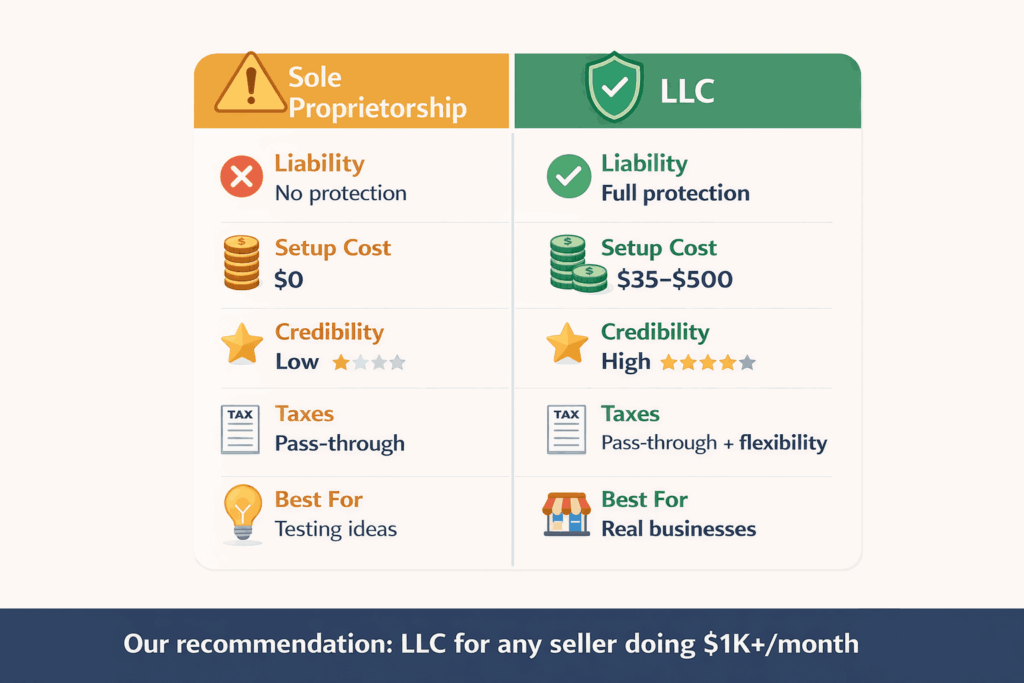
The short answer: no, you don’t need one. You can sell online right now as a sole proprietor with zero paperwork. Shopify, Amazon, Etsy – none of them require an LLC.
The real answer: if you’re serious about building a business and not just flipping a few items, you should absolutely get one. Here’s why.
An LLC creates a legal wall between your business and your personal life. If your business gets sued, if a product injures someone, if you can’t pay a supplier – your house, your car, your savings account are protected. Without an LLC, everything you own is fair game. That’s not me being dramatic. That’s how sole proprietorships work by default in every state.
| Factor | Sole Proprietorship | LLC | S-Corp (LLC Election) |
|---|---|---|---|
| Personal liability protection | None | Full protection | Full protection |
| Setup cost | $0 | $35-$500 (state filing fee) | Same as LLC + accountant fees |
| Ongoing fees | $0 | $0-$800/year (varies by state) | $0-$800/year + payroll costs |
| Taxation | Pass-through (personal taxes) | Pass-through (personal taxes) | Salary + distributions (tax savings) |
| Credibility with suppliers | Low | High | High |
| Best for | Testing an idea, under $1K/month | Most ecommerce businesses | $50K+ profit/year businesses |
My recommendation: If you’re doing under $1,000/month and just testing whether ecommerce is for you, a sole proprietorship is fine for now. The moment you start handling real money, dealing with suppliers, or shipping physical products to customers, get the LLC. The filing fee is a fraction of what a single lawsuit could cost.
Pro tip: you can always start as a sole proprietor and upgrade to an LLC later. Nothing stops you. But most sellers I talk to wish they’d just done it from the start instead of transferring everything later.
How to Set Up Your Ecommerce Business Legally: 7 Steps
This is the exact process. No fluff, no unnecessary detours. Most of these steps can be done in a single afternoon.
Step 1: Choose Your Business Structure
For 90% of ecommerce sellers, an LLC is the right choice. It gives you liability protection without the complexity of a corporation. Pass-through taxation means you don’t deal with double taxation. And it’s flexible enough to elect S-Corp status later when your profits justify it.
The S-Corp election starts making financial sense when you’re pulling $50,000+ in annual profit. It lets you split income between salary and distributions, potentially saving thousands in self-employment taxes. But that’s a conversation for your accountant, not day one.
Only consider a C-Corp if you plan to raise venture capital or issue stock. For 99% of online store owners, that’s not the case.
Step 2: Pick Your State and File Articles of Organization
Here’s where people overthink things. Unless you have a very specific reason to form in Delaware or Wyoming, just file in the state where you live. Forming in a “cheaper” state while living and operating in another means you’ll pay fees in both states. That defeats the purpose entirely.
Filing fees by state range from $35 (Montana) to $500 (Massachusetts). The average across all 50 states is about $132 (LLC University, 2026). A few highlights:
| State | Filing Fee | Annual Fee | Total Year 1 |
|---|---|---|---|
| Montana | $35 | $20 | $55 |
| Kentucky | $40 | $15 | $55 |
| Arizona | $50 | $0 | $50 |
| Colorado | $50 | $10 | $60 |
| New York | $200 | $9 | $209 + publication costs |
| California | $70 | $800 (franchise tax) | $870 |
| Massachusetts | $500 | $500 | $1,000 |
To file: go to your state’s Secretary of State website, find the LLC formation page, and submit your Articles of Organization. You’ll need your LLC name (must include “LLC” or “Limited Liability Company”), a registered agent, and a mailing address. Most states process online filings within 1-5 business days.
Step 3: Get a Registered Agent
Every LLC needs a registered agent – a person or service that receives legal documents on your behalf. You can be your own registered agent (free), but that means your home address goes on public record and you need to be available during business hours.
Most ecommerce sellers use a registered agent service for $39-$150/year. It keeps your personal address private and ensures you never miss important legal mail. Northwest Registered Agent and ZenBusiness are popular options.
Step 4: Get Your EIN (Free)
An Employer Identification Number is like a Social Security number for your business. You need it to open a business bank account, file taxes, and set up payment processing. The good news: it’s completely free and takes about 5 minutes.
Go to irs.gov, search “apply for EIN,” and fill out the online application. You’ll get your number instantly. Don’t pay any service to do this for you. It’s genuinely that simple.
Step 5: Open a Business Bank Account
This is non-negotiable, even if you’re a sole proprietor. Mixing personal and business money is the fastest way to lose your liability protection. It also makes tax season a nightmare.
Most banks offer free business checking accounts. Walk in with your Articles of Organization, EIN letter, and operating agreement. You’ll be set up in 30 minutes. Online banks like Mercury and Relay are popular with ecommerce sellers for their fee-free structures.
Step 6: Get Business Licenses and Permits
This varies wildly by location. Most ecommerce businesses need:
- General business license from your city or county (some locations don’t require one for home-based online businesses)
- Sales tax permit (also called a seller’s permit or resale certificate) from your state’s department of revenue
- Home occupation permit if you’re running from home (check local zoning laws)
Check your state’s business portal and your city/county website. The SBA’s license and permit tool can help you identify requirements specific to your location.
Step 7: Set Up Sales Tax Collection
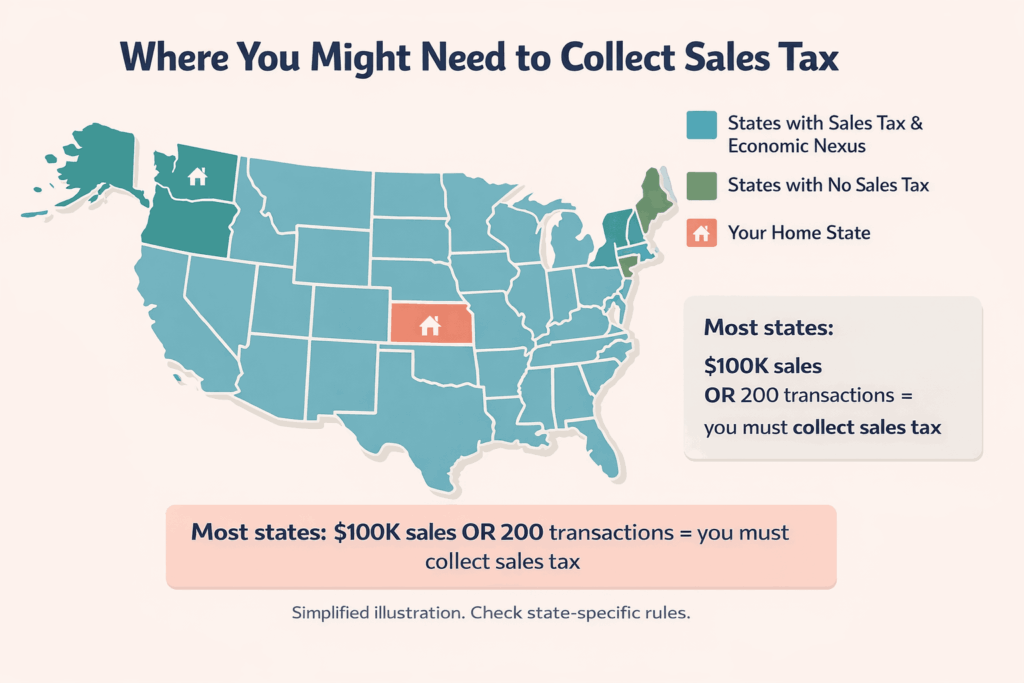
Sales tax is the part that genuinely confuses people, and I don’t blame them. After the 2018 South Dakota v. Wayfair Supreme Court decision, states can require you to collect sales tax even if you don’t have a physical presence there. This is called “economic nexus.”
Here’s the simplified version:
- You must collect sales tax in your home state (if it has sales tax)
- You must collect in any state where you exceed their economic nexus threshold (usually $100,000 in sales or 200 transactions per year)
- Five states have no sales tax: Alaska, Delaware, Montana, New Hampshire, Oregon
When you’re just starting out, you probably only need to worry about your home state. As you grow past $100K in revenue, use a tool like TaxJar or Avalara to automate multi-state sales tax compliance. Trying to track it manually across 45+ states is a losing battle.
If you’re planning your ecommerce startup costs, add $15-50/month for a sales tax automation tool once you hit multi-state nexus thresholds.
Ecommerce Tax Basics You Can’t Ignore
Beyond sales tax, here’s what you need to know about taxes as an ecommerce business owner:
Quarterly estimated taxes. As an LLC owner, nobody’s withholding taxes from your income. You’re responsible for paying the IRS quarterly (April 15, June 15, September 15, January 15). Miss these and you’ll owe penalties. Set aside 25-30% of your profit for taxes as a starting rule of thumb.
Self-employment tax. LLC owners pay 15.3% in self-employment tax (Social Security + Medicare) on top of income tax. This is the biggest tax surprise for new business owners. It’s also why S-Corp election becomes attractive once you’re profitable.
Deductible expenses. Your ecommerce business can deduct product costs, shipping, software subscriptions, advertising, home office space, internet, phone, packaging materials, and more. Track everything from day one. A tool like QuickBooks or Wave (free) makes this painless.
1099-K reporting. Payment platforms like Shopify Payments, PayPal, and Stripe report your transactions to the IRS if you exceed $600 in annual sales. This isn’t a new tax – it just means the IRS already knows what you earned. Don’t try to hide income.
Common Legal Mistakes Ecommerce Sellers Make
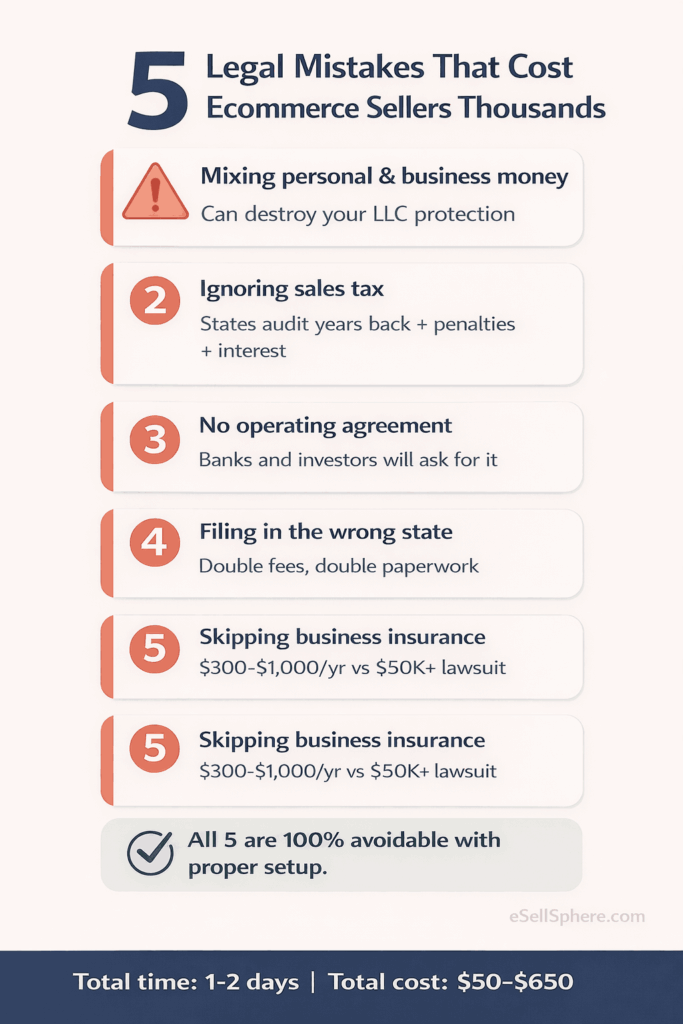
Mixing personal and business money. This is called “piercing the corporate veil” and it can destroy your liability protection. If a court sees no separation between you and your LLC, they can treat it like a sole proprietorship. Keep business money in a business account. Period.
Ignoring sales tax until it’s too late. States are aggressive about collecting unpaid sales tax. They can audit years back and charge penalties plus interest. Register for your sales tax permit before your first sale, not after.
Not having an operating agreement. Even single-member LLCs should have one. Banks ask for it. Investors ask for it. And if you ever add a partner, you’ll wish you had clear terms already written down. You can write your own using free templates online.
Forming in the wrong state for “tax benefits.” Forming in Delaware or Wyoming while living in Texas sounds clever until you realize you need to register as a foreign LLC in your home state too, paying double the fees and filing double the paperwork.
Skipping business insurance. An LLC protects your personal assets. Insurance protects your business assets. General liability insurance for a small ecommerce business runs $300-$1,000/year and covers product liability claims, copyright disputes, and property damage. It’s worth every penny.
Frequently Asked Questions
Do I need an LLC to sell on Shopify, Amazon, or Etsy?
No, none of these platforms require an LLC. You can sell as a sole proprietor on all major ecommerce platforms. However, forming an LLC is strongly recommended once you’re making consistent sales because it protects your personal assets from business liabilities, makes you look more credible to suppliers, and separates your personal and business finances for cleaner tax filing.
How much does it cost to set up an LLC for an online store?
LLC filing fees range from $35 (Montana) to $500 (Massachusetts), with the national average around $132. Add a registered agent service ($39-$150/year) and you’re looking at $75-$650 total for year one. Many states like Arizona and Missouri charge $50 to file with zero annual fees after that. The EIN from the IRS is free.
What taxes does an ecommerce business need to pay?
Ecommerce businesses pay federal income tax on profits, self-employment tax (15.3% for LLC owners), state income tax where applicable, and must collect and remit sales tax in states where they have economic nexus. Most new sellers only need to worry about their home state initially. Quarterly estimated tax payments to the IRS are required to avoid penalties.
When should I switch from sole proprietor to LLC?
Form an LLC when you start handling real revenue (consistently over $1,000/month), shipping physical products to customers, working with suppliers or manufacturers, or storing customer data. The liability exposure at that point outweighs the filing cost. Many experienced sellers recommend forming an LLC before your first sale to avoid the hassle of transitioning later.
Do I need a business license to sell online?
Requirements vary by location. Most ecommerce businesses need a sales tax permit from their state and potentially a general business license from their city or county. Home-based online businesses may also need a home occupation permit. Check your state’s business portal and local government website for specific requirements. The SBA has a free lookup tool for federal, state, and local license requirements.
What is economic nexus and why does it matter for ecommerce?
Economic nexus means a state can require you to collect sales tax even without physical presence there, triggered when your sales exceed their threshold (typically $100,000 or 200 transactions per year). After the 2018 Wayfair Supreme Court decision, most states enforce this. When starting out, focus on your home state. As revenue grows, use sales tax automation software like TaxJar or Avalara to stay compliant across multiple states.
Stop Researching, Start Filing
Here’s my honest take after watching thousands of sellers go through this process: the legal setup is not the hard part of ecommerce. Building a product people want, driving traffic, converting visitors into buyers – that’s hard. Filing some paperwork with your state? That’s a Tuesday afternoon.
The biggest mistake isn’t choosing the wrong structure or filing in the wrong state. It’s spending weeks paralyzed by legal research instead of launching your store. Pick LLC (unless you have a specific reason not to), file in your home state, get your EIN, open a bank account, and move on to the parts of your business that actually generate revenue.
Once you’re legally set up, the next step is figuring out which ecommerce business model fits your situation. And if you haven’t nailed down what you’re selling yet, our guide to profitable ecommerce niches will help you find a market worth entering.
Need a quick reference? Download our free Ecommerce Legal Setup Checklist – a one-page PDF with every step, every link, and every form you need. Print it, check things off, and get back to building your store.
Download the Free Legal Setup Checklist
Related reads: Complete Guide to Starting an Ecommerce Business | Ecommerce Business Models Explained | Ecommerce Startup Costs Breakdown | How to Start an Ecommerce Business Step by Step | Best Ecommerce Platform Overview
Enjoying this? Get more like it every week.
One email per week with ecommerce strategies, tool picks, and seller insights. No spam.