
- The AliExpress dropshipping center is a free built-in tool that helps sellers research trending products, analyze supplier performance, and find items to dropship. It includes product search by category, search by image, and product analysis with sales volume data.
- AliExpress is best for dropshipping (single-unit orders, no MOQ). Alibaba is best for wholesale and private label (bulk orders, 100-5,000+ unit minimums, lower per-unit cost). Both are owned by Alibaba Group but serve different buyer types.
- The biggest AliExpress dropshipping risk in 2026: shipping times. Standard AliExpress shipping from China takes 15-45 days. Customers expect 3-7 day delivery. Use suppliers with local warehouses (US, EU) or pair AliExpress sourcing with a domestic fulfillment center.
- Always order samples before listing any product. Always check seller ratings (4.5+ stars, 95%+ positive feedback). Always verify shipping times to your target market. The cheapest supplier is rarely the best supplier.
When I started helping sellers find products, everyone defaulted to the same approach: open AliExpress, search for something, pick the cheapest listing, import it to their Shopify store. Then they’d wonder why their customer left a one-star review about a product that took 35 days to arrive and looked nothing like the listing photo.
The AliExpress dropshipping center is a free product research tool built into the AliExpress platform that helps ecommerce sellers find trending products, analyze supplier performance data, and identify items worth dropshipping. It includes features for searching hot-selling products by category, searching by image to find cheaper sourcing alternatives, and analyzing individual product performance including sales volume and shipping data. AliExpress itself is a consumer marketplace owned by Alibaba Group, with over 100 million products from primarily Chinese manufacturers and wholesalers. For ecommerce sellers, it’s one of the most accessible sourcing platforms in the world, but it comes with specific risks you need to manage.
This guide covers how to use the AliExpress dropshipping center effectively, how to find reliable AliExpress sellers, when to use Alibaba instead, and the honest limitations of sourcing from either platform. If you’re new to dropshipping entirely, read our complete dropshipping guide first.
How the AliExpress Dropshipping Center Works
The dropshipping center is accessed at ds.aliexpress.com or through your AliExpress account dashboard. You need a free AliExpress buyer account to access it. Some accounts see it immediately; others need to place a few orders or connect a supported app like DSers before it appears. It’s completely free to use.
The center has two primary tools:
Product Search (Find Products). This tool lets you browse trending products across all AliExpress categories. You can search by keyword, browse by category, or use the “search by image” feature to upload a product photo and find similar or identical items from different AliExpress sellers (often at lower prices). Filter results by shipping destination, price range, and shipping method. The “Hot Selling Products” section shows items with the highest recent sales velocity.
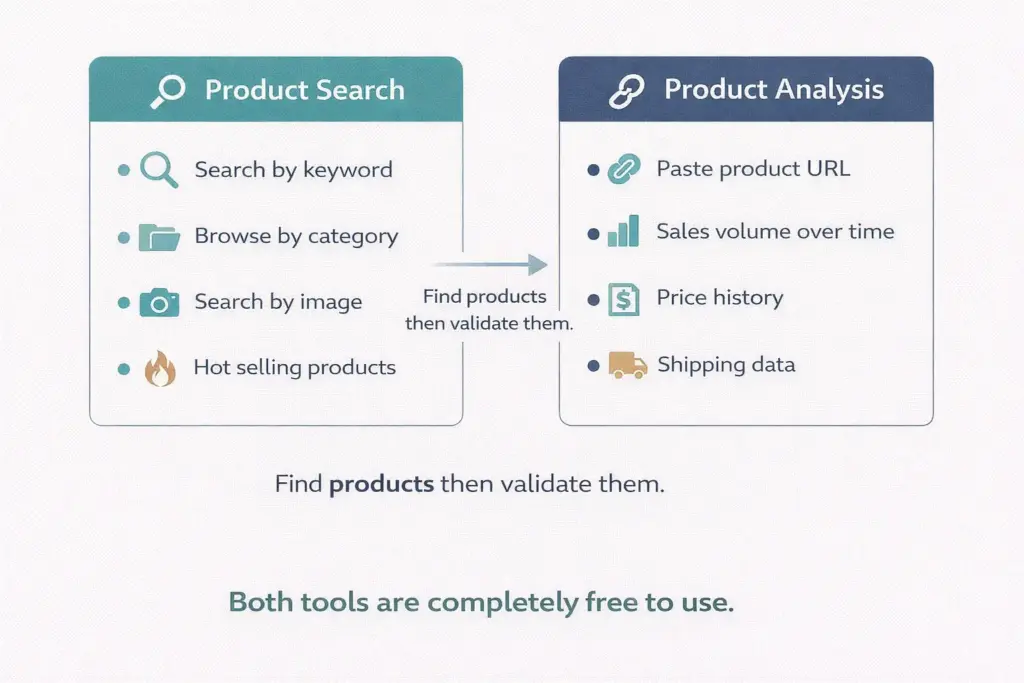
Product Analysis. Paste any AliExpress product URL into this tool and it shows you sales volume over time, price history, and shipping data. This is where you validate whether a product has sustained demand or just spiked temporarily. A product with steady sales over 3-6 months is a much better bet than one that spiked last week. Check the sales graph before committing to any product.
How to use these tools effectively: Start with Product Search to discover items in your niche. Filter by your target market’s shipping destination. Sort by orders to see what’s actually selling, not just what’s listed. Then paste promising product URLs into Product Analysis to verify the sales trend is stable or growing. Cross-reference with Google Trends to confirm demand exists outside of AliExpress too.
How to Find Reliable AliExpress Sellers
The product only matters if the supplier delivers it well. An unreliable AliExpress seller will destroy your business through late shipments, wrong items, and poor quality that generates refunds and negative reviews. Here’s how to vet them:
Seller rating: 4.5 stars or higher. AliExpress shows a seller’s overall rating plus sub-ratings for item description accuracy, communication, and shipping speed. All three sub-ratings should be 4.5+ for a supplier you’ll use regularly. Below 4.3 on any metric is a red flag.
Store age: at least 1-2 years. New stores haven’t been tested. Established stores have track records. Check how long the store has been operating in the “Store Info” section of their AliExpress page.
Order volume: look for products with 500+ orders. High order count means other sellers are successfully sourcing this item. It also means the supplier has production capacity and won’t run out of stock during your first ad campaign.
Read the reviews carefully. Ignore 5-star reviews that just say “good.” Look for reviews with photos showing the actual product received. Pay attention to complaints about shipping times, packaging quality, and product accuracy versus the listing photos. Reviews from buyers in your target market (US, UK, EU) are most relevant because shipping experience varies by destination.
Message the seller before ordering. Ask about shipping times to your market, whether they can do blind shipping (no supplier branding), whether they offer ePacket or warehouse shipping from your target country, and what their return/refund policy is. A responsive seller who answers within 24 hours is a good sign. No response in 48 hours means move on.
Always order samples. Place 2-3 sample orders to your own address before selling anything. Time the delivery. Inspect the product quality. Compare it to the listing photos. This costs $10-$30 and prevents you from selling a product that damages your brand and generates chargebacks.
AliExpress vs Alibaba: Which Platform to Use
Both platforms are owned by Alibaba Group but serve completely different purposes. Using the wrong one for your business model wastes time and money.
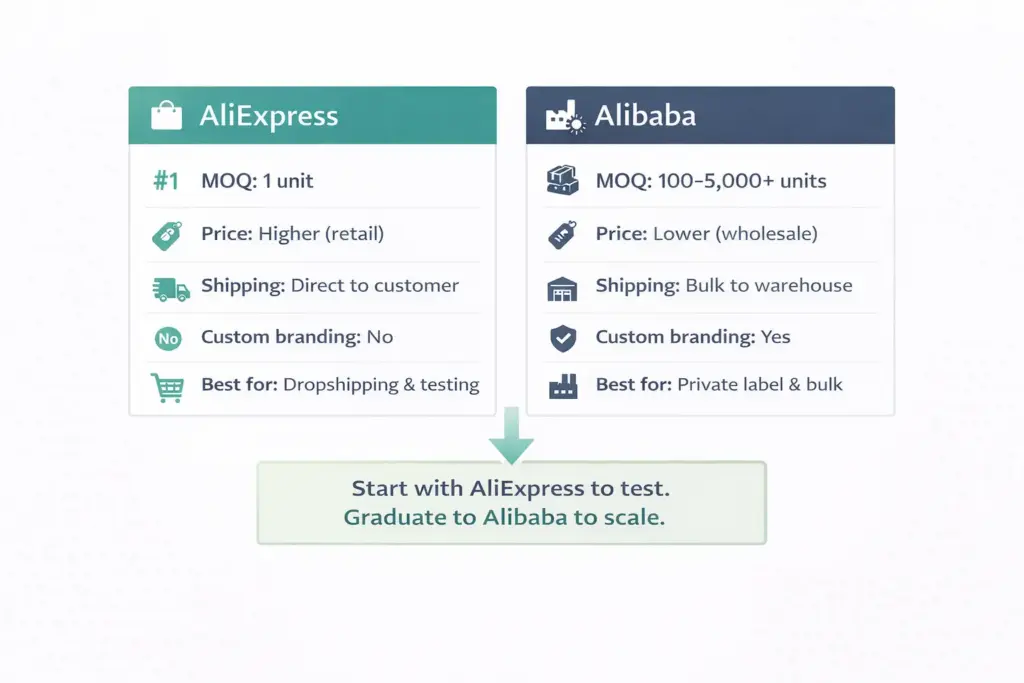
| Factor | AliExpress | Alibaba |
|---|---|---|
| Buyer type | Individual + small business | Business-to-business (B2B) |
| Minimum order | 1 unit (no MOQ) | 100-5,000+ units typically |
| Price per unit | Higher (retail/small quantity markup) | Lower (wholesale/bulk pricing) |
| Customization | None (buy as-is) | Logo, packaging, custom specs available |
| Shipping | Direct to customer (dropship ready) | Bulk to your warehouse/fulfillment center |
| Payment protection | Built-in buyer protection | Trade Assurance (verify supplier uses it) |
| Best for | Dropshipping, product testing, small orders | Private label, wholesale, bulk inventory |
| Typical shipping time | 15-45 days (China), 5-15 days (local warehouse) | 15-45 days (sea freight), 5-10 days (air freight) |
Use AliExpress when: You’re dropshipping and need single-unit fulfillment. You’re testing a product idea before committing to bulk inventory. You want zero upfront inventory investment. You’re using the AliExpress dropshipping center for product research.
Use Alibaba when: You’re ready to buy 100+ units of a proven product. You want custom branding, packaging, or product modifications (white label or private label). You need lower per-unit costs to improve margins. You’ve already validated demand through AliExpress dropshipping and want to level up.
The natural progression: test products via AliExpress dropshipping, find winners, then source those winners in bulk from Alibaba at lower cost with your branding. Our wholesale suppliers guide covers the Alibaba sourcing process step by step.
AliExpress Dropshipping Apps and Automation
Manually processing AliExpress orders one by one doesn’t scale. These apps automate the import, listing, and order fulfillment process:
DSers (official AliExpress dropshipping partner). Free plan available. Integrates with Shopify, WooCommerce, and Wix. Bulk order processing, supplier optimization, automatic tracking number sync. The most popular AliExpress dropshipping app by a wide margin.
Spocket. Sources from AliExpress plus US/EU suppliers for faster shipping. Paid plans start at $39/month. Better for sellers who want local warehouse options alongside AliExpress products.
CJ Dropshipping. Acts as a sourcing agent and fulfillment center. They buy from AliExpress/Alibaba suppliers, store products in their warehouses (including US warehouses), and ship to your customers with faster delivery times. Useful for solving the shipping speed problem.
AliDropship. WordPress/WooCommerce plugin for AliExpress dropshipping. One-time purchase ($89) rather than monthly subscription. Good for sellers who don’t want recurring app costs.
The Honest Limitations of AliExpress Sourcing
Shipping speed is the biggest problem. Standard shipping from China to the US takes 15-45 days. ePacket (faster option) takes 7-20 days. Customers in 2026 expect 3-7 day delivery because Amazon has trained them that way. Long shipping times lead to customer complaints, chargebacks, and negative reviews. Mitigation: use suppliers with US/EU warehouses, use CJ Dropshipping or similar agents with local inventory, or set extremely clear shipping expectations on your product pages.
Quality inconsistency. The same product from different AliExpress sellers can vary dramatically in quality. Photos may not accurately represent what arrives. Sizing can be inconsistent (especially clothing). There’s no way to know without ordering samples. Budget for sample testing as a non-negotiable cost of doing business.
Tariff and import changes. US import rules changed in 2026, largely revoking the $800 de minimis exemption for many shipments. Many parcels from China that previously entered duty-free now require customs clearance and duties. This affects both your costs and delivery times. Factor import duties into your pricing model.
Zero product differentiation. Every AliExpress product is available to every other dropshipper. If you import a trending product, 50 other stores are selling the exact same item, often with the same supplier photos. Your marketing, branding, and customer experience are the only differentiators. Our best dropshipping products guide covers how to compete when everyone has access to the same catalog.
Account and supplier risks. AliExpress sellers can go out of stock without warning, change prices, or close their store. Always have a backup supplier identified for your best-selling products. Never rely on a single AliExpress seller for a product that drives significant revenue.
Frequently Asked Questions
What is the AliExpress dropshipping center?
A free built-in tool on AliExpress (accessible at ds.aliexpress.com) that helps sellers research trending products, search by image to find sourcing alternatives, and analyze individual product performance including sales volume and shipping data. It requires a free AliExpress buyer account to access.
Is AliExpress dropshipping still profitable in 2026?
Yes, but margins are thinner than they were five years ago due to increased competition and rising import costs. Typical gross margins on AliExpress dropshipped products are 30-50%. Profitability depends on niche selection, marketing efficiency, and managing shipping expectations with customers.
How do I find reliable AliExpress sellers?
Check seller ratings (4.5+ stars minimum), store age (1-2+ years), product order volume (500+ orders), and photo reviews from buyers in your target market. Message the seller before ordering to verify shipping times and policies. Always order samples before listing products in your store.
What is the difference between AliExpress and Alibaba?
AliExpress is for single-unit purchases and dropshipping with no minimum order. Alibaba is for bulk wholesale orders (100-5,000+ units) with lower per-unit pricing and customization options. Use AliExpress to test products, then switch to Alibaba for bulk sourcing once you’ve validated demand.
What are the best AliExpress dropshipping apps?
DSers (free plan, official AliExpress partner, works with Shopify/WooCommerce/Wix), Spocket (US/EU supplier access alongside AliExpress), CJ Dropshipping (warehousing and faster shipping), and AliDropship (one-time purchase WordPress plugin). DSers is the most widely used and recommended for beginners.
How long does AliExpress shipping take?
Standard shipping from China: 15-45 days. ePacket: 7-20 days. AliExpress Standard Shipping: 15-30 days. Suppliers with US or EU warehouses: 3-10 days. For customer satisfaction, prioritize suppliers offering local warehouse shipping or use a fulfillment agent with domestic inventory.
Related reads: How to Start Dropshipping | Best Dropshipping Products | Amazon Dropshipping | Find Wholesale Suppliers | White Label Products | Private Label Products Guide
Enjoying this? Get more like it every week.
One email per week with ecommerce strategies, tool picks, and seller insights. No spam.