
- Alibaba is the world's largest B2B marketplace connecting ecommerce sellers with manufacturers, primarily in China. It's where most private label sellers source products for Amazon FBA, Shopify stores, and other ecommerce channels. Over 200,000 suppliers list millions of products across every category.
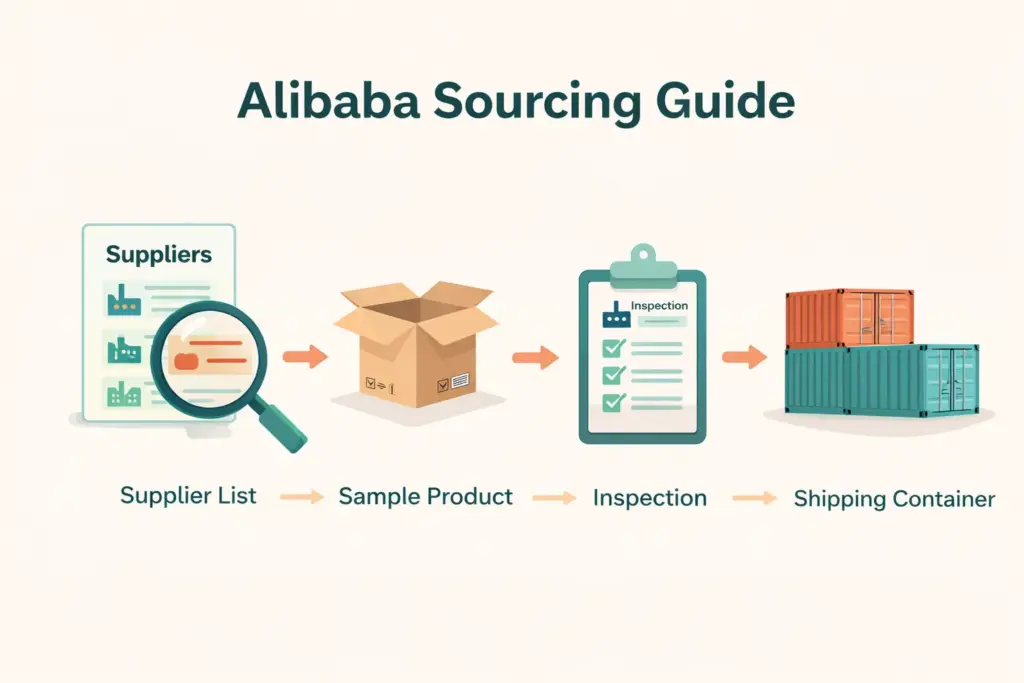
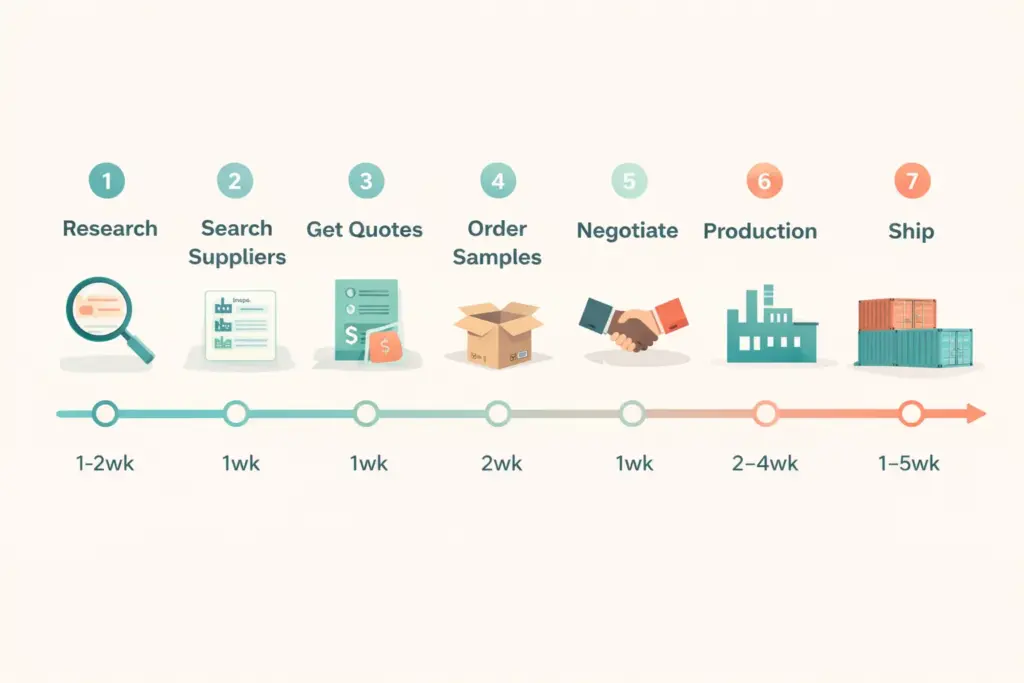
- The sourcing process has seven steps: product research, supplier search and filtering, initial contact and quotes, sample ordering, negotiation, production order, and shipping/import. From first supplier contact to inventory in hand typically takes 4-8 weeks.
- Supplier vetting is the most critical step. Use Alibaba's Verified Supplier and Trade Assurance badges as starting filters, then verify through sample quality, factory audit reports, export licenses, and responsiveness. Never place a large order without first approving a physical sample.
- Common mistakes: ordering from the cheapest supplier (cheap usually means quality problems), skipping samples to save time, paying outside Alibaba's Trade Assurance system, and not getting a written agreement on product specifications before production.
Alibaba sourcing is the process of finding manufacturers on Alibaba.com, verifying their legitimacy and production quality, negotiating pricing and minimum order quantities, and placing production orders for products you’ll sell through your ecommerce store. It’s the primary sourcing channel for private label sellers, Amazon FBA businesses, and any ecommerce brand that manufactures custom products.
Alibaba is not AliExpress. AliExpress is for single-unit retail purchases with consumer-friendly shipping. Alibaba is for bulk manufacturing orders where you’re buying 100-10,000+ units directly from the factory. The pricing, MOQs, customization options, and communication process are fundamentally different. If you’ve only used AliExpress for dropshipping, Alibaba requires a different approach.
This guide covers every step from how to buy from alibaba safely to getting your finished products shipped to your warehouse or Amazon FBA center. If you’re still deciding between sourcing models, our dropshipping vs private label vs wholesale comparison helps you determine if Alibaba sourcing is right for your stage.
Step 1: Define Your Product Specifications Before Searching
Before opening Alibaba.com, document exactly what you want:
- Product type and materials: “Stainless steel insulated water bottle, 500ml, double-wall vacuum insulated”
- Dimensions and weight: Height, diameter, cap type, weight when empty
- Customization: Your logo placement, color options, packaging design, insert cards
- Target unit cost: Based on your selling price and margin requirements (use the 3x markup rule: if you sell for $30, target $10 or less per unit)
- Order quantity: First batch size, typically 200-1,000 units for initial testing
Writing specifications before searching prevents you from being swayed by whatever suppliers offer. You approach conversations knowing exactly what you need, which puts you in a stronger negotiation position.
Step 2: Search and Filter Alibaba Suppliers
Search for your product on Alibaba using specific terms (“custom stainless steel water bottle” not just “water bottle”). Then apply these filters to narrow results:
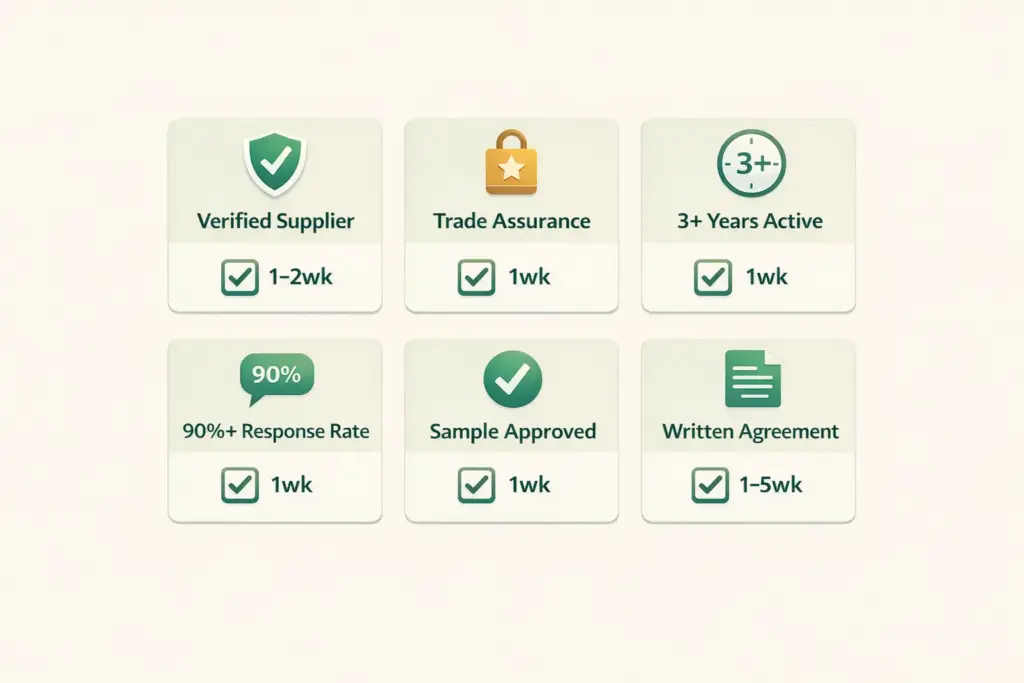
Verified Supplier badge. Alibaba’s verification means a third party has confirmed the company’s legal existence, factory location, and production capacity. This doesn’t guarantee quality but confirms the business is real.
Trade Assurance. This is Alibaba’s buyer protection program. If a supplier fails to meet agreed-upon quality, quantity, or shipping terms, Alibaba refunds your payment. Only work with alibaba suppliers that offer Trade Assurance.
Years in business. Filter for suppliers with 3+ years on the platform. Longevity correlates with reliability. A supplier that’s survived on Alibaba for 5+ years has passed through multiple review cycles.
Response rate and time. Suppliers with 90%+ response rate and under-24-hour response time are actively managing their Alibaba presence. Low response rates signal disinterest or understaffing.
From your search results, shortlist 5-10 suppliers that match your criteria. You’ll narrow this down through communication and samples.
Step 3: Contact Suppliers and Request Quotes
Send the same detailed inquiry to all shortlisted suppliers. Include:
- Your product specifications (from Step 1)
- Target order quantity for first order and estimated annual volume
- Customization requirements (logo, colors, packaging)
- Your target price range (optional but helps filter quickly)
- Request for MOQ (minimum order quantity) and lead time
Evaluate responses on: price competitiveness, MOQ flexibility (can they do 200 units or do they require 1,000?), lead time (production + shipping), communication quality (do they answer all your questions clearly?), and willingness to customize.
Red flag responses: Suppliers who don’t answer specific questions, who quote prices without understanding your specs, who pressure you to order immediately, or who can’t provide factory photos or certifications. Professional manufacturers respond with detailed quotes, ask clarifying questions about your needs, and provide references.
Step 4: Order and Evaluate Samples
This is the most important step in the entire alibaba sourcing process. Never place a production order without physically holding and evaluating a sample.
Samples typically cost $10-100 per unit plus shipping ($30-80 via DHL/FedEx for international express). This $50-150 investment protects you from a $2,000-10,000 production disaster. Order samples from your top 2-3 suppliers and compare:
- Material quality: Does it feel premium or cheap? Is the finish consistent?
- Dimensions and weight: Do they match your specifications exactly?
- Branding quality: Is logo printing crisp? Does it withstand rubbing and washing?
- Packaging: Does the unboxing experience match your brand positioning?
- Durability: Stress test the product. Drop it, wash it, use it hard for a week.
The supplier whose sample best matches your specifications AND who communicates most professionally gets your production order. Price should be a factor but not the only factor. The cheapest supplier often delivers the cheapest quality.
Step 5: Negotiate Terms
Once you’ve selected a supplier based on sample quality, negotiate these terms before placing your production order:
Unit price. Alibaba prices are rarely final. Negotiate based on order volume, repeat business commitment, and competitor quotes. “Supplier B quoted $X for the same specs” is legitimate negotiation. Most suppliers have 10-20% room on initial quotes.
MOQ. If the MOQ is 1,000 but you want 300 for your first order, many suppliers will accommodate a lower first order at a slightly higher per-unit price with the understanding that reorders will be larger.
Payment terms. Standard is 30% deposit before production, 70% before shipping. Never pay 100% upfront. Trade Assurance protects deposits. For your first order with any supplier, always pay through Alibaba’s Trade Assurance system.
Quality agreement. Get written agreement on: acceptable defect rate (typically 2-3% maximum), product specifications, packaging details, and what happens if quality doesn’t match the approved sample. This document protects both parties.
Lead time. Confirm production time (typically 15-30 days) and shipping time (sea freight: 20-40 days, air freight: 5-10 days). Add 1-2 weeks buffer for customs clearance and unexpected delays.
Step 6: Production and Quality Inspection
During production, request progress photos at key stages: materials sourced, production line, finished units before packaging, packed and ready to ship. Professional manufacturers provide these without resistance.
For orders over $3,000, consider hiring a third-party inspection company (QIMA, V-Trust, Asia Inspection) to inspect finished goods before shipping. Inspections cost $200-400 and involve a random sample check of your production run against your approved specifications. This catches quality issues before 500+ defective units arrive at your warehouse.
A pre-shipment inspection report includes: quantity verification, visual quality assessment, dimensional measurements versus specifications, functional testing, and packaging inspection. If defects exceed your agreed threshold, you can request rework before the shipment leaves the factory.
Step 7: Shipping and Import
Three shipping methods from China to the US:
| Method | Transit Time | Cost (approx.) | Best For |
|---|---|---|---|
| Sea freight (FCL/LCL) | 25-40 days | $3-8 per kg | Large, heavy orders (500+ units) |
| Air freight | 5-10 days | $5-12 per kg | Time-sensitive or lightweight products |
| Express (DHL/FedEx) | 3-7 days | $8-20 per kg | Samples, urgent small orders |
For most first orders of 200-500 units of small products, air freight balances cost and speed. Sea freight makes sense once you’re reordering 500+ units regularly and can plan 6-8 weeks ahead.
Customs and duties. Products imported from China are subject to US customs duties (rates vary by product category, typically 0-25%). Use the Harmonized Tariff Schedule to look up your product’s duty rate. Your shipping forwarder or customs broker handles the paperwork, but you’re responsible for paying the duties.
If you’re shipping directly to Amazon FBA, your freight forwarder can deliver to Amazon’s fulfillment center. Ensure your products are labeled with FNSKU barcodes before they ship from China to avoid reprocessing at Amazon. Our Amazon FBA guide covers inbound shipping requirements.
Using an Alibaba Sourcing Agent
An alibaba sourcing agent is a third-party professional who handles the entire sourcing process on your behalf: finding suppliers, negotiating prices, managing samples, overseeing production, arranging inspections, and coordinating shipping. They charge 3-10% of the order value or a flat fee per project.
When an agent makes sense: Your first time sourcing from China, orders over $10,000, complex products with multiple components, or when you don’t have time to manage the process yourself.
When to do it yourself: Simple products with established supplier options, orders under $5,000, or when you’ve completed the process before and have established supplier relationships. The steps in this guide are designed for self-sourcing.
Common Alibaba Sourcing Mistakes
Choosing the cheapest supplier. If three suppliers quote $5, $6, and $4 per unit, the $4 supplier is likely cutting corners on materials or quality control. The cheapest option almost always results in a quality problem that costs more to fix than the savings were worth.
Skipping samples. “The product photos look great, I’ll just order 500 units.” This sentence has preceded thousands of ecommerce disasters. Photos lie. Samples don’t. Spend the $50-150 on samples. Every time.
Paying outside Trade Assurance. Suppliers who ask you to pay via Western Union, personal bank transfer, or any method outside Alibaba’s system are either scammers or trying to avoid accountability. Trade Assurance exists for your protection. Use it.
No written specifications agreement. Verbal agreements and chat messages aren’t enough. Get your product specifications, quality standards, and production terms in a signed document before paying your deposit. Disputes without written agreements rarely resolve in the buyer’s favor.
Ignoring import duties and regulations. Some products require specific certifications for US import (FDA for food/cosmetics, CPSC for children’s products, FCC for electronics). Importing without required certifications can result in customs seizure. Research compliance requirements for your product category through our legal setup guide before placing your production order.
Frequently Asked Questions
Filter for Verified Suppliers with Trade Assurance. Contact 5-10 suppliers with detailed specs. Order samples from your top 2-3 before committing to production. Always pay through Alibaba’s Trade Assurance system. Get written specs agreement before production. Consider a third-party inspection for orders over $3,000. Start with a small first order (200-500 units) to test the relationship.
A typical first order costs: $50-150 for samples, $1,000-5,000 for 200-500 units of production (depending on product), $200-400 for third-party inspection (optional), and $300-1,500 for shipping. Total: $1,500-7,000 for your first alibaba sourcing run including all costs from sample to warehouse delivery.
MOQs vary by supplier and product. Common ranges: 100-500 units for accessories and small items, 500-1,000 for clothing and textiles, 1,000-5,000 for custom-molded products. Many suppliers negotiate lower MOQs for first orders at a slightly higher per-unit price. Ask specifically: “What is your MOQ for a first trial order?”
Typical timeline: 1-2 weeks for supplier search and communication, 1-2 weeks for sample production and shipping, 1 week for sample evaluation, 1-2 weeks for negotiation and order placement, 2-4 weeks for production, 1-5 weeks for shipping (air vs sea). Total: 6-14 weeks from first search to inventory in hand.
Do it yourself for simple products under $5,000, especially if you follow this guide step by step. Use a sourcing agent (3-10% of order value) for first-time complex orders over $10,000, products with multiple components, or when you lack time to manage the process. Agents add cost but reduce risk and save significant time on communication and logistics.
Alibaba is B2B: bulk manufacturing orders (100-10,000+ units), factory-direct pricing, custom branding, and 4-8 week lead times. AliExpress is B2C: single-unit purchases at retail-like pricing with consumer shipping. Use Alibaba for private label manufacturing and bulk wholesale. Use AliExpress for dropshipping or ordering individual samples before an Alibaba production run.
Related Reads
- Private Label Products Guide
- AliExpress Sourcing Guide
- Finding Wholesale Suppliers
- Manufacturers and Sourcing Guide
- Amazon FBA Guide
- Dropshipping vs Private Label vs Wholesale
Enjoying this? Get more like it every week.
One email per week with ecommerce strategies, tool picks, and seller insights. No spam.