
- Your pricing strategy determines profitability more than your product selection, marketing spend, or platform choice. A 10% price increase on the same volume drops straight to your bottom line.
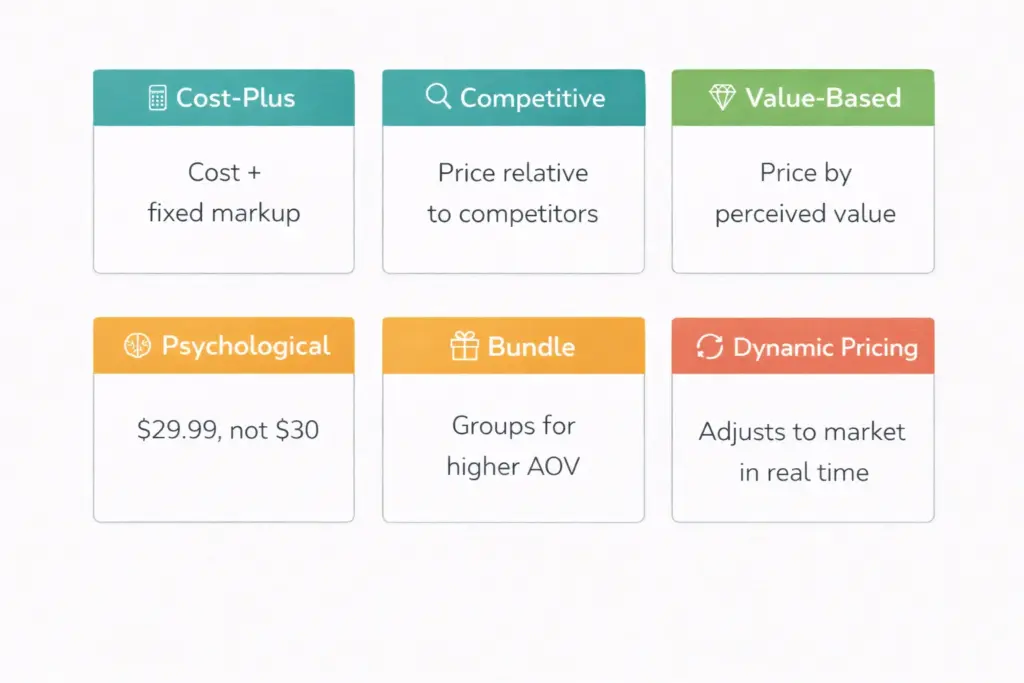
- There are six core ecommerce pricing strategies: cost-plus, competitive, value-based, psychological, bundle pricing, and dynamic pricing. Most successful stores combine two or three of these rather than relying on just one.
- Dynamic pricing means adjusting your prices based on demand, competition, inventory levels, or time. Amazon changes prices millions of times per day. You don't need enterprise software to do a simpler version. Even manually adjusting prices weekly based on competitor checks and inventory levels qualifies as dynamic pricing.
- The biggest pricing mistake: racing to the bottom on price. If your only competitive advantage is being the cheapest, you'll be unprofitable the moment a competitor undercuts you by $1. Differentiate on value, then price accordingly.
A seller I know was doing $18K/month in revenue and losing money. Shipping costs had crept up, platform fees increased, and she hadn’t adjusted her prices in eight months. A single pricing audit and a 12% price increase across her catalog turned the same revenue into $2,400/month profit. Nothing else changed. Same products, same ads, same traffic. Just better pricing.
An ecommerce pricing strategy is the methodology you use to set and adjust product prices to maximize profitability while remaining competitive. It encompasses how you calculate costs, analyze competitor prices, understand customer willingness to pay, and use dynamic pricing to adjust prices based on real-time market conditions. Dynamic pricing – where prices change based on demand, competition, inventory, and seasonality – is the fastest-growing approach in ecommerce, but it’s just one of six strategies you need to know. The right pricing strategy is the single highest-impact action in your business because unlike acquiring new customers or developing new products, adjusting prices costs you nothing and the impact hits your bottom line immediately.
This guide covers every ecommerce pricing strategy worth knowing, with specific focus on dynamic pricing since that’s where the industry is heading and where sellers have the most to gain. If you’re still setting up your store, our how to start an ecommerce business guide covers the foundations.
The Six Core Ecommerce Pricing Strategies
1. Cost-Plus Pricing (The Baseline)
How it works: Calculate your total cost per unit (product + shipping + packaging + platform fees), then add a fixed markup percentage. If your landed cost is $10 and you apply a 100% markup, you sell at $20.
When to use it: When you’re starting out and need a simple, reliable pricing floor. It guarantees you never sell at a loss. Most sellers begin here and layer other strategies on top.
The limitation: Cost-plus ignores what customers are willing to pay. If your cost is $10 and the market happily pays $45 for similar products, a 100% markup at $20 leaves $25 on the table. Conversely, if competitors sell at $15, your $20 won’t move.
Formula: Selling price = Total cost per unit x (1 + markup percentage). For most ecommerce products, aim for a minimum 2.5-3x markup on your landed cost to cover advertising and still profit.
2. Competitive Pricing (Market-Based)
How it works: Research what competitors charge for similar products and price relative to them. You can price below (penetration), at parity (matching), or above (premium positioning).
When to use it: When selling commodity products where buyers actively compare prices (electronics accessories, generic supplements, common household items). Also essential when selling on marketplaces like Amazon where price directly impacts Buy Box eligibility.
Dynamic pricing example: Amazon sellers using repricing tools automatically adjust prices within a defined range based on competitor movements. If three competitors drop their price on a phone case from $18 to $15, your repricer lowers yours to $14.99 to win the Buy Box. This is dynamic pricing in its simplest form.
The risk: A pure competitive strategy triggers price wars. If everyone keeps undercutting, margins approach zero. Use competitive pricing as a reference point, not your entire strategy.
3. Value-Based Pricing (The Profit Maximizer)
How it works: Price based on the perceived value to the customer, not your cost. A handmade leather wallet that costs $15 to make can sell for $80-$120 because the buyer values craftsmanship, uniqueness, and premium materials.
When to use it: When your products have genuine differentiation – custom designs, premium quality, unique features, strong brand story, or solving a specific pain point better than alternatives. Value-based pricing is how direct-to-consumer brands like Allbirds sell $100 shoes made from $15 in materials.
How to find the right price: Test. List the same product at different price points on different channels (or run A/B price tests on your own store) and measure conversion rate AND profit per visitor. Sometimes a higher price with slightly lower conversion rate generates more total profit than a lower price with higher conversion. Our high profit margin products guide covers which product categories support value-based pricing best.
4. Psychological Pricing
How it works: Use pricing formats that influence buying behavior through cognitive biases. This isn’t manipulation – it’s understanding how people process price information.
Common ecommerce pricing tactics:
Charm pricing: $29.99 instead of $30. The left-digit effect makes $29.99 feel meaningfully cheaper than $30, even though the difference is one cent. Works best on products under $100.
Anchor pricing: Show the “original” price crossed out next to the sale price. “$59.99” crossed out, “$39.99” highlighted. The anchor ($59.99) makes the actual price feel like a deal. This only works ethically if the anchor was a real previous price.
Price bundling: “3 for $25” feels like a better deal than “$9 each” even though the customer spends more total. Bundling increases average order value significantly.
Free shipping threshold: “Free shipping on orders over $50.” If your average order is $35, this nudges customers to add items to reach the threshold. It’s technically a pricing strategy because it changes the effective price the customer pays.
5. Bundle Pricing
How it works: Group complementary products together at a price lower than buying each individually. A skincare brand selling cleanser ($18), toner ($15), and moisturizer ($20) individually offers the “Complete Routine Bundle” for $44 instead of $53.
Why it works: Customers perceive value (saving 17% vs buying individually). Your average order value jumps. And you’re selling 3 units instead of 1, which usually improves your unit economics even at the discounted total.
Dynamic pricing application: Adjust bundle pricing based on inventory. If you’re overstocked on toner, create a bundle that includes toner at a steeper discount to move inventory. When stock normalizes, return to standard bundle pricing. This is a simple form of ecommerce dynamic pricing that doesn’t require any software.
6. Dynamic Pricing (The Adaptive Strategy)
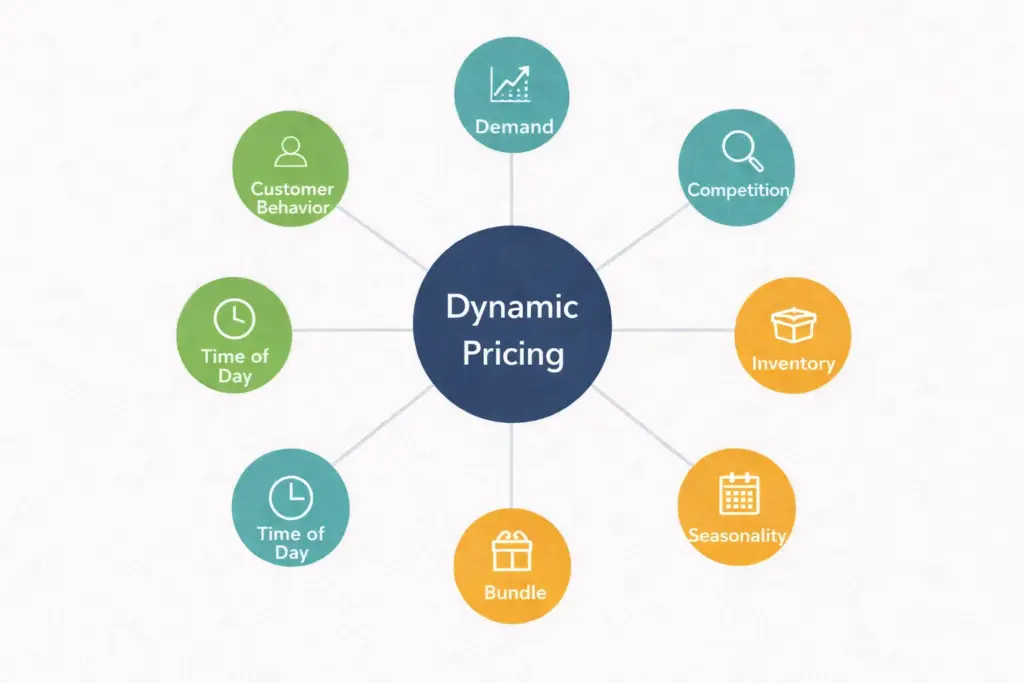
Dynamic pricing is a pricing strategy where product prices are adjusted continuously based on real-time factors including demand, competition, inventory levels, time of day, seasonality, and customer behavior. Instead of setting a price and forgetting it, dynamic pricing treats price as a variable that should change as market conditions change.
Amazon is the most famous dynamic pricing example – they adjust prices on millions of products multiple times per day using algorithms that factor in competitor pricing, demand velocity, inventory levels, and historical sales data. Retailers who implement dynamic pricing typically report a 15-25% revenue increase within six months (Lucky Orange).
Dynamic pricing for small sellers (no expensive software needed):
Weekly competitor check. Every Monday, check the top 5 competitor prices for your best-selling products. If the market shifted, adjust yours. This manual process is dynamic pricing at its simplest – and it works.
Inventory-based adjustments. Overstocked on a product? Lower the price by 10-15% to accelerate sales. Running low? Raise the price slightly. You’re the algorithm.
Seasonal pricing. Increase prices 2-4 weeks before peak demand seasons (Q4 holidays, Valentine’s Day, Mother’s Day). Reduce after the peak passes. Check Google Trends for your product’s seasonality pattern.
Abandoned cart discounting. A customer adds to cart but doesn’t buy. An automated email offering 10% off is dynamic pricing triggered by customer behavior. Every email platform (Klaviyo, Omnisend, Mailchimp) supports this.
When to invest in dynamic pricing software: Once you’re managing 100+ SKUs and selling on multiple channels, manual price adjustments become impractical. Tools like Prisync ($99-$399/month), RepricerExpress (for Amazon), and Omnia Retail automate competitor tracking and price optimization. But you don’t need these tools to start applying dynamic pricing principles.
How to Build Your Pricing Strategy (Step by Step)
Step 1: Calculate your true cost floor. Add up: product cost + shipping to customer + packaging + platform transaction fees + payment processing fees. This is your absolute minimum price. Selling below this means losing money on every order.
Step 2: Research the competitive range. Search your product on the platform you sell on. Sort by “sold” or “best-selling” to see what prices actually convert. Note the lowest price, highest price, and the cluster where most sales happen. That cluster is your target range.
Step 3: Position within the range. If your product is identical to competitors, price at or just below the cluster midpoint. If your product has better quality, branding, or a unique angle, price at or above the midpoint. If you’re just entering the market and need initial sales and reviews, price at the low end temporarily, then raise after building social proof.
Step 4: Layer psychological pricing. Round to .99 or .95. Show crossed-out “compare at” prices if you have legitimate retail comparisons. Set up a free shipping threshold just above your average order value.
Step 5: Set up dynamic pricing triggers. At minimum, schedule monthly competitor price reviews. Set up abandoned cart email with a discount offer. Adjust prices seasonally based on demand patterns. As you grow, add inventory-based adjustments and consider automated repricing tools.
Pricing Mistakes That Kill Ecommerce Stores
Racing to be the cheapest. If your only advantage is price, you have no advantage. The moment a competitor undercuts you by $0.50, you lose. Compete on value, brand, service, or uniqueness. Price is the last differentiator, not the first.
Never raising prices. Costs increase every year – shipping rates, platform fees, material costs, ad costs. If your prices stay the same, your margins shrink. Review and adjust prices quarterly at minimum. Most customers won’t notice a 5-8% increase if the value remains strong.
Ignoring perceived value. A product in a plain poly bag feels cheap even if it’s high quality. The same product in branded packaging with a thank-you card feels premium and justifies a higher price. Presentation directly affects what customers will pay. Invest $0.50-$2 in packaging and charge $5-$10 more.
Setting prices based on feelings instead of data. “I feel like $25 is fair” is not a pricing strategy. Check what the market pays. Calculate your costs. Test different price points. Let data decide.
Discounting too often. Constant sales train customers to never pay full price. They’ll just wait for the next 20% off coupon. Use discounts strategically (abandoned cart recovery, first-time buyer incentive, seasonal clearance) not as your default operating mode.
Frequently Asked Questions
What is dynamic pricing in ecommerce?
Dynamic pricing is adjusting product prices based on real-time factors like demand, competitor pricing, inventory levels, and seasonality. Amazon changes prices millions of times daily using algorithms. Small sellers can apply the same principles by manually checking competitors weekly and adjusting prices based on stock levels and seasonal demand.
What is the best ecommerce pricing strategy?
There’s no single best strategy. Most profitable stores combine cost-plus pricing as a floor, competitive pricing as a reference, value-based pricing for differentiated products, and psychological pricing tactics. Dynamic pricing layers on top, adjusting prices based on changing market conditions.
How do I price products for my online store?
Calculate your total cost per unit (product + shipping + fees + packaging). Research competitor prices for similar products. Price at 2.5-3x your cost minimum, within the competitive range for your market. Use .99 charm pricing and offer free shipping above your average order value to optimize conversion.
Can small businesses use dynamic pricing?
Yes. Dynamic pricing doesn’t require expensive software. Check competitor prices weekly and adjust yours. Raise prices when demand is high (seasonal peaks) and lower when you need to clear inventory. Set up automated abandoned cart discounts. These are all forms of dynamic pricing accessible to any seller.
What are some dynamic pricing examples?
Amazon adjusting prices hourly based on demand and competition. Airlines charging more for flights closer to departure date. Uber’s surge pricing during peak hours. An Etsy seller raising prices on handmade ornaments in November and December. An Amazon seller using a repricing tool to stay competitive on the Buy Box.
How often should I review my ecommerce pricing?
At minimum quarterly for a full pricing audit. Weekly for competitor spot-checks on your top 5-10 products. Before and after major seasonal periods (Q4 holidays, Valentine’s Day, back-to-school). Immediately when your costs change (supplier price increases, shipping rate changes, platform fee updates).
Related reads: How to Start an Ecommerce Business | High Profit Margin Products | Ecommerce Startup Costs | Ecommerce Trends | How to Sell Things Online | Ecommerce Business Models
Enjoying this? Get more like it every week.
One email per week with ecommerce strategies, tool picks, and seller insights. No spam.