
- Private label means a manufacturer makes the product, you control the branding, packaging, pricing, and customer experience. You're building a brand, not reselling someone else's.
- US private label sales hit a record $271 billion in 2024, growing 3.9% year-over-year (PLMA). Over 50% of Amazon sellers use the private label model.
- Realistic startup cost: $2,000-$10,000 for your first product including samples, initial inventory, packaging design, and product photography.
- The best private label products are small, lightweight, consumable, and hard to comparison-shop. Supplements, skincare, coffee, and pet products consistently top the charts.
Every time you buy Kirkland batteries at Costco, Great Value pasta at Walmart, or AmazonBasics anything, you’re buying private label. A manufacturer made it. The retailer slapped their brand on it. And the retailer kept a much bigger chunk of the margin than they would reselling someone else’s product.
Private label products are goods manufactured by a third-party company but sold under your own brand name. You control the branding, packaging, pricing, and product specifications while the manufacturer handles production. It’s the business model behind the majority of successful ecommerce brands you’ve never heard of, the ones quietly doing six and seven figures on Amazon and Shopify without a single viral TikTok.
Private label is where ecommerce gets serious. If dropshipping is the test drive, private labeling is buying the car. The investment is higher, but so is everything else: margins, brand equity, customer loyalty, and your ability to build something you can actually sell someday. If you’re mapping out your ecommerce business, understanding private label isn’t optional.
Private Label vs White Label vs Wholesale
These three get confused constantly. Here’s the actual difference:
Private label: A manufacturer produces a product to YOUR specifications. You customize the formula, features, packaging, and branding. The product is exclusive to you. Nobody else sells the exact same thing. Example: you work with a skincare manufacturer to create a vitamin C serum with your specific ingredient ratios, your bottle design, your label.
White label: A manufacturer produces a generic product that multiple retailers buy and rebrand. Everyone gets the same product, just with different labels on it. Less customization, lower MOQs, faster to market. Example: you buy a standard vitamin C serum from a manufacturer’s catalog and put your label on it.
Wholesale/reselling: You buy an existing branded product at wholesale prices and sell it at retail. You don’t control the brand or packaging at all. Example: you buy 500 units of CeraVe moisturizer from a distributor and resell them on Amazon.
| Factor | Private Label | White Label | Wholesale |
|---|---|---|---|
| Product customization | Full (formula, features, packaging) | Limited (packaging/label only) | None |
| Brand ownership | Yours exclusively | Your label, generic product | Someone else’s brand |
| Typical margins | 50-80% | 40-60% | 20-50% |
| Startup cost | $2,000-$10,000+ | $500-$3,000 | $1,000-$5,000 |
| MOQ (minimum order) | 500-2,000+ units typical | 100-500 units | Varies by brand |
| Time to launch | 2-6 months | 2-6 weeks | 1-2 weeks |
| Sellable as a business? | Yes (brand has value) | Somewhat | Rarely |
For a deeper comparison of all sourcing models, see our ecommerce business models guide.
Why Private Label Works (The Numbers)
Private label isn’t just a business model. It’s a market force. The Private Label Manufacturers Association (PLMA) reported a record $271 billion in US private label sales in 2024, up 3.9% year-over-year. Private label market share in the US has grown from 18% in 2019 to roughly 21% by 2024. In Europe, private label penetration runs between 20-50% of supermarket sales.
On Amazon specifically, more than 50% of sellers use the private label model. It’s the dominant approach for sellers building real businesses on the platform, not just flipping arbitrage deals.
Why the growth? Three reasons:
Consumers stopped caring about brand names. Only about 9% of consumers describe themselves as truly brand-loyal. Millennials and Gen Z actively seek alternatives to national brands, especially when the private label offers comparable quality at a better price.
Margins are significantly better. When you source directly from a manufacturer, you eliminate distributors, brand premiums, and retail middlemen. A product that costs $3-5 to manufacture and package can retail for $15-35 under your brand. Try getting those margins reselling someone else’s product.
You own an asset. A private label brand with reviews, repeat customers, and brand recognition has actual resale value. You can sell it. Dropshipping stores and wholesale businesses almost never sell because the owner doesn’t own anything proprietary.
How to Launch a Private Label Product: Step by Step
Step 1: Pick the Right Product Category
Not everything is worth private labeling. The best private label products share specific traits:
- Small and lightweight. Keeps shipping and storage costs low. Supplements, skincare, coffee, phone accessories, pet treats all fit this profile.
- Consumable or repeat-purchase. Customers who love your product come back. This is the difference between building recurring revenue and chasing new customers forever.
- Hard to comparison-shop. Nobody Googles “cheapest vitamin C serum.” They look for the one that works for their skin. Products where quality and branding matter more than price are ideal.
- Room for differentiation. If you can’t answer “why would someone buy THIS over the 50 other options?” then pick a different product.
Categories that consistently perform well for private label: skincare and beauty, supplements and vitamins, coffee and specialty food, pet products, baby products, fitness accessories, and home fragrance. Our profitable ecommerce niches guide covers market sizing for each of these.
Step 2: Find and Evaluate Manufacturers
This is the step that intimidates people most. It shouldn’t. Finding manufacturers is mostly research and outreach. Here’s where to look:
Alibaba. The default starting point. Millions of manufacturers, mostly based in China. Search for your product category, filter by “Trade Assurance” and “Verified Supplier,” and start requesting quotes. Expect to message 15-20 suppliers to find 3-5 worth sampling from. Our Alibaba sourcing guide covers the process in detail.
Thomasnet. The go-to directory for US-based manufacturers. Higher per-unit costs than overseas, but faster shipping, easier communication, and better quality oversight. Worth the premium for products where “Made in USA” adds brand value.
Trade shows. Canton Fair (China), ASD Market Week (Las Vegas), and industry-specific shows are where serious relationships get built. You can evaluate product quality in person and negotiate directly. Not necessary for your first product, but valuable as you scale.
Referrals and industry directories. The PLMA directory, industry-specific associations (like the Natural Products Association for supplements), and even asking other sellers in forums. Sometimes the best manufacturer is the one nobody’s found on Alibaba yet.
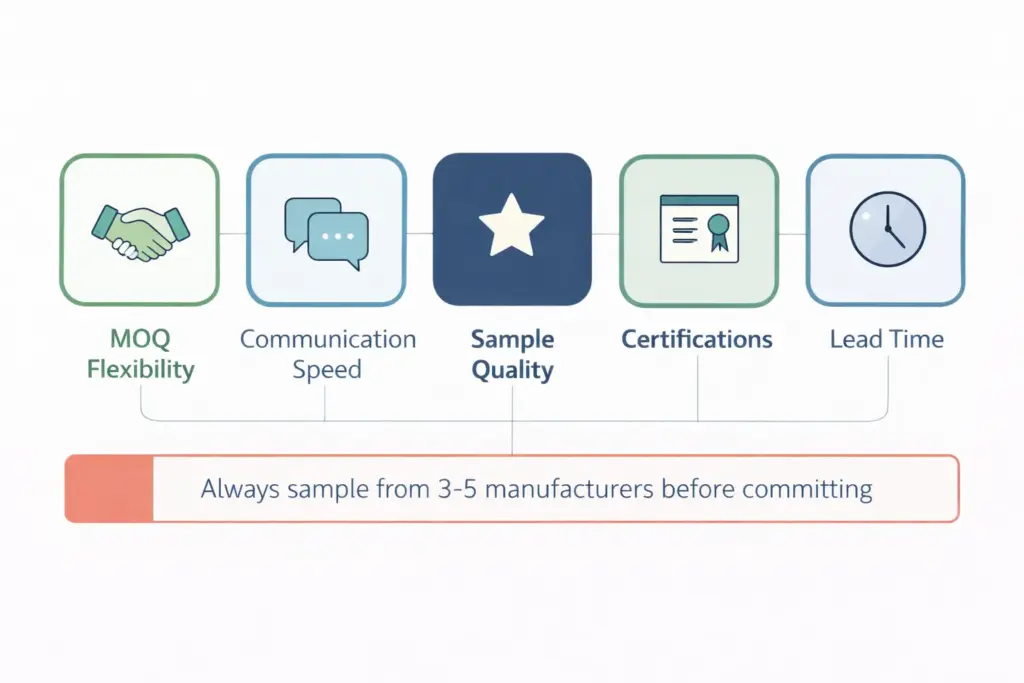
What to evaluate in every manufacturer:
- Minimum order quantity (MOQ) and willingness to negotiate for first orders
- Communication speed and English proficiency (if overseas)
- Sample quality (order samples from your top 3-5 before committing to anyone)
- Certifications relevant to your product (FDA, GMP, ISO, organic, etc.)
- Production lead time and shipping options
- Willingness to customize packaging and formulations
Step 3: Order Samples and Iterate
Never place a bulk order without testing samples first. Ever. Expect to spend $50-300 on samples from 3-5 manufacturers. This is not a cost you should cut.
When samples arrive, test them yourself. Give them to friends and family. If possible, give them to potential customers and ask for honest feedback. Compare the samples side by side. The manufacturer with the best product quality, communication, and willingness to customize wins, not the one with the lowest price.
Most manufacturers expect 1-2 rounds of revision before the product is finalized. This is normal. Don’t settle for “close enough” on your first product. The quality of this product IS your brand for the foreseeable future.
Step 4: Design Your Branding and Packaging
This is where your product stops being a generic manufactured item and becomes a brand. You need:
- Brand name and logo. Keep it clean, memorable, and relevant to your niche. A freelance designer on Fiverr or 99designs can create a professional logo for $50-300.
- Packaging design. Your packaging is the first physical interaction customers have with your brand. It needs to look professional, communicate key product benefits, and comply with any regulatory requirements (ingredient lists, warning labels, etc.). Budget $200-500 for professional packaging design.
- Product photography. Amazon and Shopify conversions live and die on product photos. Invest in professional shots: main image on white background, lifestyle images showing the product in use, and infographic images highlighting key features. Budget $200-500 for a product photo set.
Step 5: Place Your First Order and Launch
Here’s what a realistic first private label launch costs:
| Expense | Typical Range |
|---|---|
| Samples (3-5 manufacturers) | $50-$300 |
| First inventory order (500-1,000 units) | $1,000-$5,000 |
| Packaging and label design | $200-$500 |
| Logo and brand assets | $50-$300 |
| Product photography | $200-$500 |
| Amazon/Shopify setup and initial ads | $300-$1,000 |
| Shipping (manufacturer to warehouse/FBA) | $200-$1,000 |
| Total realistic first launch | $2,000-$8,600 |
Can you do it cheaper? Sometimes. Some manufacturers offer MOQs as low as 100-200 units for first orders, especially white label products where customization is minimal. But cutting the budget on samples, photography, or packaging is almost always a false economy.
Where to Sell Private Label Products
Amazon FBA is the most popular channel for private label sellers. You send inventory to Amazon’s warehouses, they handle storage, shipping, and customer service. The built-in traffic is massive (300+ million active customers). The trade-off: Amazon takes roughly 30-40% of your revenue between FBA fees, referral fees, and PPC advertising costs. But for most sellers, the volume makes up for it.
Your own Shopify/WooCommerce store gives you full margin control and direct customer relationships. No marketplace fees eating your profits. The challenge: you drive all your own traffic through ads, content, and social media. This works best as a complement to Amazon, not a replacement, at least initially.
Both. The smartest private label sellers use Amazon for discovery and volume, then funnel repeat customers to their own store where margins are higher. A packaging insert with a discount code for your website is the simplest version of this strategy.
Common Private Label Mistakes
Choosing a product you’re “passionate about” instead of one the market wants. Passion doesn’t pay the bills. Data does. Validate demand with keyword research, competitor analysis, and review mining before falling in love with a product idea.
Going with the cheapest manufacturer. The manufacturer charging 30% less than everyone else is usually cutting corners somewhere. Quality control issues, inconsistent production runs, and communication nightmares will cost you far more than the savings.
Ordering too much inventory on the first run. Start with the minimum viable order (even if per-unit cost is higher). Prove the product sells before committing $10K to a container shipment. You can always reorder. You can’t easily unload 5,000 units of a product nobody wants.
Ignoring regulatory requirements. Supplements need FDA compliance. Skincare needs proper ingredient labeling. Children’s products need safety testing. Electronics need FCC certification. Research the regulations for your product category BEFORE placing your first order. Non-compliance can get your Amazon listing killed or worse.
Skipping trademark registration. If you’re building a brand, trademark it. Amazon Brand Registry (which requires a registered trademark) unlocks A+ Content, brand analytics, and better protection against hijackers. Filing a trademark costs $250-350 through the USPTO and takes 8-12 months to process. Start early.
Frequently Asked Questions
What is a private label product?
A product manufactured by a third party but sold under your own brand name. You control the branding, packaging, and pricing. The manufacturer handles production. Examples include Kirkland (Costco), Great Value (Walmart), and AmazonBasics.
How much does it cost to start private labeling?
Realistically $2,000-$10,000 for your first product. That covers samples, initial inventory (500-1,000 units), packaging design, product photography, and initial marketing. You can start lower with white label products that require less customization.
What’s the difference between private label and white label?
Private label products are customized to your specifications (formula, features, packaging). White label products are generic items you rebrand with your label. Private label is more expensive and takes longer but offers exclusivity and better differentiation.
What are the best products to private label?
Small, lightweight, consumable products with repeat purchase potential. Supplements, skincare, coffee, pet treats, and fitness accessories consistently perform well. Avoid large/heavy items (shipping kills margins) and highly regulated categories unless you have expertise.
Can you private label on Amazon?
Yes, and over 50% of Amazon sellers use this model. Amazon FBA handles storage, shipping, and customer service. Register your trademark and enroll in Amazon Brand Registry for additional tools like A+ Content and brand protection.
How long does it take to launch a private label product?
Typically 2-6 months from initial research to first sale. The timeline includes product research (2-4 weeks), manufacturer sourcing and sampling (4-8 weeks), branding and packaging design (2-4 weeks), first production run (4-8 weeks), and shipping to warehouse or FBA.
Related reads: Complete Guide to Starting an Ecommerce Business | How to Start Dropshipping | White Label Products Guide | How to Find Wholesale Suppliers | Alibaba Sourcing Guide | Ecommerce Business Models
Enjoying this? Get more like it every week.
One email per week with ecommerce strategies, tool picks, and seller insights. No spam.