

- Email is the highest-ROI channel most ecommerce stores run, driving 25 to 40% of total revenue when done well, and the platform you choose either amplifies that or quietly caps it. The right email marketing tool for ecommerce integrates deeply with your store, syncs product and order data, and enables the automated flows (welcome, abandoned cart, post-purchase) that generate most email revenue.
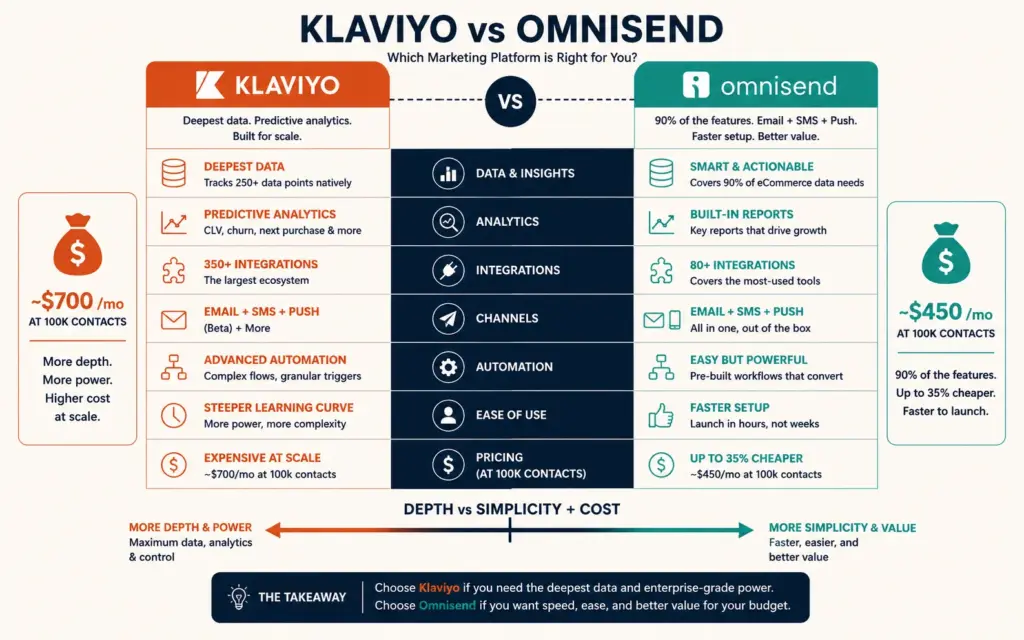
- Klaviyo is the category leader for ecommerce, with the deepest product, order, segmentation, and predictive data. Its behavioral segmentation and predictive analytics (customer lifetime value, churn risk, next-purchase timing) are materially better than alternatives. The honest downside: it gets expensive at scale (a 100k-contact list runs around $700/month) and the SMS add-on roughly doubles the bill.
- Omnisend is the strongest Klaviyo alternative and often the better choice for most Shopify and WooCommerce stores. It covers about 90% of what Klaviyo does for email and SMS, adds native web push, includes multichannel features from the free plan up, and runs up to 35% cheaper than Klaviyo at comparable contact tiers.
- The decision comes down to depth versus simplicity and cost. Klaviyo is more powerful and built for brands scaling with data; Omnisend is easier and lower-cost with faster setup. For free options: Shopify Email if you're on Shopify (10k emails/month free), MailerLite if you're not, or Omnisend's free tier which includes SMS.
Choosing among email marketing tools is one of the higher-stakes platform decisions an ecommerce store makes, because email is the highest-ROI channel most stores run. Industry benchmarks put email at driving 25 to 40% of total ecommerce revenue when done well, and automated flows generate the majority of that. The platform you choose either amplifies that revenue or quietly caps it, depending on how deeply it integrates with your store, how well it syncs your product and order data, and how capable its automation and segmentation are. This isn’t a decision to make casually, since switching platforms later means migrating your entire email operation: your lists, your carefully built automated flows, your templates, and your historical performance data. The switching cost is real, which is why it’s worth choosing thoughtfully now rather than defaulting to whatever’s easiest to set up today.
The good news is that the ecommerce email space has clear leaders and a sensible way to choose among them. The decision mostly comes down to depth and data versus simplicity and cost. This guide compares Klaviyo, Omnisend, and the top alternatives on features, pricing, and fit, and gives you a framework for matching a platform to your store’s stage and needs. The email marketing strategy guide covers what to send; this covers which tool to send it with. Getting the tool right matters because the best email strategy in the world is capped by a platform that can’t segment your customers or automate your flows the way you need.
What Makes an Email Tool Right for Ecommerce
General email tools (built for newsletters or B2B) aren’t the same as ecommerce email platforms. For a store, the features that matter are:
- Deep store integration: Native sync with Shopify or WooCommerce that automatically pulls contacts, products, orders, and browsing behavior. This data powers everything else.
- Behavioral segmentation: Segmenting customers by what they viewed, added to cart, purchased, and how much they’ve spent, so you send relevant messages to the right people.
- Pre-built ecommerce flows: Automated sequences for welcome, abandoned cart, browse abandonment, post-purchase, and win-back. These flows generate most email revenue.
- Revenue attribution: Tying email sends to actual sales, so you can see what each campaign and flow earns. As the saying goes, if you can’t tie email to revenue, you can’t optimize it.
According to Mailneo’s email tools analysis, automated emails generate roughly 320% more revenue per send than non-automated ones, which is why the quality of a platform’s automation and segmentation matters far more than its newsletter-sending features. The email automation flows guide covers building the sequences that drive this revenue, and your platform choice determines how capable those flows can be.
Klaviyo: The Ecommerce Category Leader
Klaviyo is the category leader for ecommerce email, and for good reason. Its segmentation engine handles behavioral data (viewed product, added to cart, purchased, predicted next purchase date) more naturally than anyone else, and its predictive analytics module (estimating customer lifetime value, churn risk, and next-purchase timing) is materially better than the loose equivalents elsewhere. Klaviyo integrates with 350+ apps and supports more ecommerce platforms via native apps than most competitors.
Klaviyo’s own benchmark data notes that segmented flows drive around 45% of ecommerce email revenue on its platform, reflecting how much its depth pays off for stores that use it fully. The honest downside is cost: it gets expensive at scale (a 100k-contact list runs around $700/month), and the SMS add-on roughly doubles the bill. Klaviyo is the best pick when your email revenue is already meaningful and you need the deepest product, order, segment, and predictive data, particularly for brands scaling with data as a core strategy. The predictive analytics capabilities Klaviyo offers connect directly to sharper targeting and higher email revenue for stores at scale.
Omnisend: The Strongest Alternative for Most Stores
Omnisend is the strongest Klaviyo alternative and, for most Shopify and WooCommerce stores, often the better overall choice. According to Omnisend’s own comparison, its plans run up to 35% less than Klaviyo’s at comparable contact tiers, with all multichannel features included from the free plan upward. It covers about 90% of what Klaviyo does for email and SMS, and adds native web push as a channel.
The tradeoff is depth: Klaviyo edges out on advanced analytics and deep data-science features, while Omnisend wins on ease of use and multichannel integration. For a Shopify or WooCommerce store that wants email plus SMS plus push in one platform without Klaviyo’s pricing, Omnisend is the cleaner fit. Its Shopify app (rated highly on the app store) automatically syncs historical data including contacts, products, and orders. The practical summary: Omnisend is easier and lower-cost with faster setup; Klaviyo is more powerful and built to scale. Most growing stores are well-served by Omnisend until their data needs justify Klaviyo’s depth and price. The SMS marketing capability built into Omnisend from the free tier is a genuine advantage for stores wanting email and SMS unified in one place rather than paying separately for a standalone SMS tool.
Comparing the Top Email Marketing Tools
| Tool | Best For | Note |
|---|---|---|
| Klaviyo | Scaling data-driven brands | Deepest data, expensive at scale |
| Omnisend | Most Shopify/WooCommerce stores | Up to 35% cheaper, email+SMS+push |
| Shopify Email | Shopify stores, free tier | 10k emails/month free |
| MailerLite | Non-Shopify, budget | 1k subscribers free |
| Drip | Ecommerce automation focus | Strong flows, mid-market |
| Brevo | Send-based pricing needs | Pay by sends, not contacts |
Beyond the two leaders, several tools fit specific needs. Shopify Email is the obvious free starting point if you’re on Shopify (10k emails/month free), enough to run basic campaigns before you outgrow it. MailerLite suits non-Shopify stores wanting a budget option (1k subscribers free). Drip focuses on ecommerce automation for mid-market brands. Brevo uses send-based pricing (you pay per email sent rather than per contact), which suits stores with large lists they email infrequently, since you’re not charged for storing contacts you rarely message. The ecommerce tools and tech stack should match your email tool to your platform, budget, and how sophisticated your automation needs are.
How to Choose the Right Email Tool for Your Store
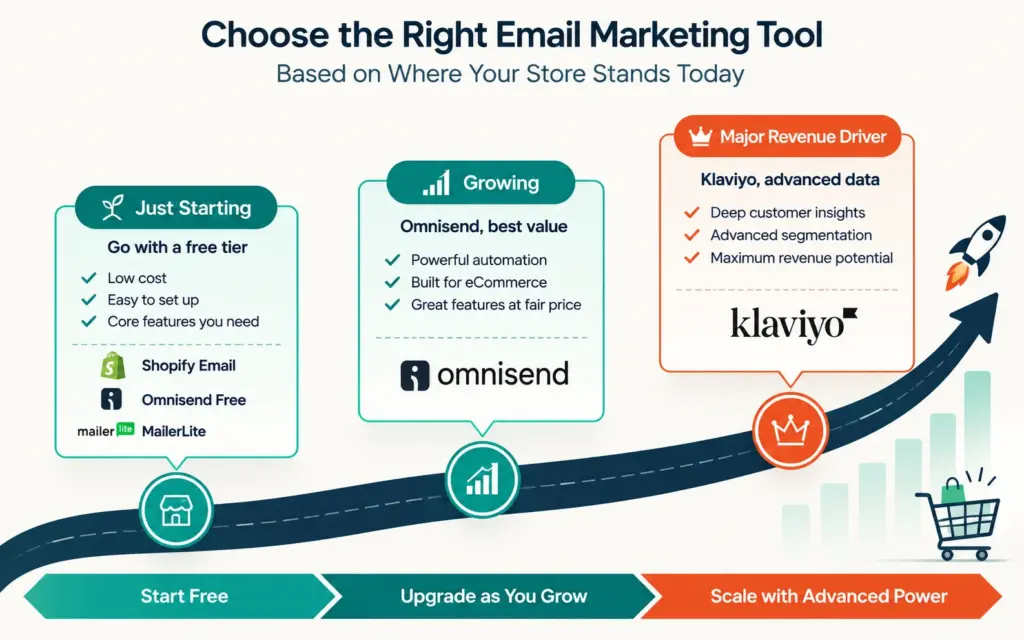
If you’re just starting: Begin with a free tier. Shopify Email (if on Shopify), Omnisend’s free plan (includes SMS), or MailerLite (if not on Shopify). This lets you build basic campaigns and flows at no cost while you learn what you need.
If you’re growing on Shopify or WooCommerce: Omnisend is usually the best value, giving you email, SMS, and push with strong ecommerce features at a lower cost than Klaviyo, with faster setup.
If email is already a major revenue driver and you need advanced data: Klaviyo’s depth in segmentation and predictive analytics justifies its higher cost. This is the tool for brands scaling with email as a core, data-driven strategy.
The key is matching the tool to your stage. Don’t pay for Klaviyo’s depth before you have the email revenue and data sophistication to use it, and don’t stay on a basic free tool once your email operation is generating meaningful revenue that a more capable platform could grow further. The ecommerce KPIs to watch include email revenue as a percentage of total revenue and revenue per email sent, which tell you whether your current tool is serving you or capping your growth. When you’re spending significant time working around your tool’s limitations, that’s the signal to upgrade. The ecommerce customer retention that email drives is one of the highest-return investments in ecommerce, making the right tool choice genuinely consequential.
Frequently Asked Questions
Klaviyo is the category leader with the deepest ecommerce data, segmentation, and predictive analytics, making it best for brands scaling with email as a core data-driven strategy. However, Omnisend is often the better choice for most Shopify and WooCommerce stores: it covers about 90% of Klaviyo’s email and SMS capabilities, adds web push, and runs up to 35% cheaper with faster setup. The right pick depends on your stage: Omnisend for most growing stores, Klaviyo when your email revenue and data needs justify its depth and cost.
Klaviyo is more powerful (deeper segmentation, better predictive analytics, more integrations) but more expensive, with a 100k-contact list around $700/month and SMS roughly doubling the bill. Omnisend is easier and lower-cost (up to 35% cheaper at comparable tiers), includes email, SMS, and web push from the free plan, and sets up faster. For most Shopify and WooCommerce stores, Omnisend is the better value. Choose Klaviyo when email is already a major revenue driver and you need its advanced data and segmentation depth.
It depends on your platform. If you’re on Shopify, Shopify Email gives you 10k emails/month free, enough for basic campaigns. Omnisend’s free tier is excellent because it includes SMS alongside email and full multichannel features. If you’re not on Shopify, MailerLite offers 1k subscribers free with strong ease of use. Klaviyo and Omnisend both have free plans matching around 250 contacts and 500 sends. Starting on a free tier lets you build campaigns and flows at no cost while learning what capabilities you actually need.
Industry benchmarks suggest email should drive 25 to 40% of total ecommerce revenue when done well. Most of that comes from automated flows (welcome, abandoned cart, post-purchase, win-back) rather than one-off campaigns, since automated emails generate roughly 320% more revenue per send than non-automated ones. If email is driving significantly less than 25% of your revenue, the opportunity is usually in building out your automated flows and improving segmentation, both of which depend on having a capable ecommerce email platform.
Yes, ideally. General email tools built for newsletters or B2B lack the ecommerce-specific features that drive store revenue: deep store integration that syncs products and orders, behavioral segmentation (by what customers viewed, carted, and bought), pre-built ecommerce flows (abandoned cart, post-purchase), and revenue attribution tying sends to sales. Ecommerce-native platforms like Klaviyo and Omnisend provide these, which is why they generate far more revenue for stores than generic email tools. The integration and automation depth is what makes the difference.
Upgrade when you’re consistently working around your current tool’s limitations or when email revenue justifies more capability. Signs to move up: you’ve outgrown a free tier’s send limits, you need segmentation or automation your tool can’t do, or you’re leaving revenue on the table because you can’t build the flows you want. Move from a basic free tool to Omnisend as you grow, and consider Klaviyo when email is a major revenue driver needing advanced data. Watch email revenue as a percentage of total revenue to gauge whether your tool is capping growth.
Related Reads
- Email Marketing Strategy
- Email Automation Flows
- SMS Marketing
- Ecommerce Tools and Tech Stack
- Ecommerce Customer Retention
- Predictive Analytics
Enjoying this? Get more like it every week.
One email per week with ecommerce strategies, tool picks, and seller insights. No spam.