

- The global subscription ecommerce market surpassed $390 billion in 2026, growing over 40% from 2024. Subscription customers spend 3 to 5x more over 12 months than one-time buyers. The strategic value isn't just recurring revenue. It's predictable revenue that enables better inventory planning, higher allowable CAC, and a customer base that competitors can't easily replicate.
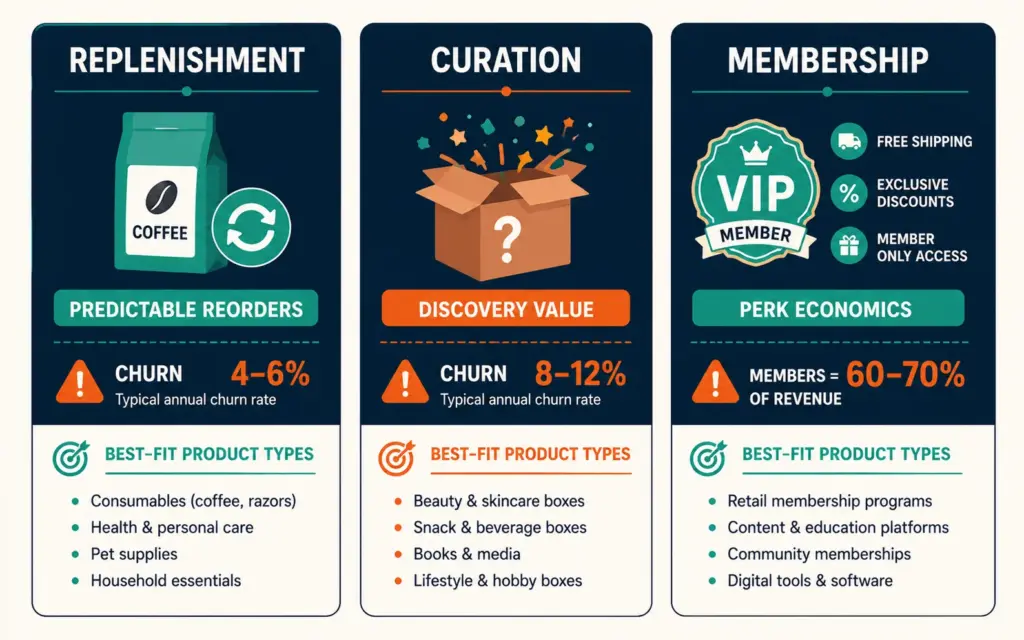
- Three subscription models dominate ecommerce: replenishment (auto-ship consumables like coffee, supplements, razors), curation (surprise discovery boxes like Birchbox, FabFitFun), and access/membership (pay for perks like free shipping, member pricing, exclusive products). Each has different economics, churn profiles, and operational requirements.
- Annual plans reduce churn by 40% versus monthly billing. Three-tier pricing (good/better/best) captures 60% more revenue per customer cohort than single-tier. These two pricing decisions alone determine whether a subscription program is marginally profitable or significantly so.
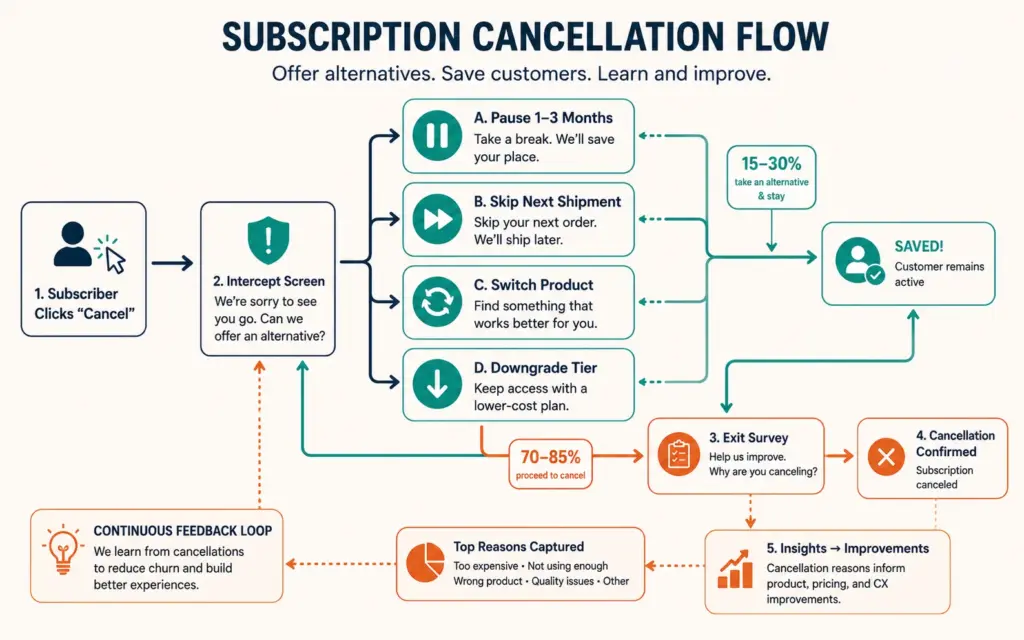
- Churn is the subscription killer. Average ecommerce subscription churn is 6 to 8% monthly, meaning you lose half your subscribers within 9 months without active retention. Smart cancellation flows that offer pause, skip, or downgrade alternatives save 15 to 30% of would-be cancellations.
Ecommerce subscription models transform one-time transactions into recurring revenue relationships. Instead of hoping a customer comes back, a subscription guarantees they do, automatically, every month or quarter. The shift from transactional to recurring changes every metric that matters: revenue becomes predictable, customer lifetime value multiplies 3 to 5x, inventory planning gets easier, and the allowable cost to acquire a customer increases because you know that customer will generate revenue for months or years, not just once.
The subscription economy hit $390 billion in 2026 according to Grand View Research data cited by Amra & Elma, growing over 40% from 2024. That growth isn’t slowing. But most subscription businesses fail not because the model doesn’t work. They fail because churn eats the base faster than acquisition replaces it. A program that acquires 100 subscribers per month but loses 80 to cancellation never scales. The model works. The retention engineering is what separates profitable subscriptions from expensive experiments.
Three Subscription Models and When Each One Fits Your Business
Replenishment Subscriptions for Products Customers Use Up and Reorder
Auto-ship of consumable products on a schedule: coffee every 2 weeks, vitamins every month, pet food every 6 weeks. The customer sets their cadence and the product arrives without reordering. Dollar Shave Club, Chewy’s Autoship, and Amazon Subscribe & Save built massive businesses on this model.
Replenishment works when your product is consumed regularly, the reorder cycle is predictable, and the customer benefits from not thinking about it. Coffee, skincare, supplements, cleaning supplies, and pet products are natural fits. Fashion, electronics, and home decor are not (consumption is irregular and preference-driven). The demand forecasting model for subscription products is simpler than for one-time products because active subscriber count times average order value gives you next month’s revenue within 5 to 10% accuracy.
Typical replenishment discount: 10 to 15% off one-time price. This discount is the subscriber’s incentive to commit. Your economics work because the guaranteed recurring order eliminates reacquisition cost. Acquiring a customer once for $30 who subscribes for 8 months at $25/month generates $200 in revenue versus $30 for a single purchase. The lifetime value calculation for subscription customers should be modeled separately from one-time buyers because the revenue curve is fundamentally different.
Curation Subscriptions for Discovery and Surprise-Driven Categories
Curated boxes of products selected by the brand, delivered monthly or quarterly. The customer doesn’t choose specific products. They subscribe for the experience of discovery: new flavors, new brands, new products they wouldn’t have found on their own. Birchbox (beauty samples), FabFitFun (lifestyle products), and Barkbox (dog toys and treats) defined this model.
Curation works when discovery is part of the value proposition and the category supports variety. Beauty, food and beverage, hobby supplies, and pet products have natural variety. Categories with narrow product ranges (you only need one yoga mat) don’t support curation well. Curation subscriptions carry higher churn than replenishment because the novelty eventually fades. After 6 to 12 boxes, subscribers start feeling like they have “enough” and cancel.
Mitigation: let subscribers customize partially. “Choose 2 of your 5 items” gives agency while preserving the discovery element. Full-surprise boxes churn 20 to 30% faster than partial-choice boxes because the customer occasionally receives items they don’t want, which accelerates the “this isn’t worth it” calculus.
Access and Membership Subscriptions for Premium Perks and Pricing
Customers pay an annual or monthly fee for benefits: free shipping on all orders, member-only pricing (10 to 15% below retail), exclusive product access, or priority support. Amazon Prime is the archetype. Costco and REI run variations. DTC brands like Thrive Market and Fabletics have built their entire business models around membership economics.
Membership works when the benefits deliver quantifiable value exceeding the fee. A $49/year membership that saves $120/year in shipping costs has an obvious value proposition. A $49/year membership that offers “exclusive community access” does not. According to DigitalApplied’s subscription commerce data, brands pairing membership with transactional ecommerce report that members account for 60 to 70% of total revenue despite being only 20 to 30% of total customers. The membership psychology (“I’m already paying, I should use it”) drives dramatically higher purchase frequency and AOV. The loyalty programs structure can be layered on top of a membership model for additional retention mechanics.
Subscription Pricing Strategy That Captures Maximum Revenue
Three-Tier Pricing Captures 60% More Revenue Than Single-Tier Plans
Offer good/better/best tiers. The entry tier captures price-sensitive subscribers. The premium tier captures enthusiasts willing to pay more. The middle tier (where most subscribers land) is anchored as “good value” relative to the premium option above it.
Example for a coffee subscription: Basic ($18/month, 12oz bag), Standard ($28/month, 12oz bag + samples + free shipping), Premium ($42/month, two 12oz bags + samples + free shipping + exclusive blends). Most subscribers choose Standard because it looks like a clear upgrade over Basic without the commitment of Premium. The Premium tier’s primary function is making Standard feel reasonable by comparison. This pricing psychology (anchoring) increases average revenue per subscriber 20 to 35%. The ecommerce pricing strategy guide covers anchoring and tier design in detail.
Annual Plans Reduce Churn by 40% Versus Monthly Billing
Offer a discount (15 to 20% off) for annual prepayment. A $28/month plan becomes $269/year ($22.40/month effective). The subscriber saves money. You collect revenue upfront and the annual commitment dramatically reduces cancellation because the sunk cost is already paid. Annual subscribers churn at 40% lower rates than monthly subscribers. Incentivize the annual plan aggressively: the upfront revenue and reduced churn more than compensate for the discount.
Managing Churn: The Factor That Makes or Breaks Subscription Revenue
Average ecommerce subscription churn is 6 to 8% monthly. That means 50% of subscribers cancel within 9 months. A subscription program that acquires 100 new subscribers per month but churns at 8% needs to acquire 8 new subscribers just to replace losses before any net growth occurs. Churn reduction has 5 to 10x more impact on subscriber count than acquisition volume.
Cancellation Flow Saves That Convert 15 to 30% of Would-Be Cancellations
When a subscriber clicks “Cancel,” don’t just cancel. Present alternatives: pause for 1 to 3 months, skip the next shipment, switch to a different product or tier, or downgrade to a smaller plan. 15 to 30% of subscribers who intend to cancel will accept an alternative if offered. A subscriber who pauses for 2 months is infinitely more valuable than one who cancels permanently.
The cancellation flow should also ask why they’re leaving (survey with predefined options: too expensive, too much product, quality concerns, found alternative). This data reveals which churn drivers to fix. If 40% of cancellations cite “too much product,” adding a skip or reduced-frequency option addresses the root cause. The email marketing strategy should include a win-back sequence for cancelled subscribers at 30, 60, and 90 days post-cancellation with a re-subscribe incentive.
Proactive Retention Outreach Before the Subscriber Decides to Leave
Don’t wait for the cancellation click. Identify at-risk subscribers through engagement signals: haven’t opened the last 3 emails, haven’t visited the site in 60 days, or skipped 2 consecutive shipments. Reach out proactively: “We noticed you haven’t checked in. Here’s a surprise bonus in your next box” or “Want to adjust your subscription? You can change products, frequency, or tier anytime.” The predictive analytics tools in Klaviyo flag churn risk scores that automate this identification.
Subscription Platform and Tool Selection for Shopify and WooCommerce
| Tool | Platform | Best For | Cost |
|---|---|---|---|
| Recharge | Shopify | Market leader, deepest feature set | $99+/month |
| Appstle | Shopify | Budget alternative, simpler setup | Free to $10+/month |
| Bold Subscriptions | Shopify | Prepaid and gift subscriptions | $49.99+/month |
| YITH Subscriptions | WooCommerce | WooCommerce-native recurring billing | $199/year |
| WooCommerce Subscriptions | WooCommerce | Official WooCommerce extension | $199/year |
Start with Appstle (free tier) if you’re testing subscription viability. Upgrade to Recharge when subscriber count exceeds 500 and you need advanced features: smart cancellation flows, analytics dashboards, and custom subscription widgets. The ecommerce tools and tech stack should evaluate subscription tools alongside email and loyalty platforms since these three systems work together for retention.
The 90-Day Subscription Launch Plan for Existing Ecommerce Stores
- Weeks 1 to 2: Model the economics. Calculate subscriber LTV at different churn rates, price points, and discount levels. Verify that the subscription price covers COGS + shipping + platform fees + acquisition cost and leaves margin. Use the profit margin calculator for per-unit margin at subscription pricing.
- Weeks 3 to 4: Build the subscription offer. Install your subscription app. Create 2 to 3 tiers. Set up the product page subscription widget (“Subscribe & Save 15%”). Configure the cancellation flow with pause/skip/downgrade alternatives.
- Weeks 5 to 8: Soft launch to existing customers. Email your customer list with the subscription offer. Target repeat purchasers first (they already buy regularly, converting to auto-ship is the smallest behavioral shift). The segmentation approach should identify 2x+ purchasers as the primary subscription launch audience.
- Weeks 9 to 12: Measure and optimize. Track: subscriber acquisition rate, churn rate by tier, average subscriber lifetime, revenue per subscriber, and cancellation reasons. Adjust pricing, frequency options, or product mix based on data. Don’t scale acquisition spend until churn is under 8% monthly.
Frequently Asked Questions
Consumables with predictable reorder cycles: coffee, supplements, skincare, pet food, cleaning supplies, and personal care. These fit the replenishment model naturally. Categories with variety (beauty, food, hobbies) fit curation boxes. High-frequency purchase categories with loyal customer bases (fitness, wellness) fit membership models. Products that are durable, infrequently purchased, or highly preference-dependent (furniture, electronics, fashion) are poor subscription fits.
For existing ecommerce stores adding subscriptions: $0 to $99/month for the subscription platform (Appstle free tier to Recharge $99+). No additional store build cost since subscriptions layer onto your existing product pages and checkout. For new subscription-first businesses: standard ecommerce setup costs ($500 to $5,000) plus subscription platform fees plus first-batch inventory for subscriber fulfillment.
Average monthly churn is 6 to 8% for ecommerce subscriptions. Below 5% monthly is excellent. Above 10% means the subscription isn’t delivering enough value to justify the recurring commitment. Replenishment subscriptions churn lower (4 to 6%) because the product is a genuine need. Curation boxes churn higher (8 to 12%) because novelty fades. Annual prepaid plans churn 40% less than monthly plans across all models.
Five tactics ranked by impact: offer pause/skip/downgrade alternatives in the cancellation flow (saves 15 to 30% of cancellations), incentivize annual prepayment (40% lower churn), proactively reach out to at-risk subscribers before they cancel, let subscribers customize their box or switch products, and continuously improve product quality based on cancellation survey data. Churn reduction has 5 to 10x more impact on growth than acquisition volume.
Yes, 10 to 15% off the one-time price is standard for replenishment subscriptions. The discount incentivizes the commitment. Your economics still work because the guaranteed recurring order eliminates reacquisition cost and enables better inventory planning. For membership models, the discount is built into member pricing (10 to 15% below retail). For curation, the discount is implicit in the per-item value versus buying each item individually.
Start with Appstle (free tier) to test subscription viability with minimal cost. Upgrade to Recharge ($99+/month) when subscriber count exceeds 500 and you need smart cancellation flows, advanced analytics, and custom subscription widgets. Bold Subscriptions ($49.99+/month) is strong for prepaid and gift subscription use cases. For WooCommerce, the official WooCommerce Subscriptions extension ($199/year) handles most recurring billing needs.
Related Reads
- Loyalty Programs
- Lifetime Value Calculation
- Email Marketing Strategy
- Demand Forecasting
- Segmentation
- Predictive Analytics
Enjoying this? Get more like it every week.
One email per week with ecommerce strategies, tool picks, and seller insights. No spam.