
- Wholesale suppliers buy from manufacturers in bulk and sell to retailers at 40-60% of retail price. Your margin lives in that gap.
- The US wholesale industry generates roughly $9.7 trillion in annual goods sales (Shopify). Finding the right supplier can mean a 10-25% difference in your margins.
- Start with online directories (Alibaba, Faire, Wholesale Central, Thomasnet), then graduate to trade shows and direct manufacturer relationships as you scale.
- The biggest red flag: any "wholesale supplier" that sells to the general public at "wholesale prices" isn't a real wholesaler. Legitimate wholesalers require a resale certificate and sell only to businesses.
Finding a good wholesale supplier is the part of ecommerce that feels most like a treasure hunt. There’s no single directory where all the great suppliers live. The best ones don’t advertise on Google. And the ones that DO advertise aggressively are often the ones you should avoid.
A wholesale supplier is a company that purchases products in bulk from manufacturers and sells them to retailers at a markup, typically 40-60% of the final retail price. The US wholesale industry generates roughly $9.7 trillion in annual goods sales. As a retailer, your profit comes from the gap between the wholesale price you pay and the retail price your customers pay. Finding the right supplier can mean a 10-25% difference in your margins, which over thousands of orders is the difference between a profitable business and a break-even one.
If you’re building your ecommerce business, supplier sourcing isn’t something you figure out once and forget. It’s an ongoing relationship you refine as you grow. Here’s how to find suppliers at every stage.
Where to Find Wholesale Suppliers
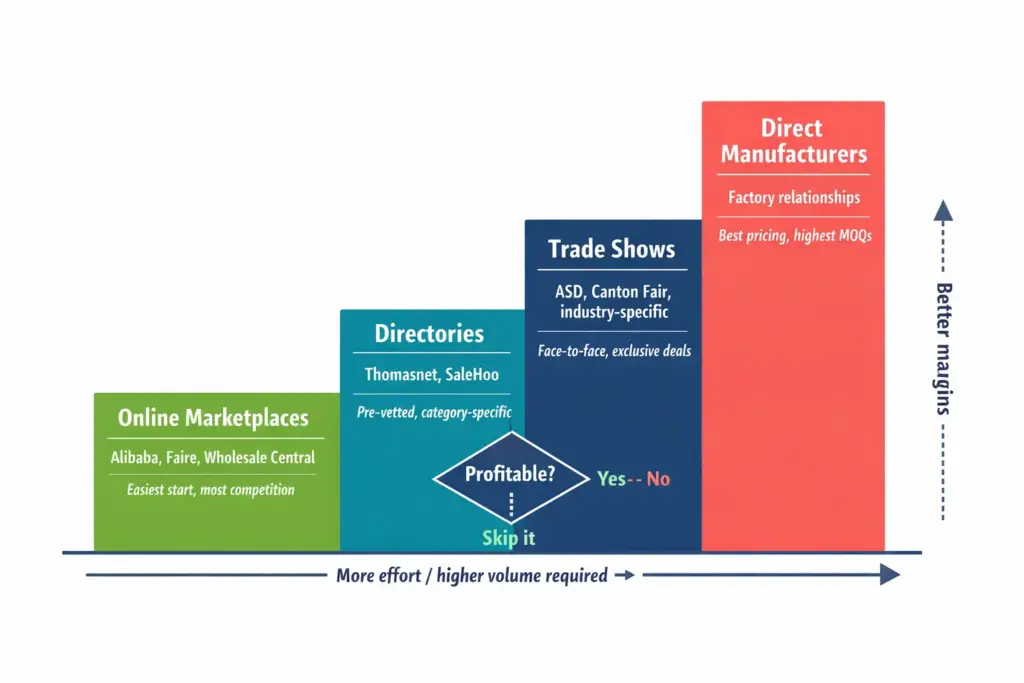
I’m going to organize this from most accessible (beginner-friendly, lower MOQs) to most profitable (requires relationships and volume). Most sellers work their way up this ladder over time.
Online Wholesale Marketplaces
These platforms aggregate thousands of suppliers in one place. They’re the fastest way to start sourcing, but they also have the most competition since every other seller is browsing the same catalogs.
Alibaba. The world’s largest B2B marketplace with millions of suppliers, mostly based in China. Best for private label and custom manufacturing, but many suppliers also offer wholesale on existing products. Filter by “Trade Assurance” and “Verified Supplier” to reduce risk. MOQs vary wildly, from 50 units to 5,000+. Expect 2-6 weeks shipping from China. Our Alibaba sourcing guide covers the platform in detail.
Faire. A curated wholesale marketplace focused on independent brands and small-batch products. Extremely popular with boutique owners and small online stores. Faire offers net-60 payment terms and free returns on first orders, which dramatically lowers risk. MOQs are usually low (6-24 units). Products tend to be higher quality with higher per-unit costs. Best for unique, brandable inventory you won’t find on Amazon.
Wholesale Central. A US-based directory recommended by Forbes that connects buyers with wholesale suppliers. Strictly B2B. Good for general merchandise, closeouts, and liquidation deals. Free to browse but you’ll need to contact suppliers directly for pricing.
Handshake (by Shopify). Shopify’s wholesale marketplace connecting brands with retailers. Integration with Shopify stores makes ordering seamless. Focuses on unique, brand-name products from smaller manufacturers.
Wholesale Directories
Directories list verified suppliers organized by category. They’re more curated than open marketplaces, which means fewer options but generally higher quality.
Thomasnet. The go-to directory for US and North American manufacturers and suppliers. Over 500,000 suppliers across every industrial category. Best for sourcing domestic products where “Made in USA” adds brand value or where you need faster shipping.
SaleHoo. A paid directory ($67/year or $127 lifetime) with 8,000+ vetted suppliers. Includes market research tools that show trending products and supplier reliability scores. Good starting point for beginners who want pre-vetted options.
Worldwide Brands. One of the oldest wholesale directories, operating since 1999. One-time fee ($187) for lifetime access. All suppliers are verified with real physical addresses and documented supply chains. Smaller than Alibaba but significantly more trustworthy per listing.
Trade Shows
Trade shows are where serious supplier relationships get built. You can evaluate product quality in person, negotiate face-to-face, and discover suppliers who don’t list online at all.
ASD Market Week (Las Vegas). The largest retail trade show in the US. Over 1,800 exhibitors across general merchandise, beauty, fashion, and more. Held twice a year. This is where many six and seven-figure Amazon sellers source their inventory.
Canton Fair (Guangzhou, China). The world’s largest trade fair by attendance. Over 25,000 exhibitors across every product category imaginable. Held twice yearly (April and October). If you’re sourcing from China and can travel, Canton Fair is worth the trip.
Industry-specific shows. Every niche has its own trade shows. Natural Products Expo for health and wellness. MAGIC for fashion. Toy Fair for toys and games. These smaller shows attract specialized suppliers you won’t find on Alibaba.
Direct Manufacturer Relationships
The best pricing comes from cutting out the middleman entirely and buying from manufacturers. This typically requires higher order volumes (1,000+ units) and a track record as a reliable buyer.
How to find them: Google “[product category] manufacturer” plus the country. Check product packaging for manufacturer names. Ask existing wholesalers who manufactures their products. Browse Thomasnet for domestic manufacturers. Attend trade shows where manufacturers exhibit directly.
Direct relationships take longer to build but offer the best margins, the most customization options, and the strongest competitive moat. Your competitors buying from the same Alibaba listing can’t match pricing you negotiated directly with the factory.
How to Contact Wholesale Suppliers (What to Actually Say)
This is where most new sellers freeze. They find a supplier, stare at the “Contact” button, and have no idea what to write. Here’s what works:
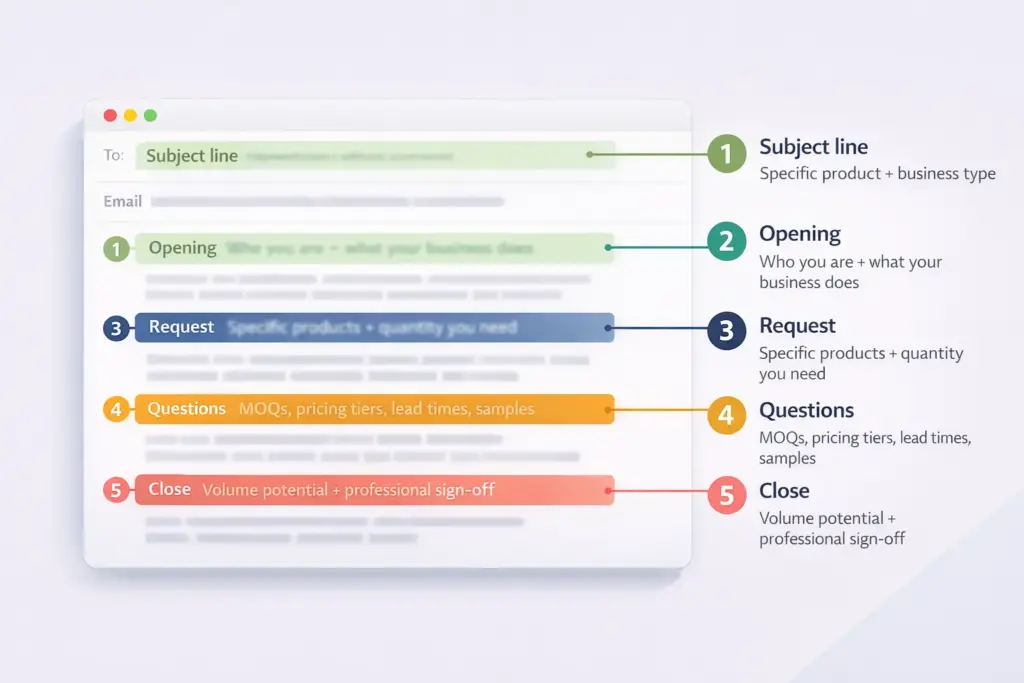
Lead with who you are and what your business does. “I run [store name], an online retail store specializing in [niche]. We sell through [platform] and are looking to expand our product line.” This establishes credibility immediately.
Be specific about what you want. “I’m interested in your [specific product or category]. Could you share your wholesale pricing, MOQs, and shipping options for [target quantity]?” Vague emails (“What products do you have?”) get ignored or deprioritized.
Ask the right questions upfront. Minimum order quantities. Payment terms (net-30, net-60, prepay). Lead times from order to delivery. Sample availability and cost. Return/defect policy. Whether they dropship or require bulk orders.
Mention your sales volume or potential. Suppliers prioritize buyers who represent real revenue. Even if you’re small, frame it forward: “We’re currently doing [volume] per month and looking to scale to [goal] within 6 months.” Honesty matters, but so does ambition.
Follow up. Suppliers get hundreds of inquiries. If you don’t hear back in 3-5 business days, send a polite follow-up. Many good supplier relationships started with the second or third email, not the first.
How to Vet a Wholesale Supplier
Not every supplier listing is what it claims. Use this checklist before committing money:
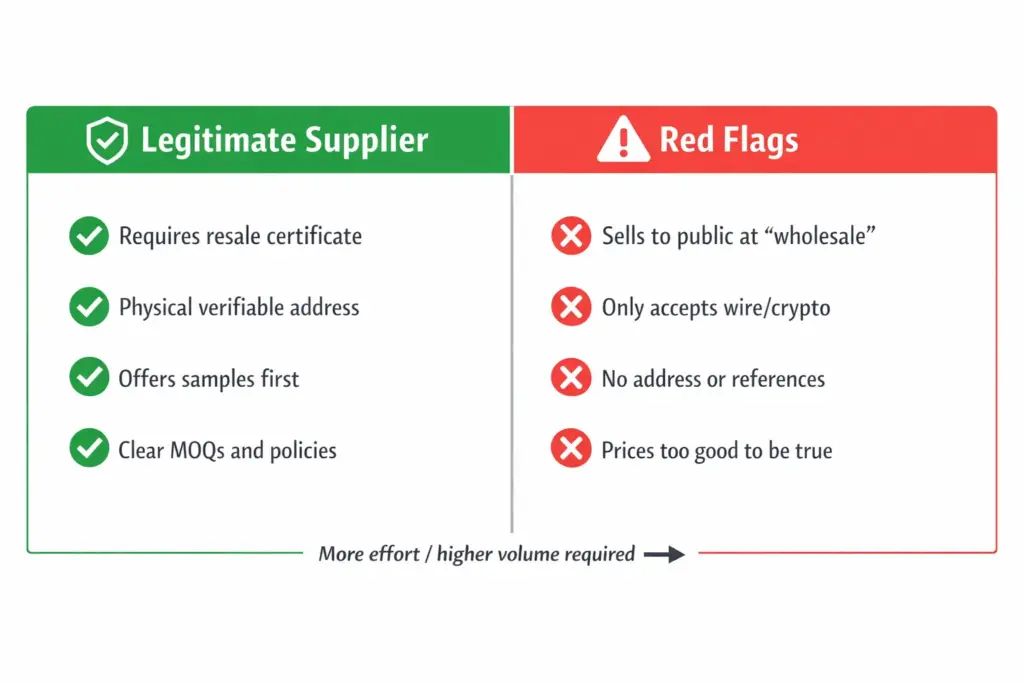
Green flags (legitimate supplier):
- Requires a resale certificate, business license, or EIN to open an account
- Has a physical business address (verify on Google Maps)
- Provides references from other retailers on request
- Offers product samples before bulk orders
- Has clear MOQs, lead times, and return policies in writing
- Appears in industry directories or trade show exhibitor lists
Red flags (avoid):
- Sells to the general public at “wholesale prices” (real wholesalers sell only to businesses)
- Charges a monthly membership fee to access their product catalog
- Only accepts Western Union, cryptocurrency, or wire transfers (no credit card or PayPal)
- No physical address or only a PO box
- Prices dramatically below every other supplier for the same products
- Refuses to provide samples or references
- No verifiable online presence, reviews, or business history
When in doubt, order a small quantity first. A $200 test order that reveals problems is infinitely cheaper than a $5,000 order you can’t return.
Do You Need a Wholesale License?
This confuses a lot of new sellers. There’s no universal “wholesale license.” What most suppliers require is a resale certificate (also called a seller’s permit or sales tax permit), which you get from your state’s department of revenue. It proves you’re a legitimate retailer who will collect sales tax from end customers, so the supplier doesn’t charge you sales tax on their wholesale prices.
Getting one is usually free or under $50 and takes minutes to apply online. Some states issue them instantly. You’ll need your EIN and basic business information. Our legal setup guide walks through the process state by state.
Some suppliers also ask for a business license or articles of organization (if you’re an LLC). Having these ready before you start contacting suppliers makes the whole process smoother and signals you’re a serious buyer.
Wholesale Pricing: How It Actually Works
Wholesale pricing typically follows a tiered structure. The more you order, the less you pay per unit. A simplified example:
| Order Quantity | Price Per Unit | Your Retail Price | Margin |
|---|---|---|---|
| 50-99 units | $8.00 | $19.99 | 60% |
| 100-499 units | $6.50 | $19.99 | 67% |
| 500-999 units | $5.00 | $19.99 | 75% |
| 1,000+ units | $4.00 | $19.99 | 80% |
That margin difference between 50 units and 1,000 units is the reason scaling matters in wholesale. But don’t over-order to chase better per-unit pricing. 500 units at a higher per-unit cost is better than 2,000 units gathering dust in a warehouse. Start with the minimum viable order, prove demand, then scale up to the next tier.
Payment terms also matter. Net-30 or net-60 terms (you pay 30 or 60 days after receiving goods) are common with established suppliers. This means you can potentially sell inventory before you’ve even paid for it. But these terms are earned, not given. Most suppliers require prepayment for first orders and extend terms after you’ve built trust through consistent reorders.
Frequently Asked Questions
How do I find legitimate wholesale suppliers?
Start with established directories (Thomasnet, SaleHoo, Worldwide Brands) and curated marketplaces (Faire, Wholesale Central). Verify suppliers have physical addresses, require business credentials, and can provide references. Attend trade shows for face-to-face vetting.
Do I need a license to buy wholesale?
Most suppliers require a resale certificate (sales tax permit) from your state. This is free or under $50 and proves you’re a legitimate retailer. Some also ask for a business license or EIN. No universal “wholesale license” exists.
What is the typical wholesale markup?
Wholesale prices are typically 40-60% of retail price. Retailers generally aim for a 50% markup (keystone pricing) at minimum, though many categories support 2-3x markup depending on the product and channel.
Can I buy wholesale with a small budget?
Yes. Faire offers net-60 terms with low MOQs (6-24 units). Some Alibaba suppliers accept orders of 50-100 units. Wholesale Central lists closeout and liquidation deals at low minimums. Start small, prove demand, then scale up to bigger orders with better pricing tiers.
What’s the difference between wholesale and dropshipping?
With wholesale, you buy inventory upfront in bulk at discounted prices, store it, and ship it yourself (or via FBA). With dropshipping, you never hold inventory; the supplier ships directly to your customer. Wholesale gives better margins (30-60%) but requires capital. Dropshipping has lower margins (10-30%) but zero inventory risk.
Related reads: Complete Guide to Starting an Ecommerce Business | Private Label Products Guide | Alibaba Sourcing Guide | How to Start Dropshipping | Products to Resell for Profit | Legal Setup (LLC, Taxes, Licenses) | Ecommerce Business Models
Enjoying this? Get more like it every week.
One email per week with ecommerce strategies, tool picks, and seller insights. No spam.