
- Reselling is one of the lowest-barrier entry points into ecommerce. You can start with $50-$200 sourcing items from thrift stores, clearance racks, or online liquidation sales.
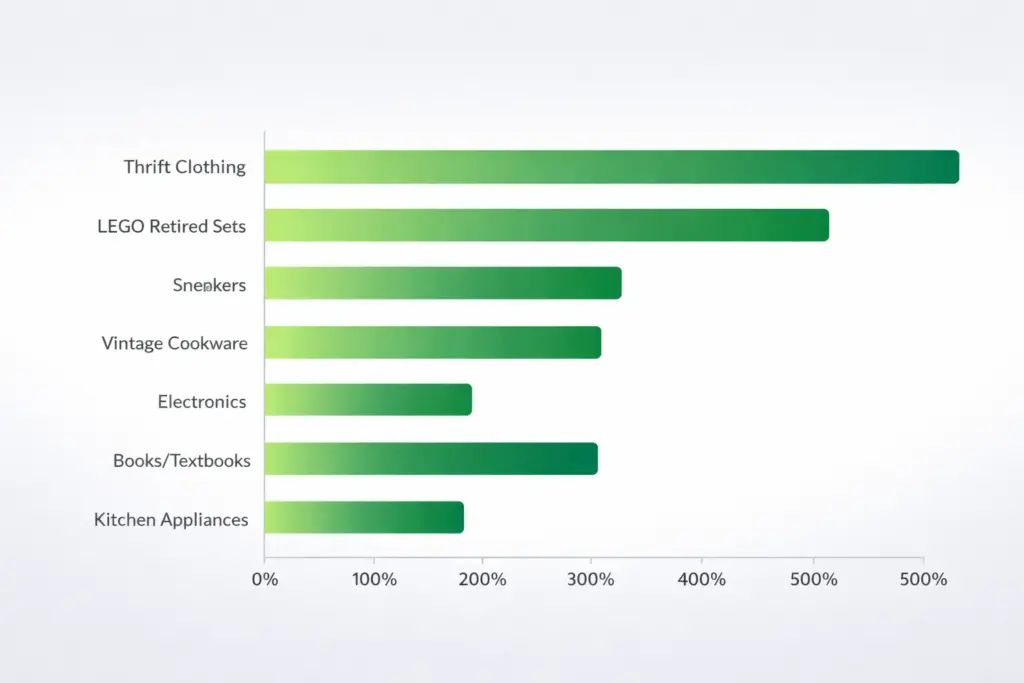
- The most profitable resale categories are sneakers, electronics, vintage clothing, LEGO sets, and designer accessories - all with margins of 50-300%+.
- Your reselling method (retail arbitrage, online arbitrage, thrift flipping, or wholesale) determines what you sell, where you source, and how you scale.
- eBay, Amazon, Poshmark, Mercari, and Facebook Marketplace each favor different product types. Selling on the wrong platform for your category kills your margins.
Reselling is how I’d tell anyone to start in ecommerce if they have more time than money. You don’t need a manufacturer. You don’t need a brand. You don’t need a website. You find something undervalued, buy it, and sell it to someone who wants it more than the person who had it. That’s the entire business.
Reselling is the practice of buying products at below-market prices and selling them at retail or near-retail value through online marketplaces, your own store, or in person. It includes retail arbitrage (buying clearance items from stores), online arbitrage (finding price gaps between websites), thrift flipping (buying used goods cheaply and reselling), and wholesale reselling (buying in bulk at wholesale prices). The US resale market alone is projected to reach $73 billion by 2028 (ThredUp Resale Report), driven by both consumer demand for deals and sustainability-minded shoppers.
The mistake most new resellers make is asking “what should I resell?” before asking “how am I going to resell?” The method comes first. The products follow. If you’re evaluating different ecommerce business models, reselling sits at the intersection of low startup cost and fast time-to-revenue, making it an ideal stepping stone before scaling into private label or your own ecommerce brand.
The Four Reselling Methods (Pick One First)
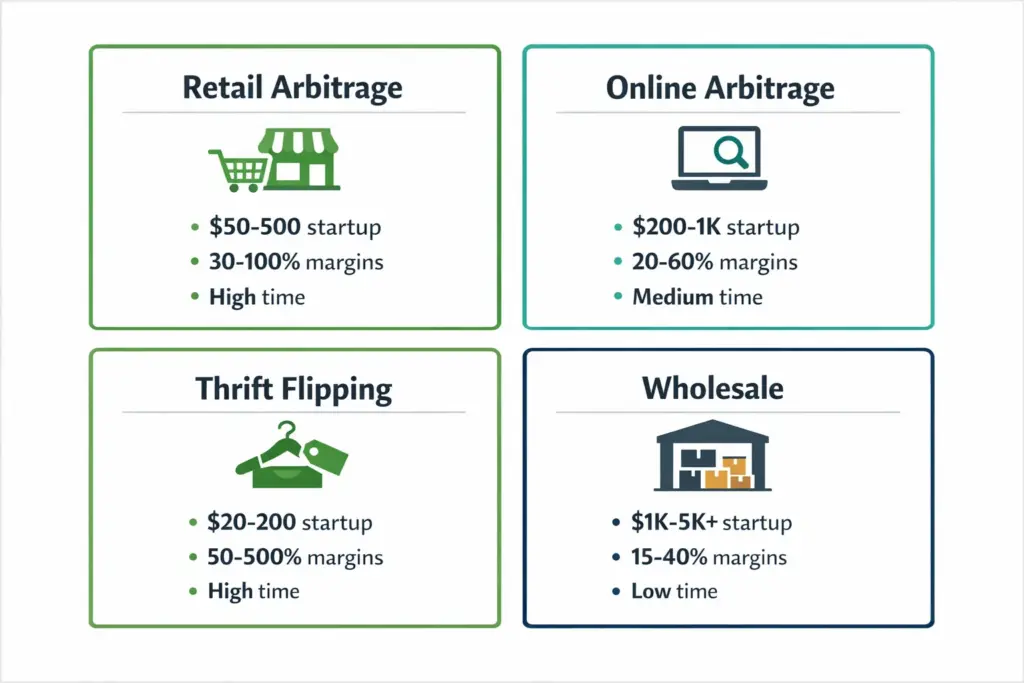
Retail arbitrage. Walk into Target, Walmart, or HomeGoods. Find clearance items priced below what they sell for on Amazon or eBay. Buy them. List them. The Amazon Seller app lets you scan barcodes in-store to see the current Amazon price and estimated fees instantly. Startup cost: $50-$500. Margins: 30-100%. Time-intensive but fast to learn.
Online arbitrage. Same concept, but you source from websites instead of physical stores. Find deals on Walmart.com, Target.com, discount sites, and liquidation platforms, then resell on Amazon or eBay. Tools like Tactical Arbitrage and Keepa automate the price comparison process. Startup cost: $200-$1,000. Margins: 20-60%. More scalable because you’re not limited by driving distance.
Thrift flipping. Buy used goods from thrift stores, garage sales, estate sales, and Facebook Marketplace “free” listings. Clean, photograph, and resell. Clothing, vintage items, electronics, books, and furniture are the bread and butter. Startup cost: $20-$200. Margins: 50-500%+. Highest margins but least predictable inventory.
Wholesale reselling. Buy new products in bulk from distributors at wholesale prices and resell at retail. More capital-intensive but more predictable and scalable than arbitrage. Startup cost: $1,000-$5,000+. Margins: 15-40%. Best for sellers ready to move past one-off sourcing. See our wholesale suppliers guide for details.
Best Products to Resell by Category
These categories consistently deliver the strongest margins and sell-through rates across platforms, based on eBay sold listing data, Amazon BSR trends, and cross-platform reseller reporting.
Sneakers and Streetwear
Limited-release sneakers remain one of the most profitable resale categories. A pair of Nike Dunks or Jordan 1s bought at retail ($110-$180) can resell for $250-$500+ depending on the colorway and availability. The authentication infrastructure (StockX, GOAT, eBay’s Authenticity Guarantee) has made this market more trustworthy for buyers, driving even more demand.
The catch: you need to know the market. Not every release is profitable. But if you can consistently hit on 2-3 releases per month, the ROI is hard to beat.
Source: Retail drops (Nike SNKRS, Foot Locker), local consignment, FB groups. Sell: StockX, GOAT, eBay.
Electronics and Tech
Used and refurbished electronics move fast. Smartphones, tablets, laptops, gaming consoles, and even “vintage” tech like digital cameras (the analog aesthetic trend pushed used Canon PowerShots from $20 to $150+). New electronics from clearance and liquidation sales also work well. A Bluetooth speaker bought on clearance for $15 that sells for $35-45 on Amazon is a bread-and-butter retail arbitrage play.
Source: Facebook Marketplace, liquidation pallets, retail clearance. Sell: eBay, Amazon, Swappa (phones).
Clothing and Fashion
Vintage band tees ($2-5 at thrift stores, sell for $30-80), designer pieces, and Y2K/90s fashion are the sweet spots. Lululemon, Nike, Patagonia, and North Face are consistently fast sellers in the secondhand market. Branded athleisure has some of the highest sell-through rates on Poshmark and Mercari because buyers know exactly what they’re getting.
Source: Thrift stores, estate sales, garage sales. Sell: Poshmark, Depop, Mercari, eBay.
Books and Textbooks
Don’t overlook books. College textbooks, niche non-fiction, and out-of-print titles carry surprisingly high resale value. A textbook bought for $1 at a library sale that sells for $30-60 on Amazon FBA is standard for experienced book resellers. The Amazon Seller app makes scanning fast: walk through a book sale, scan barcodes, and only buy what shows profit.
Source: Library sales, thrift stores, estate sales. Sell: Amazon FBA (best for books), eBay.
LEGO Sets
Retired LEGO sets appreciate in value like few other consumer products. Sets that sold for $50-100 retail can command $200-500+ once discontinued. Even opened sets with complete pieces sell well. The LEGO resale market has its own ecosystem of price guides and collector communities.
Source: Retail clearance, garage sales, Facebook Marketplace, BrickLink. Sell: eBay, BrickLink, Amazon.
Home Goods and Kitchen Appliances
Brand-name kitchen appliances (Vitamix, KitchenAid, Ninja, Breville, Nespresso) resell extremely well, especially from estate sales. A KitchenAid mixer bought for $50 at a garage sale resells for $150-250. Cast iron cookware, especially vintage Griswold and Wagner, has a dedicated collector market where a $4 thrift store find can sell for $100-200.
Source: Estate sales, Facebook Marketplace, thrift stores. Sell: eBay, Facebook Marketplace (bulky items), Amazon.
Toys, Games, and Collectibles
Discontinued toys, sealed board games, vintage action figures, and trading cards (Pokemon, Magic: The Gathering, sports cards) have dedicated buyer communities willing to pay serious premiums. The collectibles market thrives on scarcity and nostalgia.
Source: Thrift stores, garage sales, retail clearance (after holidays), storage unit auctions. Sell: eBay, Mercari, TCGplayer (trading cards).
Where to Sell (Platform Matching)
Selling on the wrong platform for your product category is one of the fastest ways to kill momentum.
| Platform | Best For | Fees | Key Advantage |
|---|---|---|---|
| eBay | Electronics, collectibles, vintage, tools | ~13% total | Auction format for rare items, global reach |
| Amazon FBA | New/like-new products, books, wholesale | ~30-40% | Prime badge, massive traffic |
| Poshmark | Women’s fashion, designer, shoes | 20% flat | Social selling, engaged buyers |
| Mercari | General merchandise, electronics, toys | 10% | Simple listing, broad categories |
| Depop | Vintage, streetwear, Y2K fashion | 10% flat | Gen Z audience, trend-driven |
| Facebook Marketplace | Furniture, bulky items, local sales | 0% local / 5% shipped | Zero fees on local pickup |
| StockX / GOAT | Sneakers, streetwear, luxury | 8-10% | Built-in authentication |
Pro move: Cross-list on multiple platforms simultaneously. The same jacket listed on Poshmark, Mercari, and eBay reaches 3x the audience. Tools like Vendoo and Crosslister automate this.
How to Source Inventory
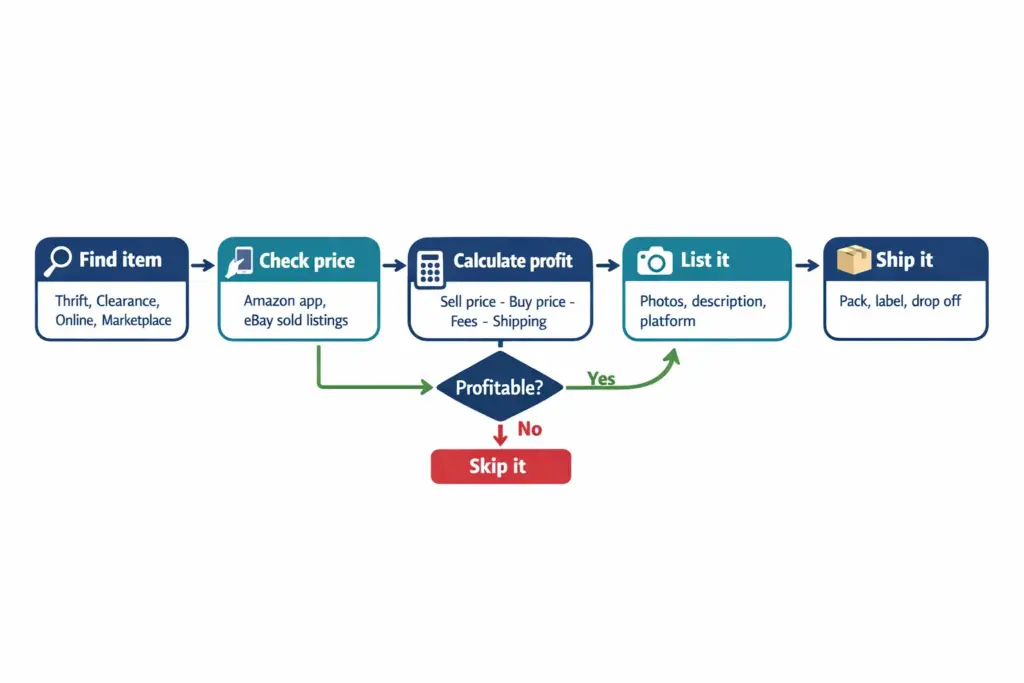
Thrift stores and garage sales. Visit regularly (inventory changes daily). Use the Amazon Seller app and eBay’s “sold listings” filter to check prices before buying. If it sold on eBay recently for $30+ and you can buy it for $5, that’s a buy.
Retail clearance. Target, Walmart, CVS, and HomeGoods markdown items aggressively when clearing seasonal or discontinued products. Use the Amazon Seller app’s barcode scanner to check profitability in real-time. Endcaps and clearance aisles are where the money is.
Online liquidation. Sites like Liquidation.com, BULQ, and Direct Liquidation sell returned and overstock merchandise in bulk lots. Buy a pallet for $200-500 that contains $800-1,500+ in resale value. The risk: you don’t always know exact condition until it arrives.
Facebook Marketplace and Craigslist. People moving, downsizing, or cleaning storage list items at rock-bottom prices (or free). Set alerts for keywords in your categories and respond quickly.
Reselling to Real Business: The Transition
Reselling is a great starting point. It’s not a great forever strategy for most people. You’re always hunting for the next deal. There’s no brand equity. No recurring customers. No asset you can sell.
The smart resellers use the model to fund their next move. Reselling profits fund a private label product launch. Reselling data reveals which categories have the strongest demand. And reselling teaches you platform algorithms, customer service, and shipping logistics before you have higher-stakes inventory.
Think of reselling as ecommerce graduate school. You learn every skill you’ll need for a bigger business, and you get paid while doing it.
Frequently Asked Questions
Is reselling legal?
Yes. The first-sale doctrine in the US gives you the right to resell any product you’ve legally purchased. You cannot sell counterfeit goods or misrepresent condition.
How much money do I need to start reselling?
As little as $20-50 for thrift flipping. Retail arbitrage typically needs $100-500. Wholesale requires $1,000-5,000+.
What are the most profitable items to resell?
Limited sneakers (40-200% margins), vintage cast iron (50-500%), retired LEGO sets (100-400%), and designer fashion (50-200%) deliver the highest margins consistently.
Where is the best place to resell items?
eBay for electronics and collectibles. Poshmark and Depop for fashion. Amazon FBA for new products and books. Facebook Marketplace for furniture and local sales.
Can you make a full-time income reselling?
Yes. Full-time resellers typically specialize in 2-3 categories and list 50-100+ items per week. Experienced resellers commonly report $3,000-$10,000+/month in revenue.
Related reads: Complete Guide to Starting an Ecommerce Business | Profitable Ecommerce Niches | How to Find Wholesale Suppliers | Private Label Products Guide | How to Sell Things Online | eBay Selling Tips
Enjoying this? Get more like it every week.
One email per week with ecommerce strategies, tool picks, and seller insights. No spam.