
- Most ecommerce businesses fail not because of bad execution but because of bad niche selection. Picking a niche is the highest-stakes decision you'll make, yet most sellers spend more time choosing a theme than validating whether anyone will buy their products.
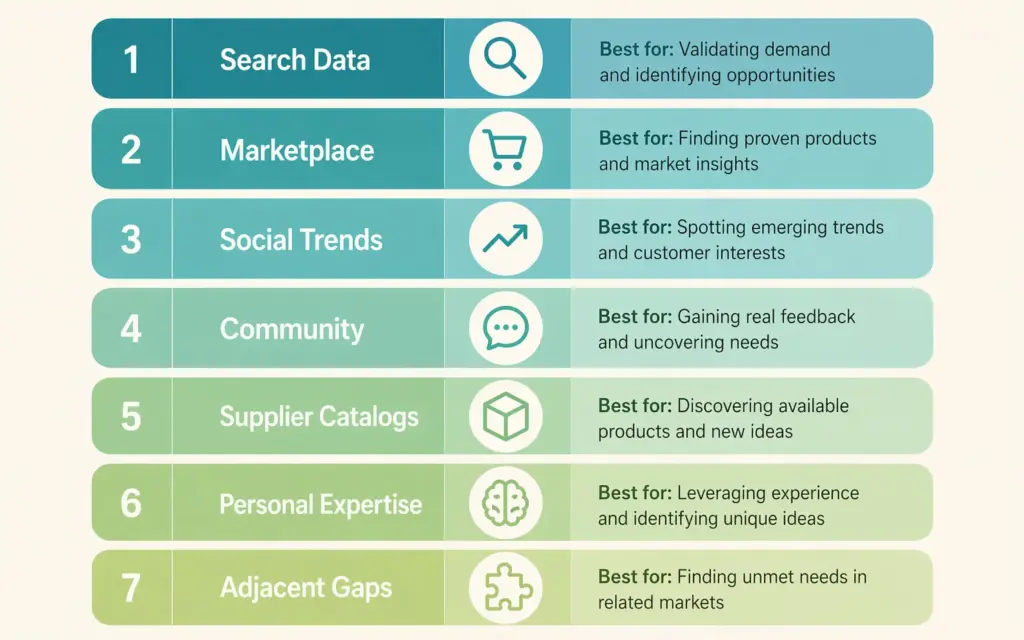
- The 7 methods below use free tools to find niches with proven demand, manageable competition, healthy margins, and long-term viability. Each method approaches the problem from a different angle: search data, marketplace data, social trends, community pain points, supplier catalogs, personal expertise, and adjacent market gaps.
- A good ecommerce niche scores well on five criteria: search demand (people are looking for these products), purchase intent (searches indicate buying, not browsing), competition level (you can realistically rank and sell), margin potential (3x markup minimum), and passion alignment (you can stay motivated for 2+ years).
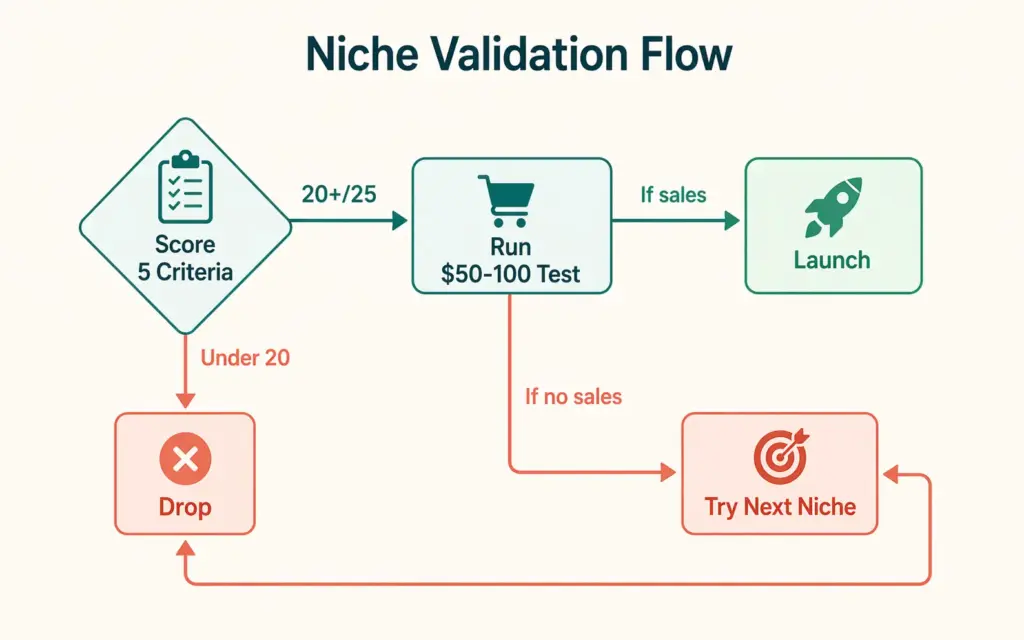
- Don't pick one niche and commit $5,000 on day one. Validate with the lowest-cost method available: list 5 products, spend $50-100 on ads, and see if real people buy. Data beats theory every time.
Ecommerce niche research is the process of identifying specific product categories and target audiences where you can build a profitable online store with manageable competition, using data from search engines, marketplaces, social platforms, and supplier catalogs to validate demand before investing money in inventory, store setup, or advertising. The niche you choose determines your competition, your margins, your marketing strategy, and ultimately whether your store succeeds or fails.
Most “how to find a niche” guides tell you to “follow your passion.” That’s incomplete advice. Passion keeps you motivated. Data keeps you profitable. The best niche sits at the intersection of something you care about and something the market actively buys. This guide teaches you to find that intersection using seven research methods, each approaching the problem from a different data source.
If you’ve already identified some product ideas, our low competition products guide covers validation at the product level. If you’re still at the “I want to sell online but don’t know what” stage, start here.
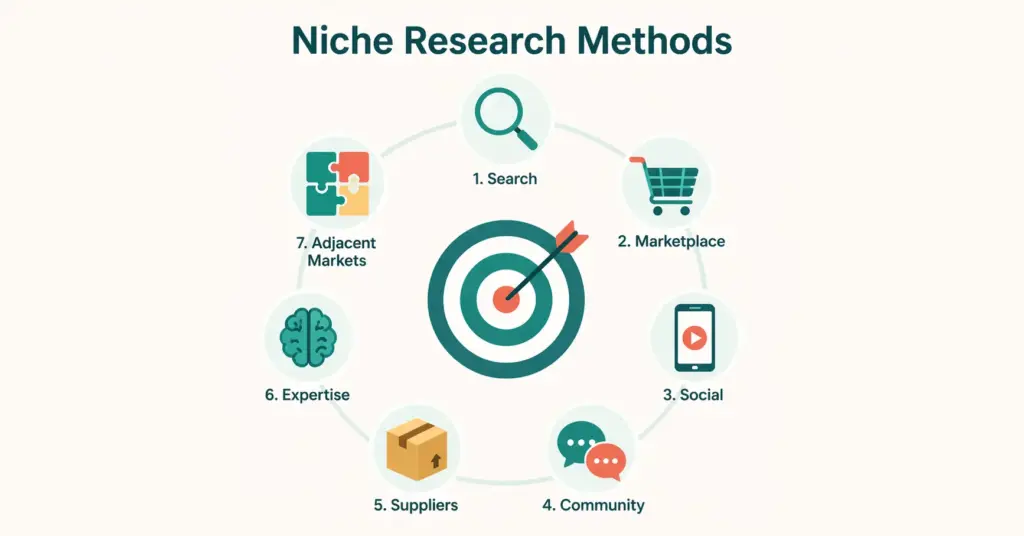
The 5-Criteria Niche Scoring Framework
Before diving into research methods, understand what you’re evaluating. Score every niche idea against these five criteria on a 1-5 scale:
| Criteria | What to Measure | Score 5 (Excellent) | Score 1 (Poor) |
|---|---|---|---|
| Search Demand | Monthly search volume for niche keywords | 10,000+ monthly searches | Under 500 searches |
| Purchase Intent | Percentage of searches with buying language | “Buy,” “best,” “price” keywords dominate | Mostly informational “what is” queries |
| Competition | Strength of existing sellers | Few established brands, low review counts | Major brands dominate, 1000+ review averages |
| Margin Potential | Gap between product cost and selling price | 3x+ markup after all costs | Under 2x markup possible |
| Personal Fit | Your knowledge, interest, sustained motivation | Deep expertise or genuine passion | Zero interest, chasing trend only |
Niches scoring 20+ out of 25 deserve serious investigation. Niches scoring under 15 should be dropped. The methods below help you gather the data to score accurately rather than guessing.
Method 1: Search Data Mining (Google-Based)
Start where buyers start: search engines. This method uses free Google tools to find niches with proven search demand.
Google Trends: Search broad product categories and look at 5-year trend lines. You want niches showing steady or rising interest, not single spikes (fads) or declining curves (dying markets). Compare related niches side by side: “mushroom supplements” versus “vitamin supplements” shows which sub-niche is growing faster.
Google Keyword Planner (ads.google.com): Enter product category terms and extract monthly search volumes. A niche with 50+ keywords averaging 1,000+ monthly searches has proven demand. Export the full keyword list and look for long-tail variations that indicate specific buying intent: “best mushroom supplement for focus” tells you more about buyer motivation than “mushroom supplement.”
Google Shopping results: Search your niche keywords and examine who’s advertising. Heavy Google Shopping competition from major retailers means tough margins. Light advertising with mostly smaller brands means opportunity.
Best for: Validating demand quickly using free tools. This is always step one regardless of which other methods you use.
Method 2: Marketplace Data Analysis (Amazon/eBay)
Amazon and eBay show you what people actually BUY, not just what they search for. This is the most concrete demand data available.
Amazon Best Sellers and Movers & Shakers: Browse subcategories deep enough to find niches (Electronics > Computer Accessories > Laptop Stands > Portable Laptop Stands). Products in BSR 1,000-50,000 have proven demand without impossible competition. Our product research guide covers the Amazon data extraction process in detail.
Review analysis: Read the 1-3 star reviews on top-selling products in a niche. Every recurring complaint represents a product improvement opportunity. “The handle breaks after two months” across multiple competitor products means a more durable version has a ready market.
eBay completed listings: Filter search results by “Sold Items” to see actual transaction prices and volume. This reveals real market prices rather than aspirational listing prices.
Best for: Finding niches with proven purchase behavior and identifying specific product improvement opportunities within those niches.
Method 3: Social Trend Spotting (TikTok/Instagram/Pinterest)
Social platforms surface emerging product trends 3-6 months before they appear in search data. This method helps you find niches early when competition is lowest.
TikTok: Search product-related hashtags (#TikTokMadeMeBuyIt, #AmazonFinds, #ProductReview). Products gaining viral traction on TikTok often translate to ecommerce demand within weeks. The TikTok Shop trending products page shows what’s selling through the platform right now.
Pinterest Trends: Pinterest users are planners and buyers. Rising search trends on Pinterest predict consumer demand 2-4 months ahead, especially for home decor, fashion, food, weddings, and DIY categories.
Instagram Explore: Browse product-focused accounts in categories you’re considering. Accounts with high engagement (comments asking “where can I buy this?”) signal unmet demand.
Best for: Finding emerging niches before competition saturates. Highest reward but shortest opportunity windows for viral products.
Method 4: Community Pain Point Research (Reddit/Forums)
The most underused niche research method. Online communities are where people describe problems in their own words, and problems are what products solve.
Reddit: Find subreddits related to broad categories you’re considering (r/skincare, r/homeoffice, r/campinggear). Search within those communities for terms like “recommend,” “looking for,” “wish there was,” “frustrated with.” Every request for a product recommendation is a confirmed buying need.
Niche forums and Facebook groups: Specialized communities discuss product gaps openly. A woodworking forum where 50 people complain about the same tool’s design flaw is a product development roadmap handed to you for free.
Quora and Answer sites: Questions like “What’s the best X for Y?” directly reveal what people want to buy and why current options fall short.
Best for: Finding niches with passionate audiences and specific unmet needs. The qualitative data from communities adds context that quantitative data from search and marketplace tools can’t provide.
Method 5: Supplier Catalog Exploration
Browse what’s available before deciding what to sell. Supplier catalogs reveal product categories, wholesale pricing (which determines your margins), and manufacturing capabilities.
Alibaba: Browse product categories on Alibaba to see what manufacturers offer. Focus on products where the wholesale price allows 3x+ markup at market retail prices. The number of suppliers for a product indicates manufacturing maturity (easy to source) without necessarily meaning the retail market is saturated.
Wholesale directories (see our suppliers guide): Faire, Tundra, and Handshake list curated wholesale products from verified brands. Browsing these catalogs surfaces product categories you might not have considered.
Print on demand catalogs: Printful and Printify product catalogs show every blank product available for custom design. If you have design skills, POD niches let you test without inventory investment.
Best for: Grounding your niche ideas in supply reality. A niche with demand but no reliable supply chain is a dead end.
Method 6: Personal Expertise Audit
Your existing knowledge is an undervalued asset for niche market research. An expert in a field spots opportunities that outsiders miss, creates more credible content, and builds trust with buyers faster.
Audit your skills and knowledge: What topics do friends ask your advice on? What problems have you solved professionally? What hobbies have you invested hundreds of hours in? Each answer is a potential niche where you have an unfair advantage.
Validate with data: Expertise alone doesn’t make a viable niche. Cross-reference your expertise areas with Methods 1-2 (search demand and marketplace data). A CrossFit enthusiast who discovers that “home gym cable machine accessories” has rising search volume and limited competition has found the intersection of expertise and opportunity.
Best for: Finding niches where you can build authority and create content that converts because you genuinely understand the customer’s needs. This is particularly valuable for content-driven SEO strategies where expertise drives rankings.
Method 7: Adjacent Market Gap Analysis
Instead of entering an existing niche directly, find the gaps between established niches that nobody serves.
How it works: Identify two overlapping audiences and find the product gap between them. “Dog owners” and “travelers” overlap into “travel gear for dogs,” a niche with passionate buyers and less competition than either parent market. “Home office workers” and “fitness enthusiasts” overlap into “under-desk exercise equipment.”
Cross-reference with demand tools: Use Method 1 (Google search data) to verify that people actually search for products in the gap you’ve identified. Adjacent niches fail when the overlap audience is too small to support a business.
Best for: Finding defensible micro-niches where you can dominate without competing against established category leaders. Our profitable niches guide covers proven examples of this approach.
From Research to Validation: The Low-Cost Test
Research narrows your options. Validation confirms your choice. Never commit significant capital based on research alone. Validate with the cheapest test possible:
Dropshipping test: List 5-10 products from your target niche on a zero-cost Shopify trial. Run $50-100 in Facebook or TikTok ads targeting your niche audience. If people buy within the first $100 of ad spend, the niche has legs. If nobody bites, you’ve lost $100 instead of $5,000 on inventory.
Pre-order test: Create a landing page showcasing your product concept. Drive traffic and measure email signups or pre-order commitments. 100+ signups from 1,000 visitors signals strong demand.
Marketplace test: List on Amazon, Etsy, or eBay where the audience already exists. Use their built-in traffic to test product demand without driving your own. If the product sells on marketplaces, it’ll sell on your own store with proper marketing.
The niche that passes both the research framework (score 20+/25) AND the low-cost validation test (real people spend real money) is your winner. Everything after that, building your store, sourcing inventory, scaling marketing, is execution on a validated foundation.
Frequently Asked Questions
Use the 5-criteria scoring framework: search demand (10,000+ monthly searches), purchase intent (buying keywords dominate), competition level (top sellers have under 500 reviews), margin potential (3x markup after all costs), and personal fit (knowledge or genuine interest). Niches scoring 20+/25 across these criteria have the highest probability of profitability. Validate with a $50-100 ad test before committing capital.
Free tools that cover 80% of niche research: Google Trends (demand direction), Google Keyword Planner (search volume), Amazon Best Sellers (proven purchases), eBay Sold Listings (real transaction data), TikTok trending products (emerging trends), Pinterest Trends (2-4 month demand predictions), and Reddit communities (qualitative pain point data). Paid tools like Jungle Scout and Helium 10 add depth but aren’t required to start.
A niche is too competitive when: the top 10 Amazon listings average 1,000+ reviews, major brands (Nike, Amazon Basics) dominate page one of Google and Amazon, Google Shopping shows heavy advertising from large retailers, and keyword difficulty exceeds 60 for all relevant terms. Some competition is healthy (proves demand). Overwhelming competition from funded brands means you can’t win without massive investment.
Both. Passion without data leads to beautiful stores nobody buys from. Data without passion leads to burnout at month 6 when growth stalls and you need to create content, engage customers, and solve problems you don’t care about. Use data to find 3-5 viable niches, then pick the one you’re most genuinely interested in. The best ecommerce niche research combines quantitative validation with personal alignment.
Thorough niche research takes 1-2 weeks of focused effort. Week one: brainstorm 10-15 ideas and run them through Methods 1-4 (search data, marketplace data, social trends, community research). Week two: score each idea against the 5-criteria framework, eliminate low scorers, and run a low-cost validation test on your top 1-2 choices. Rushing this process costs more time later than doing it right upfront.
Yes, but pivoting costs time and potentially money (unsold inventory, wasted marketing). The validation test minimizes this risk by confirming demand before you commit. If you need to pivot, dropshipping and print on demand stores can shift niches in days since there’s no inventory to liquidate. Private label stores take longer because you’re holding physical product that may not sell in the new niche.
Related Reads
- High Demand Low Competition Products
- Most Profitable Ecommerce Niches
- Trending Products to Sell
- Best Selling Products Research
- Ecommerce Business Ideas by Budget
- What to Sell Online
Enjoying this? Get more like it every week.
One email per week with ecommerce strategies, tool picks, and seller insights. No spam.