
- Where you sell matters more than what you sell. The same product can flop on one platform and thrive on another. Match your selling channel to your product type, audience, and goals.
- Free options to start today: Facebook Marketplace (local/used items), Etsy (handmade/vintage/crafts), eBay (anything resellable). No subscription fees, just listing or transaction fees.
- Your own store (Shopify, WooCommerce) makes sense after you've validated demand on a marketplace. Don't pay $39/month for a store with zero traffic.
- The fastest path to your first online sale: list 5-10 products on an existing marketplace with great photos, competitive pricing, and detailed descriptions. Most first sales happen within 1-2 weeks on platforms with built-in traffic.
The question isn’t whether you CAN sell things online. That’s been settled. Global ecommerce sales are projected to surpass $8 trillion by 2027. The real question is where to sell, what to charge, and how to not waste three months building a store that nobody visits.
I’ve watched people spend $2,000 on a Shopify store with custom branding before making a single sale. I’ve also watched people list their first product on Etsy with a phone photo and sell it the same week. The difference wasn’t the product. It was choosing the right channel for what they were selling.
This guide is platform-agnostic. I’m not going to tell you that Shopify is the answer (it might be, eventually) or that Amazon is the only way (it’s one way). Instead, I’ll help you figure out where YOUR products should be listed based on what you’re actually selling, who you’re selling to, and how fast you want that first sale. If you’re still figuring out what to sell, start with our complete guide to starting an ecommerce business, then come back here.
Where to Sell: Matching Your Channel to Your Product
This is where most guides get it wrong. They list every platform alphabetically and tell you to “choose the one that fits.” That’s useless. Here’s how to actually decide:
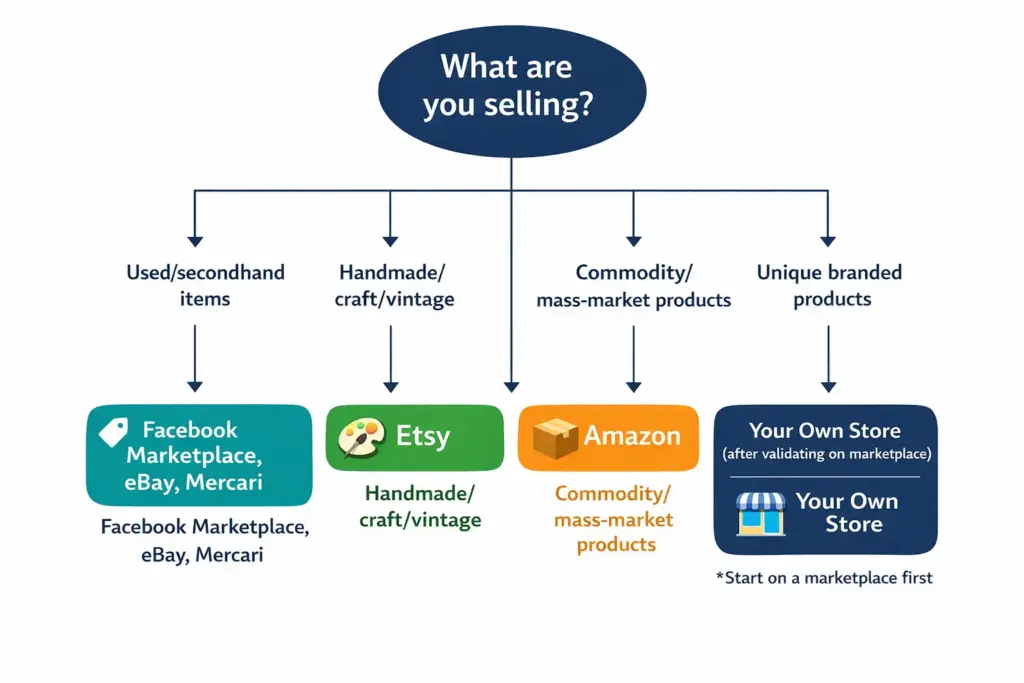
Selling used or secondhand items? Start with Facebook Marketplace (free, local pickup eliminates shipping), eBay (massive audience, auction or fixed price), or Poshmark/Mercari for clothing specifically. These platforms have built-in buyers searching for deals. You can list items in minutes from your phone and often sell within days.
Selling handmade, vintage, or craft products? Etsy is your first stop. Over 90 million active buyers specifically looking for unique and handmade items. Listing fee is $0.20 per item plus transaction fees. It’s the fastest path to sales for anything creative: jewelry, candles, art, custom gifts, knitted goods, pottery. Our things to make and sell guide covers what’s working in this space.
Selling commodity or mass-market products? Amazon is the 800-pound gorilla. Nearly 60% of US online product searches start on Amazon, not Google. If you’re selling products that compete with other brands (supplements, electronics accessories, kitchen gadgets, beauty products), Amazon gets you in front of buyers who are already searching with purchase intent. The trade-off: fees run 30-40% all-in (referral fees + FBA fulfillment), and competition is brutal.
Building a brand with unique products? Your own Shopify or WooCommerce store gives you complete control over branding, pricing, customer data, and margins. But you’re responsible for driving ALL the traffic. No built-in audience. This is the right move after you’ve validated that people want what you’re selling on a marketplace first.
Want to sell for free with zero fees? Facebook Marketplace (local), Craigslist (local), and Instagram Shopping (requires some following) charge nothing to list. These work best for local sales, one-off items, or testing product ideas before investing in a paid platform.
Free vs Paid Platforms: What You Actually Pay
Nothing is truly “free” in ecommerce. Even platforms with no listing fees take a cut somewhere. Here’s what you’ll actually pay on each major platform:
| Platform | Listing Fee | Transaction Fee | Monthly Cost | Best For |
|---|---|---|---|---|
| Facebook Marketplace | Free | Free (local pickup) | $0 | Used items, local sales |
| Etsy | $0.20/listing | 6.5% + payment processing | $0 | Handmade, vintage, crafts |
| eBay | Free (up to 250/month) | 13.25% (most categories) | $0 | Reselling, collectibles, used goods |
| Amazon | Free (Professional plan) | 8-15% referral + FBA fees | $39.99 | Commodity products, brands |
| Shopify | N/A | 2.9% + $0.30 (payment processing) | $39/month | Brand-building, DTC |
| Mercari | Free | 10% | $0 | Used items, casual sellers |
The math matters. On eBay, a $50 item nets you roughly $42 after fees. On Amazon with FBA, that same $50 item might net you $28-$32 after referral fees, fulfillment, and storage. On your own Shopify store, you’d keep $47 after payment processing, but you need to get that buyer to your store in the first place (which costs money or time in marketing).
How to Get Your First Sale (The 7-Day Plan)
Forget the 90-day launch plans. Here’s how to make your first sale as fast as possible:
Day 1-2: Choose one platform and list 5-10 products. Pick the platform that matches your product type from the framework above. Don’t overthink it. List your products with clear photos, accurate descriptions, and competitive prices. “Competitive” means checking what similar items are selling for on that platform and pricing at or slightly below the average to start.
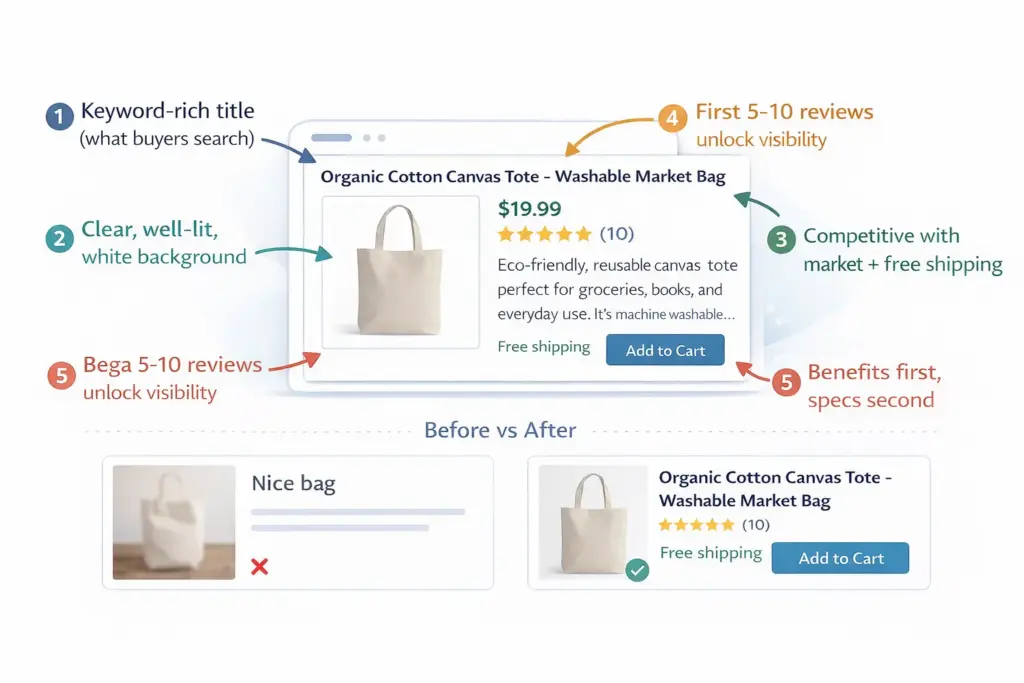
Day 3-4: Optimize your listings. Look at the top-selling listings in your category. What do their titles include? What keywords appear? How many photos do they use? Reverse-engineer what’s already working. Most beginners write vague titles like “Nice blue shirt” when the buyer is searching “Men’s slim fit oxford button-down blue large.” Match the language buyers use.
Day 5-6: Promote to your existing network. Share your listings with friends, family, social media followers. Not as begging (“please buy my stuff”) but as a genuine announcement (“I just launched an online store selling X – here’s the link if you or anyone you know is interested”). Your first 2-3 sales and reviews come from people who already know you. Those early reviews unlock algorithmic visibility on marketplaces.
Day 7: Analyze and adjust. Which listings got views? Which got zero? High views but no sales means your price or photos need work. Zero views means your titles and keywords aren’t matching what buyers search. Adjust and relist. Selling online is iteration, not perfection on the first try.
Product Photos That Actually Sell
Your photos are your storefront. On a marketplace, buyers scroll past hundreds of listings. You have about 1.5 seconds to make them stop. Here’s what works:
Main photo: Product on a white or clean background. Well-lit, in focus, filling at least 80% of the frame. This is the thumbnail that determines whether anyone clicks. A phone camera is fine if the lighting is good. Natural daylight near a window beats a $500 lighting setup used poorly.
Supporting photos (3-6 more): Show the product from multiple angles. Show it in use (being worn, on a desk, in a kitchen). Include a size reference (next to a common object or a person’s hand). Photograph any details that matter: stitching, texture, labels, packaging. One lifestyle photo showing the product “in context” dramatically improves conversion.
What kills sales: Blurry photos. Bad lighting (yellow indoor light, harsh shadows). Cluttered backgrounds. Only one photo. Using stock images when buyers expect to see the actual item. On platforms like eBay and Mercari, buyers actively distrust listings that look too polished because they expect to see the real item.
Pricing Strategy for New Sellers
Pricing is where most new sellers either leave money on the table or scare buyers away. There’s a method to it.
Research first, price second. Search your product on the platform you’re selling on. Sort by “sold” or “completed listings” (eBay lets you do this directly). This shows what buyers actually paid, not what sellers wish they’d get. The market sets the price, not your feelings about the product’s value.
Factor in all costs. Product cost + platform fees + shipping + packaging + your time. If the math doesn’t leave you with at least 30% margin on a product-based business (or at least $10 net profit per sale for lower-volume items), you need to either source cheaper, raise your price, or find a different product.
Use the “anchor and adjust” approach. Price new listings at or slightly below the market average to generate initial sales and reviews. Once you have 10-15 positive reviews, gradually raise prices. Social proof (reviews, sold count) lets you command higher prices than a listing with zero sales history.
Offer free shipping (build it into the price). Buyers psychologically prefer a $30 item with free shipping over a $24 item plus $6 shipping, even though the total is identical. On platforms like Etsy and eBay, free shipping also boosts your search ranking.
Scaling Beyond Your First Platform
Once you’ve made 20-30 sales on your first platform and confirmed that your products sell, it’s time to expand. The multichannel approach is where real growth happens.
Phase 1 (Month 1-2): One marketplace. Get sales, reviews, and operational confidence. Learn shipping, customer service, returns.
Phase 2 (Month 3-4): Add a second channel. If you started on Etsy, add eBay or Amazon. Cross-list your best sellers. Same products, different audiences.
Phase 3 (Month 5+): Launch your own store. Now you have data on what sells, what your best margins are, and what your customer looks like. Build a Shopify or WooCommerce store for your brand. Drive traffic through social media content, SEO, or paid ads. Use marketplaces as your “cash flow base” while building your brand store.
This phased approach is lower risk than dumping $2,000 into a custom store on day one. Our ecommerce platform comparison walks through the technical details of each option when you’re ready for Phase 3.
Common Mistakes That Kill First-Time Sellers
Building a store before validating demand. A beautiful website with no traffic makes zero sales. Start on a marketplace where buyers already exist. Validate first, build later.
Pricing based on cost, not market. It doesn’t matter that your handmade candle costs $8 to make if similar candles sell for $12 on Etsy. The market doesn’t care about your costs. Either find a way to differentiate (better packaging, unique scents, stronger branding) or accept the market price and optimize your costs.
Ignoring shipping costs. Shipping is the silent profit killer. A $3 shipping cost on a $15 item wipes out most of your margin. Weigh your products, check carrier rates (USPS, UPS, FedEx), and build shipping into your pricing strategy before listing.
Trying to sell everything. The temptation is to list 100 different products hoping something sticks. Focused stores with 15-30 products in a tight niche consistently outperform “general stores” with hundreds of random items. Pick a lane. Win there. Expand later.
Quitting after a week. Most successful online sellers didn’t make a sale in their first week. They adjusted photos, rewrote titles, changed prices, and kept iterating. The sellers who make it aren’t the ones with the best products. They’re the ones who keep showing up.
Frequently Asked Questions
What is the best place to sell things online for free?
Facebook Marketplace for local sales (completely free), Craigslist for local sales, and eBay’s free tier (250 free listings per month). Etsy charges just $0.20 per listing, which is close to free. For clothing specifically, Mercari and Poshmark have no upfront costs.
How do I sell stuff online as a complete beginner?
Pick one platform that matches what you’re selling (Etsy for handmade, eBay for used items, Facebook Marketplace for local). List 5-10 products with clear photos and competitive prices. Share with your network. Adjust based on what gets views and what sells. Expand to other platforms after your first 20-30 sales.
What sells best online?
Consistently strong categories include health and beauty, clothing and accessories, home and kitchen, electronics accessories, and pet supplies. But “best selling” varies by platform. Amazon favors commodity products. Etsy favors unique and handmade items. The right product depends on where you’re selling.
How much money do I need to start selling online?
As little as $0 if you’re selling items you already own on free platforms. For a new product business, expect $50-$200 to start: inventory or materials ($30-$100), sample orders ($20-$50), and packaging ($10-$30). You don’t need a paid website subscription to make your first sale.
Should I sell on Amazon or my own website?
Start on Amazon (or another marketplace) if you want fast access to buyers. Build your own website when you have proven products and are ready to invest in driving traffic. Most successful sellers do both: marketplaces for volume and visibility, their own store for brand-building and better margins.
How do I price my products for online selling?
Search your product on the platform you’re using and sort by “sold” listings to see real market prices. Factor in all costs: product, shipping, platform fees, packaging. Price at or slightly below market average to start, then increase after you build reviews and sales history.
Related reads: Complete Guide to Starting an Ecommerce Business | Profitable Ecommerce Niches | Products to Resell for Profit | Trending Products to Sell | Ecommerce Business Models | Ecommerce Web Design
Enjoying this? Get more like it every week.
One email per week with ecommerce strategies, tool picks, and seller insights. No spam.