
- The three ecommerce trends that will impact independent sellers most in 2026: AI-driven product discovery (optimize for AI agents, not just Google), social commerce going transactional (TikTok Shop, Instagram checkout), and ecommerce marketing automation replacing manual campaigns.
- Global ecommerce is heading toward $5.5 trillion in sales. US online sales grew 6% in 2025 (Signifyd). Growth is real but uneven - luxury and specialty categories are surging while commoditized products face margin pressure.
- Conversions from AI-referred traffic increased 1,247% in late 2025 (Signifyd). Shoppers are discovering products through ChatGPT, Perplexity, and TikTok before they ever reach your store. Your ecommerce strategy needs to account for these new discovery channels.
- The trends you can safely ignore as a small seller: blockchain payments, voice commerce (still under 8% of mobile orders), and VR shopping. Focus resources on AI optimization, social selling, and automated email/SMS instead.
Every year, someone publishes a “50 ecommerce trends” article that reads like a tech company’s investor pitch. Agentic AI. Composable commerce. Hyper-personalization at the edge. Great. What does any of that mean for someone running a Shopify store doing $15K a month?
Ecommerce trends are the evolving shifts in technology, consumer behavior, and market dynamics that change how products are discovered, purchased, and delivered online. In 2026, the most consequential shifts center on AI-driven product discovery, social platforms becoming full shopping channels, and marketing automation reaching a level where small sellers can compete with enterprise brands. Global ecommerce is heading toward $5.5 trillion in sales, US online sales grew 6% year-over-year in 2025 (Signifyd State of Commerce Report), and the way customers find and buy products is fundamentally different from even two years ago.
This article filters the noise. I’m covering only the ecommerce trends that independent and small-to-mid sellers need to act on, with specific strategy recommendations for each. If you’re still building your foundation, our complete guide to starting an ecommerce business should come first. This is for sellers who are already selling and need to make sure their ecommerce strategy keeps pace with how the market is moving.
Trend 1: AI Is Becoming a Shopping Channel (Not Just a Tool)
This is the single biggest shift in ecommerce right now, and most small sellers haven’t even started thinking about it.
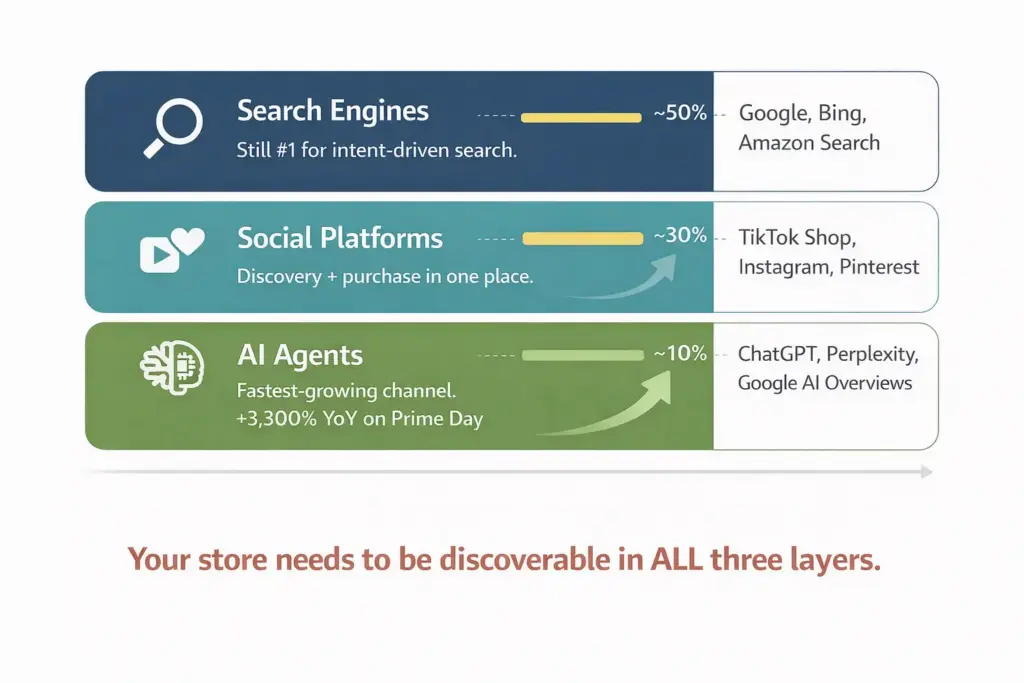
Shoppers are using ChatGPT, Perplexity, Google’s AI Overviews, and other AI tools to research and discover products before they ever visit a store. AI referral traffic to ecommerce sites on Amazon Prime Day 2025 was up 3,300% year-over-year (Adobe Analytics). Conversions from AI-referred traffic increased 1,247% in late 2025 (Signifyd). These aren’t small numbers. AI is becoming a primary discovery channel alongside Google search and social media.
“Agentic commerce” is the industry term for AI agents that can browse, compare, and even purchase products on behalf of consumers. Shopify has already launched agentic storefronts that integrate with ChatGPT and Microsoft Copilot. This isn’t coming in five years. It’s happening now.
What to do about it:
Structure your product pages and content so AI can easily extract and recommend your products. This means clear product descriptions with specific attributes (materials, dimensions, use cases, who it’s for), FAQ sections on product pages, and structured data markup (schema). AI tools pull from structured content, not marketing fluff. “This amazing revolutionary product will change your life” gives AI nothing to work with. “Organic cotton baby swaddle, 47×47 inches, GOTS certified, fits newborns 0-3 months” gives AI everything.
Build content that answers questions AI tools reference. If someone asks ChatGPT “what’s the best baby swaddle for summer?” you want your content to be the answer it cites. That means creating comparison content, “best for” guides, and detailed product education pages. Our ecommerce marketing playbook covers content strategy in depth.
Trend 2: Social Commerce Is Going Fully Transactional
Social commerce isn’t new. What’s new is that social platforms are now complete shopping channels, not just discovery tools that redirect to your website. TikTok Shop crossed $20 billion in global merchandise value. Instagram Checkout lets users buy without leaving the app. Facebook Marketplace handles billions in local transactions.
The shift: younger shoppers (18-34) increasingly discover AND purchase products entirely within social platforms. They never visit your website. They see a product in a TikTok video, tap the product link, and buy within TikTok’s checkout. Your Shopify store’s beautiful homepage? They never saw it.
What to do about it:
If you’re not on TikTok Shop yet, at minimum set it up and list your best-selling products. The organic reach on TikTok Shop is still significantly higher than on established marketplaces. Creating short-form video content showing your product in use is now a core ecommerce strategy, not a “nice to have.”
Connect your product catalog to Instagram Shopping and Facebook Shops. Even if social channels represent only 10-15% of your revenue, that’s incremental revenue you’d otherwise lose to competitors who are present where these shoppers browse.
For your ecommerce marketplace management, think of each social platform as its own marketplace with its own audience expectations, content format, and buying behavior. A product listing optimized for Amazon won’t work as-is on TikTok Shop. Adapt your presentation to each channel.
Trend 3: Ecommerce Marketing Automation Is Now Affordable
Two years ago, serious marketing automation meant paying $200-$500/month for Klaviyo or HubSpot and hiring someone to build the flows. In 2026, AI-powered tools have made sophisticated ecommerce marketing automation accessible to sellers at every revenue level.
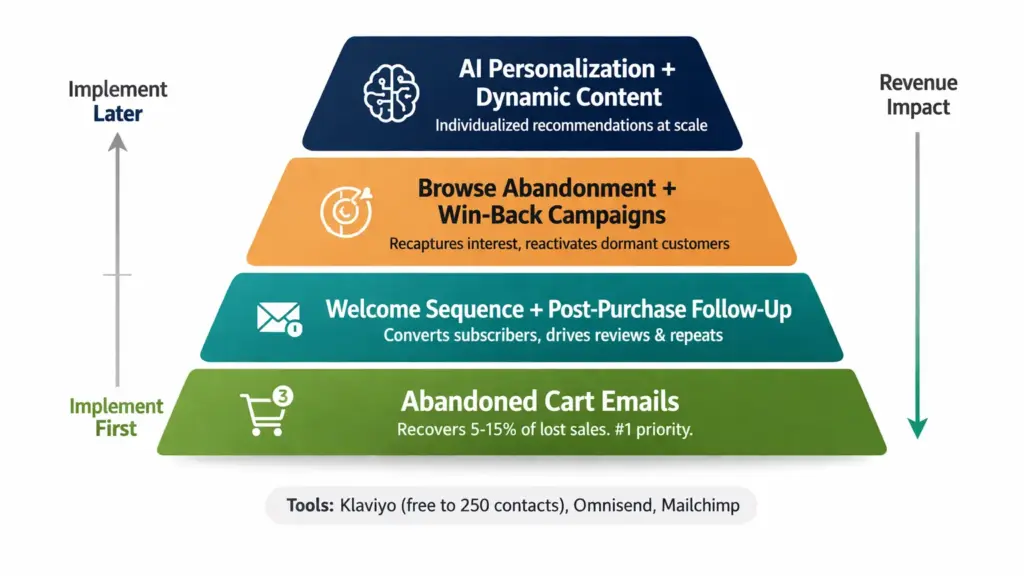
What this looks like in practice: automated email sequences that trigger based on customer behavior (abandoned cart, post-purchase, browse abandonment, win-back). AI-generated product recommendations personalized to each customer’s browsing history. Automated SMS campaigns timed to individual customer purchase cycles. Dynamic pricing adjustments based on demand and competition.
HubSpot found that personalized calls-to-action convert 202% better than generic ones. The tools to deliver that personalization used to require a team. Now they require a subscription and setup time.
What to do about it:
If you’re doing NOTHING with email automation, start with three flows today: abandoned cart (recovers 5-15% of lost sales), welcome sequence (introduces your brand to new subscribers), and post-purchase follow-up (asks for reviews and suggests related products). These three automated sequences alone can account for 15-25% of total revenue for a well-run ecommerce store.
Platforms like Klaviyo (free up to 250 contacts), Omnisend, and Mailchimp all offer pre-built ecommerce automation templates. The setup takes hours, not weeks. Once running, these flows generate revenue on autopilot while you focus on product development and customer acquisition.
Trend 4: Authenticity Is Beating Polish
Here’s an interesting counter-trend: as AI makes it trivially easy to create polished product photos, professional-looking copy, and slick brand assets, buyers are gravitating toward authenticity instead. User-generated content (UGC), raw video reviews, and unfiltered customer photos now convert better than studio-quality brand content in many categories.
One expert put it perfectly: “Once every brand looks premium by default, no one feels special.” The same dynamic happened with social media ads. Hyper-produced commercials lost ground to iPhone-shot creator content because it felt real.
What to do about it:
Actively collect and display customer photos and video reviews. Make it easy for buyers to submit UGC (post-purchase emails asking for photos with a discount incentive). Feature real customer content on product pages, not just your own photography. For social media marketing, mix polished brand content with raw, behind-the-scenes, and customer-created content. The mix builds trust in a way that perfection alone can’t.
Trend 5: Flexible Payments Are Now Table Stakes
Buy now, pay later (BNPL), digital wallets (Apple Pay, Google Pay, Shop Pay), and one-click checkout are no longer optional features. They directly impact conversion rates. Shopify reports that Shop Pay converts higher than standard checkout. Stores offering BNPL see 20-30% higher average order values because buyers are more comfortable purchasing premium-priced items when they can split payments.
What to do about it:
Enable every relevant payment method your platform supports. If you’re on Shopify, activate Shop Pay, Apple Pay, Google Pay, and at least one BNPL option (Shop Pay Installments, Afterpay, or Klarna). Each additional payment method removes one more reason for a shopper to abandon checkout. If you’re on another ecommerce platform, check which payment integrations are available and enable them.
Trend 6: Sustainability as a Purchasing Filter
Consumer surveys consistently show that 70-80% of shoppers say sustainability matters. The reality is more nuanced: shoppers want sustainable options, but they won’t pay a massive premium for them. The sweet spot is offering sustainability as a differentiator at comparable price points, not as a premium upsell.
The resale and secondhand market is accelerating. Over 44% of UK consumers bought more secondhand items in 2025 than the year before (Publicis Sapient). Platforms like ThredUp, Poshmark, and Facebook Marketplace are growing faster than traditional retail channels in several categories.
What to do about it:
If your products have any sustainability angle (eco-friendly materials, recyclable packaging, local production, reduced waste), communicate it clearly on product pages and in your brand story. Don’t greenwash. Be specific: “Made from 100% recycled polyester” beats “eco-friendly product.” For product sourcing decisions, consider sustainable materials when the cost difference is marginal. It’s becoming a tiebreaker in purchasing decisions. Our trending products guide covers which sustainable categories are gaining the most traction.
What You Can Safely Ignore (For Now)
Not every ecommerce trend deserves your attention or budget. Here’s what to deprioritize if you’re an independent seller:
Voice commerce. Still accounts for under 8% of mobile orders, mostly for repeat purchases of commodity items. Unless you’re selling replenishable basics, this isn’t moving your needle yet.
VR/AR shopping. Cool technology, tiny adoption. Useful for furniture and fashion brands with the budget to implement it. Not relevant for most independent sellers in 2026.
Blockchain payments. Crypto and blockchain-based checkout is still experimental and represents a fraction of a percent of ecommerce transactions. Don’t invest engineering time here.
Headless commerce. If you don’t know what this means, you don’t need it. It’s an architecture approach for enterprise-level stores. Your Shopify or WooCommerce setup is perfectly fine.
Building Your 2026 Ecommerce Strategy
Instead of chasing every trend, build your ecommerce strategy around three priorities:
Priority 1: Be discoverable where shoppers actually look. That means Google search (still the biggest channel), AI answer engines (growing fastest), and at least one social platform where your audience browses. Cover all three discovery layers.
Priority 2: Automate the revenue you’re leaving on the table. Set up email and SMS automation. Abandoned cart recovery alone is worth the effort. Post-purchase flows drive repeat purchases. Welcome sequences convert subscribers into first-time buyers. This is the highest-ROI ecommerce marketing automation you can implement.
Priority 3: Build trust through authenticity. Customer reviews, UGC, transparent pricing, clear shipping policies, and real behind-the-scenes content. In a market flooded with AI-generated sameness, genuine brand personality becomes your competitive moat.
The sellers who thrive in 2026 won’t be the ones who adopted the most trends. They’ll be the ones who picked the right trends for their business and executed well on a few things rather than poorly on everything. For a deeper look at how to structure your ecommerce business model to take advantage of these shifts, start with our business models guide.
Frequently Asked Questions
What are the biggest ecommerce trends in 2026?
AI-driven product discovery (shoppers using ChatGPT and AI tools to find products), social commerce going fully transactional (TikTok Shop, Instagram Checkout), and affordable marketing automation. These three shifts affect sellers at every size level.
How should I adjust my ecommerce strategy for 2026?
Structure product content for AI extraction (clear specs, FAQ sections, schema markup). Set up at least three automated email flows (abandoned cart, welcome, post-purchase). Be present on at least one social shopping platform. These three changes cover the highest-impact trends.
Is social commerce worth investing in for small sellers?
Yes. TikTok Shop still offers strong organic reach, and Instagram Shopping connects your product catalog to millions of active buyers. Even if social channels deliver only 10-15% of revenue, that’s incremental growth you’d miss otherwise. Start with one platform where your audience already spends time.
What ecommerce trends should small sellers ignore?
Voice commerce (under 8% of mobile orders), VR/AR shopping (tiny adoption outside enterprise), blockchain payments (experimental), and headless commerce (enterprise architecture not needed for most stores). Focus resources on AI optimization, social selling, and email automation instead.
How important is AI for ecommerce in 2026?
Critical. AI referral traffic to ecommerce sites grew over 3,300% year-over-year on Amazon Prime Day 2025. Shoppers are using AI tools to research products before buying. Sellers who structure their content for AI extraction will capture traffic that competitors miss entirely.
What is ecommerce marketing automation?
Automated email, SMS, and on-site experiences triggered by customer behavior. Examples: abandoned cart emails, personalized product recommendations, post-purchase review requests, and win-back campaigns for inactive customers. Tools like Klaviyo and Omnisend make this accessible to sellers at any revenue level.
Related reads: Complete Guide to Starting an Ecommerce Business | Ecommerce Business Models | How to Sell Things Online | Best Ecommerce Platform | Trending Products to Sell | Ecommerce Web Design
Enjoying this? Get more like it every week.
One email per week with ecommerce strategies, tool picks, and seller insights. No spam.