
- Realistic ecommerce startup costs range from $0 (selling items you own on free platforms) to $10,000+ (private label brand with inventory). The average new seller spends $200-$2,000 to get their first store running.
- Platform costs in 2026: Shopify starts at $29/month, WooCommerce hosting at $5-$30/month, Etsy charges $0.20/listing + 6.5% transaction fee, and Amazon's Professional plan is $39.99/month plus 8-15% referral fees.
- The costs most new sellers forget: product photography ($0-$300), shipping supplies ($20-$50), sample orders ($30-$100), business insurance ($300-$800/year), and accounting software ($0-$30/month). These "invisible" costs add up fast.
- Start lean. You don't need custom branding, professional photography, or paid apps on day one. Validate with minimum viable investment, then reinvest profits into better tools and marketing.
I get this question constantly: “How much do I need to start?” And every answer online is frustratingly vague. “$500 to $50,000 depending on your needs.” Thanks, that narrows it down.
Ecommerce startup costs are the total upfront and recurring expenses required to launch and operate an online store. They include platform fees, domain registration, product inventory or sourcing, marketing, legal setup, and operational tools. The actual amount varies dramatically based on your business model – a dropshipping store can launch for under $200 while a private label brand with custom packaging and inventory might need $5,000-$10,000. The typical ecommerce website cost for a new seller falls between $200 and $2,000 for the first three months of operation.
This guide breaks down every cost line by line, organized by business model so you can build an actual budget. Not a range. A budget. The US Small Business Administration recommends calculating startup costs before launch, and that’s exactly what we’ll do here. If you haven’t chosen your model yet, our how to start an ecommerce business guide will help you pick your path first.
Costs Every Online Store Pays (Regardless of Model)
Some expenses apply no matter what you’re selling or how you’re selling it. Let’s get these on the table first.
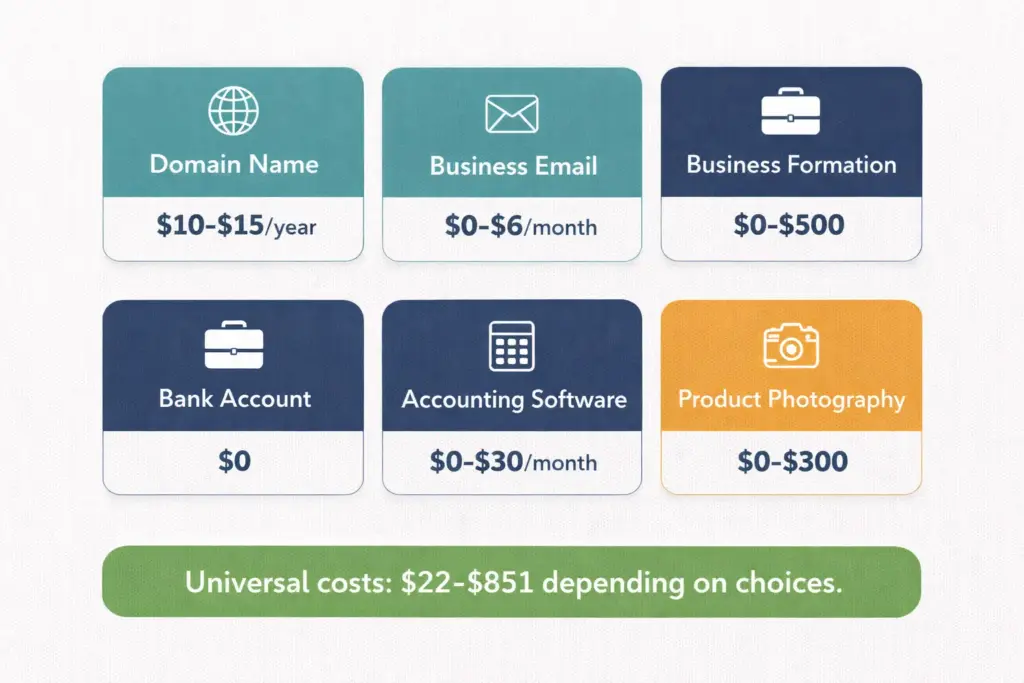
Domain name: $10-$15/year. This is your website address (yourbrand.com). Register through Namecheap, Google Domains, or your platform’s domain service. Even if you start on a marketplace, securing your domain early prevents someone else from taking it.
Business email: $0-$6/month. Google Workspace starts at $6/month for a professional email (you@yourbrand.com). Free alternatives: use Gmail with your domain forwarding, or start with a plain Gmail address and upgrade later.
Business formation (optional at start): $0-$500. Operating as a sole proprietor costs nothing. Registering an LLC costs $50-$500 depending on your state. Our legal setup guide covers when an LLC makes sense. Skip this on day one if budget is tight.
Business bank account: $0. Most banks offer free business checking accounts. Separate your business finances from personal from day one. This is non-negotiable even if everything else is lean.
Accounting software: $0-$30/month. Wave is completely free and handles invoicing, expense tracking, and basic reporting. QuickBooks starts at $30/month for more advanced features. A spreadsheet works for the first few months if needed.
Product photography: $0-$300. Your phone camera with good natural lighting is sufficient to start. A simple lightbox ($20-$40 on Amazon) dramatically improves product photos. Professional photography can wait until you’ve validated your products are selling.
How Much Does It Cost to Sell on Each Platform?
This is the section most people actually want. Here’s what each major ecommerce platform costs in 2026, with real numbers, not marketing-speak.
Shopify Costs
Monthly plan: Basic at $29/month (or $39/month billed monthly). Includes hosting, SSL, unlimited products, and Shopify Payments.
Transaction fees: 2.9% + $0.30 per transaction using Shopify Payments. Using a third-party payment gateway adds an extra 2% on Basic plan.
Theme: Free themes available (Dawn is excellent). Premium themes cost $150-$400 one-time.
Apps: This is where Shopify gets expensive. Most stores need email marketing ($0-$20/month), reviews ($0-$15/month), and 2-3 other apps. Budget $30-$100/month for apps once running. Start with free tiers.
Realistic Shopify startup budget: $150-$500 for the first 3 months (plan + domain + basic apps). Ongoing: $60-$180/month.
How Much Does It Cost to Have an Etsy Shop?
Monthly plan: $0 (standard) or $10/month (Etsy Plus for extra features). Most sellers don’t need Plus.
Listing fees: $0.20 per listing. Each listing lasts 4 months or until it sells. Budget $5-$20/month depending on catalog size.
Transaction fees: 6.5% of the sale price (including shipping). Plus payment processing at 3% + $0.25 per transaction.
Offsite Ads fee: 15% on sales generated through Etsy’s offsite ads (12% if you earn over $10K/year). You can opt out if under $10K annual revenue.
Realistic Etsy startup budget: $20-$50 to list initial products. Ongoing: fees come out of sales, so $0 upfront per month. Effective total fee per sale: roughly 10-12% of revenue.
How Much Does It Cost to Sell on Amazon?
Monthly plan: Individual plan at $0.99/item sold (for under 40 items/month) or Professional plan at $39.99/month (unlimited items).
Referral fees: 8-15% per sale depending on category. Most categories are 15%.
FBA fees (if using Fulfillment by Amazon): $3-$7+ per unit for picking, packing, and shipping, plus monthly storage fees ($0.87-$2.40 per cubic foot depending on season).
Advertising: Amazon PPC is practically required for new products. Budget $300-$1,000/month minimum for sponsored product ads to get visibility.
Realistic Amazon startup budget: $500-$3,000+ (Professional plan + initial inventory + FBA fees + ad budget). Ongoing: $200-$1,000+/month in fees and advertising. Amazon is the most expensive platform to sell on, but also has the most built-in traffic.
WooCommerce Costs
Plugin: Free. WooCommerce itself is a free WordPress plugin.
Hosting: $5-$30/month for shared hosting (SiteGround, Bluehost). $30-$100/month for managed WordPress hosting (Cloudways, Kinsta).
Theme: Free themes available. Premium WooCommerce themes cost $50-$80 one-time.
Extensions: Many free. Premium payment gateways, shipping calculators, and marketing extensions cost $0-$200 total to set up.
Payment processing: Stripe or PayPal at 2.9% + $0.30 per transaction. No additional platform transaction fees.
Realistic WooCommerce startup budget: $100-$300 for the first 3 months (hosting + domain + theme). Ongoing: $15-$60/month. Cheapest option for your own store, but requires more hands-on technical management.
Startup Cost Budgets by Business Model
Here’s where it gets specific. Below are real line-item budgets for each common ecommerce business model, covering the first 3 months of operation.
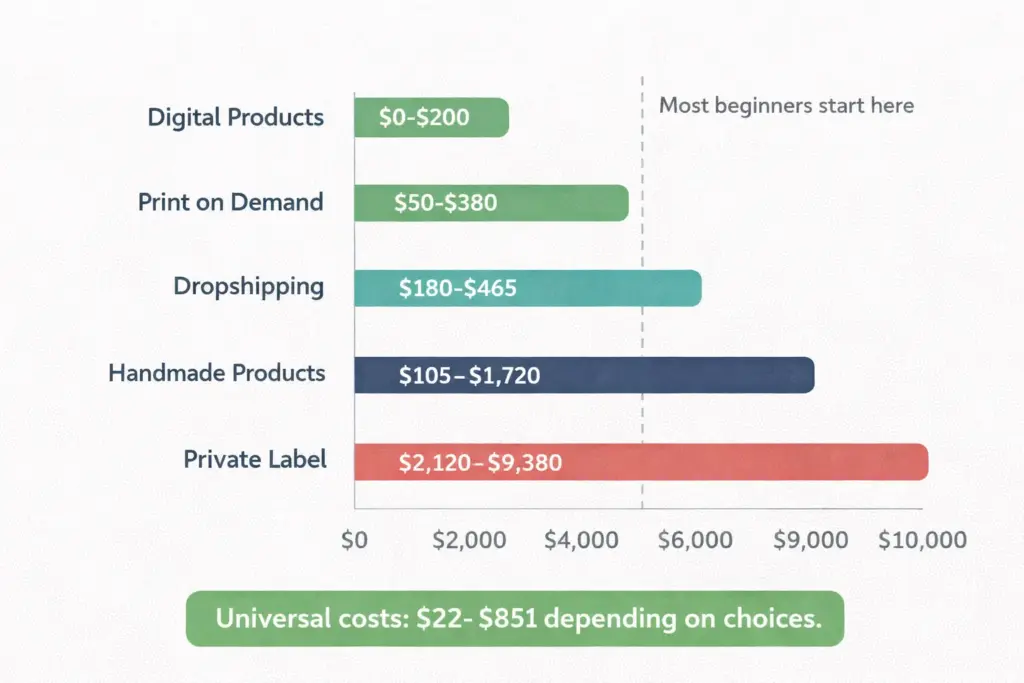
Dropshipping: $100-$500 to Start
| Expense | Cost | Notes |
|---|---|---|
| Shopify Basic (3 months) | $87-$117 | $29-$39/month |
| Domain name | $12 | Annual cost |
| Sample orders (3-5 products) | $30-$75 | Always test before listing |
| Dropshipping app (DSers/Spocket) | $0-$60 | Free tiers available |
| Initial ad testing | $50-$200 | $5-$10/day for 1-2 weeks |
| Total | $179-$464 |
Print on Demand: $50-$300 to Start
| Expense | Cost | Notes |
|---|---|---|
| Platform (Etsy or Shopify) | $5-$117 | Etsy: listing fees only. Shopify: $29-$39/month |
| Domain name | $12 | Optional if selling on Etsy only |
| Design tools (Canva Pro) | $0-$40 | Free tier works to start |
| Sample orders | $30-$60 | Test print quality before selling |
| Freelance designs (optional) | $0-$150 | Fiverr: $5-$30 per design |
| Total | $47-$379 |
Handmade Products: $200-$2,000 to Start
| Expense | Cost | Notes |
|---|---|---|
| Raw materials (initial batch) | $50-$500 | Varies hugely by product type |
| Platform (Etsy) | $5-$20 | Listing fees for 25-100 products |
| Packaging and labels | $30-$100 | Branded stickers, boxes, tissue paper |
| Product photography setup | $0-$50 | Lightbox + phone camera |
| Shipping supplies | $20-$50 | Mailers, tape, labels |
| Tools and equipment | $0-$1,000 | If you don’t already own them |
| Total | $105-$1,720 |
Private Label: $2,000-$10,000 to Start
| Expense | Cost | Notes |
|---|---|---|
| Product samples from manufacturers | $100-$300 | 3-5 samples from different suppliers |
| First inventory order (MOQ) | $1,000-$5,000 | Minimum order quantities from factories |
| Shipping/customs to your country | $200-$1,000 | Sea freight for bulk, air for small orders |
| Packaging and branding design | $100-$500 | Logo, labels, custom packaging |
| Platform (Amazon Pro + Shopify) | $70-$80/month | Most private label sellers use both |
| Product photography (professional) | $150-$500 | Amazon requires high-quality images |
| Amazon PPC launch budget | $500-$2,000 | First 2-3 months of advertising |
| Total | $2,120-$9,380 |
Digital Products: $0-$200 to Start
| Expense | Cost | Notes |
|---|---|---|
| Platform (Gumroad/Etsy/Shopify) | $0-$39/month | Gumroad: free to list. Etsy: $0.20/listing |
| Creation tools | $0-$50 | Canva (free), Google Docs (free) |
| Domain (optional) | $12 | Not needed if selling on marketplace |
| Email marketing (optional) | $0 | Mailchimp/Klaviyo free tiers |
| Total | $0-$101 |
The Costs New Sellers Forget
These are the expenses that don’t show up in any platform’s pricing page but eat into your budget during the first year:
Returns and refunds. Budget 3-5% of revenue for physical products, higher for clothing (15-20%). Every return costs you the original shipping, the return shipping (if you offer free returns), and often makes the product unsellable.
Shipping supplies. Mailers, boxes, tape, labels, packing material. Budget $20-$50/month for a store shipping 50-100 orders. Using poly mailers ($0.15-$0.30 each) instead of boxes saves significantly.
Payment processing chargebacks. When a customer disputes a charge, the payment processor holds the funds and charges you a $15-$25 fee, whether you win or lose the dispute. One or two chargebacks per month can erase profits on dozens of sales.
Software subscriptions that creep up. Email marketing, review apps, upsell apps, analytics tools, design software. Each is “only” $10-$30/month, but five subscriptions at $20/month is $100/month you didn’t plan for. Audit your app stack monthly and cancel anything not directly driving revenue.
Your time. The biggest hidden cost. If you spend 20 hours/week building your store and you value your time at $25/hour, that’s $2,000/month in opportunity cost. This isn’t a line item on a spreadsheet, but it’s real. Factor it into your expectations about when the business should be profitable.
How to Start Lean (Without Looking Cheap)
You don’t need to spend $5,000 to look professional. Here’s where to save and where to invest:
Save on: Custom logo (use Canva’s logo maker for free). Premium themes (free themes are genuinely good now). Paid apps on day one (start with free tiers, upgrade when revenue justifies it). Professional photography (phone + natural light + white background works for validation phase). Business cards and printed materials (you’re selling online).
Invest in: Sample orders (never sell a product you haven’t physically tested). One quality product photo per item (the main listing image determines click-through rate). A real domain name (builds trust from day one). At least $50-$100 in initial ad testing (validates demand faster than organic alone). Proper shipping packaging (damaged products kill your reviews and reputation).
The philosophy: spend money on things that directly impact whether someone clicks, trusts, and buys. Save money on everything behind the scenes that the customer never sees. You can always upgrade your backend tools once revenue funds it. For more on choosing where to sell, see our platform comparison guide.
Frequently Asked Questions
How much does it cost to make an ecommerce website?
Using Shopify: $29-$39/month plus $12/year for a domain. Using WooCommerce: $5-$30/month for hosting plus a free or $50-$80 premium theme. Using a marketplace like Etsy: $0 upfront, just $0.20 per listing fee. Custom-built ecommerce websites cost $5,000-$20,000+ but are unnecessary for most new sellers.
How much does it cost to sell on Etsy?
$0.20 per product listing (lasts 4 months), 6.5% transaction fee on each sale, plus 3% + $0.25 payment processing. No monthly subscription required. Total effective fee: roughly 10-12% of revenue. Etsy Plus (optional) costs $10/month for extra customization features.
How much does it cost to sell on Amazon?
Professional plan: $39.99/month. Referral fees: 8-15% per sale (most categories 15%). FBA fees: $3-$7+ per unit. Plus monthly storage fees and recommended PPC advertising budget of $300-$1,000/month. Amazon is the most expensive platform but has the most built-in buyer traffic.
Can I start an online store with no money?
Yes, with limitations. Sell items you already own on Facebook Marketplace (free) or list digital products on Gumroad (free). For a product-based business, realistically plan for at least $100-$300 to cover platform fees, samples, and basic shipping supplies.
What is the cheapest way to start an ecommerce business?
Sell digital products on Gumroad ($0 to start) or print-on-demand products on Etsy ($5-$20 in listing fees). Both require no inventory investment. For physical products, dropshipping on Shopify Basic ($29/month + domain) is the cheapest path that gives you your own branded store.
What is the typical cost to build an ecommerce site?
DIY with Shopify or WooCommerce: $100-$500 total for the first year. Hiring a freelance designer: $500-$3,000. Agency-built custom site: $5,000-$20,000+. For new sellers, DIY on Shopify or WooCommerce is the best value. Custom builds only make sense after you’ve validated your product and have revenue to reinvest.
Related reads: How to Start an Ecommerce Business | Best Ecommerce Platform | Legal Setup LLC & Tax | Ecommerce Business Models | How to Sell Things Online | Ecommerce Web Design
Enjoying this? Get more like it every week.
One email per week with ecommerce strategies, tool picks, and seller insights. No spam.