
- Cross-border ecommerce represents 22% of global ecommerce sales and is growing faster than domestic online retail. Sellers who expand internationally access customer pools 10-20x larger than their domestic market without building separate brands or stores.
- The five barriers to international selling: shipping logistics (customs, duties, delivery times), payments (currency conversion, local payment methods), tax compliance (VAT, GST, import duties), language and localization (translation, cultural adaptation), and legal compliance (data privacy, product regulations). Each is solvable with the right tools.
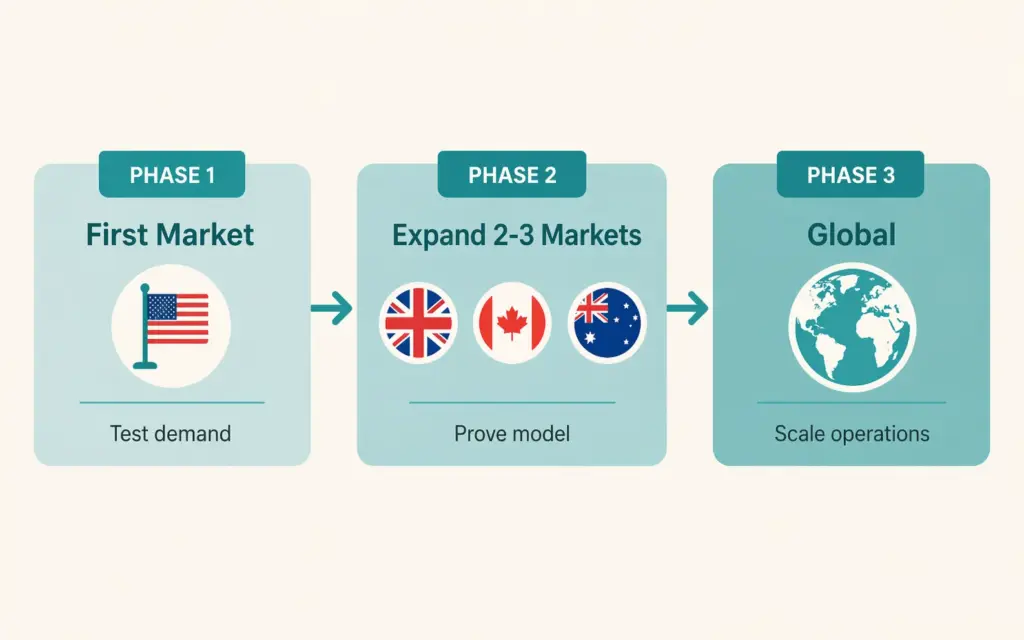
- Start with one international market, not ten. Choose based on: existing international traffic in your analytics, language overlap (English-speaking markets first for US sellers), ecommerce maturity, and shipping feasibility. Canada, UK, and Australia are the easiest first markets for US-based stores.
- Shopify Markets, BigCommerce's multi-storefront, and WooCommerce with WPML handle multi-currency, localized pricing, and international shipping from a single store admin. You don't need separate stores for each country.
Selling internationally ecommerce means expanding your online store beyond your domestic market to accept orders from, ship to, and optimize for customers in other countries, handling the added complexity of international shipping, multi-currency pricing, tax compliance, language differences, and varied consumer expectations. Cross-border ecommerce now represents roughly 22% of global online sales and is growing at nearly double the rate of domestic ecommerce.
Most ecommerce sellers never go international because the complexity feels overwhelming. Customs forms, VAT registration, currency conversion, translated product pages, it sounds like a full-time job on top of running your existing store. But modern ecommerce platforms and tools have reduced most of these barriers to configuration settings rather than operational headaches.
This guide covers the practical steps to take your store global, starting with how to choose your first international market and ending with the tools that make ongoing international operations manageable. If you’re still building your domestic operation, focus on our store launch guide first and come back here when you’re generating consistent domestic revenue.
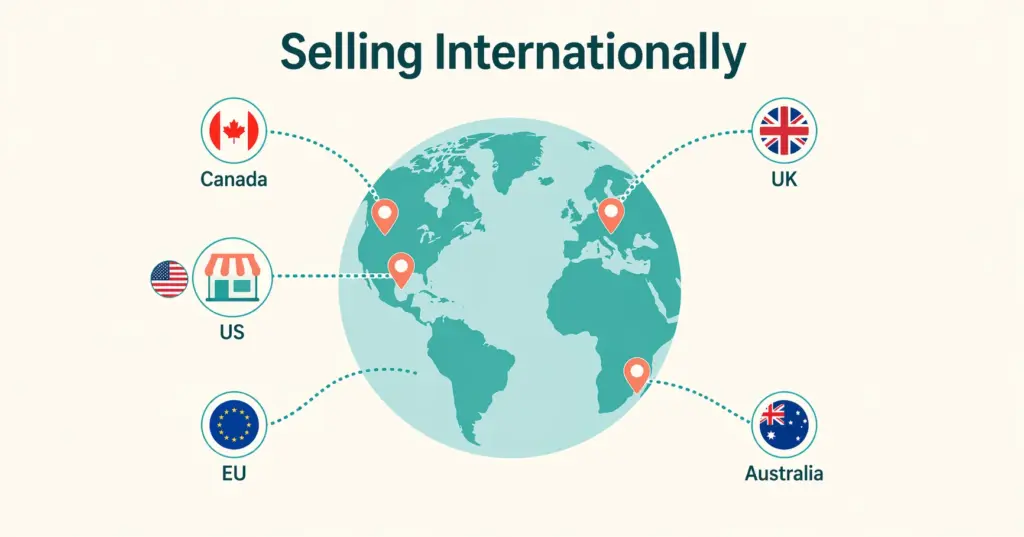
Why Sell Internationally
The case for global ecommerce selling is straightforward math. The US has 340 million people. The English-speaking world has 1.5 billion. The global online shopping population exceeds 2.7 billion. Going international multiplies your addressable market by 5-10x without creating new products.
Additional advantages:
- Reduced seasonal dependency. When it’s winter in the US, it’s summer in Australia. Seasonal products sell year-round across hemispheres.
- Lower competition in some markets. Products saturated in the US market may face little competition in Southeast Asia, Latin America, or Eastern Europe.
- Currency diversification. Revenue in multiple currencies reduces exposure to any single economy’s fluctuations.
- Higher margins in premium-perception markets. US and European brands often command premium pricing in Asian and Latin American markets where “imported” carries cachet.
Choosing Your First International Market
Don’t try to sell to 20 countries simultaneously. Start with one market, prove the economics work, then expand methodically.
Check your existing data first. Open your Google Analytics and look at geographic data. If 5% of your traffic already comes from Canada or the UK, those visitors are finding you organically. Converting existing international interest is easier than creating demand from zero.
Easiest first markets for US-based sellers:
| Market | Why It’s Easy | Key Consideration |
|---|---|---|
| Canada | English-speaking, similar culture, land border shipping | CAD pricing, Canadian sales tax (GST/HST) |
| United Kingdom | English-speaking, high ecommerce adoption | UK VAT registration required for B2C sales, Brexit customs |
| Australia | English-speaking, strong ecommerce market | GST registration for sellers over AUD $75K, longer shipping |
| European Union | Massive market (450M people), high spending power | IOSS VAT registration, EU product compliance, GDPR |
Start with the market that has the lowest barriers and the strongest existing signal from your analytics data.
International Shipping: Options and Costs
Shipping is the most tangible barrier to selling internationally online. Here are the options from simplest to most sophisticated:
Direct Shipping From Your Warehouse
Ship each international order from your domestic location using USPS International, UPS Worldwide, FedEx International, or DHL Express. Simple to start, no upfront investment, but per-package costs are high ($15-50+ depending on weight and destination) and delivery takes 7-21 days.
Best for: Testing international demand with low order volumes. If you sell 5-10 international orders per week, direct shipping works fine.
International Fulfillment Centers
Store inventory in a fulfillment center located in your target market. A UK-based 3PL stores your products and ships domestically within the UK, giving customers 1-3 day delivery instead of 2-3 weeks from the US. Higher upfront commitment (shipping bulk inventory overseas) but dramatically better customer experience.
Best for: Markets generating 50+ orders per month. The improved delivery times increase conversion rate enough to justify the logistics investment. Amazon FBA supports this through their international fulfillment programs (FBA Export, Pan-EU, NARF).
Cross-Border Fulfillment Services
Services like Global-e, Passport Shipping, and ShipBob Global handle international fulfillment including customs clearance, duties calculation, and local last-mile delivery. They act as intermediaries that simplify the complexity into a single integration.
Best for: Stores wanting a hands-off international experience. Higher per-order cost but minimal operational burden.
Multi-Currency Payments
Showing prices in the customer’s local currency increases conversion by 12-20% compared to showing USD. Nobody wants to do math while shopping.
Platform solutions:
- Shopify Markets: Built-in multi-currency, automatic exchange rate conversion, localized checkout. Included on all Shopify plans.
- BigCommerce: Multi-currency built into the platform with the ability to set fixed prices per currency rather than just automatic conversion.
- WooCommerce: WPML + WooCommerce Multilingual plugin handles both multi-language and multi-currency. Requires more configuration than hosted platforms.
Beyond currency display, consider local payment methods. Credit cards dominate in the US, UK, and Australia. But iDEAL dominates in the Netherlands, Bancontact in Belgium, and PIX in Brazil. Offering local payment methods can increase conversion by 20-30% in markets where alternative payments are preferred. Stripe and PayPal support most major local payment methods through a single integration.
Tax Compliance: VAT, GST, and Duties
This is the part that scares most sellers, but it’s more manageable than it appears.
European Union (VAT and IOSS)
For shipments to EU consumers valued under €150, register for the Import One-Stop Shop (IOSS). This lets you collect VAT at checkout and remit it through a single EU member state, rather than dealing with customs VAT collection on each package. Without IOSS, your customers pay VAT plus handling fees at delivery, creating a terrible buying experience and increasing refusal rates.
United Kingdom (UK VAT)
Non-UK sellers must register for UK VAT if selling B2C goods valued under £135. You charge VAT at checkout (20%) and remit it quarterly through HMRC. Above £135, the customer pays import VAT at customs.
Australia (GST)
Non-resident sellers must register for Australian GST if annual sales to Australian consumers exceed AUD $75,000. GST rate is 10%, collected at checkout.
Canada
Canada has relatively simple cross-border rules. No GST registration required for non-resident sellers under most circumstances. Customs duties and GST are collected at the border by the carrier. The de minimis threshold (duty-free up to CAD $20 for gifts, CAD $40 for postal shipments) means many small-value orders enter duty-free.
Automation tools: Avalara, TaxJar, and Zonos handle international tax calculation and compliance across markets. They integrate with Shopify, WooCommerce, and BigCommerce to automatically charge the correct VAT/GST at checkout based on the customer’s location. Our legal and tax guide covers domestic tax fundamentals that international compliance builds on.
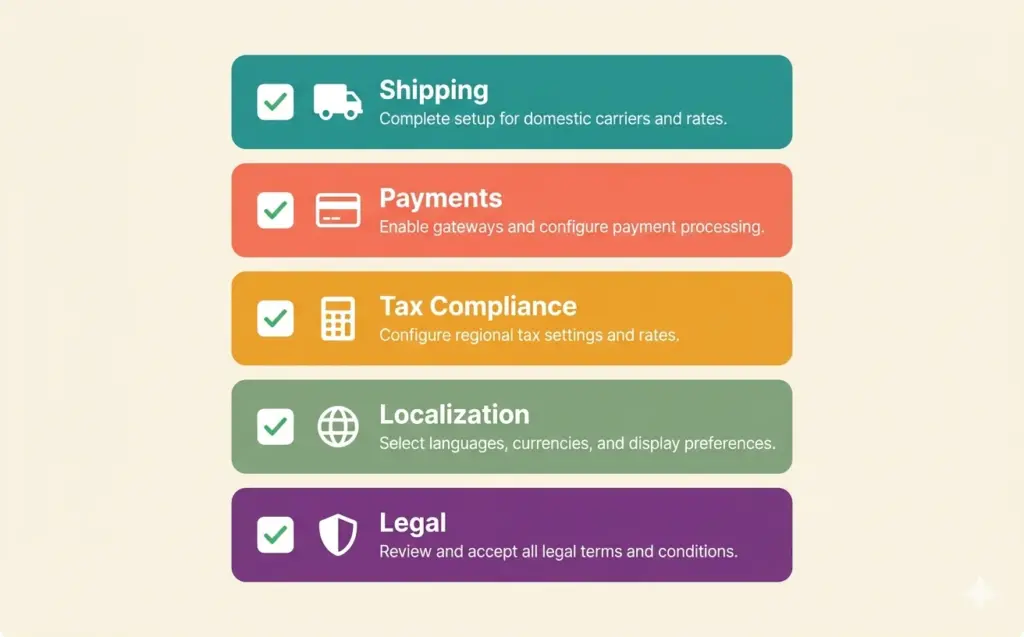
Localization Beyond Translation
Localization means adapting your store experience for each market, not just translating words.
Language: For English-speaking markets (Canada, UK, Australia), localization is minimal: adjust spellings (colour vs color), measurement units (kg vs lb), and date formats. For non-English markets, professional translation matters. Machine translation creates awkward phrasing that signals “this brand doesn’t care about my market.” Invest in human translation for product pages, at minimum.
Sizing and measurements: Convert to local standards. US shoe size 9 = UK 8.5 = EU 43. List ALL relevant sizing systems on your product pages. Sizing confusion is the top cause of international returns.
Cultural adaptation: Marketing imagery, color associations, and messaging tone vary by culture. Red signifies luck in China and danger in Western markets. White is associated with purity in the West and mourning in some Asian cultures. Research your target market’s preferences before localizing creative.
Localized content marketing. Your US-focused SEO strategy won’t transfer directly. Keyword volumes, search intent, and competing content differ by market. Build market-specific content for your top international markets once they generate meaningful revenue.
International Selling on Marketplaces
The fastest way to test international demand without building localized infrastructure is through global marketplaces.
Amazon Global Selling: Sell on Amazon.co.uk, Amazon.de, Amazon.co.jp, and 15+ international Amazon marketplaces. FBA handles local fulfillment, customer service, and returns. You ship bulk inventory to each market’s Amazon warehouse. This is the lowest-friction path to international sales for Amazon sellers.
eBay Global Shipping Program: Ship to eBay’s US hub, and they handle international forwarding, customs, and delivery. Zero international logistics for you. Higher shipping costs for buyers but zero complexity for sellers.
Etsy: Etsy’s global marketplace exposes listings to international buyers automatically. You set shipping profiles per country. Etsy handles currency conversion at checkout. For handmade and vintage sellers, Etsy is the easiest international channel.
Use marketplace international sales data to validate demand before investing in your own localized store experience. If your products sell well on Amazon UK through FBA, building a UK-optimized version of your own store has a proven market behind it.
Common International Selling Mistakes
Expanding to too many markets at once. Each new market adds compliance requirements, shipping logistics, and customer service complexity. Master one market before adding another. Even large brands typically expand one market at a time.
Ignoring customs duties in pricing. If a customer in Germany orders a $40 product and gets hit with a €15 duty and €5 handling fee at delivery, they’ll refuse the package and request a refund. Calculate landed cost (product + shipping + duties) and either include duties in your pricing (DDP: Delivered Duty Paid) or clearly communicate expected duties at checkout.
Not localizing customer service. An English-only support team can’t help a French customer describing a product issue in French. At minimum, use AI translation tools to understand incoming support requests in other languages. For major markets, hire native-speaking support agents or use multi-language chatbots.
Using your domestic return address. International return shipping costs $15-40+. If your return rate is 10%, you’re spending $1.50-4.00 per order on returns you may never receive (customers often discard rather than ship back internationally). Consider offering refund-without-return for items under $30 in international markets. Your pricing should account for higher return logistics costs.
Frequently Asked Questions
Check your analytics for existing international traffic. Choose one market with the strongest signal (Canada, UK, or Australia are easiest for US sellers). Enable multi-currency on your platform (Shopify Markets handles this natively). Set international shipping rates. Research tax obligations for that market. Start with direct shipping from your warehouse and upgrade to local fulfillment when order volume justifies it.
The five main challenges: international shipping costs and delivery times, tax compliance (VAT/GST registration and collection), currency conversion and local payment methods, language and cultural localization, and product compliance with local regulations. Each is solvable with modern tools and platform features, but they require upfront research and configuration.
For B2C shipments to EU consumers valued under €150, register for IOSS (Import One-Stop Shop) to collect and remit VAT at checkout. Without IOSS, customers pay VAT plus handling fees at delivery, which damages their experience and increases refusal rates. For the UK specifically, VAT registration is required for B2C goods under £135. Consult a tax advisor for your specific situation.
Shopify with Shopify Markets is the easiest for international selling, with built-in multi-currency, localized checkout, international domains, and duties estimation. BigCommerce supports multi-currency and multi-storefront natively. WooCommerce with WPML offers the most flexibility but requires more configuration. All three platforms support international selling; Shopify requires the least setup effort.
Use Amazon Global Selling to list products on international Amazon marketplaces (UK, Germany, Japan, Australia, etc.). Ship bulk inventory to each market’s FBA warehouse. Amazon handles local fulfillment, customer service, and returns. Amazon also offers FBA Export (ship from US FBA to international customers) and NARF (North America Remote Fulfillment) for simpler cross-border options.
Canada is the easiest first international market for US sellers: English-speaking, similar consumer culture, land border for affordable shipping, no VAT registration requirement for most non-resident sellers, and a high ecommerce adoption rate. After Canada, the UK and Australia are natural next steps as English-speaking markets with strong online shopping habits.
Related Reads
- Amazon FBA Guide
- Inventory Management Guide
- Ecommerce Automation Guide
- Legal Setup and Tax Guide
- Best Ecommerce Platform Comparison
- Ecommerce Pricing Strategy
Enjoying this? Get more like it every week.
One email per week with ecommerce strategies, tool picks, and seller insights. No spam.