

- Trending products fall into two categories: short-lived viral products (fidget spinners, viral TikTok gadgets) and sustained growth categories (clean beauty, smart home, pet wellness). Build your business on sustained trends, not viral spikes.
- The free tools that actually work for spotting trends: Google Trends, Amazon Best Sellers + Movers & Shakers, TikTok Creative Center, and Pinterest Trends. Use them weekly, not once.
- Products showing stable or rising search interest for 90-180 days consistently outperform viral items in long-term sales and repeat purchases.
- The best approach: build in an evergreen niche, then selectively add trending products within that niche to capture short-term demand without betting your entire business on a fad.
Every week someone asks me “what’s trending right now?” And every week my answer is the same: the product doesn’t matter as much as how you found it and whether the trend has legs.
Trending products are items experiencing a significant rise in consumer demand, search volume, and sales velocity over a defined period. They can be driven by social media virality (TikTok, Instagram), seasonal shifts, cultural moments, new technology, or evolving consumer behavior. The critical distinction most sellers miss: there’s a massive difference between a product that’s trending upward on a sustained growth curve and a product that spiked for two weeks because a TikTok video went viral.
One builds a business. The other leaves you with a garage full of unsold inventory.
If you’re starting an ecommerce business, this article will do two things: show you what’s trending right now, and more importantly, teach you HOW to spot trends yourself so you’re never dependent on someone else’s list. Because by the time a product shows up on a “top trending products” blog post, thousands of other sellers have already read the same article.
How to Spot Trending Products (The 5 Free Tools That Work)
Before I give you a single product recommendation, here are the tools that actually reveal trends in real time. Bookmark these. Check them weekly.
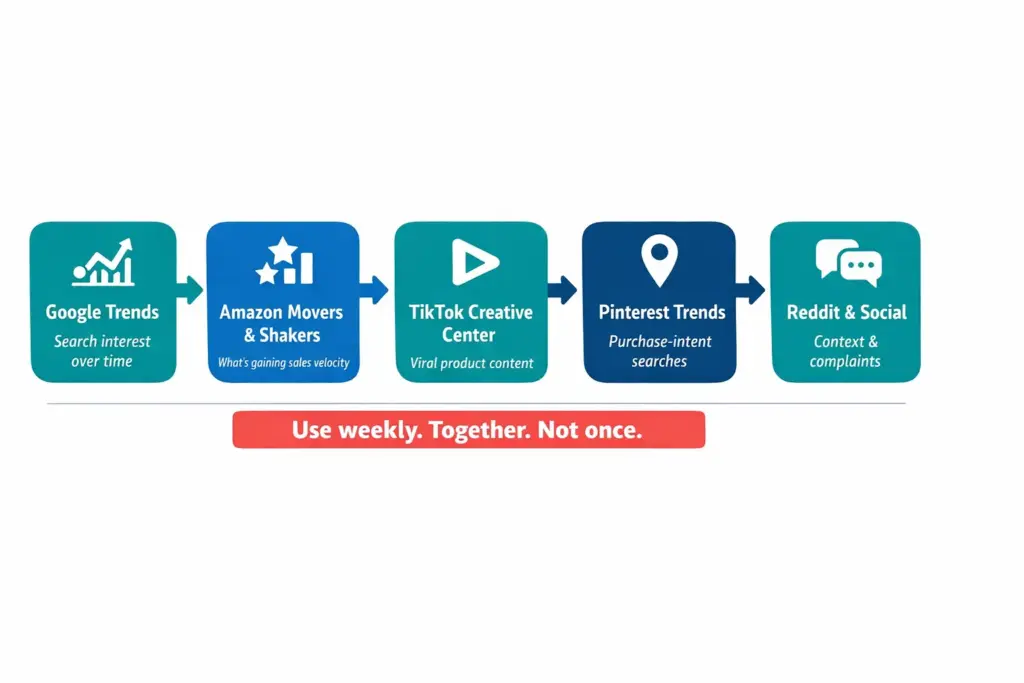
1. Google Trends (trends.google.com). The single most important free tool for product research. Type any product keyword and see search interest over time. What you’re looking for: steady upward trajectory over 12+ months (sustained trend) vs a sharp spike and drop (fad). Compare multiple products side by side. Filter by region to find geographic opportunities. Check “Related queries” for emerging sub-trends you haven’t considered.
2. Amazon Best Sellers and Movers & Shakers. Amazon’s Best Sellers list shows what’s selling right now. Movers & Shakers shows what’s gaining sales velocity fastest. The combination tells you both current demand and acceleration. Look for products climbing Movers & Shakers that have a Best Sellers Rank (BSR) under 100,000 in their main category with under 500 reviews. That’s demand without entrenched competition.
3. TikTok Creative Center. TikTok drives product trends faster than any other platform. The Creative Center shows trending hashtags, products, and ad creatives. Search product-related hashtags and sort by growth rate. Products getting millions of views on TikTok today often hit mainstream demand 2-4 weeks later. This is your early warning system.
4. Pinterest Trends. Pinterest is a visual search engine where people plan purchases. Pinterest Trends shows rising search terms with actual data. Because Pinterest users search with buying intent (planning a room makeover, a wedding, a wardrobe refresh), rising Pinterest searches translate to actual sales better than most social platforms.
5. Social listening (Reddit, Twitter/X). Browse niche subreddits (r/ecommerce, r/AmazonFBA, r/dropshipping, plus subreddits for your specific niche). What are people asking about? What products are getting organic praise? What complaints reveal unmet needs? Reddit won’t give you data, but it gives you context that no tool can replicate.
What’s Trending Now: Products by Trend Durability
Instead of dumping 50 products on you, I’m organizing these by how LONG the trend is expected to last. This matters because your sourcing strategy, inventory investment, and brand-building approach should be completely different for a 3-month fad versus a 3-year growth wave.
Sustained Growth Trends (Multi-Year Runway)
These categories have been growing for years and show no signs of slowing. Build a brand here.
Clean and sustainable beauty. The clean beauty market is expected to reach $21.29 billion by 2030 (Grand View Research). Consumers are switching to products with transparent ingredient lists, cruelty-free certifications, and refillable packaging. Specific products gaining traction: solid shampoo bars, bakuchiol serums (retinol alternative), probiotic skincare, and waterless beauty concentrates.
Smart home devices and accessories. Over 69% of US households are expected to have at least one smart home device by 2026. Beyond the big-ticket items (smart speakers, thermostats), the accessories market is where smaller sellers can compete: smart plugs, sensor lights, cable management for smart setups, universal remotes, and smart home “starter kits” bundling compatible devices together.
Pet wellness and tech. The global pet care market is projected to grow at 6.8% annually through 2032 (Global Market Insights). The specific trend within pet products: wellness-oriented and tech-enabled items. GPS trackers, automatic feeders with cameras, calming supplements, dental health chews, and breed-specific nutrition products. Pet owners are spending like parents now. The “pet humanization” trend is real and accelerating.
Health supplements (targeted formulations). The global supplement market is projected to reach $230.7 billion by 2027. Generic multivitamins aren’t the trend. Targeted formulations are: gut health probiotics, mushroom-based adaptogens (lion’s mane, reishi), collagen peptides, magnesium supplements for sleep, and women’s hormone-balancing blends. The more specific the problem it solves, the higher the willingness to pay.
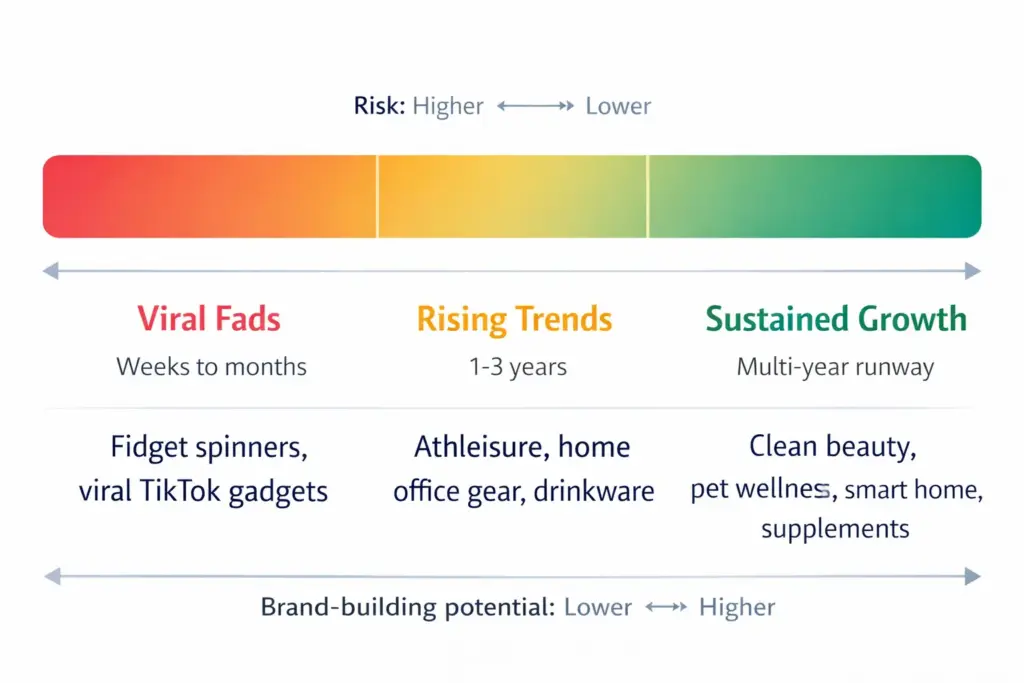
Rising Categories (1-3 Year Opportunity Window)
These are growing fast right now but the trajectory could flatten. Get in, build position, and diversify.
Athleisure and hybrid workwear. The line between gym clothes and office clothes keeps blurring. Searches for athleisure remain consistently high on Google Trends year over year. Products moving: jogger pants that look professional, performance polo shirts, stretchy blazers, and crossover pieces that work for a Zoom call and a gym session.
Home office and productivity gear. With over 40% of the global workforce still working remotely at least part-time, demand for home office products remains strong. Rising sub-categories: ergonomic desk accessories (monitor stands, keyboard trays), acoustic panels for home offices, desk organizers, blue light glasses, and standing desk converters.
Air quality and personal wellness devices. Portable air purifiers, humidifiers with aromatherapy, red light therapy panels, and sleep-enhancing devices (white noise machines, weighted sleep masks). The wellness device market sits at the intersection of health consciousness and home comfort.
Personalized and custom products. This isn’t a single product but a trend cutting across every category. Personalized jewelry, custom pet portraits, monogrammed leather goods, engraved kitchenware. Nearly 60% of consumers feel emotionally connected to personalized items (Merchize, 2026). The customization premium adds 80-150% to the price of generic equivalents.
Current Hot Products (3-12 Month Opportunity)
These are selling well RIGHT NOW but could cool off. Source light, move fast, don’t over-invest in inventory.
Insulated tumblers and drinkware. The Stanley Cup craze proved drinkware can be a cultural phenomenon. Customized, color-coordinated, and limited-edition tumblers continue to sell aggressively. The opportunity for smaller sellers: niche designs (specific professions, hobbies, fandoms) rather than competing on generic tumblers.
Portable power and tech accessories. Portable battery packs, magnetic phone mounts, MagSafe-compatible accessories, and multi-device charging stations. Every new phone launch creates a wave of accessory demand. Dashboard accessories saw 140% annual sales growth on Shopify in 2024.
Acne patches and targeted skincare tools. Pimple patches went from niche Korean beauty product to mainstream essential. Related products gaining traction: microcurrent devices, ice roller facial tools, LED face masks for home use, and post-procedure skincare kits.
Baby and toddler products (safety and developmental focus). Montessori-style toys, silicone feeding sets, baby-led weaning tools, and organic baby skincare. Parents prioritize safety certifications and developmental benefits over price, making this a premium-friendly category.
How to Validate a Trend Before Investing
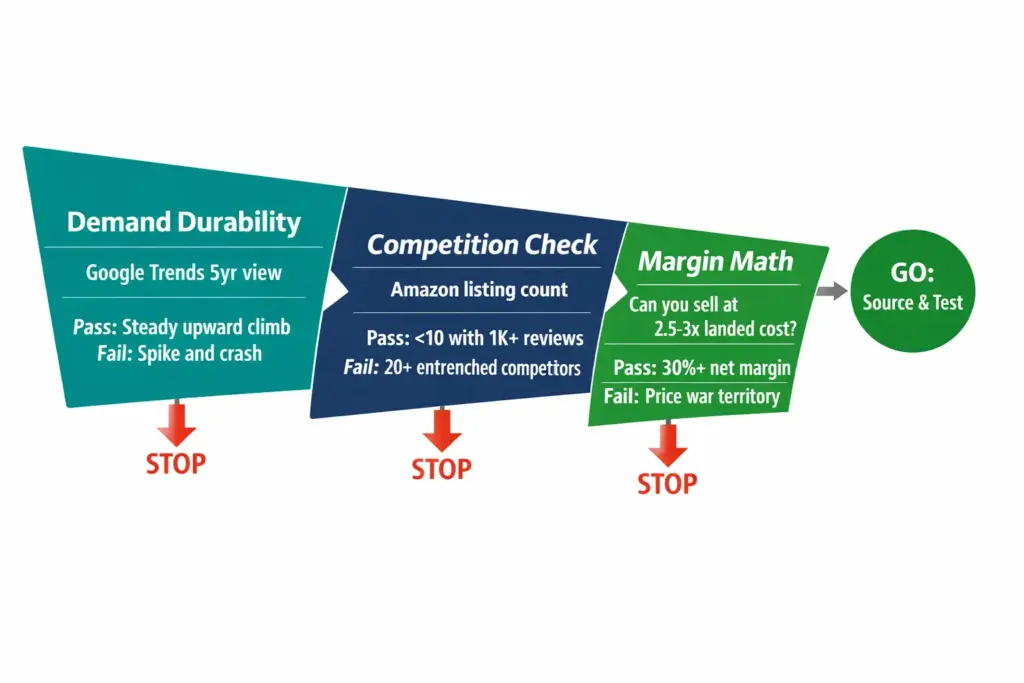
Spotting a trend is step one. Validating whether YOU should sell it is step two. Run every trending product through these three filters:
Filter 1: Demand durability. Pull the product keyword into Google Trends. Set the time range to 5 years. Is the trend line going up over the full period, or did it spike once and flatline? If the trend only appeared in the last 3 months, it might be a fad. If it’s been climbing for 2+ years with seasonal peaks, it’s sustained demand.
Filter 2: Competition reality. Search the product on Amazon and count listings with 1,000+ reviews. More than 20 entrenched competitors with thousands of reviews? You’ll spend a fortune on ads to crack that market. Under 10? There’s room. Also check: are the top sellers major brands or small independent sellers? Small sellers succeeding means you can too.
Filter 3: Margin math. Trending doesn’t mean profitable. Source the product, estimate landed cost (product + shipping + customs if importing), add platform fees (Amazon takes 30-40% all-in, Shopify costs less but requires ad spend). If you can’t sell at 2.5-3x your landed cost, the margins probably don’t work. Trending products with heavy competition often trigger price wars that destroy margins for everyone.
Trending vs Evergreen: The Smart Approach
Here’s what experienced sellers do that beginners don’t: they build their store around an evergreen niche and ADD trending products within that niche as seasonal or limited-time offerings.
A pet store built on evergreen products (food, leashes, beds) adds trending items (GPS collars, calming supplements) when demand spikes. The evergreen core provides steady revenue. The trending additions capture growth waves without risking the whole business on a fad.
This is the model that works long term. Our profitable ecommerce niches guide covers how to pick the evergreen foundation, and this article shows you how to layer trending products on top of it.
Frequently Asked Questions
What are the most trending products to sell right now?
Clean beauty products, smart home accessories, pet wellness items, targeted health supplements, personalized/custom products, and athleisure are the strongest sustained trends. For shorter-term opportunities: insulated drinkware, portable tech accessories, and acne patches.
How do I find trending products before they blow up?
Use Google Trends weekly to monitor rising search terms. Check Amazon Movers & Shakers for fast-climbing products. Browse TikTok Creative Center for viral product content. Pinterest Trends reveals purchase-intent search growth. Combine all four for the clearest picture.
Is it better to sell trending or evergreen products?
Build on evergreen, layer trending on top. Evergreen products (pet food, baby essentials, skincare basics) provide stable revenue. Trending products capture short-term demand spikes. The combination gives you both predictability and growth.
How do I know if a trend is a fad or sustainable?
Check Google Trends over a 5-year window. Sustained trends show steady upward trajectory across years. Fads show a sharp spike and rapid decline within weeks or months. If the product solves a real ongoing problem (not just novelty), it’s more likely sustainable.
What trending products sell best on Amazon?
Amazon’s best-performing trending categories include health and household, beauty and personal care, pet supplies, home and kitchen, and electronics accessories. Use Amazon’s Best Sellers and Movers & Shakers lists filtered by subcategory to find specific products with rising demand.
Related reads: Complete Guide to Starting an Ecommerce Business | Profitable Ecommerce Niches | Best Selling Products Research | What to Sell Online | Products to Resell for Profit | Ecommerce Business Models
Enjoying this? Get more like it every week.
One email per week with ecommerce strategies, tool picks, and seller insights. No spam.