
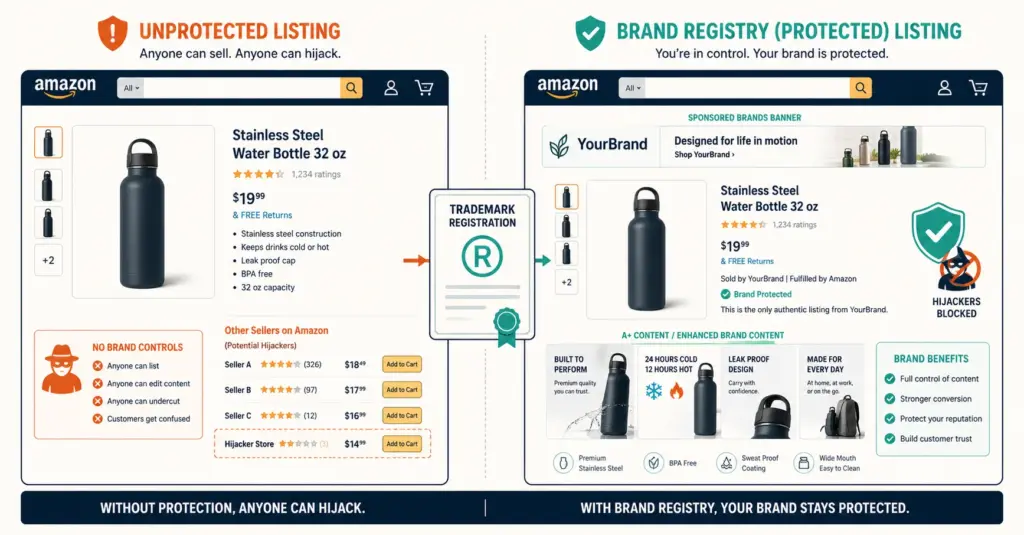
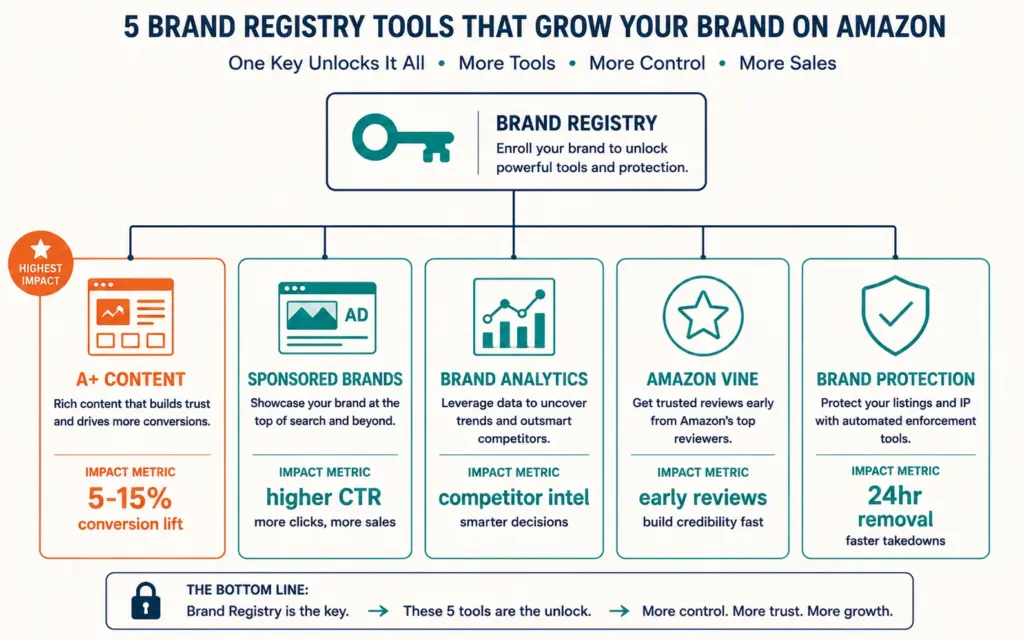
- Amazon Brand Registry is a free program that verifies you own your brand's trademark and unlocks tools you can't access without it: A+ Content (5 to 15% conversion lift), Sponsored Brands ads, Brand Analytics (competitive intelligence), Amazon Vine (early reviews), and automated counterfeit protection. It's not optional for serious Amazon sellers in 2026.
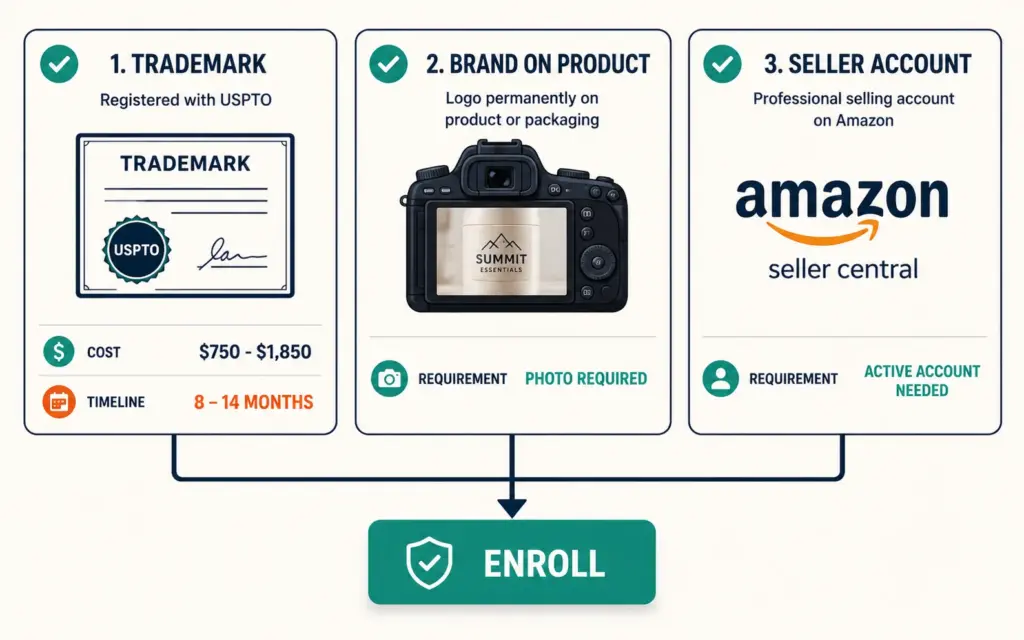
- The main requirement is a registered or pending trademark. US trademark filing costs $250 to $400 through USPTO, takes 8 to 14 months for approval, and you need a trademark attorney or filing service ($500 to $1,500 additional). Amazon accepts pending applications through their IP Accelerator program, which gets you earlier access to Brand Registry benefits while your trademark is processed.
- Enrollment itself takes 1 to 5 business days once you have your trademark. You'll need: your brand name (matching your trademark exactly), a logo image, photos of your brand on products or packaging, and your trademark registration or application number. Common rejection reason: the brand name on your application doesn't exactly match your trademark filing.
- The ROI is clear. A+ Content alone lifts conversion 5 to 15%. Brand Analytics gives you competitor search term data you can't get anywhere else. Listing hijacker protection locks your content so competitors can't edit your product pages. The trademark is the real investment; Brand Registry itself is free and the tools it unlocks pay for the trademark many times over.
Amazon Brand Registry is Amazon’s program for verifying trademark ownership and granting access to selling tools that are locked behind enrollment. You can sell on Amazon without it. Plenty of resellers and arbitrage sellers do. But if you’re building a brand (private label, DTC expanding to Amazon, or manufacturing your own products), Brand Registry is the dividing line between sellers who control their listings and sellers who don’t.
Without Brand Registry, anyone can modify your product listing’s title, images, and bullet points. Competitors can hijack your listing by adding themselves as sellers. Counterfeiters can list knock-offs using your brand name. You have no access to A+ Content, Sponsored Brands ads, Brand Analytics, or Amazon Vine. According to Amazon’s Brand Registry page, the program puts “additional protections in place to help safeguard your brand’s product information,” but what it really does is give you the controls that every brand owner on Amazon needs.
What You Need Before You Can Enroll
A registered or pending trademark
This is the gatekeeper. Brand Registry requires a trademark that’s either registered (fully approved) or pending (application filed) with a recognized government trademark office. In the US, that’s the USPTO. In the EU, it’s EUIPO. Amazon accepts trademarks from most major national offices.
Two types of trademarks qualify: a text-based mark (word mark, which is your brand name in standard lettering) or an image-based mark (design mark, your logo with words, letters, or numbers). Your trademark must match your brand name exactly. If your trademark says “WILDPEAK OUTDOORS” and your Brand Registry application says “Wild Peak,” it will be rejected. Character-for-character matching matters.
Trademark costs and timeline
Filing a US trademark through USPTO costs $250 to $350 per class of goods. Most Amazon sellers file in one class (covering their product category). Adding a trademark attorney to handle the filing: $500 to $1,500 additional. Total cost: $750 to $1,850. Processing time: 8 to 14 months for approval.
If you don’t want to wait 8 to 14 months, Amazon’s IP Accelerator program connects you with Amazon-vetted trademark attorneys. Filing through IP Accelerator gets you earlier access to Brand Registry benefits while your trademark is still pending. The cost is comparable to hiring any trademark attorney ($600 to $2,000 depending on complexity). The how to start ecommerce business process should include trademark filing as a standard step for any brand planning to sell on Amazon.
Brand presence on products
Your brand name or logo must be permanently affixed to your products or packaging. During enrollment, Amazon asks for photos showing your brand on the product. Digital-only brands without physical labeling face challenges here. If you sell physical products, make sure your brand name appears on the product itself, the packaging, or a hang tag. A sticker on the packaging counts. A brand name only on your website does not.
How to Enroll: Step by Step
- Go to brandservices.amazon.com and sign in with your Seller Central credentials. If you don’t have a Seller Central account, create one first.
- Click “Enroll a new brand.” Enter your brand name exactly as it appears on your trademark record. Upload your logo exactly as it appears on your trademark. Any discrepancy triggers rejection.
- Provide trademark details. Enter your trademark registration number (or pending application number), the trademark office that issued it, and the trademark type (word mark or design mark).
- Upload product photos. Photos must clearly show your brand name on the product or packaging. Good lighting, readable text, clear enough that Amazon’s review team can verify the brand is physically on the item.
- Submit and verify. Amazon sends a verification code to the contact associated with your trademark filing. Enter the code to confirm your identity. This is Amazon’s way of verifying you’re actually the trademark owner.
Approval takes 1 to 5 business days after verification. Common rejection reasons: brand name doesn’t exactly match the trademark, photos don’t clearly show the brand on the product, or the trademark is expired. Fix the issue and resubmit. Most rejections are resolvable.
What Brand Registry Unlocks
A+ Content (biggest conversion impact)
A+ Content replaces your basic product description with visually rich modules: comparison charts, branded image banners, detailed feature breakdowns, and brand story sections. It transforms a plain text listing into a branded product page. The impact is real: A+ Content lifts conversion 5 to 15% on average across categories. On a listing getting 1,000 visits/month with a 15% conversion rate, a 10% lift means 15 additional sales per month. At $30 AOV, that’s $450/month from a one-time content investment.
The Amazon listing optimization strategy should treat A+ Content as the highest-priority Brand Registry benefit because it directly lifts the metric that determines everything else: conversion rate. Higher conversion improves organic ranking, which increases traffic, which produces more sales.
Sponsored Brands ads
Brand Registry unlocks Sponsored Brands (banner ads at the top of search results featuring your logo, a custom headline, and multiple products) and Sponsored Brands Video (video ads in search results). These ad formats produce higher click-through rates than standard Sponsored Products ads because they occupy more visual real estate and carry brand-level messaging. The Facebook ads for ecommerce strategy should include Sponsored Brands as a separate budget line once Brand Registry is active.
Brand Analytics
Competitive intelligence that’s impossible to get anywhere else. Brand Analytics shows you: the top search terms buyers use to find products in your category (with click and conversion share by ASIN), the “market basket” of products frequently bought together, and the demographics of buyers in your category. This data shapes your keyword strategy, product development, and advertising targeting. The customer acquisition cost analysis gets more precise when Brand Analytics reveals which search terms actually drive purchases vs just clicks.
Amazon Vine
Vine is Amazon’s invite-only review program where trusted reviewers receive your product for free and post honest reviews. You provide the product (at your cost), Amazon handles the reviewer selection and review process. Cost: $200 per enrolled product plus the cost of the free units. Vine reviews carry the “Vine Voice” badge and are perceived as more trustworthy by buyers. For new product launches, Vine provides 5 to 30 early reviews that build the social proof needed to start organic sales momentum. The reviews and social proof strategy for Amazon should include Vine as the primary early-review mechanism.
Brand protection tools
Automated counterfeit detection scans for listings using your brand name without authorization. Report a Violation tool lets you flag infringing listings for removal (Amazon typically removes within 24 hours for Brand Registry members vs weeks for unregistered brands). Project Zero gives you the power to remove counterfeit listings yourself without waiting for Amazon’s review. Listing edit lockdown means only Brand Registry holders can modify core listing content (title, bullets, images, A+ Content), preventing competitors from sabotaging your listings. According to Amazon’s Brand Registry overview, Amazon spent over $1.2 billion on brand protection and blocked 99% of suspected infringing listings before brands even had to report them in 2024.
Is Brand Registry Worth It for Your Situation?
Definitely yes if: You sell private label products, manufacture your own goods, or are a DTC brand expanding to Amazon. The trademark investment ($750 to $1,850) pays for itself within the first few months through A+ Content conversion lift alone. Listing protection and Sponsored Brands access accelerate growth beyond what’s possible without enrollment.
Probably not yet if: You’re doing retail arbitrage or wholesale reselling of other brands’ products. You can’t register a trademark for a brand you don’t own. If your Amazon revenue is under $10,000/year and you’re selling other people’s products, the trademark cost and timeline may not justify the investment at this stage.
Start the trademark now if: You’re planning to launch a private label product in 6 to 12 months. Trademark processing takes 8 to 14 months. File now so Brand Registry is available when your product launches. Trying to get a trademark after launch means months of selling without A+ Content, Sponsored Brands, or listing protection. The niche validation process should include checking trademark availability for your planned brand name as part of Step 5 (sustainable advantage assessment).
Common Enrollment Problems and Fixes
Brand name mismatch. The #1 rejection reason. Your Brand Registry application brand name must match your trademark character for character. “WILDPEAK” on your trademark means “WILDPEAK” on your application, not “Wild Peak” or “Wildpeak Outdoors.” Check your trademark certificate and copy the exact text.
Photos don’t show the brand clearly. Amazon needs to see your brand name on the physical product or packaging. Blurry photos, partially visible text, or brand names that are too small to read get rejected. Take well-lit, close-up photos where the brand name is clearly legible. Multiple angles help.
Verification code not received. Amazon sends the code to the contact listed on your trademark filing. If that’s your attorney’s office and they don’t forward it quickly, enrollment stalls. Ensure your trademark attorney knows to expect this code and can forward it immediately.
Trademark expired or inactive. Trademarks require periodic renewal. If yours lapsed, Brand Registry enrollment will fail. Check your trademark status on the USPTO website (or equivalent office) before applying. The standard operating procedures for brand management should include trademark renewal dates as calendar reminders.
Frequently Asked Questions
Brand Registry enrollment is free. The cost is the trademark: $250 to $400 USPTO filing fee per class, plus $500 to $1,500 if you use a trademark attorney. Total: $750 to $1,850. This is a one-time investment (trademarks last 10 years before renewal). The tools Brand Registry unlocks (A+ Content, Sponsored Brands, Brand Analytics) typically generate enough additional revenue to cover the trademark cost within the first 2 to 3 months of use.
Yes, in many cases. Amazon accepts pending trademark applications from supported trademark offices. Filing through Amazon’s IP Accelerator program provides earlier access to Brand Registry benefits while the trademark is still processing. Direct pending applications may also qualify depending on your country and trademark office. Full benefits require an approved (registered) trademark, but pending status grants access to most Brand Registry tools.
Enrollment review takes 1 to 5 business days after you submit your application and complete verification. The longer timeline is getting the trademark: 8 to 14 months for US trademark approval through USPTO. If you use IP Accelerator, you may get Brand Registry access while the trademark is still pending, shortening the effective wait time. The application itself takes about 30 minutes to complete.
A+ Content replaces your text-only product description with visually rich modules: image banners, comparison charts, feature breakdowns, and brand story sections. It lifts conversion rate 5 to 15% on average. A+ Content is free to create and publish for Brand Registry members. The conversion lift comes from better visual communication of product benefits and brand credibility that a text-only description can’t match.
No. Brand Registry does not prevent authorized resellers or wholesalers from listing genuine products they legally purchased. What it does: prevents unauthorized sellers from modifying your listing content (title, images, bullets), provides faster removal of counterfeit listings, and gives you tools to report trademark violations. If someone sells a genuine product they bought at retail, that’s not a Brand Registry issue. If someone sells a counterfeit using your brand name, Brand Registry enables removal within 24 hours.
Brand Registry is Amazon-specific. If you sell exclusively through your own Shopify or WooCommerce store and have no plans to sell on Amazon, you don’t need it. However, the trademark you’d file for Brand Registry also protects your brand legally across all channels, including your own website. If there’s any chance you’ll sell on Amazon in the future, file the trademark now because the 8 to 14 month processing time means planning ahead is essential.
Related Reads
- Amazon Listing Optimization
- A-Plus Content guide
- Amazon PPC Strategy
- Reviews and Social Proof
- Customer Acquisition Cost
- Niche Validation
Enjoying this? Get more like it every week.
One email per week with ecommerce strategies, tool picks, and seller insights. No spam.