
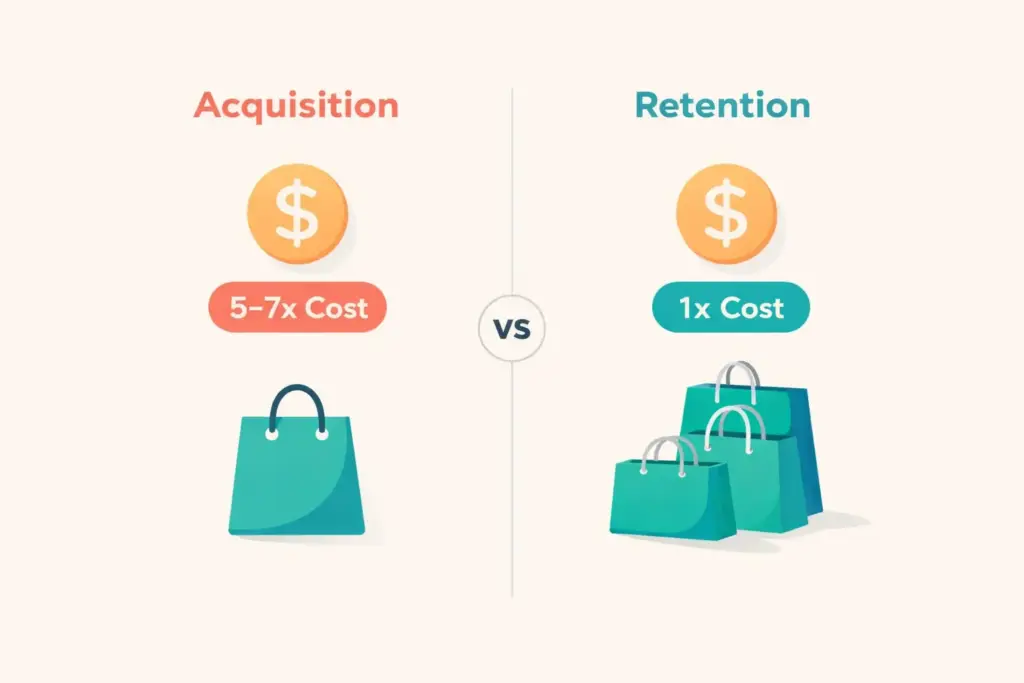
- Acquiring a new customer costs 5-7x more than retaining an existing one. A 5% increase in customer retention can boost profits by 25-95% according to Harvard Business Review research. Despite this, most ecommerce stores spend 80%+ of their marketing budget on acquisition and almost nothing on retention.
- The average ecommerce customer retention rate sits around 30-40%. Top-performing stores hit 60%+. Calculate yours with this formula: ((Customers at end of period - New customers acquired) / Customers at start of period) x 100.
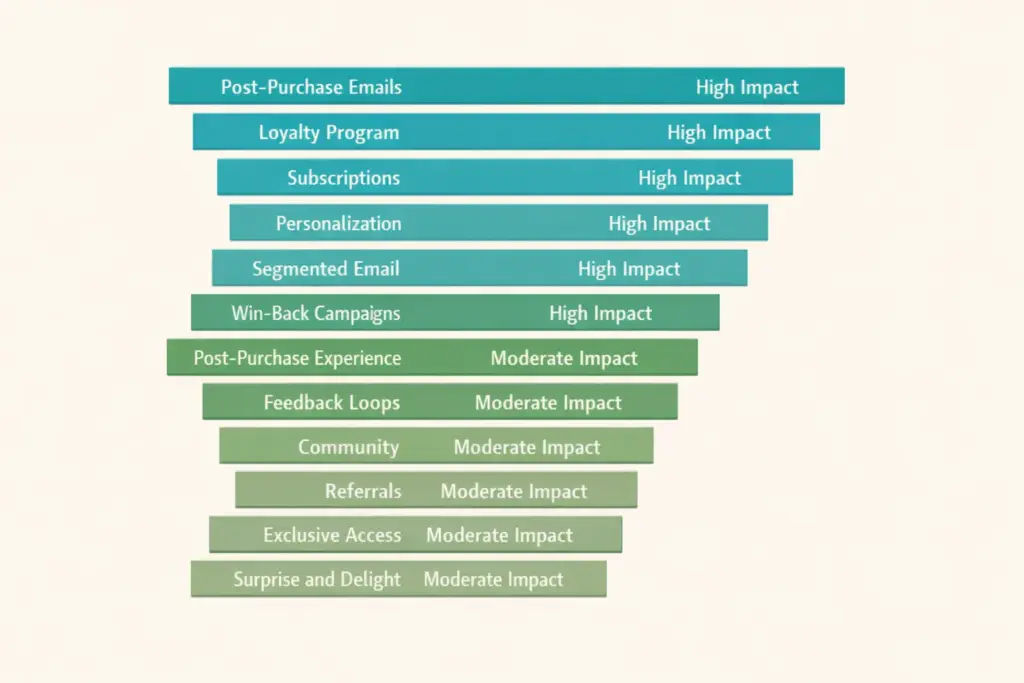
- The 12 strategies below are ordered by impact and ease of implementation: post-purchase email flows, loyalty programs, subscription options, personalization, and customer feedback loops are the highest-ROI retention investments for most stores.
- Retention compounds. A customer who buys 4 times is worth 3-5x more than a one-time buyer when you factor in reduced acquisition cost, higher average order value, and word-of-mouth referrals.
Ecommerce customer retention is the practice of keeping existing customers engaged and buying repeatedly from your online store, measured by the percentage of customers who return to make additional purchases over a given time period. It’s the single most underinvested area in ecommerce because most store owners are addicted to acquisition (getting new customers) while ignoring the fact that their existing buyers are 60-70% more likely to purchase again than a brand-new visitor.
Here’s the math that should change how you allocate your marketing budget: acquiring a new customer costs 5-7x more than retaining an existing one. A 5% increase in retention can boost profits by 25-95% according to Harvard Business Review. Yet most stores spend 80%+ of their budget chasing new traffic through ads while their existing customers quietly disappear after a single purchase.
This guide covers 12 ecommerce retention strategies ordered by impact, starting with the ones that deliver results fastest with the least effort. If you’ve been focused entirely on marketing for acquisition and haven’t built any retention systems, start with strategies 1-3 and add the rest over time.
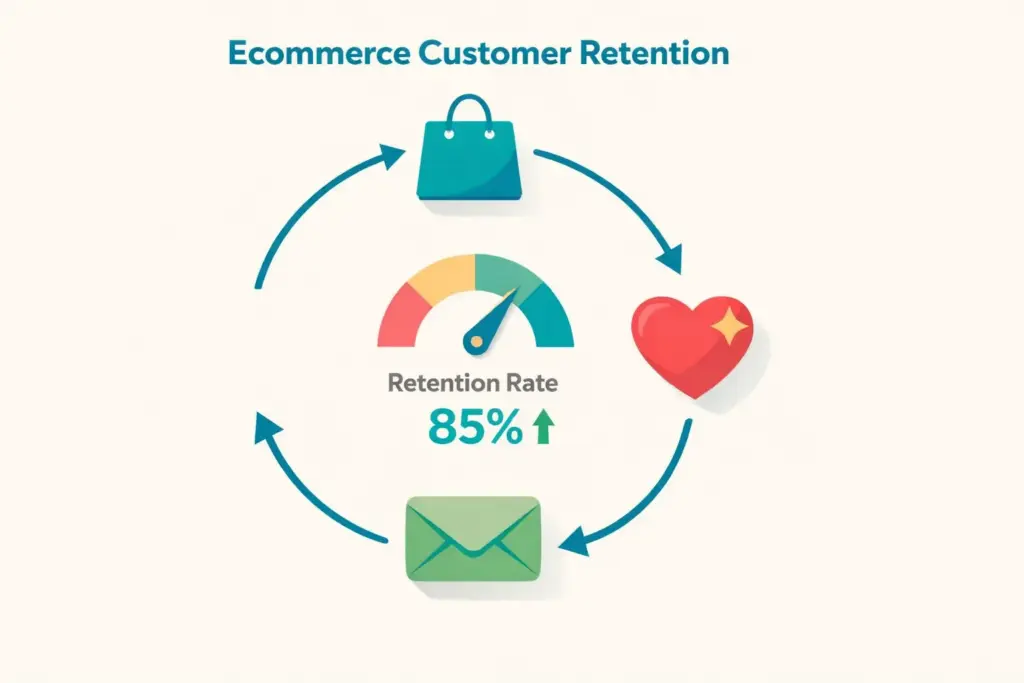
What Is a Good Customer Retention Rate for Ecommerce?
What is a good customer retention rate for an online store? The benchmarks vary by industry, but here’s what the data shows:
| Store Type | Average Retention Rate | Top Performers |
|---|---|---|
| General ecommerce | 30-40% | 55-65% |
| Subscription boxes | 45-55% | 70-80% |
| Fashion/apparel | 25-35% | 50-60% |
| Beauty/cosmetics | 35-45% | 60-70% |
| Food/consumables | 40-55% | 65-80% |
Customer Retention Rate Calculation
The customer retention rate calculation is straightforward:
Retention Rate = ((E – N) / S) x 100
- E = Number of customers at the end of the period
- N = Number of new customers acquired during the period
- S = Number of customers at the start of the period
Example: You start the quarter with 1,000 customers, acquire 300 new ones, and end with 1,100 total. Retention rate = ((1,100 – 300) / 1,000) x 100 = 80%. That means 80% of your starting customers came back.
If you’re on Shopify, your Shopify retention rate is visible in the Analytics dashboard under Customer Reports. Look at “Returning customer rate” for a quick read, though the full calculation above gives you more precision over specific time periods.
12 Ecommerce Customer Retention Strategies
1. Post-Purchase Email Sequence
The most impactful retention tool you can build in a single afternoon. After a customer buys, they’re at peak engagement with your brand. Most stores send a single order confirmation and then silence until the next promotional blast. That silence kills retention.
Build this 5-email post-purchase flow:
- Day 0: Order confirmation with delivery timeline
- Day 2-3: Shipping notification with tracking
- Day 7-10: “How’s your product?” check-in with usage tips
- Day 14: Review request (builds social proof while keeping engagement)
- Day 21-30: Related product recommendation or replenishment reminder
This sequence is the foundation of every customer retention campaign that works. It keeps your brand in front of buyers during the critical post-purchase window when they’re forming opinions about whether to buy from you again.
2. Loyalty and Rewards Program
Points-based loyalty programs give customers a tangible reason to return. Every purchase earns points. Points convert to discounts, free products, or exclusive perks. The psychological effect of accumulated points creates switching costs: a customer with 500 points is far less likely to buy from a competitor than one with zero.
For Shopify customer retention, apps like Smile.io, LoyaltyLion, and Yotpo Loyalty integrate directly and handle points tracking, tier management, and reward redemption. The investment is typically $50-200/month, which pays for itself if it prevents even a few customers from churning.
3. Subscription and Auto-Replenishment
If you sell consumable products (coffee, supplements, skincare, cleaning supplies), offering a subscription option with a 10-15% discount converts one-time buyers into recurring revenue. The customer locks in a convenient reorder schedule. You lock in predictable monthly income with zero re-acquisition cost.
This is the highest-ceiling retention strategy because subscription customers have retention rates of 70-80% compared to 30-40% for standard ecommerce.
4. Personalized Product Recommendations
Generic “you might also like” sections don’t move the needle. Personalized recommendations based on actual purchase history and browsing behavior drive 10-30% of ecommerce revenue for stores that implement them well. “Customers who bought your moisturizer also bought this serum” is more compelling than a random product grid.
5. Segmented Email Marketing
Stop sending the same promotional email to every customer. Segment by purchase history, average order value, product category, and engagement level. A customer who bought running shoes should receive content about running gear, not kitchen appliances. Segmented campaigns generate 760% more revenue than one-size-fits-all blasts according to Campaign Monitor research.
6. Win-Back Campaigns for Lapsed Customers
Customers who haven’t purchased in 60-90 days are at risk of churning permanently. A targeted win-back email sequence with a compelling offer (free shipping, 15% discount, new product announcement) recovers 5-15% of lapsed customers. That’s pure profit since you already paid to acquire them.
7. Exceptional Post-Purchase Experience
The experience between checkout and delivery shapes whether a customer returns. Branded packaging, a personal thank-you note, a free sample of another product, or even just fast and accurate shipping with proactive updates creates the kind of experience customers talk about. This doesn’t cost much per order but dramatically impacts retention and referrals.
8. Customer Feedback Loops
Ask customers what they want. Send a brief survey after their second purchase. Monitor review sentiment for recurring complaints. Act on the feedback publicly (“You asked for larger sizes, we listened”). Customers who feel heard become advocates. Those who feel ignored become competitors’ customers.
9. Community Building
Facebook groups, Discord servers, or branded communities around your product category create emotional attachment beyond the transaction. A skincare brand’s community where customers share routines and results creates stickiness that no discount can match. The best ecommerce business ideas are often the ones with built-in community potential.
10. Referral Program
“Give $10, Get $10” referral programs turn retained customers into acquisition channels. A referred customer has a 37% higher retention rate than one acquired through ads because they come with built-in trust from the person who referred them. Tools like ReferralCandy and Smile.io handle the mechanics.
11. Exclusive Access and Early Launches
Give returning customers first access to new products, limited editions, or sales events. VIP treatment makes customers feel valued and creates urgency to maintain their “status” with your brand. This costs nothing to implement but creates powerful psychological loyalty.
12. Surprise and Delight
Random unexpected gestures: a free product upgrade, a handwritten note on their 5th order, a birthday discount they didn’t sign up for. These moments are disproportionately memorable. One unexpected positive experience can cement loyalty more effectively than a 10% ongoing discount.
Measuring Ecommerce Retention: Key Metrics
Beyond the retention rate formula, track these metrics to understand whether your retention efforts are working:
Customer Lifetime Value (CLV). Total revenue from a customer across all purchases. Rising CLV means retention strategies are working. Calculate it: Average Order Value x Purchase Frequency x Average Customer Lifespan.
Repeat Purchase Rate. Percentage of customers who make more than one purchase. Visible in Shopify analytics under Customer Reports. Aim for 25%+ for general ecommerce, 40%+ for consumables.
Purchase Frequency. How often the average customer buys. More frequent purchases indicate stronger retention. Track this monthly and quarterly.
Time Between Purchases. The average gap between a customer’s first and second order. Shortening this gap is one of the clearest signs your customer retention campaigns are effective.
Net Promoter Score (NPS). One-question survey: “How likely are you to recommend us?” Scores above 50 indicate strong loyalty. Below 20 signals retention problems. Use this alongside your purchase data for a complete picture. Understanding your pricing strategy’s impact on perceived value is critical here too.
Building a Retention-First Ecommerce Business
Most stores operate on a “leaky bucket” model: pour money into ads to fill the bucket with new customers while existing customers drain out the bottom. A retention-first approach plugs the holes first, then fills the bucket.
The practical shift: allocate 20-30% of your marketing budget to retention activities (email automation, loyalty program, post-purchase experience) before scaling acquisition spend. A store with 50% retention rate needs half the acquisition budget as one with 25% retention to maintain the same revenue.
If you’re still in the early stages of building your ecommerce business, build retention systems from day one rather than bolting them on later. Choose a platform and tools that support email automation, loyalty programs, and customer segmentation natively.
Retention compounds. Every customer you keep becomes more valuable over time through repeat purchases, higher AOV, lower service costs, and referrals. The stores winning in 2026 aren’t the ones spending the most on ads. They’re the ones keeping the customers they already have.
Frequently Asked Questions
What is ecommerce customer retention and why does it matter?
Ecommerce customer retention is the ability to keep existing customers buying from your store over time. It matters because acquiring new customers costs 5-7x more than retaining existing ones, and a 5% increase in retention can boost profits by 25-95%. Retained customers also spend more per order and refer new buyers.
What is a good customer retention rate for ecommerce?
The average ecommerce customer retention rate is 30-40%. Top-performing stores achieve 55-65%. Subscription-based stores see 45-80%. Beauty and consumables tend to retain better (35-55%) than fashion (25-35%) because of built-in repurchase cycles. Anything above 40% puts you ahead of most competitors.
How do I calculate my customer retention rate?
Customer retention rate calculation: ((Customers at end of period – New customers acquired during period) / Customers at start of period) x 100. If you started the quarter with 1,000 customers, gained 300 new ones, and ended with 1,100 total, your retention rate is ((1,100 – 300) / 1,000) x 100 = 80%.
How do I check Shopify customer retention and Shopify retention rate?
Shopify customer retention data is in your admin under Analytics > Reports > Customers. Look for “Returning customer rate” for a quick overview. For deeper analysis, use the “Customers over time” report to track repeat purchase rate, customer lifetime value, and purchase frequency across specific date ranges.
What are the most effective customer retention campaigns?
The highest-impact customer retention campaigns are post-purchase email sequences (builds relationship after the sale), loyalty programs (creates switching costs), win-back emails for lapsed customers (recovers 5-15% of churned buyers), and personalized product recommendations (increases repeat purchase rate by 10-30%).
How do I improve ecommerce retention on a small budget?
Start with free or low-cost tactics: set up a post-purchase email sequence (free with most email tools), request reviews after delivery, add personalized recommendations to your store, and include a thank-you note or free sample in shipments. These cost almost nothing but dramatically improve ecommerce retention by building the relationship between purchases.
Related Reads
- Ecommerce SEO Complete Guide
- Ecommerce Pricing Strategy
- Ecommerce Business Ideas by Budget
- Ecommerce Tools and Tech Stack
- Best Ecommerce Platform Comparison
- How to Start an Ecommerce Business
Enjoying this? Get more like it every week.
One email per week with ecommerce strategies, tool picks, and seller insights. No spam.